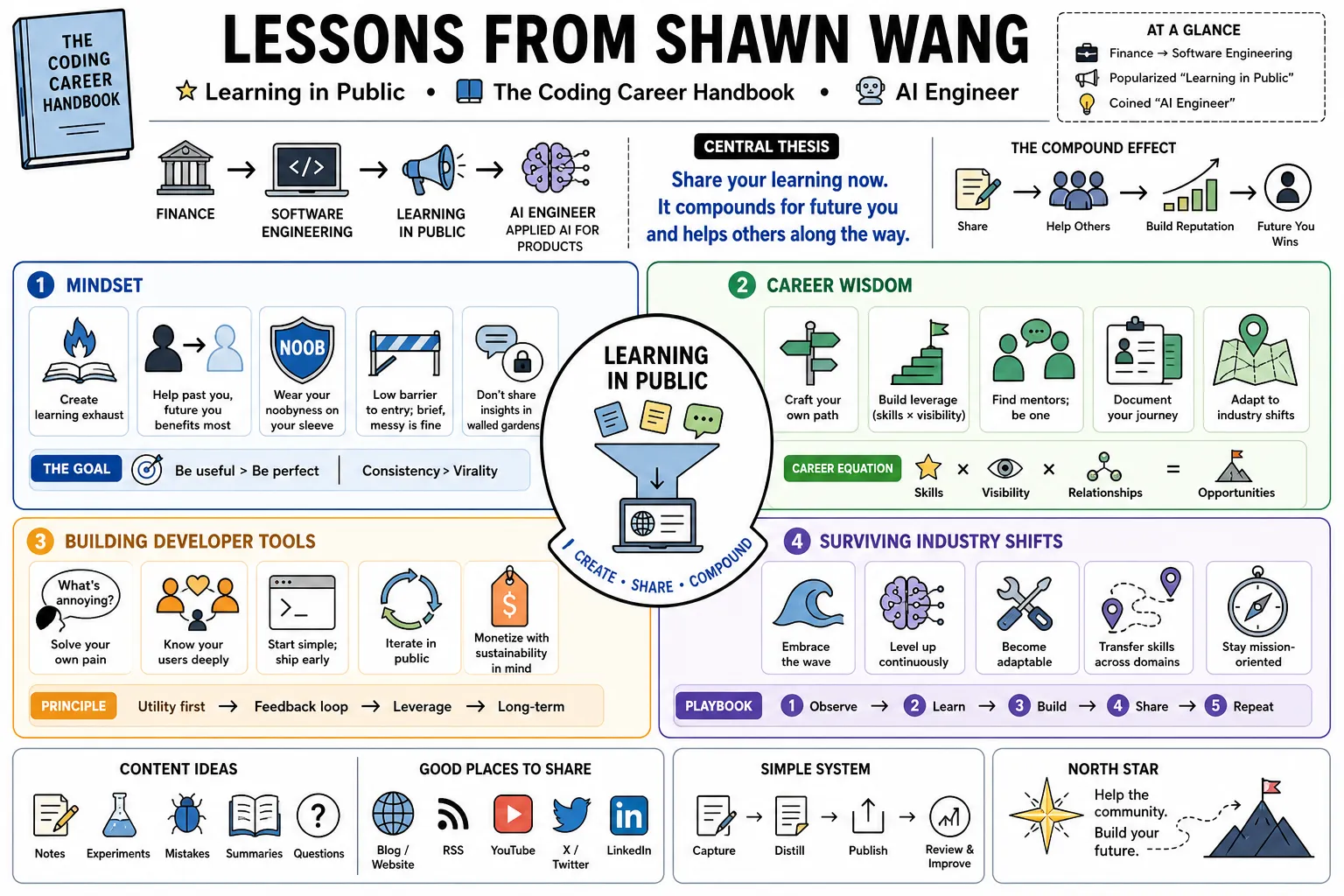
Lessons from Shawn Wang
After leaving a career in finance for software engineering, Shawn "swyx" Wang made a name for himself by popularizing the concept of "Learning in Public" and writing The Coding Career Handbook. He later coined the term "AI Engineer" to capture the industry's pivot from machine learning research to applied product development. This collection gathers his advice on managing a tech career, building developer tools, and surviving major industry shifts.
Part 1: Learning in Public
- On creating learning exhaust: "Instead of consuming information in private, have a habit of creating learning exhaust by documenting what you learn as you go." — Source: [swyx.io]
- On the primary beneficiary: "The biggest beneficiary of you trying to help past you is future you. If others benefit, that’s icing." — Source: [swyx.io]
- On vulnerability: "Try your best to be right, but don't worry when you're wrong. Repeatedly. Wear your noobyness on your sleeve." — Source: [swyx.io]
- On the barrier to entry: "You don't need to be an expert before you can start sharing. Just keep the barrier to entry low. It can be brief, messy." — Source: [Glasp]
- On avoiding walled gardens: "Don't share your best insights in Slack or Discord because they aren't searchable or permanent. Use blogs, GitHub, or public forums instead." — Source: [swyx.io]
- On documenting versus creating: "Don't feel pressured to create content. Simply document the problems you solved today. If you had to Google it, someone else will too." — Source: [swyx.io]
- On the beacon effect: "By learning in public, you are putting a beacon out there. It attracts mentors, collaborators, and job opportunities because your progress is visible." — Source: [Heavybit]
- On the cost of learning: "You can learn so much on the Internet, for the low, low price of your Ego." — Source: [Codewars]
- On recovering from errors: "Don't try to never be wrong in public. This will only slow your pace of learning and output. A much better strategy is getting really good at recovering from being wrong." — Source: [Codewars]
- On learning timing: "You should learn just in time, not just in case." — Source: [Hope in Source]
Part 2: The AI Engineer Movement
- On defining the AI Engineer: "The AI engineer is a software engineer who is building with AI, not necessarily being a researcher or an ML engineer, but knowing just enough AI concepts and limitations to put things into production applications." — Source: [Latent Space]
- On the democratization of AI: "A wide range of AI tasks that used to take 5 years and a research team to accomplish in 2013 now just require API docs and a spare afternoon in 2023." — Source: [Latent Space]
- On Software 3.0: "In Software 3.0, prompts are programs, and engineers use off-the-shelf foundation models rather than collecting their own data to train models from scratch." — Source: [Latent Space]
- On the virtuous cycle of AI: "You just cannot do anything interesting unless you can write software to orchestrate the AI systems, and then use the systems to write software." — Source: [RedMonk]
- On early status: "AI engineer is going to be low status for a long time compared to ML researchers, but it is where the value is being created." — Source: [Latent Space]
- On natural language: "English is the hottest new programming language." — Source: [Latent Space]
- On the talent gap: "App developers want a place in AI but are being denied by traditional ML researchers. Companies want to hire engineers who are good at AI but not PhDs." — Source: [Latent Space]
- On Code AGI: "Code AGI will be achieved in 20% of the time of full AGI, and capture 80% of the value." — Source: [Latent Space]
- On agent infrastructure: "AI agents need more than just a code execution box; they need composable computers—stateful sandboxes with instant startup and dynamic resources." — Source: [Latent Space]
Part 3: The Coding Career
- On scaling yourself: "Writing is like DB caching; you can scale yourself. By writing down what you learn, you create a resource you can refer others to." — Source: [The Coding Career Handbook]
- On the one percent rule: "90% of people view content passively, 9% modify or share it, and only 1% actually create it. Aim to be in the 1%." — Source: [Substack]
- On seniority: "A senior engineer doesn’t have to know all the answers. They have to know how to ask good questions." — Source: [Software Philosopher]
- On inevitable change: "Optimize for inevitable change, not for smartness." — Source: [The Coding Career Handbook]
- On the easiest part of the job: "The coding will always be the easiest part of a coding career." — Source: [DataTalks.Club]
- On handling criticism: "People think you suck? Good. You agree. Ask them to explain, in detail, why you suck. Do you want to feel good or do you want to be good?" — Source: [The Coding Career Handbook]
- On marathon thinking: "This career is a marathon, not a sprint. Your hands, back, and brain are the money-makers. Take care of them." — Source: [DEV Community]
- On industry inclusion: "If you are part of an underrepresented minority, know that you are desperately needed. If your current company doesn’t value you, there are lots of other inclusive companies that would." — Source: [DataTalks.Club]
- On finding drive: "Find your drive, and keep it alive. It is the thing that will get you through tough times." — Source: [DEV Community]
Part 4: Developer Experience (DX) and DevRel
- On the Platonic ideal of DX: "If the Platonic ideal of Developer Experience is a world where you 'Just Write Business Logic', the logical endgame is a language plus infrastructure combination that figures out everything else." — Source: [swyx.io]
- On the end-to-end journey: "Developer Experience is the entire end-to-end journey: from first contact (DevRel) to learning (Docs) to API Design (SDKs) to ecosystem (Community)." — Source: [swyx.io]
- On the power gap in DevRel: "Dev Advocates speak the most to users, but usually have the least power to make fundamental changes to solve their pain." — Source: [InfraEng]
- On Developer Exceptions: "Developer Exceptions are the bugs and edge cases that occur after the happy path demo. A true DX team must own the resolution of these pain points." — Source: [InfraEng]
- On building distribution: "DX is supposed to be the superset, but frankly, the lion's share of DX is still DevRel because most developers know how to build product, but are terrible at building distribution." — Source: [InfraEng]
- On internal productivity: "If you have 50 engineers and can improve productivity by more than 1% a quarter, you'd be silly not to invest in 1-2 engineers who just focus on making everyone else more productive." — Source: [InfraEng]
- On shipping the org chart: "Companies ship their org charts, but developers don't care what team shipped which. It makes sense to have someone coordinate developer-facing efforts cohesively." — Source: [swyx.io]
- On self-provisioning runtimes: "Advancements in two fields—programming languages and cloud infrastructure—will converge in a single paradigm where all resources required by a program will be automatically provisioned." — Source: [swyx.io]
- On taking DX seriously: "People who are really serious about developer experience should make their own language or runtime." — Source: [swyx.io]
Part 5: Open Source and Communities
- On community density: "People will go wherever they get access to people who are in the know and for whatever reason, r/ReactJS has the right amount of people." — Source: [ShopTalk Show]
- On the importance of community: "I think that code only goes so far, and I think that communities around code matters." — Source: [Kent C. Dodds]
- On keeping identity small: "If you call yourself a React developer, you're incentivized to think React is the world. But if you keep your identity small, you'll be hyper aware to changes in the facts." — Source: [Kent C. Dodds]
- On leaving the door open: "You always need to have a way to win, even if it's a single player game. You just need to leave the door open for it to be multiplayer." — Source: [Kent C. Dodds]
- On building knowledge bases: "Building a knowledge base and a community that contributes is the advanced form of Learning in Public." — Source: [Kent C. Dodds]
- On external mentorship: "When you engage the broader tech sphere, you get to pick your own mentors, externally, and that really accelerated my career." — Source: [Kent C. Dodds]
Part 6: Navigating Tech Transitions
- On picking up breadcrumbs: "Look for the maintainers of libraries and languages you use. Whatever they put down, you pick up and see what knowledge you can gain." — Source: [Codewars]
- On the 80/20 rule of shipping: "Good enough is better than best." — Source: [Substack]
- On creating luck: "Luck is random, but creating luck is a skill. You increase your surface area for luck by being visible." — Source: [swyx.io]
- On breaking through interviews: "If you learn in public right, you’ll never even have to interview again." — Source: [Nicole van der Hoeven]
- On changing careers: "You build a track record, you build a network, and you build a feedback loop that corrects your misconceptions faster than any private study ever could." — Source: [swyx.io]
- On the beginner phase: "This is your time to suck. Embrace making mistakes publicly because few people are watching yet." — Source: [The Coding Career Handbook]
- On the Third Age of JavaScript: "The Third Age is about moving from tools for developers to tools for the platform." — Source: [swyx.io]
- On trusting your intuition: "If you know how to wrangle an API, you should start taking a serious look because this is giving you new capabilities that you haven't considered before." — Source: [Uvik]
- On walking away: "The true leverage in any negotiation is your true willingness to walk away." — Source: [Latent Space]
Part 7: Thought Leadership and Content
- On bookmarks vs feeds: "People want to be the person their bookmarks reflect, not what their feed reflects." — Source: [swyx.io]
- On simplicity: "The real thought leadership work is reducing everything to three white boxes and three words. It takes more effort to make something simple than to make it complex." — Source: [swyx.io]
- On aspiration: "Good leaders appeal to what people aspire to be rather than their basal instincts." — Source: [swyx.io]
- On the L1 Cache of knowledge: "To be a thought leader or top engineer, you must have better facts than anyone else stored in your own memory for instant recall." — Source: [swyx.io]
- On the Learning Gears: "Switch between Explorer, Settler, and Planner modes depending on where you are in your career." — Source: [swyx.io]
- On the Explorer phase: "As an Explorer, you are just trying to cover ground. Your exhaust consists of notes-to-self, Gists, and tweets." — Source: [swyx.io]
- On the Connector phase: "As a Connector, you start connecting people and ideas. You create tutorials and cheatsheets specifically designed to help others understand." — Source: [swyx.io]
- On the Miner phase: "As a Miner, you go deep into one specific domain for years. You build a persistent knowledge base and become a go-to authority." — Source: [swyx.io]
- On continuous output: "I think people should just do more in public, and there's no way in which we can overshoot on that goal." — Source: [Hope in Source]
Part 8: The Future of Software
- On the AI job shift: "In numbers, there's probably going to be significantly more AI Engineers than there are ML engineers." — Source: [Latent Space]
- On the AI Engineer shelling point: "The AI Engineer role is a shelling point for software developers who were previously denied entry into AI by the high academic bar of traditional machine learning." — Source: [Latent Space]
- On intensity: "Intensity is a non-obvious but critical trait for success in high-growth tech hubs like San Francisco." — Source: [swyx.io]
- On the Bitter Lesson: "Scaling compute and data eventually beats human-designed heuristics in every field." — Source: [Latent Space]
- On the IOI Gold Paradox: "If you told me we'd achieve IOI Gold in 2022, I'd assume we could all go on vacation—AI solved. But life is still the same." — Source: [Latent Space]
- On the commodification of intelligence: "Intelligence is becoming a commodity where the cost is dropping toward zero, shifting the value from the model itself to the product insight and customer relationship." — Source: [Latent Space]
- On distribution of the future: "The future is always here but unevenly distributed." — Source: [Latent Space]
- On learning compounding: "I am a knowledge compounding machine. Consistent learning and sharing lead to exponential career growth." — Source: [swyx.io]
- On big L notation: "Big L Notation refers to the learning efficiency of your career." — Source: [DEV Community]