Lessons from Sian Beilock
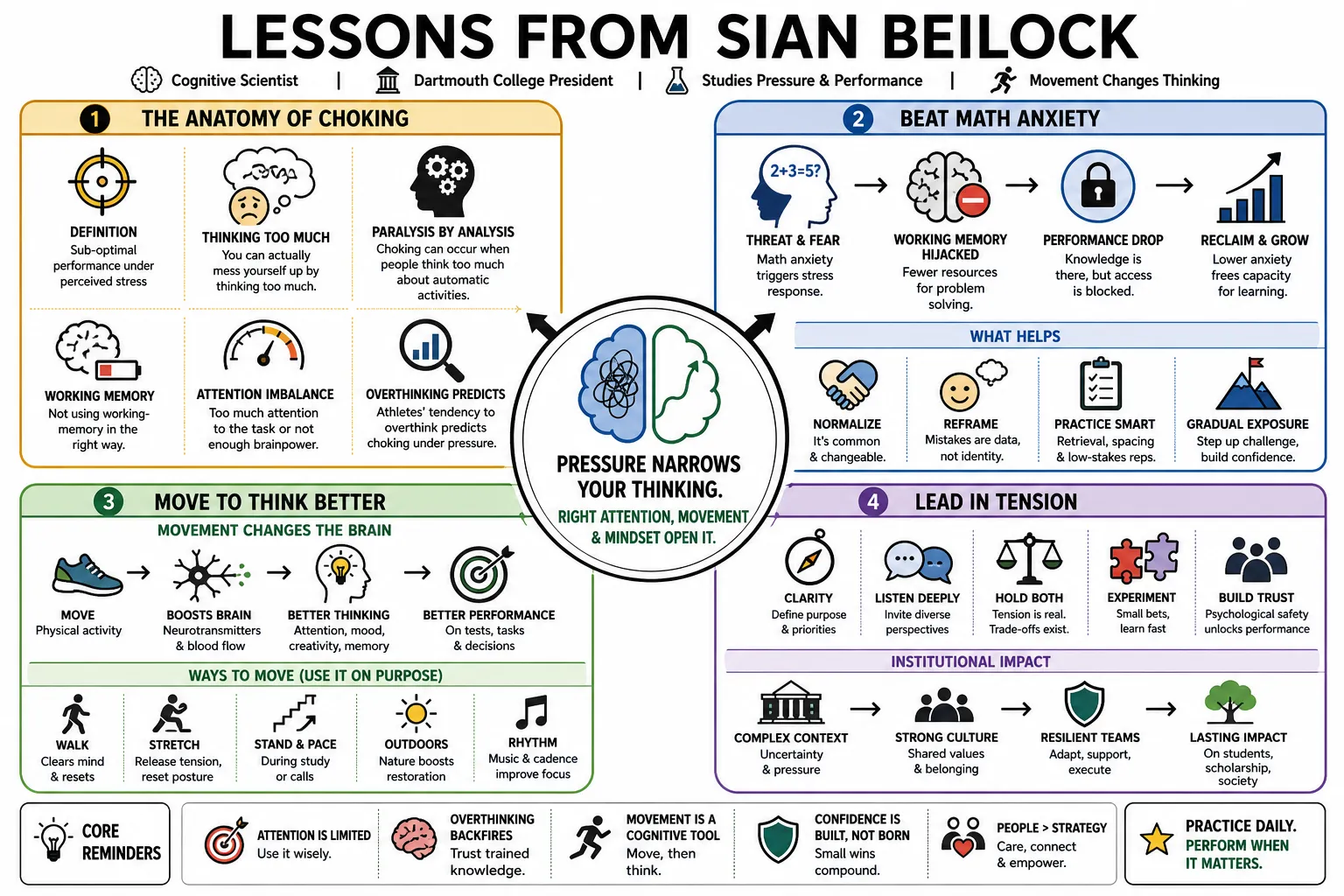
Cognitive scientist and Dartmouth College president Sian Beilock studies what happens to the brain under pressure. Her research explains why people choke when the stakes are high and how physical movement actively changes our thinking. This profile organizes her core ideas on math anxiety, the mechanics of overthinking, and steering institutions through tension.
Part 1: The Anatomy of Choking
- On the definition of choking: "Choking under pressure is poor performance that occurs in response to the perceived stress of a situation—choking is sub-optimal performance." — Source: [Podcast Notes]
- On why we fail: "You can actually mess yourself up by thinking too much." — Source: [Podcast Notes]
- On paralysis by analysis: "Choking can occur when people think too much about activities that are usually automatic." — Source: [Goodreads]
- On working memory depletion: "One of the main reasons that people choke under pressure is that they are not using their working-memory in the right way." — Source: [Goodreads]
- On attention distribution: "They are either paying too much attention to what they are doing or not devoting enough brainpower to the task at hand." — Source: [Goodreads]
- On overthinking predictors: "Athletes' tendency to overthink their performance is one of the big predictors of whether they will choke in important games or matches." — Source: [The High Performance Mindset]
- On the 'don't think' rule: For highly practiced skills, the prefrontal cortex can actively interfere with the motor cortex's autopilot. — Source: [WindoTrader]
- On the pain of failure: "One of the most humiliating things that you can say about someone is 'they choked.' And boy, do I know that feeling." — Source: [Singju Post]
- On rapid performance drops: "In a matter of seconds, I went from playing at the top to the bottom of my ability." — Source: [Singju Post]
- On under-attention: "By contrast, people also choke when they are not devoting enough attention to what they are doing and rely on simple or incorrect routines." — Source: [Goodreads]
Part 2: Math Anxiety and The Brain
- On anticipation vs. reality: For highly math-anxious people, the mere anticipation of doing math activates neural networks associated with physical pain. — Source: [Hidden Brain]
- On math anxiety as a barrier: Math anxiety acts as a psychological obstacle that consumes working memory rather than just signaling a lack of skill. — Source: [Singju Post]
- On the contagion of fear: Math anxiety can spread from adults to children. — Source: [CBC]
- On elementary influence: When parents or teachers are anxious about math, their students learn less over the year and develop their own anxieties. — Source: [CBC]
- On knowledge versus anxiety: This contagion effect persists after accounting for the teacher's math knowledge; anxiety itself becomes part of the learning environment. — Source: [PNAS]
- On early compounding effects: The "Matthew Effect" in STEM shows how small early advantages or disadvantages in confidence multiply over a student's lifetime. — Source: [Scott Barry Kaufman]
- On teacher preparation: Education majors frequently report the highest levels of math anxiety among college students. — Source: [The Psychology Podcast]
- On the dual-task problem: Anxiety functions as a secondary task running in the background, draining the cognitive resources required to solve the primary math problem. — Source: [Singju Post]
- On pausing: "Pausing to assess the situation before starting to solve a difficult problem is one way to ensure success, especially if your first inclination is to look for the quickest and easiest way out." — Source: [Goodreads]
- On gender disparities: Math anxiety is often more prevalent in girls and women, frequently linked to stereotype threat. — Source: [Singju Post]
Part 3: The Mind-Body Connection
- On embodied learning: "Your body helps you learn, understand, and make sense of the world." — Source: [Trolio Golf]
- On unconscious influence: "It can influence and even change your mind – whether or not you are aware of its influence." — Source: [SoBrief]
- On the body as a participant: "The human body is not just a passive device carrying out messages sent by the brain, but rather an integral part of how we think and make decisions." — Source: [Goodreads]
- On hacking the brain: Our physical bodies essentially "hack" our brains based on the environments we place them in. — Source: [Porchlight Books]
- On the facial feedback loop: "Your face does a lot more than simply express your emotions; it affects how you register those emotions inside your head and remember them." — Source: [SoBrief]
- On generating emotion: "Our physical expressions are not merely outward manifestations of internal feelings; they actively influence our emotional state." — Source: [SoBrief]
- On the mechanics of reading: "When the body figures out how to write letters, the mind follows suit in being able to read them." — Source: [SoBrief]
- On eye movement and insight: "By moving the body (in this case the eyes) in a way that mimics the solution, people have thoughts about the problem that they wouldn't have otherwise had." — Source: [SoBrief]
- On spatial reasoning: "The environment that this body is in contributes nontrivially to our thinking and reasoning skills." — Source: [SoBrief]
- On greening the brain: "Taking a break to connect with the natural world — 'greening the brain' — is restorative." — Source: [Medium]
Part 4: Reframing Stress and Pressure
- On cognitive horsepower: Reappraising physical symptoms of stress allows you to protect your working memory for the task itself. — Source: [Stacy Blackman]
- On physical cues: "Reminding yourself, 'yeah these sweaty palms and beating heart mean I'm ready to go'… it matters, just saying that." — Source: [Podcast Notes]
- On the purpose of arousal: Physical symptoms of anxiety and excitement are nearly identical in the body; how the brain interprets them dictates performance. — Source: [Singju Post]
- On expressive writing: "Writing about your worries before a test or presentation prevents choking." — Source: [Goodreads]
- On offloading anxiety: Journaling prior to a high-stakes event effectively downloads worries from your working memory, leaving more capacity for execution. — Source: [Stacy Blackman]
- On the necessity of practice stress: "Even practicing under mild levels of stress can prevent you from choking when high levels of stress come around." — Source: [Goodreads]
- On stress simulation: "Simulating low levels of stress helps prevent cracking under increased pressure." — Source: [Goodreads]
- On habituating to pressure: By introducing mild stress in practice, people "learn to stay calm, cool, and collected in the face of whatever comes their way." — Source: [Goodreads]
- On self-compassion: "If you do choke, don't listen too much to your negative inner voice and be compassionate with yourself." — Source: [Podcast Notes]
Part 5: Strategies for High-Stakes Performance
- On trusting the work: "It's about doing the reps, putting the hard work in, and then when everything is on the line, throwing everything aside and just going for it." — Source: [Podcast Notes]
- On the QWERTY effect: Our physical interactions with tools subtly influence our cognitive preferences, like favoring certain words based on how easily they are typed. — Source: [Porchlight Books]
- On physical pacing: Movement, such as gesturing while speaking or pacing, can unlock new thoughts and prevent mental blocks. — Source: [Porchlight Books]
- On embodied metaphors: We understand abstract concepts by mapping them onto physical experiences, such as perceiving a "warm" personality when holding a warm drink. — Source: [SoBrief]
- On unexpected cognitive aids: "Playing action video games, for example, can improve your brainpower." — Source: [Goodreads]
- On skill transfer: Time spent on certain fast-paced games improves core cognitive abilities that extend beyond the screen. — Source: [Goodreads]
- On managing rumination: Breaking free from mental loops and perfectionism requires active strategies to protect productivity. — Source: [Book Hero]
- On the danger of self-focus: "We often get in our own way precisely because our worries prompt us to concentrate too much." — Source: [Singju Post]
- On bouncing back: Resilience involves understanding how to recover from setbacks while maintaining performance under sustained stress. — Source: [HBR]
Part 6: Women in STEM and Stereotype Threat
- On systemic barriers: The gender gap in STEM fields is heavily influenced by early exposure to adult anxieties and societal stereotypes. — Source: [Times Higher Education]
- On overcoming doubt: Women in male-dominated fields must combat "stereotype threat," where the fear of confirming a negative bias disrupts cognitive performance. — Source: [HBR]
- On institutional responsibility: "Ability is widespread, but opportunity is not." — Source: [Barnard College]
- On structural entry points: Incorporating "design thinking" can serve as a more inclusive entry point into engineering than rigid, calculus-heavy pathways. — Source: [Podbean]
- On female leadership networks: Forming consortiums of female presidents and engineering deans helps institutionalize support for women in STEM. — Source: [Podbean]
- On compounding disadvantage: Stereotype threat acts as a continuous cognitive tax on working memory for minority groups in academic settings. — Source: [HBR]
- On the role of models: Female role models in early education shape whether young girls internalize the stereotype that boys are better at math. — Source: [PNAS]
- On environmental influence: The physical and social setup of a classroom dictates which students feel they naturally belong there. — Source: [HBR]
- On career transitions: Centralized hubs for career and graduate school support are vital for leveling the playing field for underrepresented students. — Source: [Barnard College]
Part 7: Leadership and "Brave Spaces"
- On rethinking comfort: Learning and growth are inherently uncomfortable processes that require friction. — Source: [Dartmouth College]
- On brave versus safe: The transition from "safe spaces" to "brave spaces" encourages individuals to engage with views fundamentally different from their own. — Source: [Dartmouth College]
- On shared humanity: The primary goal of dialogue should be "finding common humanity," not necessarily winning a debate. — Source: [Times Higher Education]
- On inviting criticism: "I often go to the people who are going to give me the most negative feedback to try to understand how I can improve." — Source: [Times Higher Education]
- On viewpoint diversity: Dartmouth's "brave space" framing depends on bringing diverse perspectives into direct conversation rather than smoothing over disagreement. — Source: [Chautauquan Daily]
- On human-centric skills: Higher education should give students skills for building common ground and coming to a shared understanding, not only more information. — Source: [Chautauquan Daily]
- On seeking opposition: "I constantly seek out voices that might be in opposition to what I think." — Source: [The Dartmouth]
- On the power of dialogue: "I really do believe in the power of dialogue." — Source: [The Dartmouth]
- On team structure: Cognitive diversity within senior management teams leads to more resilient problem-solving. — Source: [HBR]
Part 8: Institutional Change in Higher Ed
- On well-being and excellence: "You can't have academic excellence if you don't have wellbeing as a precursor—it's not something that sits on the side." — Source: [The Dartmouth Review]
- On institutional neutrality: "I believe in the fierce independence of higher education." — Source: [Dartmouth Alumni & Families]
- On political restraint: A university's mission and values should not change depending on who is in political office. — Source: [Chautauquan Daily]
- On the core mission: "We are an educational institution, not a political organization." — Source: [Chautauquan Daily]
- On quelling dialogue: Institutional statements can undermine the mission of inquiry when they make students feel unwelcome before class even begins. — Source: [Chautauquan Daily]
- On data-driven admissions: Reinstating standardized testing was an evidence-based decision to help identify high-achieving students from less-resourced backgrounds who get overlooked in test-optional environments. — Source: [Times Higher Education]
- On administrative integration: Appointing chief health and wellness officers at the senior management level ensures mental health strategies shape overall university policy. — Source: [Times Higher Education]
- On interdisciplinary impact: The future of higher education lies in combining tight-knit liberal arts communities with the scale of major research universities. — Source: [Times Higher Education]
- On navigating controversy: During periods of campus unrest, a leader’s "north star" must remain the institution's fundamental academic mission rather than short-term political appeasement. — Source: [Times Higher Education]