Lessons from Sid Sijbrandij
Sid Sijbrandij co-founded GitLab and built it into a public company famous for its massive, publicly accessible handbook. He ran an all-remote workforce driven by asynchronous communication and strict iteration long before those practices were common. This profile covers his specific approaches to management, open-core pricing, and running a company entirely on written documentation.
Part 1: Remote & Asynchronous Work
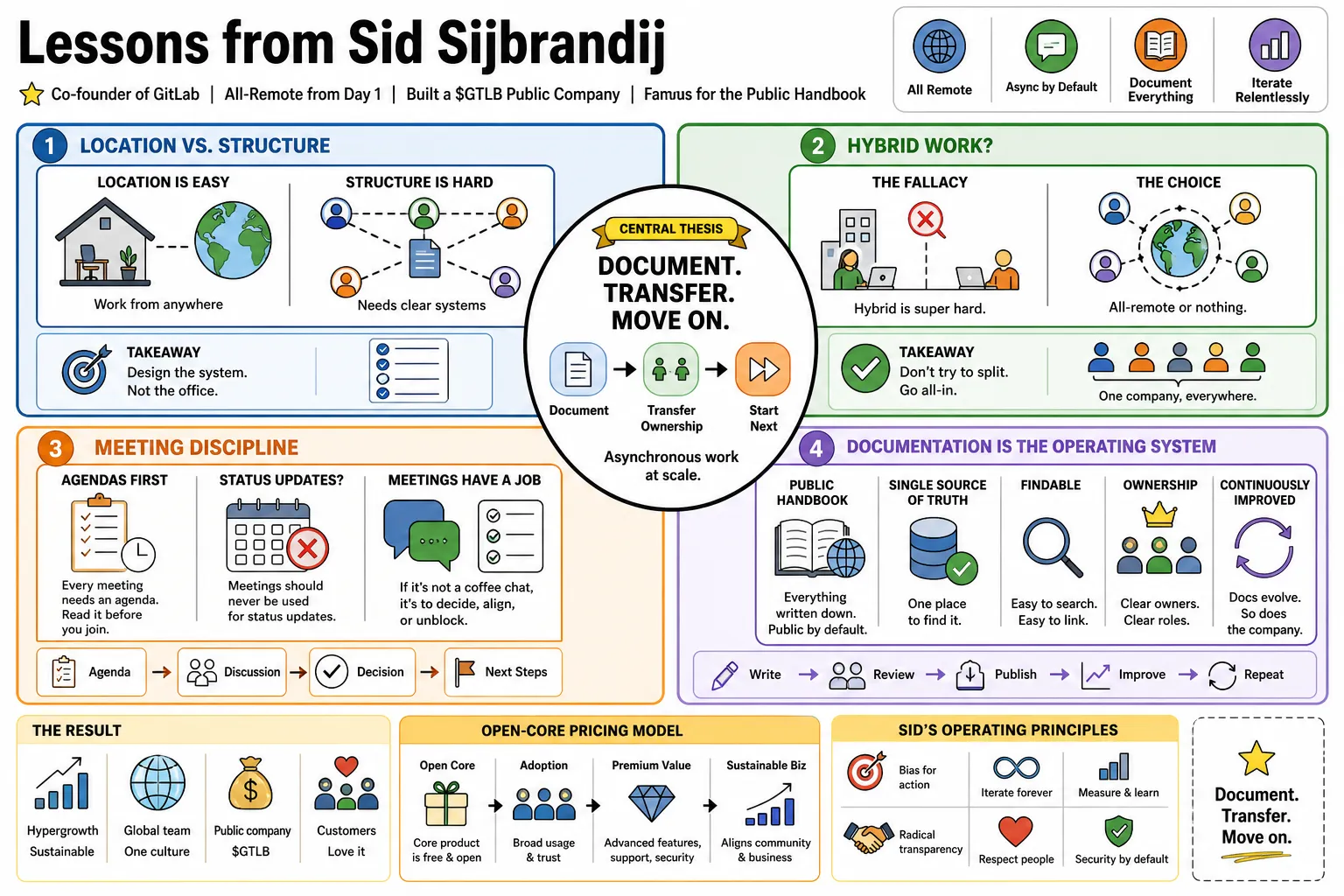
- On Location vs. Structure: "Working remotely is easy. The challenge is working asynchronously." — Source: [McKinsey]
- On Hybrid Work: "The fallacy that you can do hybrid—hybrid is super hard. So don't do that... I could not run a hybrid company." — Source: [The Twenty Minute VC]
- On the Definition of Async: "Asynchronous work is a simple concept: Do as much as you can with what you have, document everything, transfer ownership of the project to the next person, then start working on something else." — Source: [GitLab Handbook]
- On Meeting Agendas: "Meetings shouldn't just be gatherings of people for a conversation. Unless it's a coffee chat, every meeting must have an agenda, and people are expected to read the agenda before the meeting." — Source: [Distributed Podcast]
- On Status Updates: "Meetings should never be used to deliver status updates; participants must consume the relevant document or video in advance so live time is strictly for decisions." — Source: [The Eric Ries Show]
- On Natural Instincts: "It's an unnatural motion. Naturally, communication descends into meetings and synchronous communication. So you have to keep reinforcing it." — Source: [GV]
- On Time Fatigue: "Transition to 'speeding meetings' that last 25 or 50 minutes instead of the full half-hour or hour to ensure employees have buffer time between calls." — Source: [GitLab Handbook]
- On Forced Discipline: "Remote work does not invent new management requirements; it simply forces a company to operate with the discipline they should have been using anyway." — Source: [The Twenty Minute VC]
- On Global Contribution: "Organizations must create a system where everyone can consume information and contribute regardless of their level, function, or location." — Source: [McKinsey]
- On Measuring Success: "Measure impact, not activity. At other companies, there's still a lot of presenteeism... It's much better to reward the results." — Source: [GitLab Handbook]
Part 2: The Handbook & Written Culture
- On the Source of Truth: "A company handbook must serve as the absolute single source of truth; if a rule or policy is not in the handbook, it does not exist." — Source: [GitLab Handbook]
- On Process Changes: "We make every process change at GitLab through a change in our handbook." — Source: [The Eric Ries Show]
- On Finding Answers: "When an employee has a question, they can almost always find the answer documented in our handbook, without having to tap someone on the shoulder." — Source: [Distributed Podcast]
- On Reinforcement: "It’s super hard to reinforce working handbook-first... every single day I have to keep reinforcing that throughout the organization." — Source: [GV]
- On the Scale of Writing: "Maintaining a massive, actively updated public handbook drastically reduces the friction of internal coordination." — Source: [The Twenty Minute VC]
- On Onboarding: "A deeply written culture accelerates onboarding, building immediate trust and independence for new hires on their first day." — Source: [a16z Podcast]
- On Living Documents: "The handbook is never treated as finished; it operates like software and receives hundreds of small merge requests daily." — Source: [GitLab Handbook]
- On Avoiding Silos: "Defaulting to written communication prevents the isolated knowledge silos that paralyze large, traditional corporations." — Source: [McKinsey]
- On Institutional Memory: "Documenting every mistake and immediate policy update creates permanent scar tissue that stops the company from repeating past failures." — Source: [The Eric Ries Show]
- On Context Giving: "As leaders scale, they must stop delivering oral directives and start writing down the context that allows others to make the right choices." — Source: [The Twenty Minute VC]
Part 3: Radical Transparency
- On Public by Default: "Operate under the assumption that all information is public to the world unless there is a specific legal, privacy, or security mandate to hide it." — Source: [GitLab Handbook]
- On Remote Necessity: "All-remote companies require transparency to thrive." — Source: [McKinsey]
- On Being a Public Company: "Going public should not mean hiding more information; the word public should literally translate to being more open with the world." — Source: [GV]
- On Unblocking Teams: "By working in the open, everyone is more easily able to see and understand what others are working on without meetings or interruptions." — Source: [GitLab Handbook]
- On Shadowing Leadership: "Running a CEO Shadow program, where employees attend every executive meeting, proves to the company that leadership behavior matches the documented values." — Source: [The Twenty Minute VC]
- On Handling Failure: "When an engineer accidentally deleted the production database, live-streaming the recovery process built more community trust than a polished PR apology ever could." — Source: [The Eric Ries Show]
- On Public Strategy: "Publishing the internal framework for how features are priced prevents users from feeling tricked when changes occur." — Source: [Open Core Ventures]
- On Meeting Prerequisites: "Transparency dictates that a meeting cannot be put on the calendar without a fully accessible agenda attached." — Source: [Distributed Podcast]
- On Feedback Safety: "Leaders foster psychological safety by accepting public criticism with visible humility and gratitude." — Source: [The Twenty Minute VC]
- On the Limits of Openness: "Transparency does not apply to negative performance feedback, which must always be delivered privately to preserve dignity." — Source: [GitLab Handbook]
Part 4: Iteration & Velocity
- On the Toughest Value: "Transparency is a value, but the toughest value is iteration... scoping down the work so that you can get it out the door quickly." — Source: [The Eric Ries Show]
- On Step Size: "The smaller we split things up, the smaller the steps we take, the faster we can go." — Source: [GitLab Handbook]
- On Minimum Viable Change (MVC): "Ship the absolute smallest enhancement that provides value, accepting that an imperfect release today beats a perfect release next month." — Source: [The Twenty Minute VC]
- On Preventing Waste: "Pushing a minimum viable change to production acts as a visible flag that prevents other teams from starting duplicate work." — Source: [GV]
- On Unlearning Polish: "Senior executives often struggle the most with iteration because their careers trained them to rely on massive, highly polished big bang launches." — Source: [The Eric Ries Show]
- On Interviewing for Iteration: "Filter candidates by giving them a massive, complex project and asking them to define the uncomfortably small first step they would take." — Source: [The Twenty Minute VC]
- On Sustainable Pace: "Iterating in tiny increments eliminates the need for massive coordination, allowing the company to move faster without working longer hours." — Source: [GitLab Handbook]
- On Two-Way Doors: "Recognize that the vast majority of decisions are reversible; for these, teams must act immediately rather than seeking permission." — Source: [a16z Podcast]
- On Embracing Discomfort: "Teams must learn to tolerate the friction of shipping features that feel uncomfortably bare or incomplete." — Source: [The Eric Ries Show]
- On Failure Rates: "If an organization is not experiencing small, frequent failures, their iteration cycle is moving too slowly." — Source: [The Twenty Minute VC]
Part 5: Product Strategy & The Single Application
- On the Toolchain Tax: "Unfortunately, organizations are spending a lot of time integrating tools instead of improving their apps." — Source: [GitLab Handbook]
- On the Core Vision: "GitLab's vision is to provide best-in-class tools for the complete DevOps lifecycle in a single application." — Source: [a16z Podcast]
- On User Experience: "Developers can simply get more done, as there's only one UI and one authorization." — Source: [GitLab Handbook]
- On Concurrent Work: "A unified platform allows development, security, QA, and operations to work simultaneously rather than waiting in a linear queue." — Source: [GV]
- On Cycle Time: "GitLab's single application is easier to use, leads to faster cycle time and allows visibility throughout." — Source: [The Twenty Minute VC]
- On Data Truth: "Utilizing a single data store creates an unbroken chain of custody for code, drastically simplifying security and compliance audits." — Source: [The Eric Ries Show]
- On Market Speed: "To be competitive in the market today, companies need to be 10x faster to market and that requires a dramatically different way of developing." — Source: [McKinsey]
- On DIY DevOps: "Trying to stitch together ten different best-in-class point solutions is a dead strategy that creates fragile, unmaintainable systems." — Source: [a16z Podcast]
- On Continuous Evolution: "Moving from basic source control to full DevSecOps requires an architecture built from the ground up to let everyone contribute." — Source: [GitLab Handbook]
Part 6: Open Core & Business Strategy
- On Buyer-Based Pricing: "Monetization tiers should be determined by the persona buying the software, not by how difficult the feature was to build." — Source: [Open Core Ventures]
- On the Open Source Tier: "Any feature required by an individual contributor to execute their daily technical tasks must be kept in the free, open-source core." — Source: [a16z Podcast]
- On the Paid Tier: "Features that solve high-level organizational headaches—like compliance dashboards and portfolio management—belong strictly in the proprietary paid tiers." — Source: [The Eric Ries Show]
- On Failed Models: "Relying on community donations or selling consulting hours cannot generate the revenue required to sustain heavy software development." — Source: [Open Core Ventures]
- On Feature Demand: "If enterprise managers are actively requesting a feature to mitigate risk, it is an immediate candidate for a paid upgrade." — Source: [The Twenty Minute VC]
- On the 5x Pricing Rule: "Because the free core absorbs so much value, the price jumps between paid tiers can be unusually large without alienating enterprise buyers." — Source: [Open Core Ventures]
- On Competitive Advantage: "A global community of open-source contributors provides a speed advantage that outweighs the risks of exposing intellectual property." — Source: [a16z Podcast]
- On Avoiding Fragmentation: "Building custom, paid features for specific clients fractures the codebase and distracts from the overarching product vision." — Source: [The Twenty Minute VC]
- On Scaling Projects: "To survive long-term, widely adopted open-source projects must pair with a commercial entity running a strict buyer-based playbook." — Source: [Open Core Ventures]
Part 7: Management & The DRI Model
- On Consensus: "Forcing an organization to reach consensus on every decision creates bottlenecks; prioritize wide debate but individual authority." — Source: [GitLab Handbook]
- On the DRI: "The Directly Responsible Individual is empowered to make the final decision and execute without begging a committee for permission." — Source: [The Twenty Minute VC]
- On Feedback Loops: "Shortening the distance between writing code and shipping it reduces institutional fear and keeps momentum high." — Source: [The Eric Ries Show]
- On Board Members: "Recruit board members who operate with a high signal-to-noise ratio and refuse to get dragged into the operational weeds." — Source: [The Twenty Minute VC]
- On Board Prep: "Distribute exhaustive reading materials well before a board meeting so the entire session is spent debating hard strategic pivots." — Source: [a16z Podcast]
- On CEO Coaching: "Treat a professional coach like a therapist for the business, but discard them the moment their advice plateaus into an asymptote." — Source: [The Twenty Minute VC]
- On Executive Focus: "Leaders must fiercely protect their strategic bandwidth, actively declining enterprise sales calls if they begin causing cognitive overload." — Source: [The Eric Ries Show]
- On Managers of One: "Scale rapidly by hiring people who act as their own managers, taking a project from start to finish without hand-holding." — Source: [GitLab Handbook]
- On Doing vs. Leading: "As headcount swells, a founder's primary job shifts entirely away from making choices to providing the context necessary for others to choose." — Source: [Distributed Podcast]
Part 8: Culture, Values & Hiring
- On Living Values: "Defining values is useless unless they are forcefully injected into every operational mechanism, from the interview process to performance reviews." — Source: [GitLab Handbook]
- On Trimming Values: "Distill corporate values down to the fewest possible concepts; if you have over a dozen, no one will remember them." — Source: [The Eric Ries Show]
- On "Boring Solutions": "Focus innovation solely on the end product; strictly use boring, reliable tools and processes internally to minimize risk." — Source: [The Twenty Minute VC]
- On Outbound Recruiting: "When hiring for rare traits like the capacity to iterate, abandon inbound applications and hunt specifically for individuals with a bias for action." — Source: [The Eric Ries Show]
- On the Value of Results: "A functional remote culture fundamentally requires an absolute focus on what is achieved, completely ignoring how many hours a person sits at a desk." — Source: [McKinsey]
- On Diversity and Inclusion: "Operating an asynchronous, all-remote company organically bypasses geographical biases and builds a more diverse talent pool." — Source: [GV]
- On Collaboration: "True collaboration is not about constant meetings; it is about extending help, assuming positive intent, and operating with kindness during high-speed execution." — Source: [GitLab Handbook]
- On Adapting Culture: "Treat the cultural framework as a continuously living document that is refined and updated every time the company breaks and learns." — Source: [Distributed Podcast]