Stephan Crétier turned a $25,000 second mortgage into GardaWorld, a $14 billion enterprise built on aggressive acquisitions and early predictive intelligence. He pushed the private security industry past basic guard work and into risk management, surviving near-bankruptcy to create one of the world's largest privately held companies. This profile breaks down his approach to risk and operational scaling.
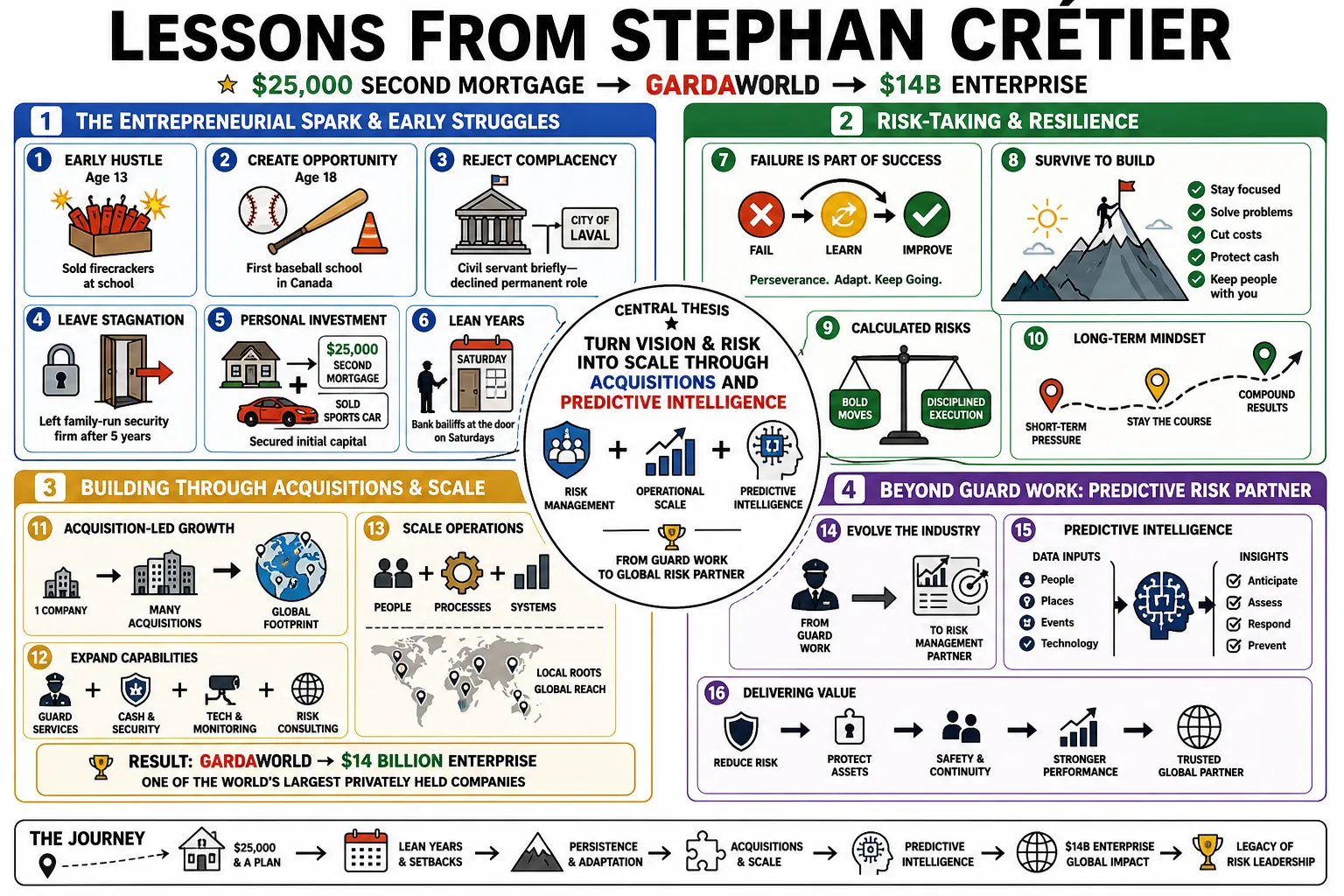
Part 1: The Entrepreneurial Spark & Early Struggles
- On leaving stagnant environments: After five years at a family-run security firm, he left because the owner showed no interest in expanding the business or sharing leadership. — Reference: Horatio Alger Canada
- On personal investment: He founded his enterprise by taking out a $25,000 second mortgage on his house and selling his sports car to secure the initial capital. — Reference: Horatio Alger Canada
Part 2: Risk-Taking & Resilience
- On navigating near-ruin: Over the course of building his business, he confronted the prospect of bankruptcy four separate times. — Reference: Business Council of Canada
- On doing whatever it takes: To meet a looming payroll without a line of credit, he once tracked down a client on vacation to secure a payment and keep the company afloat. — Reference: Horatio Alger Canada
- On operating through crises: During a massive Quebec ice storm, his office maintained power due to its proximity to a prison, forcing his small team to rapidly adapt and scale their operations. — Reference: Horatio Alger Canada
- On calculated audacity: He attributes his progress to being both courageous and a bit crazy, allowing him to accept risks that others would avoid. — Reference: Horatio Alger Canada
- On maintaining perspective: He draws inspiration from baseball, pointing out that a batter who fails two out of three times is still considered one of the sport's greatest players. — Reference: Horatio Alger Canada
- On standing your ground: Growing up as a francophone minority in an English school taught him to fight for respect, instilling an instinct to hold his ground rather than seek out conflict. — Reference: Horatio Alger Canada
- On long-term focus: He manages setbacks by keeping a strict focus on the end game, ensuring temporary failures do not derail his ultimate vision. — Reference: Horatio Alger Canada
Part 3: The Business of Security & Disruption
- On early industry flaws: When he entered the market in 1999, he observed that the industry was dominated by "security people in business instead of business people in security." — Reference: Feral Jundi
- On service integration: He envisioned creating the "Wal-Mart of security"—a single destination where clients could access guards, investigations, and armoured trucks through one contact point. — Reference: Feral Jundi
- On external catalysts: He noted that the events of September 11 forced the North American security sector to rapidly professionalize and modernize its approach. — Reference: Feral Jundi
Part 4: Operating Model & Scaling
- On overcoming entry barriers: To compete with entrenched giants in the cash and armoured car business, he executed a massive acquisition strategy to secure the necessary infrastructure. — Reference: Feral Jundi
- On structural agility: He credits much of his portfolio’s success to an owner-operator model that grants individual divisions the flexibility to adapt to their local markets. — Reference: GardaWorld Leadership
- On balancing autonomy: The decentralized owner-operator approach is kept in check by maintaining tight corporate governance and alignment among executive leadership. — Reference: GardaWorld Leadership
- On building an investment platform: He designed his corporation as an incubator that builds independent, financially secure operating companies with large runways for growth. — Reference: Crisis24
- On managing private equity: He observed that private equity firms tend to exit early when a company consistently delivers 35% annual returns, which prompted him to take his company private. — Reference: Business Council of Canada
Part 5: Leadership & Talent Strategy
- On continuous scouting: Much like a baseball manager looking for the next star, he interviews candidates every week, regardless of whether there is an open position. — Reference: Horatio Alger Canada
- On winning dynamics: He operates on the philosophy that strong lineups win championships, emphasizing that a company is only as good as the talent it recruits. — Reference: Horatio Alger Canada
- On shared values: Beyond mere skills, he focuses on assembling a team that shares his core drive and appetite for continuous growth. — Reference: Horatio Alger Canada
Part 6: Navigating Complex Environments & The Middle East
- On entering hazardous markets: He established a foothold in the Middle East by acquiring a company in Kurdistan that was providing protection for oil and gas teams. — Reference: Feral Jundi
- On selective engagements: He deliberately avoided acting as a subcontractor for the military, choosing instead to focus on NGOs, reconstruction firms, and energy companies. — Reference: Feral Jundi
- On shaping corporate culture: He rejected the mercenary model because it did not align with the professional culture and specific business profile he wanted to establish. — Reference: Feral Jundi
- On crisis logistics: In natural disaster scenarios like hurricanes and wildfires, his company pivots to provide essential logistics, ensuring first responders have access to basic necessities like showers. — Reference: CONTACT AVEC STÉPHAN BUREAU
- On filling regional voids: He saw potential in the Middle East because the local security industry lacked professionalism, allowing him to quickly scale his workforce from 3 to 1,300 employees in Kurdistan. — Reference: Feral Jundi
Part 7: The Future of Security & Anticipatory Intelligence
- On the evolution of security: He argues that modern security is no longer siloed but entirely integrated, encompassing everything from supply chains to high-net-worth protection. — Reference: CONTACT AVEC STÉPHAN BUREAU
- On predictive technology: By partnering with tech firms like Palantir, his enterprise utilizes AI-driven anticipatory intelligence to map vulnerabilities before threats materialize. — Reference: CONTACT AVEC STÉPHAN BUREAU
- On the ethics of prediction: He acknowledges the democratic dilemmas that arise when private entities possess the power to foresee and preempt criminal activity. — Reference: CONTACT AVEC STÉPHAN BUREAU
- On bespoke risk management: He developed highly specialized services, acting as a private intelligence agency that provides medical concierge and embedded intelligence for prominent global organizations. — Reference: Crisis24
- On global realities: Viewing the world as a predatory environment, he notes that individuals and organizations must choose between reading the menu or being on the menu. — Reference: CONTACT AVEC STÉPHAN BUREAU
Part 8: Wealth, Philanthropy, and Legacy
- On the true meaning of wealth: He never pursued success purely for monetary gain; instead, achieving a fortune represented financial liberty and a guarantee of survival. — Reference: CONTACT AVEC STÉPHAN BUREAU
- On honoring his roots: As the son of immigrants who experienced early precarity and the premature loss of his father, his drive is deeply rooted in overcoming his family's initial struggles. — Reference: CONTACT AVEC STÉPHAN BUREAU
- On public safety philanthropy: He established the BOLO Program through his foundation, utilizing technology and public awareness to help law enforcement locate Canada’s most wanted fugitives. — Reference: Bolo Program