Steve Hafner, the co-founder and CEO of KAYAK, has spent over two decades redefining how consumers search for and book travel online. From his early days at Orbitz to scaling KAYAK into a global metasearch giant, Hafner’s career is a masterclass in operational efficiency, technological adaptation, and the power of simplicity. The following insights capture his philosophy on leadership, the future of AI, and the enduring value of curiosity.
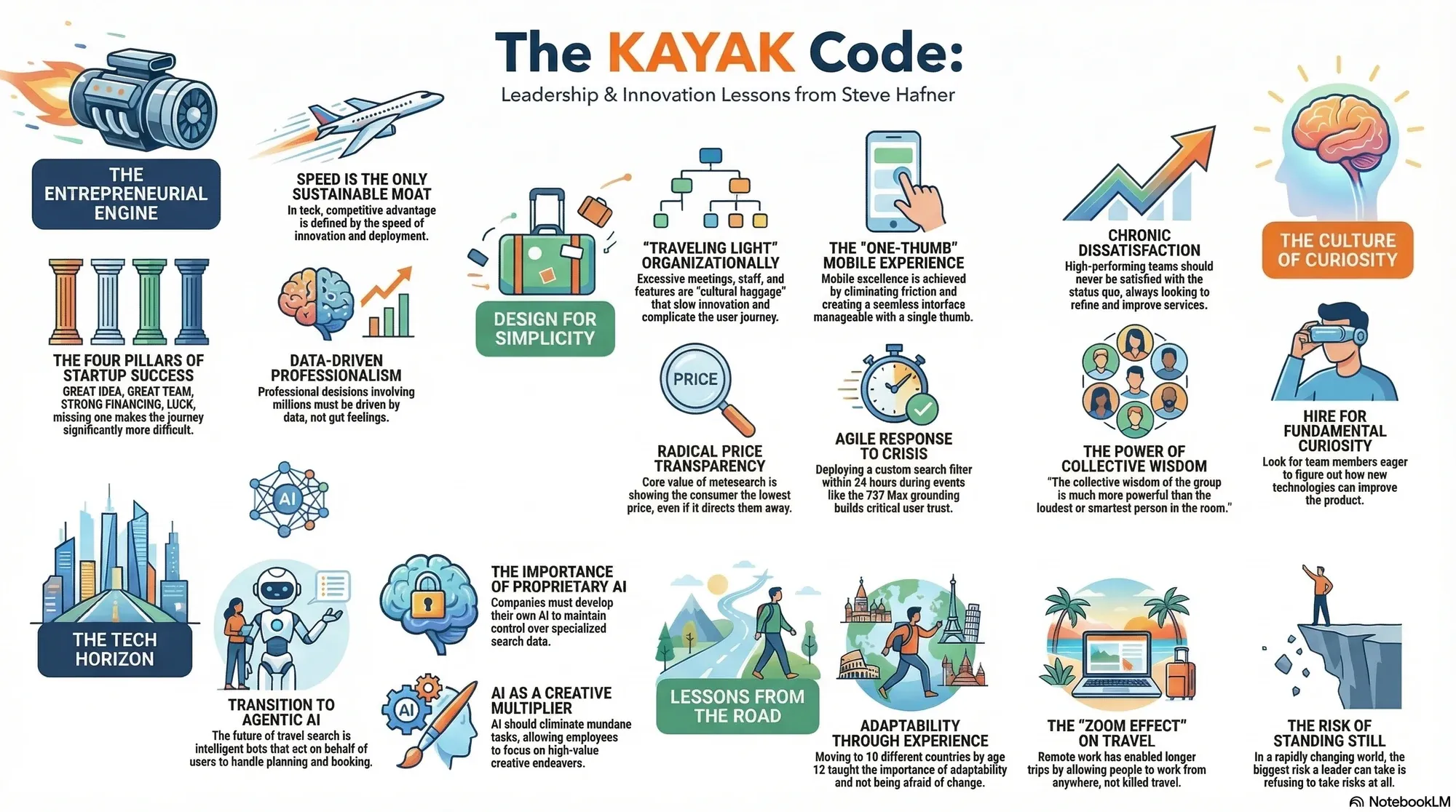
Part 1: The Entrepreneurial Engine
- On Startup Success: "You have to have a great idea. You have to have a great team. You have to be very well financed, and you have to be lucky. If you don't have all four of those things, it's going to be difficult." — Source: Phocuswire
- On Market Timing: Success is often a matter of launching at the precise moment when technology and consumer behavior converge; starting a year too early or too late can be the difference between a breakthrough and a failure. — Source: Vertex Search/YouTube
- On Identifying Market Flaws: The transition from Orbitz to KAYAK was driven by the realization that online travel agencies had heavy back-office costs and couldn't show all available options, creating an opening for a "pure" search model. — Source: Hotel Business
- On Entrepreneurial Passion: "You have to love what you do, whether it's washing cars, making burritos, or creating a travel site. When you have passion about something, you tend to think about it all the time." — Source: Dartmouth University
- On Problem Solving: Focus on solving a specific, high-friction problem for the customer rather than just trying to build a "cool" piece of technology. — Source: Northwestern McCormick
- On Staying Lean: A startup’s ability to move fast is directly proportional to its lack of "cultural baggage" and process-heavy bureaucracy. — Source: Northwestern McCormick
- On Speed as a Moat: In the tech world, the only sustainable competitive advantage is the speed at which you can innovate and deploy new features. — Source: Phocuswire
- On Professional Risk: "I gamble in my personal life, but I don't do that in my professional life," emphasizing the need for data-driven decisions over gut-feeling bets when millions are at stake. — Source: Phocuswire
- On Capital Requirements: Being well-financed allows a company to survive industry-wide shocks and pivot when initial assumptions prove wrong. — Source: Phocuswright Conference
- On Competition: To win against established players, you must offer search results that are demonstrably better, including more options and more accurate pricing. — Source: Skift
Part 2: Design for Simplicity
- On Pure Search: By focusing solely on search and avoiding the complexities of payment processing and customer support, a company can maintain a higher level of operational efficiency. — Source: Medium
- On "Traveling Light": Organizational efficiency mirrors personal travel; the more "stuff" you carry—excessive meetings, staff, and features—the slower and more difficult the journey becomes. — Source: Northwestern McCormick
- On Simplicity and Innovation: Complexity is the enemy of rapid innovation; keeping the business model and product simple is what allows for frequent updates. — Source: Northwestern McCormick
- On Mobile Excellence: The goal of a mobile app should be to provide a frictionless, "one-thumb" experience for the user. — Source: Skift
- On Friction Points: Innovation in travel is far from over because there are still countless friction points in the booking and transit process that frustrate consumers. — Source: Phocuswire
- On Price Transparency: The core value proposition of metasearch is radical transparency, showing the consumer the lowest price even if it means directing them away from your own site. — Source: Travel Weekly
- On Powerful Filtering: A great travel product doesn't just show options; it gives users the power to filter out the noise based on their specific needs, such as aircraft type or flexible cancellation. — Source: Vertex Search/YouTube
- On Eliminating Redundancy: Avoid building back-office systems for things that others already do better; leverage their APIs and focus on your unique search engine. — Source: Medium
- On Agile Implementation: During crises like the 737 Max grounding, the ability to build and deploy a filter in 24 hours is what builds long-term user trust. — Source: Vertex Search/YouTube
- On User Loyalty: Loyalty in travel is rare and expensive to maintain; the only way to keep customers is to consistently be the best tool for price comparison. — Source: Travel Weekly
Part 3: The Culture of Curiosity
- On Likeability: "Soft skills become more important as your career progresses," and being a likable person is a critical professional asset that opens doors. — Source: Northwestern McCormick
- On Hiring Philosophy: Look for people who are fundamentally curious and eager to figure out how new technologies can be configured to make the product better. — Source: Phocuswire
- On Dissatisfaction: A high-performing team should be chronically dissatisfied with the status quo, always looking for ways to improve existing services. — Source: Phocuswire
- On Collective Wisdom: "The collective wisdom of the group is much more powerful than the loudest or smartest person in the room." — Source: Northwestern McCormick
- On Leadership Soft Skills: As an executive, your job shifts from being the "smartest guy in the room" to being the person who can manage and inspire those people. — Source: Northwestern McCormick
- On Transparent Communication: Radical transparency within a team helps uncover opportunities and identify failures before they become catastrophic. — Source: Vertex Search/YouTube
- On Humility: A leader must have the humility to realize they don't have all the answers and to rely on the diverse opinions of their team. — Source: Northwestern McCormick
- On Team Diversity: Surrounding yourself with people from different backgrounds prevents blind spots in product development and strategy. — Source: Vertex Search/YouTube
- On Complementary Skills: Identify your own weaknesses and hire people who are strong in exactly those areas to create a balanced leadership team. — Source: Phocuswright Conference
- On Managing Growth: As a company scales, the primary challenge is maintaining the lean, fast-moving culture that made it successful in the first place. — Source: Northwestern McCormick
Part 4: Navigating the Tech Horizon
- On AI Efficiency: "If you are on a customer service team, you better get good at using AI because you want to be more efficient, so you don't get replaced." — Source: Phocuswire
- On Agentic AI: The future of travel search is moving toward an "agentic AI world" where intelligent bots act on behalf of the user to find and book information. — Source: Travel Weekly
- On Strategic Misses: Failing to acquire key technologies early, like Google’s acquisition of ITA software, can create long-term competitive hurdles. — Source: Phocuswire
- On the Future of Interaction: We are moving toward a world where users will speak to intelligent agents to handle all aspects of their trip, from planning to booking. — Source: Phocuswire
- On Metasearch vs. Google: To survive Google's dominance, platforms like KAYAK must provide deeper, more specialized search results that a generalist engine can't match. — Source: Skift
- On Organic Search Decline: As AI search engines reduce organic traffic, travel companies must pivot to heavier investments in paid advertising and brand-direct loyalty. — Source: Skift
- On AI in the Workplace: AI should be viewed as a tool to eliminate mundane tasks, allowing employees to focus on high-value creative endeavors. — Source: Vertex Search/YouTube
- On AI-Driven Personalization: The true power of AI in travel is its ability to understand a traveler’s specific preferences and predict what they want before they even search. — Source: Phocuswire
- On Metasearch's Value: Metasearch remains essential because it is the only model that puts the consumer first by showing all options regardless of where the booking happens. — Source: Vertex Search/YouTube
- On Investing in Proprietary AI: While external models are powerful, travel companies must develop their own proprietary AI to maintain control over the specialized search data. — Source: Travel Weekly
Part 5: Lessons from the Road
- On Global Perspective: Moving to 10 different countries by age 12 taught the importance of being adaptable, not being afraid of change, and traveling light. — Source: Northwestern McCormick
- On Resilience in Crisis: Surviving major industry shocks like 9/11 and COVID-19 requires making the difficult decisions early, including layoffs and radical pivots. — Source: Vertex Search/YouTube
- On Regretting Missed Bets: Looking back, there is often a wish that the company had "gambled a bit more" on aggressive expansions like Skyscanner or Uber. — Source: Phocuswire
- On Business Travel Evolution: "Ineffective and inefficient meetings aren't going to happen anymore in person," as the bar for traveling for work has been permanently raised by video conferencing. — Source: The Hustle
- On Travel and Empathy: Experiencing different cultures firsthand is what makes people more empathetic and broadens their worldview, which is why the industry will always recover. — Source: Vertex Search/YouTube
- On Pent-Up Demand: Travel is a fundamental human need; whenever restrictions are lifted, the immediate spike in search data proves that demand is inevitable. — Source: The Hustle
- On Premium Trends: Consumers are increasingly looking for "premium" experiences—like business class or premium economy—valuing comfort and flexibility over the absolute lowest price. — Source: AP News
- On Authenticity: Modern travelers are moving away from cookie-cutter tourism in favor of authentic local experiences and adventurous travel that connects them with experts. — Source: The Hustle
- On the "Zoom Effect": Remote work hasn't killed travel; it has actually made it easier for people to take longer trips because they can work from anywhere. — Source: The Hustle
- On Risk-Taking: "Don't be afraid of new things... don't be afraid of taking risks," because the biggest risk in a rapidly changing world is standing still. — Source: Vertex Search/YouTube