Lessons from Steven Kotler
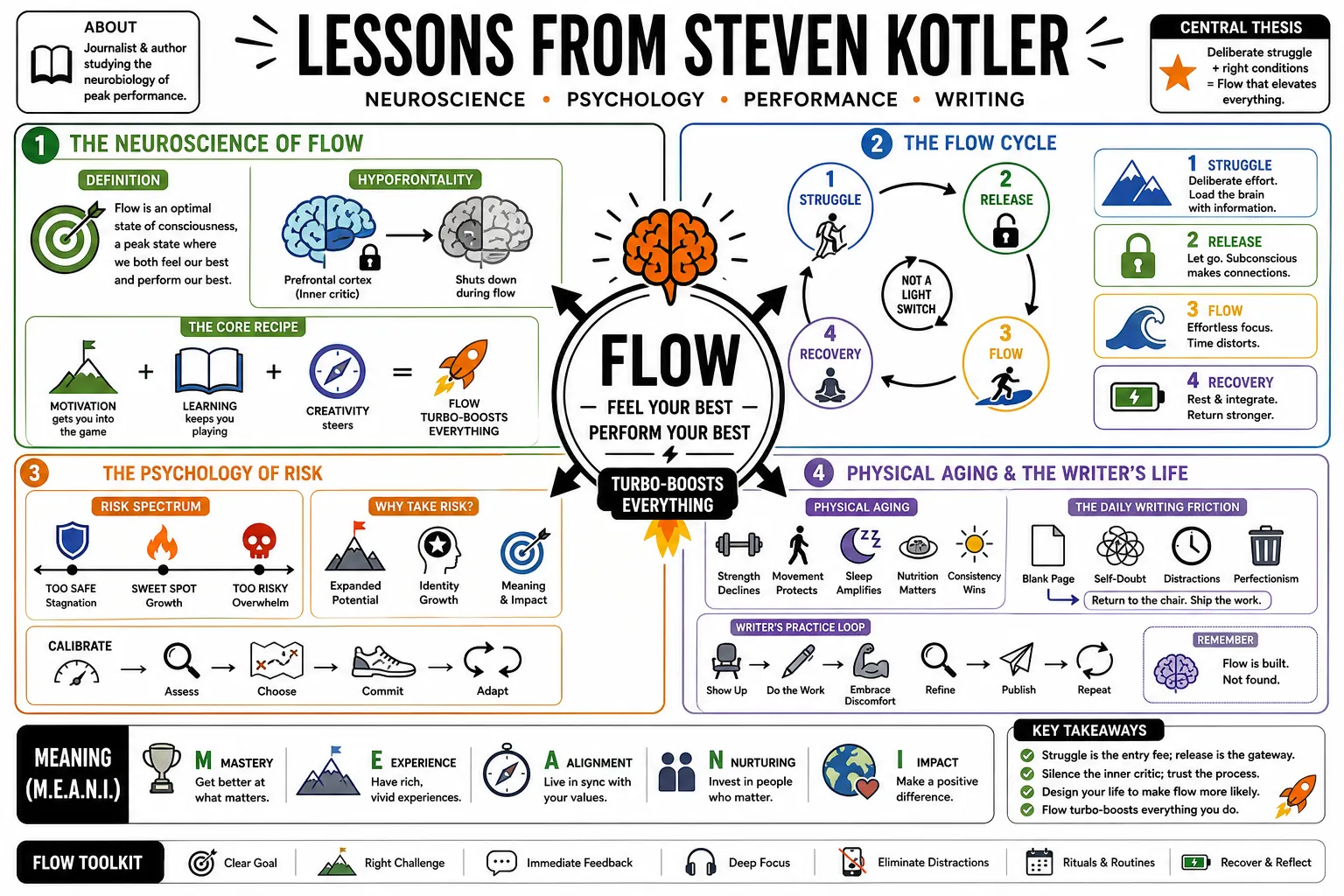
Journalist and author Steven Kotler has spent his career studying the neurobiology of peak performance. He is best known for mapping the mechanics of "flow," the cognitive state where people operate at their absolute best. This collection breaks down his specific frameworks on extreme focus, the psychology of risk, physical aging, and the daily friction of writing.
Part 1: The Neuroscience of Flow
- On the Definition: "Flow is an optimal state of consciousness, a peak state where we both feel our best and perform our best." — Source: [The Rise of Superman]
- On the Core Recipe: "Motivation gets you into the game. Learning keeps you playing. Creativity steers. And flow turbo-boosts everything." — Source: [The Art of Impossible]
- On Hypofrontality: During flow, the prefrontal cortex temporarily shuts down, silencing the inner critic and allowing for faster, more intuitive decision-making. — Source: [Flow Research Collective]
- On The Flow Cycle: Flow is not a light switch but a four-stage cycle consisting of struggle, release, flow, and recovery. — Source: [The Rise of Superman]
- On the Necessity of Struggle: You must go through a deliberate struggle phase to load the brain with information before experiencing the release that leads to flow. — Source: [Flow Research Collective Radio]
- On Meaning: "Flow is more than an optimal state of consciousness... it also appears to be the only practical answer to the question: What is the meaning of life? Flow is what makes life worth living." — Source: [Goodreads]
- On Recovery: Recovery is a vital phase of the flow cycle, required to rebuild depleted neurotransmitters like dopamine and endorphins used during peak cognitive output. — Source: [The Rise of Superman]
- On Biology Over Personality: "Personality doesn't scale. Biology scales," meaning that neurobiology is a shared machinery allowing anyone to access peak performance regardless of their temperament. — Source: [The Art of Impossible]
- On Extreme Focus: Flow refers to those moments of rapt attention and total absorption where you get so focused on the task at hand that everything else just seems to disappear. — Source: [This Is Your Brain Podcast]
- On Productivity: Executives operating in a flow state report being 500 percent more productive than their baseline, highlighting the massive return on investment of entering optimal states. — Source: [Stealing Fire]
Part 2: Triggers and the Challenge Balance
- On the Sweet Spot: "If you want to trigger flow, the challenge should be 4 percent greater than the skills." — Source: [The Rise of Superman]
- On Risk as a Trigger: High-consequence environments, whether physical, social, or intellectual, demand total focus and serve as immediate flow triggers. — Source: [The Rise of Superman]
- On Dopamine and Focus: Risk produces dopamine, which in turn drives the intense focus required to trigger a flow state. — Source: [This Is Your Brain Podcast]
- On Novelty and Environment: Environmental triggers like high stakes and deep novelty force the brain into the physical embodiment required for focus. — Source: [The Brainfluence Podcast]
- On the 90-Minute Rule: Maximizing the chance of entering flow requires 90 minutes of uninterrupted concentration, defending this block from all external distractions. — Source: [Stealing Fire]
- On Group Flow Goals: Group flow requires a clear goal to provide baseline focus, but one that remains open enough to leave room for group creativity. — Source: [Medium]
- On Communication in Flow: "Constant communication is necessary for group flow. Even while deep listening, the conversation must move forward. This follows the most important rule of improv: 'Yes, and...'" — Source: [Medium]
- On Shared Focus: Community interaction drives focus into the present moment, making shared attention one of the simplest flow hacks available. — Source: [Medium]
- On the Spectrum of Flow: Flow ranges from micro-flow, such as losing track of time while typing an email, to macro-flow, which can manifest as a highly intense, quasi-mystical experience. — Source: [The Science of Success]
- On Managing Challenges: Productivity stalls when a task is too easy and boring, or too hard and anxiety-inducing; sustained flow requires navigating exactly between those two states. — Source: [The Art of Impossible]
Part 3: Overcoming the Inner Critic and Self
- On The Paradox of Selflessness: "That’s the paradox of selflessness—by periodically losing our minds we stand a better chance of finding ourselves." — Source: [Stealing Fire]
- On Losing Limits: When the concept of self disappears during flow, it takes many of our self-imposed limits and anxieties along for the ride. — Source: [Stealing Fire]
- On Silencing the Critic: "Once the voice in my head disappears, I get out of my own way." — Source: [Stealing Fire]
- On Merging Action and Awareness: "In flow, we are so focused on the task at hand that everything else falls away. Action and awareness merge. Time flies. Self vanishes." — Source: [Stealing Fire]
- On Present Focus: "Ecstasis only arises when attention is fully focused in the present moment." — Source: [Stealing Fire]
- On the Ego in Later Life: As people age, if they navigate the transition correctly, the ego naturally starts to quiet, widening perspective into a distinct cognitive advantage. — Source: [Gnar Country]
- On Group Mind: High-performing teams stop acting like isolated individuals and start operating as a single entity when deep in collective flow. — Source: [Stealing Fire]
- On Collective Intelligence: When a team enters a state of ecstasis, the whole becomes structurally smarter and braver than the sum of its individual parts. — Source: [Stealing Fire]
- On Altered States: Elite physical and intellectual performers utilize altered states of consciousness to bypass standard psychological barriers and accelerate their output. — Source: [Stealing Fire]
Part 4: Risk, Fear, and Extreme Performance
- On Embracing Risk: "To really achieve anything, you have to be able to tolerate and enjoy risk. It has to become a challenge to look forward to." — Source: [The Rise of Superman]
- On Breakthroughs: "In all fields, to make exceptional discoveries you need risk—you’re just never going to have a breakthrough without it." — Source: [The Rise of Superman]
- On Fear as a Compass: "When risk is a challenge, fear becomes a compass—literally pointing people in the direction they need to go next." — Source: [The Rise of Superman]
- On the Action Barrier: "Since flow is a fluid action state, making better decisions isn't enough: we also have to act on those decisions. The problem is fear, which stands between us and all actions." — Source: [Goodreads]
- On Extreme Athletes: Action sports athletes are functional flow hackers because their life-or-death environments force them into the state simply to survive. — Source: [The Brainfluence Podcast]
- On High Consequence: The brain demands absolute focus in situations where failure carries severe physical, mental, or social consequences. — Source: [The Rise of Superman]
- On The Intrinsic Stack: Sustaining extreme performance requires sequentially stacking five internal drivers: curiosity, passion, purpose, autonomy, and mastery. — Source: [The Art of Impossible]
- On Curiosity to Purpose: "Curiosity into passion; passion into purpose; and purpose into patient profit—that’s the safest way to play this game." — Source: [The Art of Impossible]
- On Finding Purpose: A practical way to find an ultimate cognitive driver is to list 25 specific curiosities and identify the exact nodes where three or more intersect. — Source: [The Art of Impossible]
Part 5: Gnar Country and Redefining Aging
- On the Prison of Aging: "Most of us arrive in our fifties feeling that the cage has gotten smaller. What’s actually shrunk is our mindset. We’re in a prison of our own making." — Source: [Gnar Country]
- On Escaping the Cage: "Once we discover we can keep on learning later in life, that mindset shifts. The cage vanishes. This changes everything." — Source: [Gnar Country]
- On Aging vs. Old: "Aging is a fact of life, but 'old' is a mindset." — Source: [Substack]
- On Mindset and Longevity: "Aging is a mental event as much as a physical process, and a shift in mindset can add seven and a half years to our lives." — Source: [Gnar Country]
- On Disuse: "Strength, stamina, and all the other abilities we once believed declined over time are now seen as use-it-or-lose-it skills." — Source: [Gnar Country]
- On Sustaining Prowess: "By training our bodies and brains for our later years, we can retain and improve our prowess far longer than suspected." — Source: [Gnar Country]
- On Advancing Skills: "If you keep training these skills, you get to hang on to them and even advance them far later in life than anyone thought possible." — Source: [Gnar Country]
- On the Action Trigger: "Aging starts when action stops." — Source: [Gnar Country]
- On Second-Half Superpowers: Entering our fifties can unlock legitimate neurological advantages as the brain fundamentally shifts how it routes and processes information. — Source: [Gnar Country]
- On Peak Performance Later in Life: Modern research demonstrates that humans can sustain high-level physical and cognitive performance much further into their twilight years than historically recorded. — Source: [Gnar Country]
Part 6: Abundance and Exponential Tech
- On the Definition of Abundance: "Abundance is not about providing everyone on this planet with a life of luxury—rather it's about providing all with a life of possibility." — Source: [Abundance]
- On Liberating Resources: "Technology is a resource-liberating mechanism. It can make the once scarce the now abundant." — Source: [Abundance]
- On Scarcity: "When seen through the lens of technology, few resources are truly scarce; they're mainly inaccessible." — Source: [Abundance]
- On Solving Global Problems: "In today's hyperlinked world, solving problems anywhere, solves problems everywhere." — Source: [Abundance]
- On the Media's Negativity: "Bad news sells because the amygdala is always looking for something to fear." — Source: [Abundance]
- On the Linear Brain: The human brain is wired for local and linear thinking, making it inherently blind to the speed and scale of exponential technological change. — Source: [Abundance]
- On Creating the Future: "The best way to predict the future is to create it yourself!" — Source: [Bold]
- On Business Opportunities: "The world's biggest problems are the world's biggest business opportunities." — Source: [Bold]
- On Crazy Ideas: "The day before something is a breakthrough, it's a crazy idea." — Source: [Bold]
Part 7: The Craft of Writing and Productivity
- On Editing as a Warm-up: Starting a writing session by editing yesterday’s work triggers pattern recognition and releases dopamine, acting as a direct ramp into flow. — Source: [Writing Cooperative]
- On External Loading: Reading rich, well-ordered nonfiction can load the brain's pattern recognition system, making it easier to generate unforced creative leaps. — Source: [CreativeLive]
- On Setting Word Limits: Apply the four percent rule by setting a word count goal that stretches you but forces you to stop at a transition point, leaving an easy starting place for tomorrow. — Source: [Medium]
- On Defending Your Morning: Define and protect the first 90 minutes of your workday to execute your most difficult task, staying completely offline for the duration. — Source: [Stealing Fire]
- On the Cost of Distraction: Creative flow needs protected attention because pattern recognition works best with deep, ordered information rather than fragmented inputs. — Source: [CreativeLive]
- On Knowing Where to End: Writers can make flow easier by giving the mind clear structure before asking it to improvise inside the draft. — Source: [CreativeLive]
- On Navigational Writing: Clear constraints help the brain's pattern recognition system fill in gaps instead of chasing tangents. — Source: [CreativeLive]
- On Wading Through Sewage: Flow often requires pushing through an early struggle phase before release and pattern recognition come online. — Source: [CreativeLive]
- On the Last Word Hack: Surprise matters because novelty catches attention and gives the brain a pattern break to work with. — Source: [CreativeLive]
Part 8: Dogs, Rescue, and the Human-Animal Bond
- On Animal Rescuers: "When people say that animal rescuers are crazy, what they really mean is that animal rescuers share a number of fundamental beliefs that makes them easy to marginalize." — Source: [A Small Furry Prayer]
- On Descartes: "Among those is the belief that Rene Descartes was a jackass," rejecting the philosopher's historical view that animals are merely unfeeling machines. — Source: [A Small Furry Prayer]
- On Adoptability: "As it turns out, what makes a dog adoptable has very little to do with dogs, a great deal to do with humans." — Source: [A Small Furry Prayer]
- On Industrial Breeding: Animals in factory settings are often fed mechanically, meaning their only human contact is the artificial snatching away of their young. — Source: [A Small Furry Prayer]
- On the Shelter Crisis: "According to the official numbers, shelters take in somewhere between six million and eight million dogs and cats every year and euthanize about half of them." — Source: [A Small Furry Prayer]
- On the Human-Animal Bond: "Words are too recent an imprinting. Animals, though, are part of our ancient grammar, prehistorically embedded in the brain." — Source: [A Small Furry Prayer]
- On Understanding Humanity: "Living in a world of dogs may be the best way to uncover the truth about what it really means to be human." — Source: [A Small Furry Prayer]
- On the Urge to Save: Encountering a massive shelter or puppy mill creates a visceral instinct to just take them all home, strap the burden to your back, and run away from the misery. — Source: [A Small Furry Prayer]
- On the Reality of Puppy Mills: In commercial breeding facilities, dogs are packed into wire cages for their entire lives, facing pitch-black conditions, extreme temperatures, and severe untreated injuries. — Source: [A Small Furry Prayer]