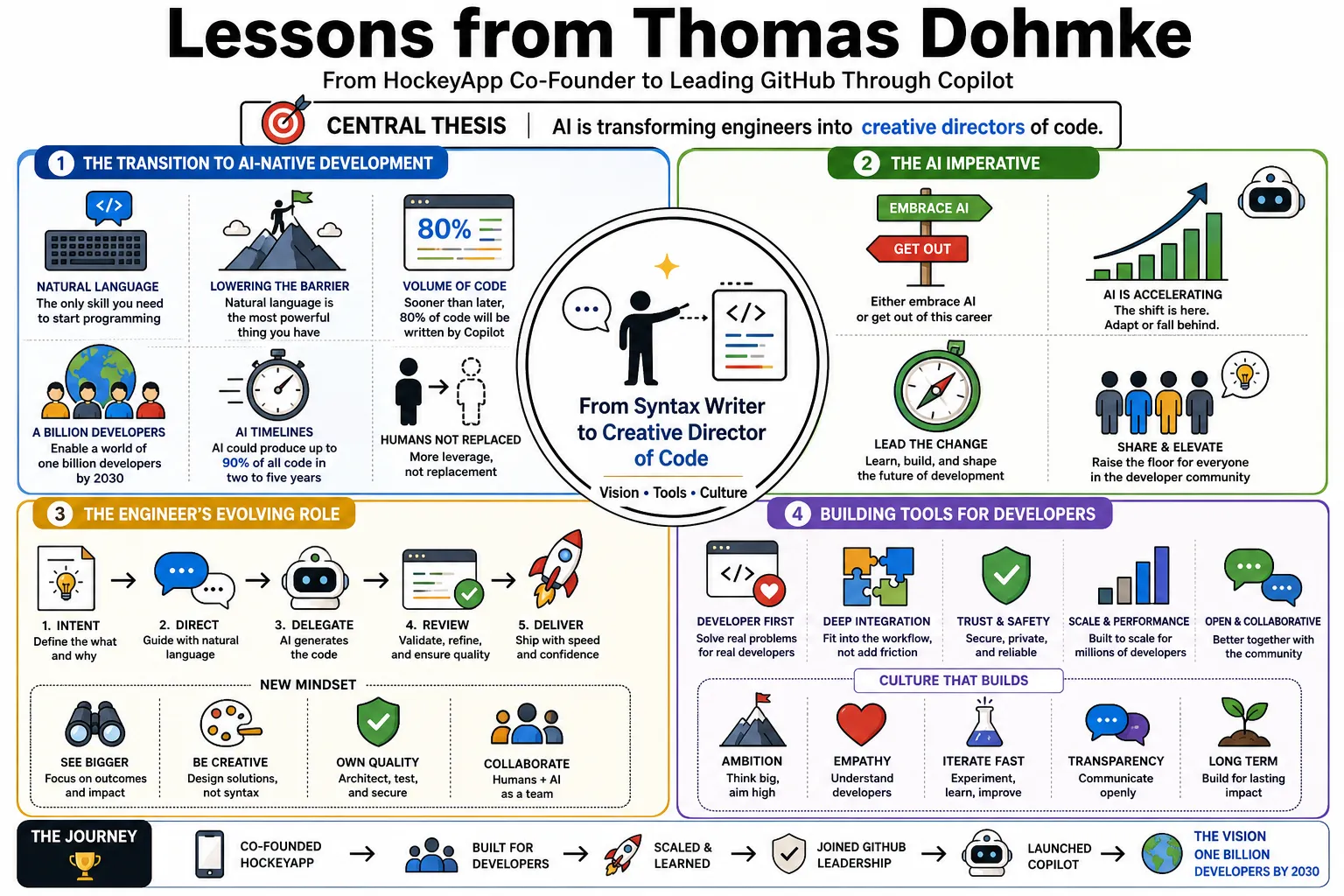
Lessons from Thomas Dohmke
Thomas Dohmke went from co-founding HockeyApp to leading GitHub through the launch of Copilot. He argues the shift toward AI is turning software engineers from manual syntax writers into "creative directors of code." This profile outlines his views on the reality of engineering craft and the culture required to build tools for other developers.
Part 1: The Transition to AI-Native Development
- On the AI imperative: "Either embrace AI or get out of this career." — Source: [DLD Conference]
- On natural language: "Any human language is now the only skill that you need to start computer programming." — Source: [TED]
- On volume of generated code: "Sooner than later, 80% of the code is going to be written by Copilot. And that doesn't mean the developer is going to be replaced." — Source: [GitHub Blog]
- On lowering the barrier: "The greatest barrier to entry is the complexity of this abstraction layer... natural language is now the most powerful thing you have." — Source: [TED]
- On a billion developers: "We have an ambitious vision for enabling a world of one billion developers by 2030, democratizing access to coding." — Source: [Sequoia Capital]
- On AI timelines: "AI could produce up to 90% of all code in two to five years." — Source: [DLD Conference]
- On the legacy system problem: AI has the potential to finally untangle and update legacy systems like COBOL running on mainframes that have been untouched for decades. — Source: [Freethink]
- On the transition phase: We are shifting away from a manual, craft-based production system to something resembling an automated moving assembly line. — Source: [The New Stack]
- On new resource constraints: "I think in 2026, any leader needs to think about head count no longer just as salaries and benefits and travel and expenses, but tokens." — Source: [The Verge]
- On shifting focus: The transition allows us to spend less time typing syntax and more time asking why a feature actually matters to the end user. — Source: [Reddit]
Part 2: The Evolving Role of the Developer
- On the new job description: Developers are moving away from being raw code producers to becoming code enablers. — Source: [The New Stack]
- On creative direction: The future role of a software engineer looks much closer to a "creative director of code" than a traditional typist. — Source: [Freethink]
- On orchestrating agents: A developer's primary job will soon be to act as the conductor of various AI agents, organizing them to build out software. — Source: [YouTube]
- On maintaining human strategy: Humans will continue to handle the strategic thinking and system design that AI currently cannot replicate. — Source: [Freethink]
- On the end of syntax mastery: Rote memorization of programming languages is being replaced by the ability to formulate intent and evaluate machine outputs. — Source: [TED]
- On problem decomposition: "You need people that take large complex problems, break them down into smaller problems. That’s what engineering is all about." — Source: [Business Insider]
- On the value of junior engineers: Junior developers are essential because they eventually become the senior engineers who understand how to guide AI at scale. — Source: [The Pragmatic Engineer]
- On specification-based engineering: The role is evolving to focus heavily on writing precise specifications and letting AI handle the implementation details. — Source: [The New Stack]
- On the joy of building: "Very soon building software will be just as simple and joyful as stacking a Lego." — Source: [TED]
- On evaluating talent: "I think in 2025, it's totally fair game to say you should reflect on your AI usage, and you should reflect what did you learn about AI." — Source: [The Verge]
Part 3: The Mechanics of Copilot and Productivity
- On defining productivity: Productivity is not measured solely in lines of code written; developer happiness is the ultimate metric for true output. — Source: [Weights & Biases]
- On the speed of iteration: Clinical studies have shown that developers using Copilot can complete tasks up to 55% faster. — Source: [Weights & Biases]
- On returning to baseline: "No matter what developer I talk to, those that have used Copilot for a while no longer want to work without a Copilot." — Source: [Sequoia Capital]
- On the daily work mode test: "If this thing can't change the daily work mode of developers, then it's not worth existing." — Source: [36Kr]
- On solving the review bottleneck: As AI writes more code, the real bottleneck shifts from writing to reviewing, tracking reasoning, and understanding intent. — Source: [GeekWire]
- On continuous workflow: By handling repetitive boilerplate, AI agents let you focus entirely on solving the actual customer problem. — Source: [Freethink]
- On tracking intent: We need systems that track the reasoning and intent behind AI-generated code, rather than just delivering the final raw files. — Source: [GeekWire]
- On end-to-end agents: The evolution of development tools is moving from simple autocomplete to autonomous agents that handle the workflow from idea to pull request. — Source: [Sequoia Capital]
- On the limits of time: "My creativity during the coding process is limited by the time that I have available and the energy that I have." — Source: [Niels Berglund]
- On removing drudgery: "Copilot brings the fun back, it brings the creativity back." — Source: [Freethink]
Part 4: Vibe Coding and Flow State
- On defining Vibe Coding: Vibe coding is a high-level, natural-language-driven approach where developers iterate on software rapidly by focusing on intent. — Source: [Medium]
- On the magic state: The goal of modern tooling is to keep the developer in a magic flow state where they are entirely focused on problem-solving. — Source: [Freethink]
- On conserving energy: "Copilot and agent mode keep you in that zone of creativity and let you really focus." — Source: [Niels Berglund]
- On conversational programming: The interaction between a developer and their tools is becoming a continuous dialogue rather than a sequence of static commands. — Source: [YouTube]
- On leveraging peak creativity: "Stay focused and leverage the time of the day when you're actually creative because that time is so limited." — Source: [YouTube]
- On the limits of vibing alone: You still need structural understanding; you cannot build a reliable, complex system at scale strictly by prompting AI without architectural knowledge. — Source: [India Times]
- On removing friction: When developers avoid context switching to search for documentation, they stay in the flow state significantly longer. — Source: [Sequoia Capital]
- On intuitive interfaces: The best tools disappear into the background, allowing the developer to simply guide the logic. — Source: [TED]
- On the rhythm of coding: Writing software is a deeply rhythmic process, and AI interruptions should be designed to match that natural cadence. — Source: [Weights & Biases]
Part 5: Dogfooding and Company Culture
- On mandatory usage: "There is no world where I would allow for somebody to say, 'Well, sorry, I don't want to use GitHub.'" — Source: [The Verge]
- On cultural alignment: "It's part of our company culture that everybody at GitHub uses GitHub." — Source: [The Verge]
- On the consequences of opting out: If an employee refuses to use their own company's tools, there are tens of thousands of other tech companies they can join instead. — Source: [The Verge]
- On cross-functional dogfooding: Employees outside of engineering, such as those in HR or Legal, benefit from using the core platform to build empathy with the customer base. — Source: [The Verge]
- On remote-first operations: A globally distributed, asynchronous culture requires a deep reliance on written communication and shared digital platforms. — Source: [The Pragmatic Engineer]
- On identifying with the user: As a leader of a developer platform, it is crucial to remain the chief nerd of the world's computer nerds. — Source: [DLD Conference]
- On internal testing: Before launching Copilot broadly, the product had to fundamentally change the day-to-day habits of the internal engineering team. — Source: [36Kr]
- On post-acquisition integration: Maintaining the cultural identity of an acquired company while integrating into a massive parent organization requires a delicate balance of autonomy. — Source: [The Pragmatic Engineer]
- On asking questions: Employees must interrogate their own tool choices and actively reflect on why they are or aren't adopting new AI capabilities. — Source: [The Verge]
Part 6: Leadership and the Business of Open Source
- On the AI multiplier effect: "The companies that are the smartest are going to hire more developers. Because if you 10x a single developer, then 10 developers can do 100x." — Source: [Economic Times]
- On the myth of code-free businesses: "The idea that AI without any coding skills lets you just build a billion-dollar business is mistaken." — Source: [Economic Times]
- On structural advantages: If building a massive business required absolutely no technical foundation, the market would instantly saturate because everyone would do it. — Source: [Economic Times]
- On open source dependency: "You can't really build anymore without relying on open source." — Source: [YouTube]
- On the foundation of tech: The vast majority of proprietary software stacks are built on top of open-source components that require community maintenance. — Source: [YouTube]
- On platform neutrality: Even when owned by a parent cloud provider, a developer platform must maintain neutrality to support all languages and ecosystems. — Source: [Wikipedia]
- On global collaboration: "GitHub is the largest team sport on Earth. It’s one of the few things on this planet where we collaborate with each other without any cultural boundaries." — Source: [India Times]
- On building bridges: Open source ecosystems in international regions represent a fantastic opportunity to overcome geopolitical boundaries through shared code. — Source: [GitHub]
- On post-acquisition survival: For founders selling their startup, the immediate aftermath often feels empty; the best advice is to stay sane and get some sleep. — Source: [YouTube]
Part 7: Craft, Mastery, and Engineering Depth
- On the necessity of craft: Even in an AI-first world, fundamental engineering skills are irreplaceable. You have got to develop craft. — Source: [Tekedia]
- On systems thinking: "Systems thinking—understanding the complexity of software and being able to take a really big problem... and decomposing it into small problems—will play an ever-increasing role." — Source: [Freethink]
- On impact over cleanliness: "The efficiency, cleanliness and poetry of your code will get you in the door, but to become a stellar developer, you need to focus on creating an impact." — Source: [Reddit]
- On the core question: "For every project, ask yourself 'why is this important?' and then shape your daily tasks around that goal." — Source: [Reddit]
- On practice: "Create things... You perfect your craft through practice." Recreating admired work is one of the best ways to learn underlying architecture. — Source: [Reddit]
- On the limits of non-technical founders: "A non-technical founder will find it difficult to build a startup at scale without developers because they can't build a complex system to justify the next round." — Source: [India Times]
- On semantic reasoning: Every child should learn coding, not to manually type syntax, but to build the logical and semantic reasoning required to direct software behavior. — Source: [YouTube]
- On architectural integrity: AI can write the functions, but human engineers must design the structural integrity that keeps the system stable under load. — Source: [Business Insider]
- On senior judgment: True mastery is knowing when to reject an AI's suggestion because it violates the broader architectural pattern of the codebase. — Source: [Business Insider]
Part 8: The Future of Software Production
- On escaping the prototyping phase: "The longer you are in the honeymoon [prototyping phase], the more goes your anxiety that what you're building is actually something that nobody wants." — Source: [YouTube]
- On the necessity of launching: You have to ship eventually; getting trapped in endless prototyping denies you the critical feedback cycle from real users. — Source: [YouTube]
- On the new lifecycle: We must reimagine the entire software development lifecycle for a world where machines act as the primary producers of boilerplate code. — Source: [The New Stack]
- On the industrial revolution of code: The shift AI brings to software is equivalent to the leap from craft-based manufacturing to the automotive assembly line. — Source: [The New Stack]
- On human-AI synergy: The most successful future organizations will be those that figure out the optimal collaboration layer between human reasoning and AI generation. — Source: [GeekWire]
- On tracking machine reasoning: As AI agents take over implementation, the platforms of the future will need to store not just code, but the AI's logical reasoning for writing it. — Source: [GeekWire]
- On democratizing creation: Lowering the barrier to code means we will see an explosion of bespoke, single-use applications built by domain experts rather than software engineers. — Source: [TED]
- On continuous evolution: The transition from autocomplete tools to autonomous agents will redefine the speed at which ideas become production-ready products. — Source: [Sequoia Capital]
- On the ultimate goal: The end state of developer tooling is to remove the friction between a human's idea and the functioning software that realizes it. — Source: [Freethink]