Tony James is a former Blackstone president and long-time Costco chairman who helped build modern private markets and scale alternative asset management. Beyond his early work in leveraged buyouts at DLJ, he co-authored a deficit-neutral plan to address the American retirement crisis. This profile collects his views on spotting structural market shifts and running businesses for the long term.
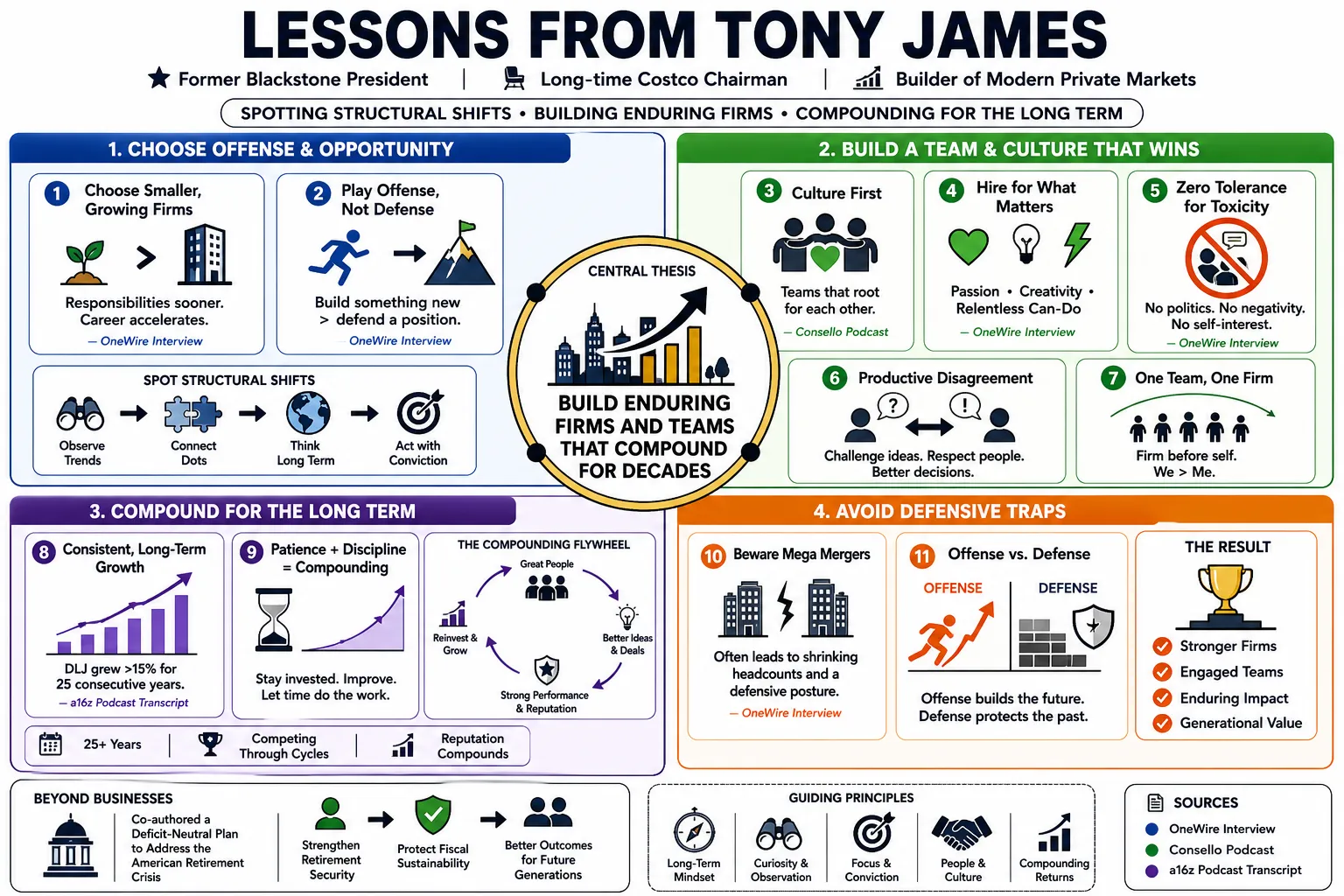
Part 1: Building Enduring Firms and Teams
- On choosing opportunities: Joining a smaller, growing firm often accelerates your career faster than joining a larger, established competitor because you are given responsibilities earlier than you might otherwise deserve. — Reference: OneWire Interview
- On playing offense: It is far more enjoyable to build something at a young company than to try and defend a position at a massive, entrenched institution. — Reference: OneWire Interview
- On firm culture: Successful organizations prioritize teams that root for each other over individual talent. — Reference: Consello Podcast
- On hiring traits: When evaluating candidates, look for a deep passion for the business, creative thinking, and relentless can-do energy. — Reference: OneWire Interview
- On toxic traits: There should be absolutely zero patience for internal politics, negativity, or people who prioritize their own interests over the firm. — Reference: OneWire Interview
- On firm consolidation: Going through a massive corporate merger often leads to shrinking headcounts and a defensive posture rather than a positive, growth-oriented environment. — Reference: OneWire Interview
- On long-term growth: A successful organization can compound its growth consistently for decades, as DLJ did by growing over 15 percent for 25 consecutive years. — Reference: a16z Podcast Transcript
- On productive disagreement: Elite teams need direct, robust debate without status games; people should challenge one another in a shared search for the truth without treating disagreement as a personal attack. — Reference: a16z Interview
- On modeling standards: Leaders cannot demand rigor from an investment team unless they do the work themselves, study the details, and meet the same standard they expect from everyone else. — Reference: a16z Interview
- On investment committees: An investment committee is more than an approval mechanism; it is where analytical rigor, language, judgment, and lessons from wins and losses are transmitted to the next generation. — Reference: a16z Interview
- On collective judgment: A leader can correct an unfair drift in a discussion, but the final investment decision should still belong to the group because a rigorous team usually sees more than a lone decision-maker. — Reference: a16z Interview
- On retaining ambitious people: Growth is a talent strategy: creating new businesses and responsibilities gives exceptional people room to advance before frustration pushes them to leave and build elsewhere. — Reference: a16z Interview
Part 2: The Evolution of Private Markets
- On early signals: "By the time they're obvious, it's priced in." — Source: podscripts.co
- On overcoming disadvantages: When competing against much larger firms that have more capital, clients, and history, you must find structural workarounds, like buying companies outright to secure their banking business. — Reference: a16z Podcast Transcript
- On the origin of merchant banking: Seeing early leveraged buyouts in the 1980s revealed that firms could purchase massive companies almost entirely with debt and use the resulting fees to essentially own the business. — Reference: a16z Podcast Transcript
- On incumbent ambivalence: Major Wall Street firms initially hesitated to enter the leveraged buyout space because they were afraid of competing with their own clients, which left a wide-open runway for smaller, more aggressive firms. — Reference: a16z Podcast Transcript
- On building synergistic businesses: Creating a private equity business naturally creates the need for a high-yield debt business, which can then lead to restructuring advisory services when the market eventually turns. — Reference: OneWire Interview
- On covenant-lite debt: Flexible debt structures that remove hair-trigger covenants actually benefit the broader economy by giving companies the breathing room they need to recover during a recession. — Reference: Private Capital Symposium
- On preserving enterprise value: By keeping a struggling company intact and preventing creditors or suppliers from fleeing, flexible debt preserves the optionality of recapturing value for everyone involved. — Reference: Private Capital Symposium
- On bold bets: Sometimes the most consequential investments require acting aggressively during a market collapse, such as spending a billion dollars on a distressed credit team in the middle of a downturn. — Reference: Consello Podcast
- On operating capability: Modern private equity needs more than transaction and investment skill; it must bring scarce expertise in procurement, pricing, data, manufacturing, healthcare, and marketing to improve portfolio companies. — Reference: Bloomberg Talks
- On becoming builders: As easy financial engineering disappeared, private equity had to evolve from flipping asset-heavy companies into holding and transforming businesses over several years. — Reference: Bloomberg Talks
- On investment duration: A lower annual return compounded for much longer can create more wealth than a spectacular short burst, so patient capital should evaluate total compounding rather than IRR alone. — Reference: Bloomberg Talks
- On secondary liquidity: Private-market investors often sell strong assets because allocations drift, liabilities change, or life circumstances intervene; a secondary market turns those needs into liquidity without implying that the underlying investment failed. — Reference: Bloomberg Talks
Part 3: Scaling an Investment Platform
- On cross-business insight: A multi-strategy firm earns an advantage when different businesses reinforce one another with data, relationships, capital, and independent signals that reveal structural shifts early. — Reference: a16z Interview
- On firm-level alignment: Building a durable firm requires incentives that make each fund care about the institution while preserving enough ownership and autonomy for investment teams to remain entrepreneurial. — Reference: a16z Interview
- On distribution as a moat: A broad retail-distribution capability can stabilize an investment platform when individual funds no longer lead their categories, making access and trust durable strategic assets. — Reference: a16z Interview
- On educating a market: Blackstone built distribution by teaching brokers about alternatives and pairing that education with proprietary client data, creating infrastructure that smaller competitors could not easily reproduce. — Reference: a16z Interview
- On acquisition design: The best financial-services acquisitions resemble talent platforms: buy a small, ambitious, culturally compatible team, align much of the price with future success, and use the larger institution to scale it into a leader. — Reference: a16z Interview
Part 4: The Costco Philosophy and Governance
- On corporate focus: "Focus, focus, focus, flawless execution of details, build for the long term." — Source: podscripts.co
- On the core business principle: A company should be built around the single principle of always doing what is right for the customer; if you do that, the shareholders will naturally be taken care of. — Reference: Consello Podcast
- On avoiding distractions: A major key to long-term success is doing one thing extraordinarily well and refusing to be distracted by anything else. — Reference: Consello Podcast
- On customer trust: Relentlessly pursuing the trust of your customers is far more valuable than trying to maximize short-term profits. — Reference: DMA Presentation
- On operational discipline: Maintaining strict operational discipline over decades allows a company to consistently deliver long-term value. — Reference: DMA Presentation
- On the board's lane: A board should ensure excellent management and help leaders look five or ten years ahead, while resisting the temptation to prescribe day-to-day operations. — Reference: Chief Executive
- On shielding the long term: A good board gives management cover from quarterly pressure so the company can protect members, employees, and suppliers without sacrificing its principles to short-term promises. — Reference: Chief Executive
- On engaged governance: Small, prepared boards can be highly interactive without becoming prescriptive when directors read materials in advance, ask informed questions, and preserve management's authority. — Reference: Chief Executive
- On owning critical assets: Owning real estate can be worth the capital because it lowers fixed costs and preserves the freedom to remodel, relocate, or operate without a landlord constraining the business. — Reference: Chief Executive
- On international control: As a company develops global operating competence, direct ownership can replace joint ventures so management can make cleaner decisions and control its own destiny. — Reference: Chief Executive
Part 5: Macro Trends and Artificial Intelligence
- On the AI revolution: Artificial intelligence is a deeply transformational but highly disruptive force, and society is currently unprepared for its full implications. — Reference: DMA Presentation
- On the displacement of workers: While AI has the potential to dramatically increase productivity, it could also displace millions of knowledge workers and leave many struggling to find a sense of purpose. — Reference: DMA Presentation
- On technological investment cycles: The AI boom is comparable to the historical expansion of canals and railroads—technologies that transformed society but often failed to generate sustainable profits for investors due to rapid obsolescence and fierce competition. — Reference: DMA Presentation
- On the pace of change: Governments are moving far too slowly to address the challenges of AI, while technology companies are forced to race ahead simply to survive global competition. — Reference: DMA Presentation
- On offsetting fiscal pressures: The productivity gains generated by AI might eventually help offset the long-term dangers of mounting federal debt, similar to how the internet boom strengthened government finances in the late 1990s. — Reference: DMA Presentation
- On geopolitical risks: A Chinese takeover or the destruction of Taiwan's semiconductor production capacity would likely trigger a severe global economic depression. — Reference: DMA Presentation
- On geopolitical deterrence: The strategy for preventing conflict over Taiwan relies not just on military superiority, but on creating enough uncertainty in the minds of adversaries to deter aggression. — Reference: DMA Presentation
Part 6: Structural Innovation and Retirement Policy
- On the retirement crisis: If the United States does not modernize its retirement infrastructure, it will face senior poverty rates not seen since the Great Depression. — Reference: Blackstone Press Release
- On Guaranteed Retirement Accounts: Every American worker should have an individually owned, mandated retirement account to ensure consistent savings throughout their career. — Reference: Blackstone Press Release
- On pooling assets: Retirement savings should be pooled and invested in long-term strategies that can generate higher returns than traditional, individually managed 401(k) plans. — Reference: Blackstone Press Release
- On deficit-neutral policy: A pragmatic retirement solution can redeploy existing tax subsidies and leverage current federal payment infrastructure to avoid raising taxes or increasing the deficit. — Reference: Blackstone Press Release
- On guaranteed income: To secure retirees' standard of living, savings should be returned as life-long payments that guarantee continuous income for as long as they live. — Reference: Blackstone Press Release
- On bipartisan appeal: A successful policy model must keep accounts under personal control and distribute savings based on the amount invested rather than income level. — Reference: Blackstone Press Release
Part 7: Succession and Renewal
- On succession as a process: Leadership transition must begin years before departure: choose the successor, develop them, protect the business they leave behind, and make sure disappointed candidates do not fracture the organization. — Reference: a16z Interview
- On leaving with momentum: The right time to hand over leadership is while both the leader and the institution are still performing strongly; waiting for decline forces the successor to recover lost momentum. — Reference: a16z Interview
Part 8: Civic Obligation and Institutional Capacity
- On civic obligation: Giving back to the community is not just a philanthropic choice; it is an obligation that everyone who has experienced success should fulfill. — Reference: OneWire Interview
- On operational philanthropy: Philanthropy can donate capabilities rather than only money by adapting private-equity operating resources in technology, finance, marketing, and student support for institutions that cannot build them alone. — Reference: a16z Interview
- On strengthening high-leverage institutions: HBCUs produce strong graduation and income outcomes despite limited resources, so improving their administrative and student-support infrastructure can multiply an institution's existing social impact. — Reference: a16z Interview