Howard Marks is Oaktree Capital Management’s co-chair and a long-time author of its investment memos. His writing examines investment risk, market cycles, price versus value, and the limits of forecasting. — Oaktree — Howard Marks.
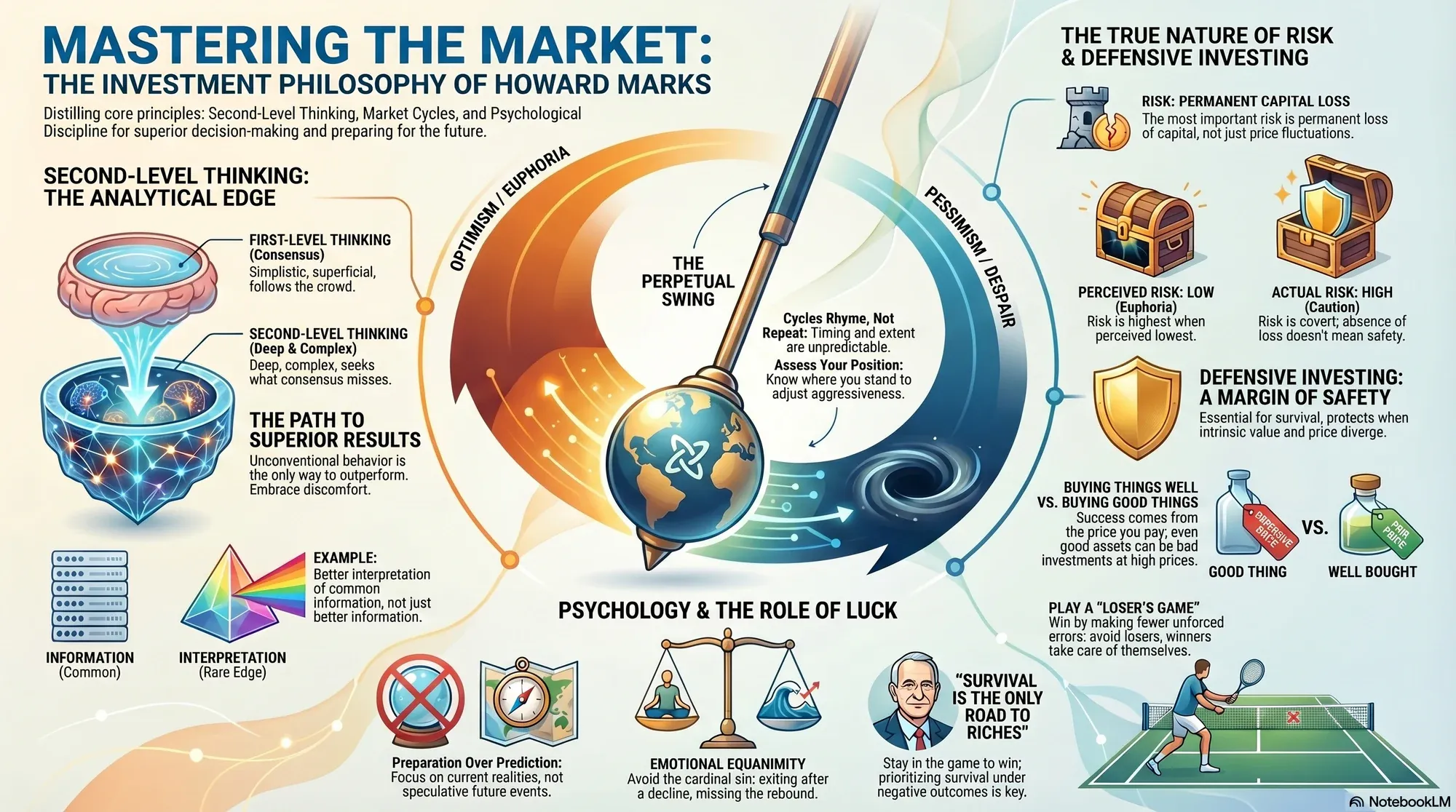
Part 1: The Art of Second-Level Thinking
- On trying to outperform: Marks argues that an investor who wants above-average results cannot simply make the same choices as everyone else. Acting differently only creates the possibility of outperformance; the judgment must also be better. — I Beg to Differ.
- On a durable philosophy: Marks says Oaktree wrote down six investing tenets based on what its founders had learned and kept them unchanged for decades. The lesson is to know which principles guide a decision, not to pretend consistency alone ensures success under pressure. — Taking the Temperature.
- On being more right than the consensus: Marks distinguishes being right from being more right than other investors. A non-consensus judgment has value only if it more accurately assesses the asset and the expectations already reflected in its price. — I Beg to Differ.
- On looking wrong for a while: Marks says unconventional positions can appear wrong for an extended period, even when ultimately sound. Pursuing them requires both insight and the ability to withstand mistakes and social pressure. — I Beg to Differ.
- On judgment rather than formulas: Marks says evaluating a company combines quantitative and qualitative considerations that cannot be reduced to one number or a sure-fire algorithm. The necessary judgment is difficult and can be wrong. — The Calculus of Value.
- On what the price reflects: Marks describes a market price as investors’ consensus view of underlying value. Because optimism and pessimism can move price beyond value, consensus is information about opinion rather than a guarantee of truth. — The Calculus of Value.
- On second-level questions: Marks contrasts simple directional opinions with questions about possible outcomes, probabilities, consensus expectations, the current price and what happens if either view proves right. — I Beg to Differ.
- On the risk of being different: Marks warns that any attempt to deviate from consensus can produce below-average returns if the judgment is mistaken. Willingness to differ must include willingness to accept that risk. — I Beg to Differ.
- On developing an analytical edge: Marks says active investors need insight other investors lack: noticing overlooked considerations, interpreting published numbers better, or judging a company’s qualitative prospects. Ready access to the same data is not itself an edge. — I Beg to Differ.
Part 2: Navigating Market Cycles & Pendulums
- On the pendulum of investor sentiment: Marks compares market psychology to a pendulum: investors swing between optimism and pessimism, often spending little time at a balanced midpoint. These shifts can move prices farther than changes in fundamentals alone would imply. — Mr. Market Miscalculates.
- On the themes that recur: Marks says investment history does not repeat exactly, but investor behavior often follows familiar themes. He studies recurring optimism, speculation and reversals without treating a past cycle as a precise forecast. — Bull Market Rhymes.
- On the danger of carefree markets: Marks warns that strong returns can encourage optimism, aggressive bidding and less scrutiny. Risk can rise precisely as investors feel most comfortable taking it. — Bull Market Rhymes.
- On a change in the rate regime: In his December 2022 “Sea Change” memo, Marks argued that decades of falling interest rates had boosted asset values and investor returns, and that a higher-rate environment could favor different strategies. This was a dated assessment, not a claim that its 2022 conditions still prevail. — Sea Change.
- On knowing where we are: Marks argues that investors cannot reliably know the macro future, but can assess the current environment and adjust their risk posture when conditions are unusually favorable or unfavorable. That is a different task from calling an exact top or bottom. — Taking the Temperature.
- On the cost of selling at the bottom: Marks considers selling at a market bottom worse than buying before a decline: it locks in the loss and forfeits participation in a possible long-term recovery. The argument assumes the underlying investment thesis remains sound. — Taking the Temperature.
- On buying amid pessimism: Marks says extreme pessimism can leave little optimism in prices and create bargains, but he does not recommend waiting for a knowable bottom. Oaktree buys when it finds value cheap, accepting that prices may fall further. — Taking the Temperature.
- On the late stage of a bull market: Marks describes how rising prices can draw in less discerning buyers until optimism, fear of missing out and aggressive risk-taking leave a market more vulnerable. The familiar bull-market aphorism in the old lesson is not his. — Bull Market Rhymes.
- On the limits of extrapolation: Marks warns that a real innovation can still be priced as if its strongest companies will grow and dominate indefinitely. Fundamental promise does not justify an unlimited price; even compelling growth stories face competitors and negative surprises. — On Bubble Watch.
Part 3: The True Nature of Risk
- On multiple possible outcomes: Quoting Elroy Dimson, Marks emphasizes that risk comes from the range of outcomes that could occur, not just the single outcome eventually observed. Investors must consider unfavorable possibilities before committing capital. — Risk Revisited.
- On risk that has not yet produced a loss: Marks says a benign period can make a risky investment look safe. The absence of losses does not prove that a portfolio can withstand an adverse event; risk control may remain invisible until conditions worsen. — Risk Revisited.
- On probabilities versus outcomes: Marks warns that even a well-judged probability is not a prediction of a single result: unlikely events occur, and likely events sometimes fail to occur. A bad outcome alone cannot establish that a decision was poorly reasoned. — Risk Revisited.
- On risk control rather than avoidance: Marks distinguishes risk control from avoiding uncertainty altogether. Investors can accept risks they understand, can diversify and are adequately compensated to bear; refusing all risk can also mean refusing potential return. — Fewer Losers, or More Winners?.
- On acting despite discomfort: Marks describes buying during panics as difficult even when bargains appear. The relevant question is whether the value and risks justify the purchase, not whether the crowd feels comfortable. — Taking the Temperature.
- On risk perception moving with the crowd: Marks argues that widespread risk aversion can restrain excessive lending and prices, while widespread risk tolerance can erode scrutiny and increase latent risk. Perceived safety and actual risk need not move together. — Risk Revisited.
- On the investor’s role in creating risk: Marks says risk is shaped not only by an asset’s fundamentals but also by how investors price it, finance it and react to changing conditions. Overpaying or relying on liquidity that disappears can turn a sound asset into a poor investment. — Risk Revisited.
- On avoiding losers in credit: Marks explains Oaktree’s motto in the context of diversified bond investing: if most bonds pay as promised, avoiding defaults can matter more than finding exceptional winners. He cautions that higher-return strategies may also need genuine winners. — Fewer Losers, or More Winners?.
- On permanent loss as a central risk: Marks distinguishes temporary price volatility from permanent capital loss. Permanent loss can follow a fundamental failure or a forced or emotional sale during a temporary decline; he also recognizes other risks such as insufficient return. — Risk Revisited.
Part 4: Defensive Investing & Downside Protection
- On what the tennis analogy teaches: Drawing on Charles Ellis’s “loser’s game,” Marks says an investor can succeed with fewer costly mistakes, but avoiding every loss is not the goal. In tennis and investing, the relevant balance is winners against losers, adjusted for skill and the strategy pursued. — Fewer Losers, or More Winners?.
- On a margin of safety in the purchase price: Marks argues that overpaying can make even a strong asset risky, while a sufficiently low price offers a margin for error. An investor must consider valuation risk separately from whether the underlying business survives. — Risk Revisited.
- On asymmetric results: For Marks, investment skill shows up in an asymmetric record: earning strong gains when conditions favor a strategy without surrendering comparable amounts when they do not. Merely taking more risk or changing market exposure does not establish such skill. — What Really Matters?.
- On patience with a sound holding: Drawing on an insight from his son Andrew, Marks says holding a long-term compounder can be harder than buying it. News, emotion, realized gains and tempting alternatives can push an investor to sell even while its prospective return and risk still justify ownership. — Selling Out.
- On quality versus the price paid: Marks says a great business can become a poor investment when its shares are priced for implausible perfection. Buying well means assessing both the asset and the price rather than assuming quality alone protects the investor. — On Bubble Watch.
- On preparing for illiquidity: Marks argues that long-term portfolios should not depend on being able to sell at a favorable price on short notice. Aligning holdings with a sufficiently long horizon can make illiquidity less threatening and sometimes let a patient buyer exploit forced sales. — Selling Out.
- On the trade-off in defensive investing: Marks says investors cannot maximize growth and preserve capital with equal emphasis at every moment. A defensive posture seeks a tolerable balance of losses and returns, not zero losses or guaranteed safety. — What Really Matters?.
- On the primacy of risk control: Marks calls risk control Oaktree’s first tenet. It means asking how much could be lost and what must go wrong, while still bearing risks the investor understands and is paid to assume. — Fewer Losers, or More Winners?.
- On staying able to invest through a downturn: Marks warns that a temporary decline can become a permanent loss if an investor must sell under financial or emotional pressure. An investment plan therefore has to fit the holder’s time horizon and capacity to remain invested. — Risk Revisited.
Part 5: Value, Price, and Intrinsic Worth
- On buying well rather than merely buying quality: Marks says good investing depends on the price paid relative to the asset’s worth. His Nifty Fifty experience showed that even excellent companies can be disappointing investments at inflated prices. — On Bubble Watch.
- On buying below estimated value: Marks describes value investing as estimating a business’s intrinsic worth from fundamentals and buying when the market price is meaningfully lower. The discount matters only if the estimate itself is sound. — Something of Value.
- On comparing price with value: Marks says a price is not informative by itself: investors must relate it to what the asset is worth. A low nominal price is no bargain without an appraisal of earning power, prospects and risk. — The Calculus of Value.
- On present and future earning power: Marks says an asset’s value depends on its present earnings and its capacity to earn in the future. Prudent analysis therefore considers management, competition and other factors that can change that earning power. — The Calculus of Value.
- On an independent estimate of intrinsic value: Marks argues that investors need an estimate of fundamental worth independent of the daily market quote. That estimate gives them a basis for recognizing a meaningful price discount and resisting emotional swings. — Something of Value.
- On the false divide between value and growth: Marks argues that value and growth should not be treated as mutually exclusive styles. Future growth can be part of intrinsic value, while a low valuation ratio alone can conceal weak prospects. — Something of Value.
- On paying too much for a great asset: Marks says even a high-quality business can be dangerous when the purchase price assumes too much success. Quality and valuation are separate questions. — On Bubble Watch.
- On where bargains are more likely to appear: Marks says assets surrounded by pessimism, controversy or poor recent performance are more likely to be offered at bargain prices than universally admired holdings. That is a reason to investigate them, not to buy without analysis. — I Beg to Differ.
- On discounted cash flow as a valuation tool: Marks describes discounted future cash flows as a central way to estimate a business’s worth, but emphasizes that the calculation is only as useful as the judgments about future cash flows and the discount rate. — Something of Value.
- On what can happen after overpayment: Marks warns that when a popular asset is priced for continuing success, even a modest negative surprise can produce a severe decline. Investors should examine the expectations embedded in the price, not simply the asset’s appeal. — On Bubble Watch.
Part 6: Efficiency, Inefficiency, and the Consensus
- On the source of an active investor’s edge: Marks argues that an active investor needs both an exploitable market mispricing and the skill to recognize it. Mispricing creates an opportunity; it does not ensure that every active manager will profit from it. — What Really Matters?.
- On non-consensus forecasts: Marks says a consensus forecast is usually already reflected in prices. A non-consensus prediction can help only if it is also more accurate, and he doubts anyone can achieve that reliably in macro forecasting. — Thinking About Macro.
- On interpreting the crowd’s opinion: Marks treats the market as the aggregate judgment of its participants, not an oracle with special information. Short-term price moves can reflect emotion as much as changes in fundamentals, so investors should examine rather than automatically follow them. — What Does the Market Know?.
- On pessimism as a possible opening: Marks says widespread pessimism can leave little hope embedded in prices, making bargains possible. An investor still has to appraise the asset and distinguish a low price from genuinely impaired value. — On Bubble Watch.
- On what a market quote actually measures: Marks describes a market price as the prevailing balance of optimistic and pessimistic investors’ views. It records their current opinion, which may diverge from the underlying asset’s value. — The Calculus of Value.
- On limits to market efficiency: Marks accepts that competitive analysis usually makes obvious bargains scarce, yet argues that emotional extremes and forced selling can still push prices away from fundamentals. Active investing requires identifying those exceptions with better judgment than the crowd. — Something of Value.
- On passive investing and price discovery: Marks argues that passive funds rely on active investors to assess securities and set prices. If passive ownership grew enough to weaken that price discovery, mispricings might become more common—but he does not claim this has already guaranteed an active-manager advantage. — Investing Without People.
- On skepticism that stays open to evidence: Marks says skepticism helps investors challenge herd assumptions and implausible promises, but warns that reflexively dismissing innovation can also blind them. He pairs skepticism with curiosity and further study. — Something of Value.
Part 7: The Role of Luck and Randomness
- On admitting what cannot be known: Marks favors guarded judgment about the macro future over confidence unsupported by a forecasting record. He says investors can make decisions without pretending to know the exact future path. — The Illusion of Knowledge.
- On the role of luck in apparent success: Marks says skill, work and preparation matter, but chance also affects whether a sound investment thesis produces a favorable outcome. A short streak of success should not automatically be treated as repeatable skill. — Getting Lucky.
- On living with an unknowable future: Marks argues that uncertainty is unavoidable in investing. Investors have to build portfolios and make choices despite not knowing which of several possible events will occur. — Risk Revisited.
- On judging a decision separately from its result: Marks says incomplete information and luck can cause well-reasoned decisions to fail and poor ones to succeed. Especially over a small sample, evaluate the decision process as well as the result. — You Bet!.
- On why macro models disappoint: Marks doubts that any process can consistently convert an economy’s many changing variables and human responses into useful macro forecasts. The concern is reliability, not that every individual forecast must be wrong. — The Illusion of Knowledge.
- On preparing rather than predicting: Marks argues that not knowing the timing or shape of the next cycle is no excuse to ignore cycles. Investors can study present conditions, consider the possibilities and position portfolios to withstand adverse turns. — You Can’t Predict. You Can Prepare..
Part 8: Predicting vs. Preparing
- On false confidence in forecasting: Marks opens “The Illusion of Knowledge” with John Kenneth Galbraith’s warning about forecasters who do not know—and may not realize it. Marks’ own argument is to demand evidence of a forecasting record before trusting confident macro calls. — The Illusion of Knowledge.
- On using observable conditions rather than a single forecast: Marks favors assessing current valuations, investor behavior and risk compensation over building an investment case on one predicted macro outcome. The future still matters, but conviction should match what can actually be known. — Taking the Temperature.
- On the rarity of macro-forecasting success: Marks says he knows of only a few highly successful macro investors and regards them as exceptions, not proof that forecasting generally produces superior returns. He does not say that no one has ever profited from it. — The Illusion of Knowledge.
- On what the credit cycle can reveal: Marks says credit availability, lending standards and risk tolerance tend to move cyclically. Their current state can indicate how favorable the odds are for prospective investments without revealing when the next turn will occur. — You Can’t Predict. You Can Prepare..
- On adjusting risk posture sparingly: Marks says Oaktree normally keeps a stable balance of aggressiveness and defense, changing it only when conditions make a different posture compelling. This is a cautious response to unusually strong evidence, not routine market timing. — Taking the Temperature.
Part 9: Investor Psychology and Emotional Discipline
- On greed eroding caution: Marks says strong returns can feed optimism and fear of missing out, causing investors to bid prices up while doing less due diligence. The resulting decline in risk aversion can make future returns less attractive. — Bull Market Rhymes.
- On what fear does to selling behavior: Marks says extreme fear can lead holders to sell because they need cash or cannot tolerate uncertainty. Those sales can create unusually low prices for a prepared buyer, but the existence of fear does not by itself prove an asset is cheap. — Taking the Temperature.
- On emotional discipline: Marks argues that investors need to resist the market’s emotional pull and base decisions on their appraisal of fundamental value. Discipline does not require a person to feel no emotion; it requires that emotion not substitute for analysis. — Something of Value.
- On fear of missing out: Marks describes FOMO as a force that can push buyers toward popular assets and away from skepticism about price. Investors should ask what expectations are already embedded in a fast-rising market. — Bull Market Rhymes.
- On a philosophy that guides decisions under pressure: Marks says Oaktree’s investing tenets were formulated from experience and kept stable, including the primacy of risk control. A stated philosophy matters when it shapes the questions asked before taking risk, especially in unusual markets. — Taking the Temperature.
- On selling for psychological comfort: Marks says investors sometimes sell appreciated assets to avoid the embarrassment of giving back gains, or sell declined assets to escape regret. Neither emotion, on its own, establishes that selling improves the investment decision. — Selling Out.
- On the market as people rather than an oracle: Marks emphasizes that a market is the people participating in it. Their changing sentiment and social reinforcement can move prices without a comparable change in an asset’s fundamentals. — What Does the Market Know?.
Part 10: Practical Wisdom for Long-Term Success
- On when restraint is the decision: Marks says investors often trade too much and can damage results by reacting to short-term moves. When an existing holding remains attractive on its fundamentals, continuing to hold it may be the better decision than trading for the sake of activity. — Selling Out.
- On liquidity disappearing when needed: Marks warns that an asset can seem easy to sell in ordinary times but become hard to sell, or require a sharp discount, when many holders want cash at once. Liquidity should not be assumed available at the moment of stress. — Liquidity.
- On when a strategy needs actual winners: Marks says avoiding defaults is central to a diversified bond portfolio, but a strategy seeking returns far above ordinary bonds cannot rely on loss avoidance alone. It needs to identify or create genuine winners from time to time. — Fewer Losers, or More Winners?.
- On liquidity as a changing market condition: Marks says liquidity is not a permanent property of an asset. The ability to trade at a fair price varies with market mood, the direction of the trade, the size of the position and other holders’ need to act. — Liquidity.
- On identifying the mistake in a trade: Marks says investment returns often arise because one side of a transaction has misjudged the asset. Risk control means asking what error the counterparty might be making—and testing whether the error may instead be one’s own. — It’s All a Big Mistake.
- On building a consistent long-term record: Marks favors a sequence of reasonably good years and avoidance of disastrous ones over repeated attempts at spectacular annual rankings. The point is a risk-controlled long-term record, not a guarantee that every year will be positive. — Fewer Losers, or More Winners?.
- On combining skepticism with curiosity: Marks says past patterns can warn investors about speculative excess, but they should not become a reason to dismiss every new technology. He urges deep study of an innovation’s positive case before reaching a firm conclusion. — Something of Value.
- On defining success for the investor: Marks argues that an investment approach should begin with the investor’s objectives and capacity to bear risk. For a pension plan, meeting promised benefits over time matters more than beating peers in a single year; a benchmark should reflect the actual mandate. — A Look Under the Hood.