Tuhin Srivastava is the CEO and co-founder of Baseten, an AI infrastructure company that helps businesses post-train and serve their own models cost-effectively. He built the company around the shift from renting foundation models to owning them. This profile outlines his operating philosophy, from treating inference as the core of the AI stack to managing startup growth through short-horizon planning.
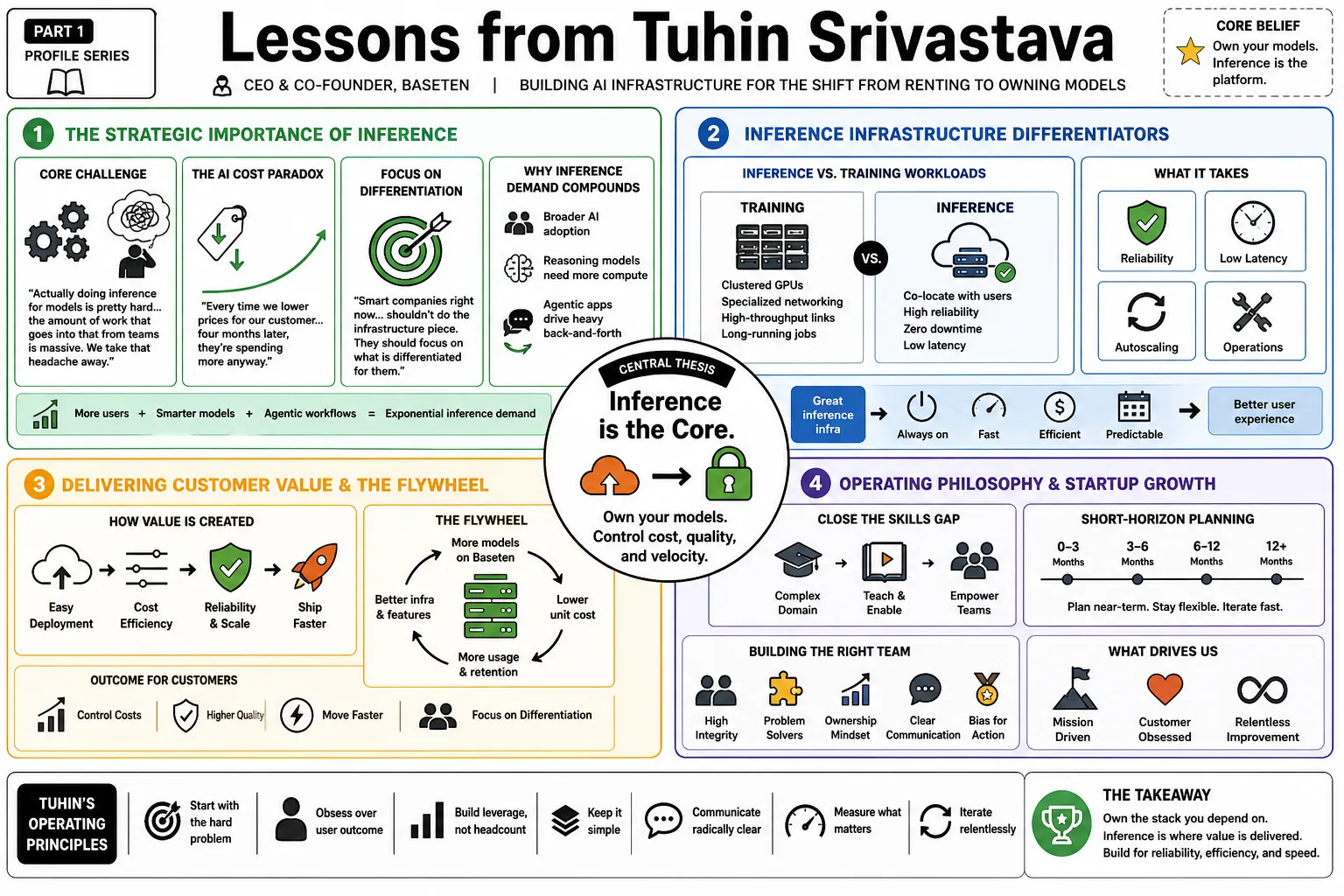
Part 1: The Strategic Importance of Inference
- On the core challenge of production AI: "Actually doing inference for models is pretty hard... the amount of work that goes into that from teams is massive. And we're just trying to take that headache away." — Source: YOU'RE READING TBPN
- On the AI cost paradox: "Every time we lower prices for our customer... four months later, they're spending more anyway." — Source: YOU'RE READING TBPN
- On infrastructure vs. differentiation: "The smart companies right now... shouldn't do the infrastructure piece. They should focus on what is differentiated for them." — Source: YOU'RE READING TBPN
- On compounding inference demand: The surge in inference usage is driven by a combination of broader AI adoption, reasoning models that inherently demand more compute, and agentic applications that generate heavy back-and-forth traffic. — Reference: Baseten's Tuhin Srivastava on China AI Coding breaking into the U.S. — 1/26/2026 - YouTube
- On inference vs. training workloads: While training requires specialized rack networking and clustered GPUs, inference prioritizes co-location with user workloads, high reliability, and zero downtime. — Reference: No Priors: Artificial Intelligence | Technology | Startups - Speed will win the AI computing battle with Tuhin Srivastava from Baseten Transcript and Discussion
- On closing the skills gap: The hurdle in deploying AI often stems from research scientists lacking web development experience; infrastructure should let them build and serve user-facing apps using pure Python. — Reference: SED1263 - Tuhin Srivastava
- On human-in-the-loop workflows: True production AI often requires wrapping a model in business logic that routes uncertain outputs, such as fraud flagging, back to human reviewers for a final decision. — Reference: SED1263 - Tuhin Srivastava
Part 2: From Rented to Owned Intelligence
- On moving past rented APIs: Transactionally querying external models limits a company's ability to control application quality, performance SLAs, and underlying costs. — Reference: The Infrastructure Behind AI Agents with Baseten - YouTube
- On the necessity of owning intelligence: Durable competitive advantage requires enterprises to build learning systems around their own proprietary data, judgment, and feedback loops. — Reference: Announcing our Series F
- On user indifference to model origins: End users do not care whether an application is powered by an open or closed model; they only care that the product effectively solves their problem. — Reference: Announcing Baseten’s $150M Series D
- On the viability of open-source: Open-weight models have advanced rapidly, becoming strong enough that enterprises can confidently adopt them as alternatives to closed frontier APIs. — Reference: Announcing our Series F
- On the resilience of the application layer: Companies building AI apps will maintain their moats by encoding unique user signals into specialized, post-trained models rather than relying purely on generic infrastructure. — Reference: Baseten CEO Tuhin Srivastava o… - No Priors: Artificial Intelligence | Technology | Startups - Apple Podcasts
Part 3: Architecting for Speed and Scale
- On the three pillars of scale: Serving production-grade AI ubiquitously requires fast models, interchangeable compute resources, and flexible, open runtimes. — Reference: Announcing Baseten’s $150M Series D
- On compute diversification: Relying on a single cloud provider creates unacceptable risk; robust inference infrastructure must span dozens of clouds and clusters to ensure capacity and failover resilience. — Reference: AI-Services Startup Baseten Nabs $13 Billion Valuation - YouTube
- On code over no-code: Because engineers fundamentally want to write code, infrastructure should provide intuitive abstractions that simplify easy tasks while leaving the underlying knobs accessible for complex needs. — Reference: No Priors: Artificial Intelligence | Technology | Startups - Speed will win the AI computing battle with Tuhin Srivastava from Baseten Transcript and Discussion
- On preparing for future workloads: The ecosystem is shifting toward a reality where applications don't just rely on one or two monolithic models, but actively juggle many specialized models concurrently. — Reference: The Infrastructure Behind AI Agents with Baseten - YouTube
- On the necessity of transparency: Developers managing expensive inference workloads require visibility and trust, demanding direct control over their runtimes and costs. — Reference: Announcing Baseten’s $150M Series D
Part 4: The Mechanics of Startup Execution
- On founder psychology: "If you cannot be irrationally optimistic about your own trajectory and your own ability to do things, then you’re just dead already. Your biggest fan should be you." — Source: The Most Underrated Unicorn Founder In Silicon Valley - Tuhin Srivastava
- On pacing startup growth: Building a company is like playing test cricket; rather than swinging for the fences constantly, founders should aim to accumulate advantage by winning small, session-by-session goals. — Reference: The Most Underrated Unicorn Founder In Silicon Valley - Tuhin Srivastava
- On the decay of information: In the fast-moving AI sector, what a team knew three months prior is often completely stale, rendering long-term roadmaps dangerously rigid. — Reference: The Most Underrated Unicorn Founder In Silicon Valley - Tuhin Srivastava
- On operating horizons: To stay responsive to rapid market shifts and model advancements, startups should plan in strict 90-day increments with monthly checkpoints. — Reference: The Most Underrated Unicorn Founder In Silicon Valley - Tuhin Srivastava
- On codifying kill criteria: It should be just as easy to stop a project as it is to start one; teams must predefine success metrics and enforce strict 4-to-6-week timeboxes for experiments. — Reference: The Most Underrated Unicorn Founder In Silicon Valley - Tuhin Srivastava
- On delaying go-to-market scaling: Expanding headcount locks a company into a specific direction, so founders should hold off on scaling sales and marketing until their retention math is conclusively proven. — Reference: The Most Underrated Unicorn Founder In Silicon Valley - Tuhin Srivastava
- On maintaining dry powder: Startups must preserve optionality across their capital, engineering bandwidth, and leadership focus to capitalize on unexpected, nonlinear market shifts. — Reference: The Most Underrated Unicorn Founder In Silicon Valley - Tuhin Srivastava
Part 5: Product Philosophy and Customer Centricity
- On customer proximity: Rather than taking feature requests literally, teams must dig deeper to understand and solve the underlying job the customer is actually trying to accomplish. — Reference: The Most Underrated Unicorn Founder In Silicon Valley - Tuhin Srivastava
- On deferring early greed: In complex B2B infrastructure, establishing trust and proving value through timeboxed pilots is a better long-term strategy than trying to immediately extract revenue from discovery phases. — Reference: The Most Underrated Unicorn Founder In Silicon Valley - Tuhin Srivastava
- On signaling confidence via contracts: Offering short, monthly or quarterly terms without punitive lock-ins forces an infrastructure company to continually prove its worth and allows poorly fitting customers to churn gracefully. — Reference: The Most Underrated Unicorn Founder In Silicon Valley - Tuhin Srivastava
- On true retention: Contractual lock-in is meaningless; true retention is measured by having satisfied customers who organically expand their usage and actively advocate for the product. — Reference: The Most Underrated Unicorn Founder In Silicon Valley - Tuhin Srivastava
- On compensating early talent: The first ten employees at a startup absorb exponential risk and should be compensated based on their actual nonlinear impact, bypassing standard corporate HR bands. — Reference: The Most Underrated Unicorn Founder In Silicon Valley - Tuhin Srivastava
Part 6: Product Design for Production AI
- On treating shipping as the start of the learning loop: A model begins improving against reality only after users can interact with it, provide feedback, and make decisions through the product; deployment is therefore the beginning of iteration, not the final handoff. — Reference: Introducing Baseten
- On reducing the coordination tax of machine learning: Moving from a notebook to a usable application often requires model serving, scalable infrastructure, integrations, and interface work to proceed together, so the product opportunity is to collapse that coordination burden. — Reference: Introducing Baseten
- On using familiar concepts in unfamiliar products: New infrastructure should follow the principle of least astonishment, mapping its abstractions to concepts engineers and data scientists already understand instead of forcing them to relearn the whole stack. — Reference: Introducing Baseten
- On designing for the path from prototype to production: A useful platform should let teams begin with small experiments while preserving a credible route to stateful, mission-critical applications with many creators and operators. — Reference: Introducing Baseten
- On creating a graduated adoption path: Shared model APIs can provide the easy starting point for open models, but the product should offer a smooth transition to dedicated infrastructure when customers need steadier performance, reliability, and control. — Reference: Introducing Model APIs and Training
- On following customers up the model-ownership curve: AI teams often move from closed APIs to open models and then toward fine-tuning their own models, so infrastructure products should support that progression rather than treating each stage as a separate market. — Reference: Introducing Model APIs and Training
Part 7: Building the Inference Platform
- On avoiding the two bad extremes of training infrastructure: Teams should not have to choose between manually acquiring machines and managing jobs through SSH or surrendering their data to an opaque service that returns an underwhelming model. — Reference: Introducing Model APIs and Training
- On separating model work from infrastructure work: Customers should be able to retain their own data and training scripts while the platform handles capacity acquisition, scheduling, multi-node execution, and the operational burden of newer training techniques. — Reference: Introducing Model APIs and Training
- On treating inference as three connected systems: Production inference combines applied model-performance research, infrastructure that scales elastically across many nodes and regions, and management tooling that makes deployments observable and controllable. — Reference: Announcing Baseten’s $75M Series C
- On optimizing across models and hardware together: Peak inference performance depends on techniques such as speculative decoding plus detailed knowledge of changing accelerator architectures; optimizing only the model or only the chip leaves performance on the table. — Reference: Announcing Baseten’s $75M Series C
- On making workload placement a product capability: Compliance, cost, latency, and resilience requirements mean organizations need explicit control over the regions, clouds, and infrastructure on which their models run. — Reference: Announcing Baseten’s $75M Series C
- On tuning the entire serving stack to the workload: Runtime choice, model size, accelerator generation, and traffic scale interact; serving large models reliably requires workload-specific tuning rather than a universal runtime configuration. — Reference: The CEO Behind the Fastest-Growing AI Inference Company