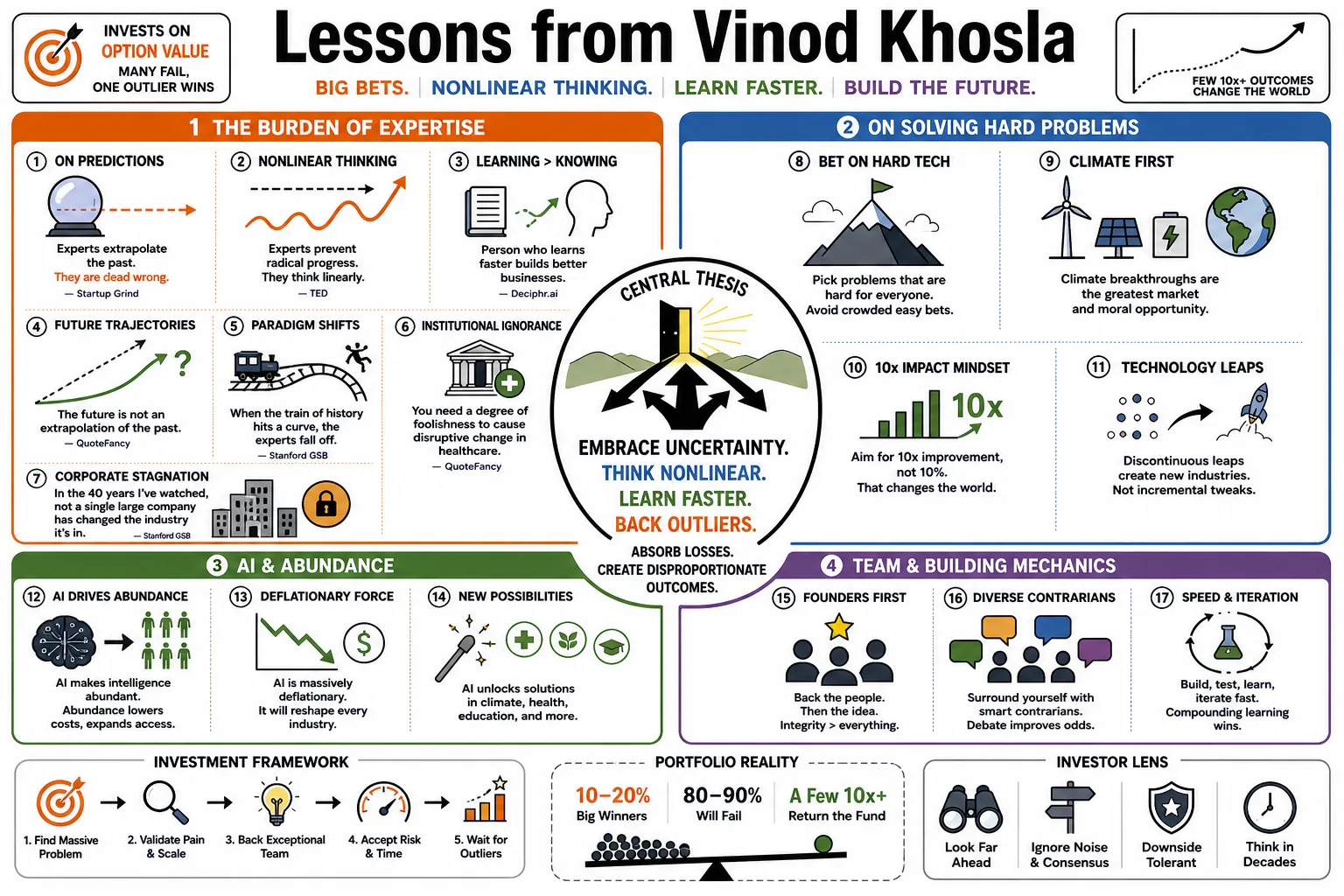
Lessons from Vinod Khosla
Vinod Khosla co-founded Sun Microsystems and launched Khosla Ventures to back companies facing massive technical risk. He invests strictly on option value, absorbing frequent failures for a rare shot at an outsized outcome. This collection details his arguments on climate breakthroughs, the limits of expertise, AI abundance, and team mechanics.
Part 1: The Burden of Expertise
- On Predictions: "Almost all experts extrapolate the past to predict the future and they are dead wrong." — Source: Startup Grind
- On Nonlinear Thinking: "Experts prevent radical progress because they don't think nonlinearly." — Source: TED
- On Learning vs. Knowing: "I have found that the person who learns faster is way better at building businesses than the person who is a deep expert." — Source: Deciphr.ai
- On Future Trajectories: "The future is not an extrapolation of the past." — Source: QuoteFancy
- On Paradigm Shifts: "When the train of history hits a curve, the experts fall off." — Source: Stanford GSB
- On Institutional Ignorance: "You need a degree of foolishness to cause disruptive change in healthcare." — Source: QuoteFancy
- On Corporate Stagnation: "In the 40 years that I've watched it, no major innovation has ever come from any large company." — Source: Forbes
- On Finding Evolution: "If there is a market forecast, it's not at the edge of the system. In the edges where things are uncertain is where all the evolution is." — Source: Singju Post
- On Customer Feedback: "If you want to do great products, don't listen to your customers." — Source: Stanford GSB
- On Academic Credentials: "College degrees are becoming useless... 90% of AI experts don't know what they are talking about." — Source: Singju Post
Part 2: Risk, Failure, and Consequence
- On the Value of Failing: "Your willingness to fail is what will let you succeed." — Source: Deciphr.ai
- On Acceptable Odds: "It doesn't matter what your probability of failure is. If there's a 90% chance of failure, there's a 10% chance of changing the world." — Source: ToolsHero
- On Option-Value Investing: "I'd rather have a high probability of failure and a large consequence of success than reduce risk to the point where my probability of success is high and consequences of success are inconsequential." — Source: Medium
- On Memory and Success: "I've probably failed more often than anybody else in Silicon Valley. Those don't matter. I don't remember the failures. You remember the big successes." — Source: Singju Post
- On Meaningless Wins: "Most people in business reduce the probability of failure to the point where the consequences of success are, in my view, inconsequential." — Source: Startup Grind
- On Paralysis: "Failure is inconsequential—yet what I hear most people do is not do things because they are afraid of failure." — Source: India Times
- On Moving Forward: "Everybody else is afraid to fail. I do not really care because when I fail, I try something new." — Source: ILoveIndia
- On Self-Limitation: "People's fear of failure restricts them from doing most of what they can do. I like to say most people are limited by what they think they can do, not by what they can do." — Source: DrOdió
- On Pacing: "Screw up often; but screw up ahead of everybody else, and then learn as much, and then use it to make subsequent investments." — Source: Global Indian
- On Ordinary Actions: "To do something exceptional, you have to do something out of the ordinary. And that usually means risk." — Source: YouTube
Part 3: Team Building and Gene Pool Engineering
- On Organizational Identity: "A company becomes the people it hires, not the plan it makes." — Source: JotEngine
- On Cultural DNA: "The first ten people you hire will hire the next ten and so on. If you fire the original team, the DNA will stay." — Source: Medium
- On Hiring Strategy: "Startups are about risk management, which is more effective than a generic ‘hire great people.’" — Source: Medium
- On Engineering the Pool: "Gene pool engineering is a process about hiring around your risks." — Source: Holloway
- On Covering Weaknesses: "It is easy to hire to boost a team's strengths without addressing a team's weaknesses." — Source: Holloway
- On Precision Recruitment: "You've then engineered the gene pool of your company for the risks that are in the plan you're going to pursue. It's way more precise than the platitude of 'let's hire great people.'" — Source: JotEngine
- On Critical Choices: "The single most important decision by far you will make is the team you build." — Source: Deciphr.ai
- On Long-Term Outcomes: "Almost certainly, what you have by 2030 will not depend on the plan you have as much as on the team you end up with." — Source: Deciphr.ai
- On Team Dynamics: "It's really important to have disagreement, diversity, and the ability to debate." — Source: ToolsHero
Part 4: The Science of Healthcare
- On Software in Biology: "In the next 10 years, data science and software will do more for medicine than all of the biological sciences together." — Source: AZQuotes
- On Medical Practice: "The state of healthcare today is that we are busy in the practice of medicine vs. being in the science of medicine." — Source: AZQuotes
- On Human Sensors: "Your cellphone has 10 sensors, and your car has 400. But your body has none – that's going to change." — Source: QuoteFancy
- On Symptom-Based Care: "Eliminating symptom-based medicine should be a key goal for 2030. You shouldn't have to start losing your memory before you're diagnosed with Alzheimer's." — Source: Business Insider
- On Preventative Awareness: "It is silly that... most people who discover they have heart disease discover it by having a heart attack. You should know it 10 years in advance when you can do something about it." — Source: Health Evolution
- On Replacing Doctors: "Doctors can be replaced by software – 80% of them can. I'd much rather have a good machine learning system diagnose my disease than the median or average doctor." — Source: Business Insider
- On Future Training: "If I wanted to be a doctor today, I'd go to math school, not med school." — Source: YouTube
- On Quality Control: "I believe the only way we dramatically improve quality is to get humans generally out of the loop whenever possible." — Source: Health Evolution
- On Rebuilding Systems: "If you're going to re-invent healthcare, you have to start from scratch." — Source: QuoteFancy
Part 5: Artificial Intelligence and Abundance
- On Job Obsolescence: "By 2050, traditional jobs may become largely unnecessary as AI advances across industries." — Source: Economic Times
- On the End of Servitude: "I think we will have enough abundance the need to work will go away... freeing us of servitude jobs that are just jobs that you have to do because you need a living." — Source: YouTube
- On Human-Computer Interaction: "In the past, users of computers have had to learn computers. I think in the future, computers will learn humans." — Source: Forbes
- On Democratizing Code: "A billion people in the world will be programming in the next 10 years. You'll be writing in the English language what you need." — Source: Fast Company
- On the IT Department: "Every employee can write their own applications without going to IT." — Source: Fast Company
- On Bipedal Robots: "This business of bipedal robots will be larger than the auto industry within 20 years, and the auto industry doesn't know it." — Source: Forbes
- On Free Expertise: "Almost all expertise globally will be free... AI will make expertise essentially free." — Source: YouTube
- On Personalized Cures: "I don't think we're very far from having one medicine for one person." — Source: Fast Company
- On Geopolitics: "Whoever wins the AI race wins the economic race. Whoever wins the economic race wins influence over society." — Source: Fast Company
- On Sovereign AI: "Countries should develop their own AI systems, especially for sensitive areas like cyber security and defence, rather than depend on foreign models." — Source: Economic Times
Part 6: Climate Change and Breakthrough Technology
- On Main Tech: "It’s not about clean tech, it’s about main tech. If you’re going to find climate change solutions, it’s got to be about main tech." — Source: CNET
- On Real Markets: "The new green is about engines, lighting, appliances, batteries, gasoline, diesel. The Prius sells well, but so do Gucci bags... This is about real stuff, not fashion." — Source: CNET
- On Deploying Capital: "If you’re deploying poor technologies more broadly, we have less money to deploy breakthrough technologies and less money to invest in breakthrough technology." — Source: GeekWire
- On Fusion Scale: "Only one [fusion effort] needs to work to solve the planet’s energy problem." — Source: GeekWire
- On Resource Multiplication: "The only way you multiply resources is with technology. To really affect poverty, energy, health, education, or anything else—there is no other way." — Source: ToolsHero
- On Relevancy: "The technologies not only have to be fashionable but they have to be relevant at scale." — Source: Illuminem
- On Mass Adoption: "Clean technologies must achieve price points attractive enough for mass adoption in major economies like China and India, regardless of policy support." — Source: Illuminem
- On Relative Threats: "I vote against all taxes, but I do believe the environment and climate change is a bigger issue than fiscal deficits are as a risk to the nation." — Source: YourStory
- On Tipping Points: "Is it 10 years, 20, 50 before we reach that tipping point where climate change becomes irreversible? Nobody can know... We need to insure this planet, and we need to do it quickly." — Source: ToolsHero
Part 7: Venture Assistance and Investment Strategy
- On Business Models: "We're not in the venture capital business, we're in the venture assistance business." — Source: Medium
- On Real Value: "An investor isn't about money—it's about the help and advice you can get." — Source: Medium
- On Asymmetric Returns: "Venture capital is interesting because you can only lose one-time your money. If you can make 50-times your money and only lose one time, that's a pretty good deal." — Source: Deciphr.ai
- On Getting Involved: "The first rule of venture capitalism is hands-on experience. You have to get your hands dirty." — Source: Deciphr.ai
- On Building Significance: "If you build the big successful company, then the returns take care of themselves. Returns come second. Building something of significance comes first." — Source: Medium
- On Taking Counsel: "Knowing whose advice to take and on what topic is the single-most important decision an entrepreneur can make." — Source: Deciphr.ai
- On Acquisition Goals: "Seeking an acquisition from the start is more than just bad advice for an entrepreneur... it leads to short-term tactical decisions rather than company-building decisions." — Source: Deciphr.ai
- On Managing Risk: "Risk management is even more important than project management." — Source: SlideShare
- On Brutal Honesty: "We prefer brutal honesty to hypocritical politeness... the one thing I'll do is not do what others want me to do or be polite, which generally means dishonest." — Source: Singju Post
Part 8: Innovation, Belief, and the Future
- On Opportunity Sizing: "Any problem is an opportunity. The bigger the problem, the bigger the opportunity." — Source: Forbes
- On Technological Imagination: "Everything we can imagine technologically, we can invent." — Source: Forbes
- On Bottom-Up Solutions: "Innovative, bottom-up methods will solve problems that now seem intractable—from energy to poverty to disease." — Source: ToolsHero
- On Being Foolish: "An entrepreneur is someone who dares to dream the dreams and is foolish enough to try to make those dreams come true." — Source: Deciphr.ai
- On Imagination Limits: "Not thinking it's possible is a failure of imagination." — Source: QuoteFancy
- On Vision and Tactics: "Be obstinate about your vision, be flexible about your tactics." — Source: Holloway
- On Execution Scaling: "Think big but act small." — Source: Holloway
- On Figuring Things Out: "The only thing we know about the future is it'll be uncertain. We have to figure it out in increments." — Source: YouTube
- On Impossible Things: "With enough persistence, most things that seem impossible become possible." — Source: Stanford GSB