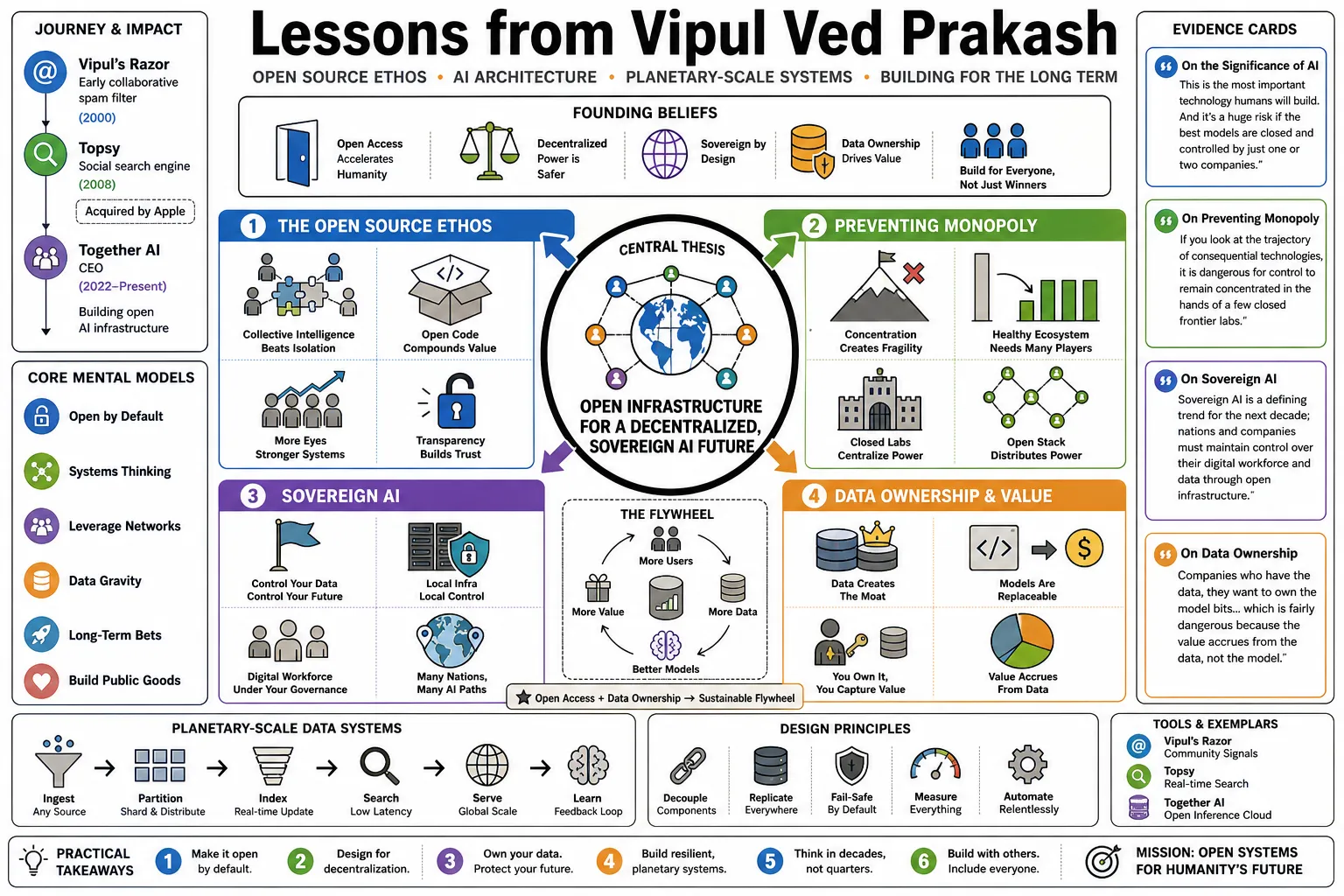
Lessons from Vipul Ved Prakash
Vipul Ved Prakash is a software engineer and entrepreneur known for his work in distributed systems, real-time search, and AI infrastructure. He created the early collaborative spam filter Vipul's Razor, co-founded the social search engine Topsy (acquired by Apple), and is currently the CEO of Together AI. This profile compiles his perspectives on open-source philosophy, the architecture of generative models, and the mechanics of planetary-scale data systems.
Part 1: The Open Source Ethos
- On the Significance of AI: "This is the most important technology humans will build. And it's a huge risk if the best models are closed and controlled by just one or two companies." — Source: [Forbes India]
- On Preventing Monopoly: If you look at the trajectory of consequential technologies, it is dangerous for control to remain concentrated in the hands of a few closed frontier labs. — Source: [Latent Space Podcast]
- On Sovereign AI: Sovereign AI is a defining trend for the next decade; nations and companies must maintain control over their digital workforce and data through open infrastructure. — Source: [RAISE Summit 2025]
- On Data Ownership: "Companies who have the data, they want to own the model bits... which is fairly difficult for closed companies to do because if they give away the model bits, they're kind of really giving away their entire IP." — Source: [Grit Podcast]
- On Open Source Independence: Fundamentally, Together is about open and independent AI systems. Our focus is to build a platform for open source, independent, user-owned AI systems. — Source: [Latent Space Podcast]
- On Global Accessibility: By making tier-one open-source models available, we ensure researchers and developers outside of massive tech monopolies can actually participate in building the future. — Source: [Forbes India]
- On Transparency in Enterprise: Enterprises want to control their own destiny with generative AI. This means higher accuracy and dependability, but also transparency and reproducibility. — Source: [SambaNova Systems]
- On the Limitations of Closed Models: While closed models will not disappear, the bulk of enterprise AI will inevitably trend toward open source because it permits superior fine-tuning over private datasets. — Source: [Grit Podcast]
- On the Core Mission: "We want to be the platform that provides access to tier-one, open-source models, so people can build with them, fine-tune them, and deploy them however they want." — Source: [Forbes India]
- On the Plurality of Models: The future will not be dominated by a single omnipotent model; it will be an ecosystem of specialized, open models tailored to specific domains. — Source: [Bloomberg Technology]
Part 2: The Future of AI Infrastructure
- On the Digital Mechanism of the World: "We really believe that generative AI will be the digital mechanism of the world... it requires incredible amount of horsepower, but it also requires optimization of these workloads." — Source: [RAISE Summit 2025]
- On the Shift to AI Factories: The fundamental unit of compute is shifting from CPU-based cloud environments to GPU-dense AI factories built specifically for the demands of generative models. — Source: [theCUBE]
- On Breakneck Infrastructure Growth: AI-native applications are scaling at breakneck growth, forcing a total architectural rethink of how data centers are constructed and provisioned. — Source: [theCUBE]
- On Providing the Plumbing: Together AI functions as the essential plumbing for the open-source movement, providing the GPU clusters and orchestration necessary to make models production-ready. — Source: [Bloomberg Technology]
- On Hardware-Software Co-optimization: Driving down the cost of inference requires extreme hardware-software co-optimization; you cannot simply throw more standard compute at the problem. — Source: [Latent Space Podcast]
- On Neo-Cloud Architectures: We are witnessing the emergence of neo-cloud architectures, specialized entirely for training and serving massive neural networks rather than general-purpose web hosting. — Source: [RAISE Summit 2025]
- On the Inference Bottleneck: "We are running into the limits of how fast you can make transformers. And we want inference at 5,000 tokens per second." — Source: [Latent Space Podcast]
- On Optimizing for Scale: True infrastructure scale in the AI era means treating the entire data center as a single optimized inference engine. — Source: [Grit Podcast]
- On Decentralized Compute: Building a decentralized cloud platform for large-scale generative models is the only way to meet the global demand for AI compute sustainably. — Source: [TechAviv]
- On Lowering Token Costs: By aggressively tuning our software stack, we have demonstrated the ability to cut model inference costs drastically, turning expensive queries into commodity computing. — Source: [RAISE Summit 2025]
Part 3: Together AI’s Mission and Architecture
- On the Full Stack Approach: Together is built as a platform for everything else outside the big closed labs, handling the full stack of research, fine-tuning, and inference for open models. — Source: [Latent Space Podcast]
- On the RedPajama Initiative: Our goal with RedPajama was to create a massive open dataset to help the broader community replicate and build upon the recipes used for leading foundation models. — Source: [Forbes India]
- On Expanding the Dataset: The release of the RedPajama-Data-v2 dataset, containing over 30 trillion tokens, fundamentally changed the baseline for what independent researchers could train. — Source: [Forbes India]
- On Sub-Quadratic Architectures: To overcome transformer limitations, we are heavily researching sub-quadratic architectures like Monarch Mixer (M2) that scale more efficiently as sequence lengths increase. — Source: [Newcomer]
- On Building a Research Lab: Nearly half of our team consists of researchers, because to provide the best AI cloud, you have to fundamentally understand and advance the underlying science. — Source: [Latent Space Podcast]
- On FlashAttention: Technologies like FlashAttention are cornerstones of our stack, significantly speeding up training and inference by optimizing GPU memory utilization. — Source: [Newcomer]
- On Hosting Open Models: There is immense power in hosting hundreds of open-source models in one place, allowing developers to seamlessly switch and integrate the best tool for their specific task. — Source: [RAISE Summit 2025]
- On Training the Incite Models: Training the RedPajama-INCITE family of models proved that high-quality, parameter-efficient open models could be created collaboratively by the community. — Source: [Forbes India]
- On Surpassing Proprietary Baselines: We operate on the belief that open-source models, when optimized correctly on a specialized stack, can outperform proprietary models for targeted enterprise tasks. — Source: [Bloomberg Technology]
- On the AI Acceleration Cloud: Together AI has evolved into an AI Acceleration Cloud, specifically designed to abstract away the deep complexities of scaling generative models for developers. — Source: [RAISE Summit 2025]
Part 4: Real-time Data and the Topsy Era
- On Ranking Massive Information: "How do you make sense of 400 billion pieces of content? By ranking it. We do that ranking by looking at how much a particular piece of content is being cited by other people." — Source: [Radarr]
- On the Shift in Public Data: "The amount of data being created on Twitter plus Facebook today is more than the data being created on the rest of the web… Social data has become the bigger public corpus." — Source: [The Guardian]
- On Historical Indexing: "By adding a full historical index, now we can look even further back to the very first tweets 7 years ago, meaning our users have access to the best, most accurate view of the world's social conversation." — Source: [PR Newswire]
- On Real-Time Monitoring: "Topsy Alerts bring the full power of the Topsy search engine to your inbox and allow you to monitor the real-time conversation on Twitter effortlessly." — Source: [PR Newswire]
- On Indexing the Firehose: Building a search engine capable of indexing the complete Twitter firehose required breakthroughs in distributed systems and real-time processing. — Source: [Wikipedia]
- On Social Signals as Search Relevance: Traditional web search relied on static links; Topsy proved that real-time social citations were a vastly superior signal for breaking information. — Source: [Clay]
- On the Value of Public Sentiment: The ability to instantly query the entire history of public social thought created entirely new categories of analytics for media and enterprise. — Source: [HighPerformr]
- On Designing Real-Time Architecture: Real-time search is not just fast batch processing; it requires an architecture that can instantly integrate and rank millions of discrete events per minute. — Source: [Wikipedia]
- On Apple's Acquisition of Topsy: The technology built at Topsy was robust enough to influence the core search capabilities of consumer products like Spotlight and Siri. — Source: [Wikipedia]
- On the Evolution of Search: Topsy represented the transition from searching static documents to searching human conversation as it happened. — Source: [Clay]
Part 5: Security and Collective Intelligence
- On the Nature of Spam: "Spam is a collective intelligence problem, and it requires a collective intelligence solution." — Source: [HackersMinds]
- On Building Vipul's Razor: "I ended up building an open-source collective intelligence system that allowed people who were receiving spam emails to report them." — Source: [Forbes India]
- On the Failure of Static Blacklists: Relying on technical algorithms or static blacklists to fight dynamic adversaries is fundamentally a losing battle; the network itself must respond. — Source: [Bitcoin Wiki]
- On Harnessing the Network: By calculating a unique signature for a reported message and sharing it across the network, we allowed the entire community to benefit from an individual's discovery instantly. — Source: [HackersMinds]
- On Founding Cloudmark: Cloudmark was born from the realization that the open-source collective intelligence model of Vipul's Razor could be scaled to protect enterprise infrastructure globally. — Source: [Milken Institute]
- On Cryptography as Activism: Writing a Perl implementation of the RSA algorithm to be printed on T-shirts was a direct protest to demonstrate the absurdity of classifying cryptography as a munition. — Source: [Wikipedia]
- On Adapting to Threat Vectors: Security systems must be designed as living, distributed networks that mutate and adapt faster than the threats targeting them. — Source: [Bitcoin Wiki]
- On the Power of Crowdsourcing: Long before Web 2.0 popularized the term, anti-spam efforts proved that harnessing the decentralized actions of millions of users was the ultimate defense mechanism. — Source: [HackersMinds]
- On Trust Architectures: Establishing trust on the internet requires distributed consensus mechanisms, where the collective experience outweighs individual anomalies. — Source: [Milken Institute]
Part 6: Systems Engineering and Optimization
- On the Math of Scaling: "If you look at the next 10 years or the next 20 years, we are doing maybe 0.1 percent of [the] AI that we'll be doing 10 years from now." — Source: [Kleiner Perkins Podcast]
- On Deep Stack Tuning: Cutting inference costs from $8 to $0.55 per million tokens requires relentless engineering at the compiler, memory management, and hardware routing layers. — Source: [RAISE Summit 2025]
- On Advancing the Science of Compute: We cannot just consume research; to build efficient systems, we have to invent new computational primitives like FlashAttention. — Source: [Latent Space Podcast]
- On the Limits of Current Models: We must acknowledge that the current transformer architecture will eventually hit physical and economic limits, necessitating new sequence models. — Source: [Newcomer]
- On Distributed Systems Experience: Building systems that index the entire Twitter firehose or coordinate global anti-spam networks teaches you the unforgiving realities of planetary-scale data routing. — Source: [HighPerformr]
- On the Value of Open Code: Open-source AI allows engineers to literally look inside the engine, removing bottlenecks that would be hidden behind a proprietary API wall. — Source: [Bloomberg Technology]
- On Managing GPU Memory: The primary constraint in serving modern foundation models is not compute cycles, but the physics of moving data in and out of GPU memory. — Source: [Latent Space Podcast]
- On Building for 5,000 Tokens/Sec: Achieving extreme inference speeds requires stripping away legacy virtualization and building bare-metal orchestration designed specifically for tensors. — Source: [Latent Space Podcast]
- On the Evolution of Engineering: The era of AI engineering demands a hybrid skill set: one part distributed systems engineer, one part deep learning researcher. — Source: [Grit Podcast]
Part 7: Enterprise Adaptation and "The Super Cycle"
- On the AI Super Cycle: We are at the very beginning of an infrastructure super cycle that will completely rewrite how enterprise software is built and deployed. — Source: [Grit Podcast]
- On True Enterprise Integration: Real enterprise adoption happens when AI stops being a novelty chat interface and becomes an invisible, high-volume routing engine within business logic. — Source: [theCUBE]
- On the IP Perimeter: Enterprises are realizing that sending their most valuable proprietary data to closed models fundamentally compromises their intellectual property perimeter. — Source: [SambaNova Systems]
- On Fine-Tuning Economics: The economic advantage of open-source is the ability to take a smaller, cheaper model and fine-tune it to outperform massive generic models on specific vertical tasks. — Source: [Bloomberg Technology]
- On Deterministic Reliability: To deploy generative AI in critical workflows, enterprises need transparency and reproducibility that only open architectures can provide. — Source: [SambaNova Systems]
- On Replacing Legacy Search: AI models will fundamentally cannibalize traditional enterprise search, moving from keyword retrieval to synthesized, contextual understanding. — Source: [HighPerformr]
- On Model Lock-in: CTOs are acutely aware of the dangers of vendor lock-in; adopting an open ecosystem ensures flexibility to swap models as the state of the art advances. — Source: [Grit Podcast]
- On Specialized Workforces: Companies will eventually orchestrate fleets of specialized open-source models, functioning as a highly trained, digital workforce. — Source: [RAISE Summit 2025]
- On the ROI of Generative AI: The return on investment for enterprise AI hinges entirely on reducing the cost of inference while maintaining strict control over the fine-tuning pipeline. — Source: [theCUBE]
Part 8: Philosophy on Enterprise and Societal Impact
- On the Scope of the Shift: The transition to generative AI is not a feature update; it is a fundamental re-platforming of human knowledge and digital interaction. — Source: [Forbes India]
- On the Danger of Consolidation: Allowing one or two corporations to dictate the boundaries of artificial intelligence is an unacceptable risk to global innovation. — Source: [Forbes India]
- On the Necessity of Openness: Transparency in how models are built and trained is the only mechanism society has to ensure AI aligns with diverse human values. — Source: [Latent Space Podcast]
- On Cypherpunk Roots: The cypherpunk ethos of decentralizing power through open code remains highly relevant; code is still speech, and AI weights are the new code. — Source: [Wikipedia]
- On the Democratization of Power: Providing open access to foundational models ensures that brilliant minds globally, regardless of their institutional affiliation, can shape the future. — Source: [Forbes India]
- On the 20-Year Horizon: The systems we are building today are rudimentary compared to the planetary-scale intelligence architectures we will deploy over the next two decades. — Source: [Kleiner Perkins Podcast]
- On Technological Determinism: We must actively choose to build open systems; an open future is not guaranteed unless developers demand and construct it. — Source: [Bloomberg Technology]
- On the Ultimate Goal: The end state of this work is a world where generative intelligence is as accessible, ubiquitous, and fundamental as electricity. — Source: [RAISE Summit 2025]