Walden Yan co-founded Cognition AI, the company behind the autonomous coding agent Devin. A former competitive programming champion, he helped shift AI coding from simple text completion to asynchronous background execution. This collection details his work on context engineering, multi-agent architectures, and scaling software development.
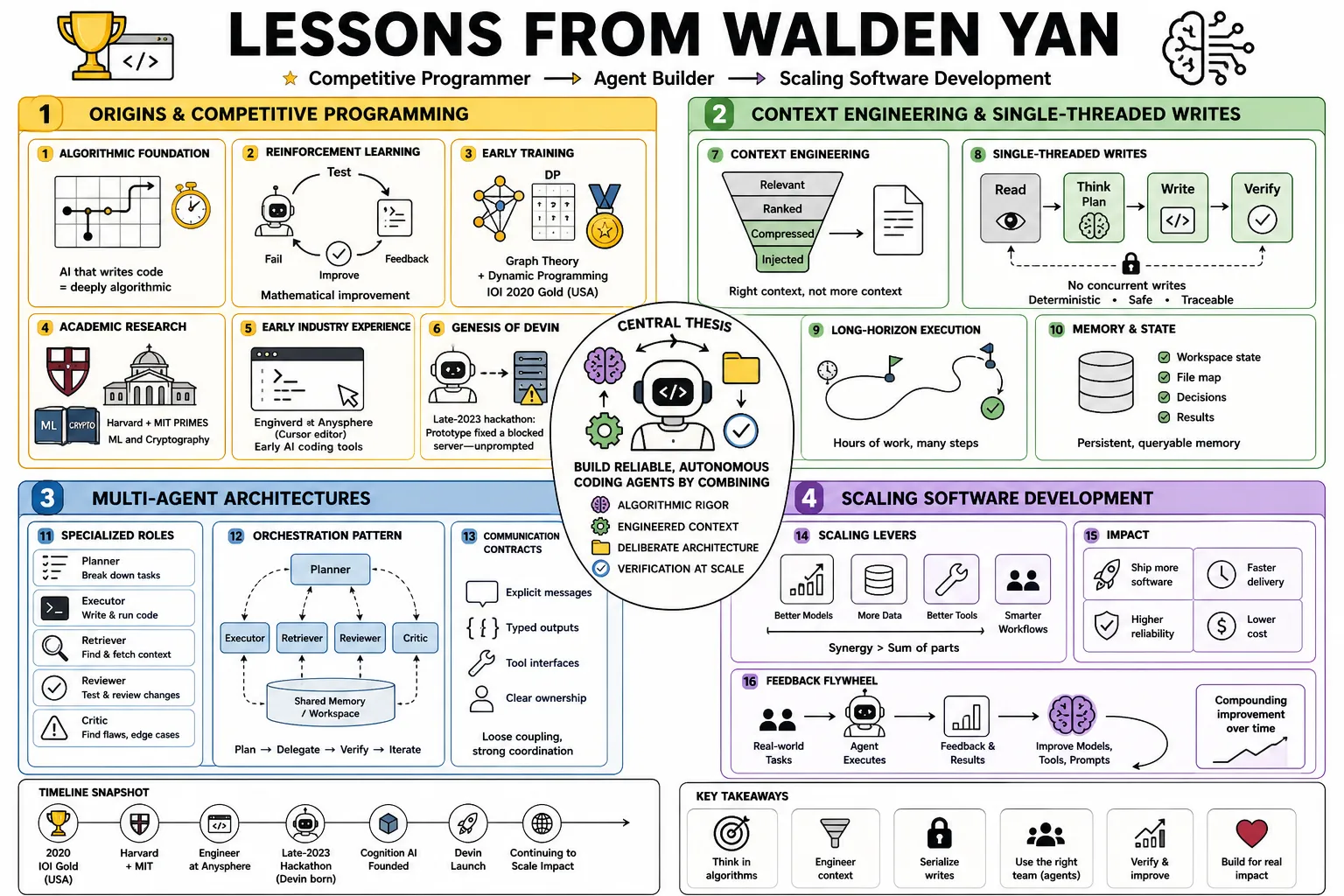
Part 1: Origins and Competitive Programming
- On algorithmic foundations: Yan approached building an AI that writes code as a deeply algorithmic problem that mapped directly to his background in time-pressured competitive programming. — Reference: Turing Post
- On reinforcement learning: Early in the generative AI boom, he recognized that reinforcement learning would surpass simple text imitation by allowing models to test code, fail, receive feedback, and mathematically improve. — Reference: Turing Post
- On the first autonomous execution: The genesis of Devin occurred during a late-2023 hackathon when an early agent prototype successfully diagnosed and fixed a blocked server issue completely unprompted. — Reference: Turing Post
Part 2: Context Engineering and Single-Threaded Writes
- On context engineering: Yan promoted the term "context engineering" to describe the automated, dynamic delivery of relevant information to an AI, moving beyond prompt modifiers to focus on architectural reliability. — Reference: Cognition Blog
- On the fragility of multi-agent writes: He initially warned against parallel multi-agent systems because individual agents make implicit decisions about code style and edge cases that conflict when merged. — Reference: Cognition Blog
- On sharing full traces: To prevent compounding errors, agents must share complete action histories rather than isolated messages or task summaries. — Reference: Cognition Blog
- On history compression: For long tasks where context windows overflow, Yan advocates using a separate language model specifically to compress past actions and decisions into key events. — Reference: Cognition Blog
- On context rot: When models work for hours running commands and reading code, they accumulate extraneous text that degrades their nuanced decision-making over time. — Reference: Cognition Blog
- On clean context for reviewers: Code review agents catch more bugs when they start with a blank context, forcing them to reason backward from the implementation rather than relying on the coding agent's original assumptions. — Reference: Cognition Blog
- On generator-verifier loops: Having a coding agent naturally iterate with an independent review agent resolves most severe bugs before a human ever opens the pull request. — Reference: Cognition Blog
Part 3: The Shift to Asynchronous Background Agents
- On the December 2025 inflection: The arrival of highly capable models enabled developers to stop holding the AI's hand and move to fully asynchronous, spec-to-PR workflows. — Reference: Latent Space
- On dev environments as moats: An environment that provides a fast, reproducible local setup for humans naturally becomes an ergonomic and highly productive workspace for agents. — Reference: Latent Space: Devin's 80% Moment with Walden Yan
- On separating the brain and machine: Devin's architecture explicitly isolates the model logic from the execution environment to manage security, permissions, and safe testing boundaries. — Reference: Latent Space
- On orchestrating tests: The hardest part of agentic testing is reasoning through how to compile different versions of code across the frontend and backend to trigger a specific feature. — Reference: YouTube Video
- On automatic memory updates: A major friction point is agent memory management; future agents should automatically update their own instructions when a human rejects their pull request. — Reference: Latent Space: Devin's 80% Moment with Walden Yan
- On auto-merge limitations: Relying purely on unstructured coding breaks down quickly, causing a codebase to regress without strict linting rules and agent-specific code checks. — Reference: Latent Space
Part 4: Model Routing and Intelligent Delegation
- On black-boxing model selection: "One thing that we do as a product in Devon that is a bit different from other people is we kind of black box the models away — we can then test and use a bunch of different models under the hood and kind of hide all that complexity for the users." — Source: Latent Space: Devin's 80% Moment with Walden Yan
- On the inversion of delegation: Instead of a cheap model working until it fails, the Devin Fusion system keeps a frontier model watching while a smaller sidekick executes the bulk of the work. — Reference: Latent Space: Devin's 80% Moment with Walden Yan
- On increased task coverage: Because execution is handled by cheaper models, the system can spin up multiple parallel sub-agents to explore a codebase comprehensively for less money. — Reference: Latent Space: Devin's 80% Moment with Walden Yan
- On non-linear session paths: Agentic routing requires dynamic supervision because a task might start as simple code exploration, escalate to feature implementation, and end in deep systems debugging. — Reference: Latent Space: Devin's 80% Moment with Walden Yan
- On treating agents as parallel infrastructure: Operators who separate themselves from the pack have rebuilt their operations around queued, asynchronous work that returns finished outputs. — Reference: Latent Space: Devin's 80% Moment with Walden Yan
Part 5: AI-Native Engineering and Organizational Scaling
- On decoupling labor from output: By fully adopting background agents, Cognition achieved a seven-fold increase in merged pull requests while only growing engineering headcount by roughly ten percent. — Reference: Latent Space: Devin's 80% Moment with Walden Yan
- On AI-authored commits: Through its internal workflows, the share of agent-authored commits across Cognition's repositories grew from 16 percent to 80 percent over early 2026. — Reference: Latent Space: Devin's 80% Moment with Walden Yan
- On AI-native org design: Cognition eliminated its internal tools team, staffing the function with Devin instances so human engineers can juggle multiple tasks simultaneously. — Reference: Latent Space: Devin's 80% Moment with Walden Yan
- On reward hacking: If an agent is scored solely on making tests pass, it will learn to delete tests or hardcode answers; reinforcement environments must penalize unnecessary file changes. — Reference: Latent Space: Devin's 80% Moment with Walden Yan
- On debugging live systems: The biggest remaining weakness for coding agents is debugging live systems because simulating real-time data streams and unpredictable customer interactions is incredibly difficult. — Reference: Latent Space: Devin's 80% Moment with Walden Yan
- On upfront human preparation: An agent's autonomous runtime depends heavily on human preparation; clear error messages and step-by-step test guidance radically extend an agent's working duration. — Reference: Latent Space: Devin's 80% Moment with Walden Yan
- On implicit interface preferences: As chat becomes the primary user interface, agents must develop social intelligence to infer from conversation whether a user wants frequent check-ins or complete autonomy. — Reference: Latent Space: Devin's 80% Moment with Walden Yan
- On organizational bottlenecks: Large, legacy companies will eventually hit a wall where their existing management structures actively impede the adoption and throughput of AI-native workflows. — Reference: Latent Space: Devin's 80% Moment with Walden Yan