Warren Hellman was a titan of private equity, a dedicated philanthropist, and a world-class endurance athlete who famously viewed his billionaire status with characteristic humility and a banjo in hand. As the co-founder of Hellman & Friedman, he pioneered a collaborative, fiduciary-first approach to investing while simultaneously reshaping the cultural and civic landscape of San Francisco through his "rugged iconoclasm."
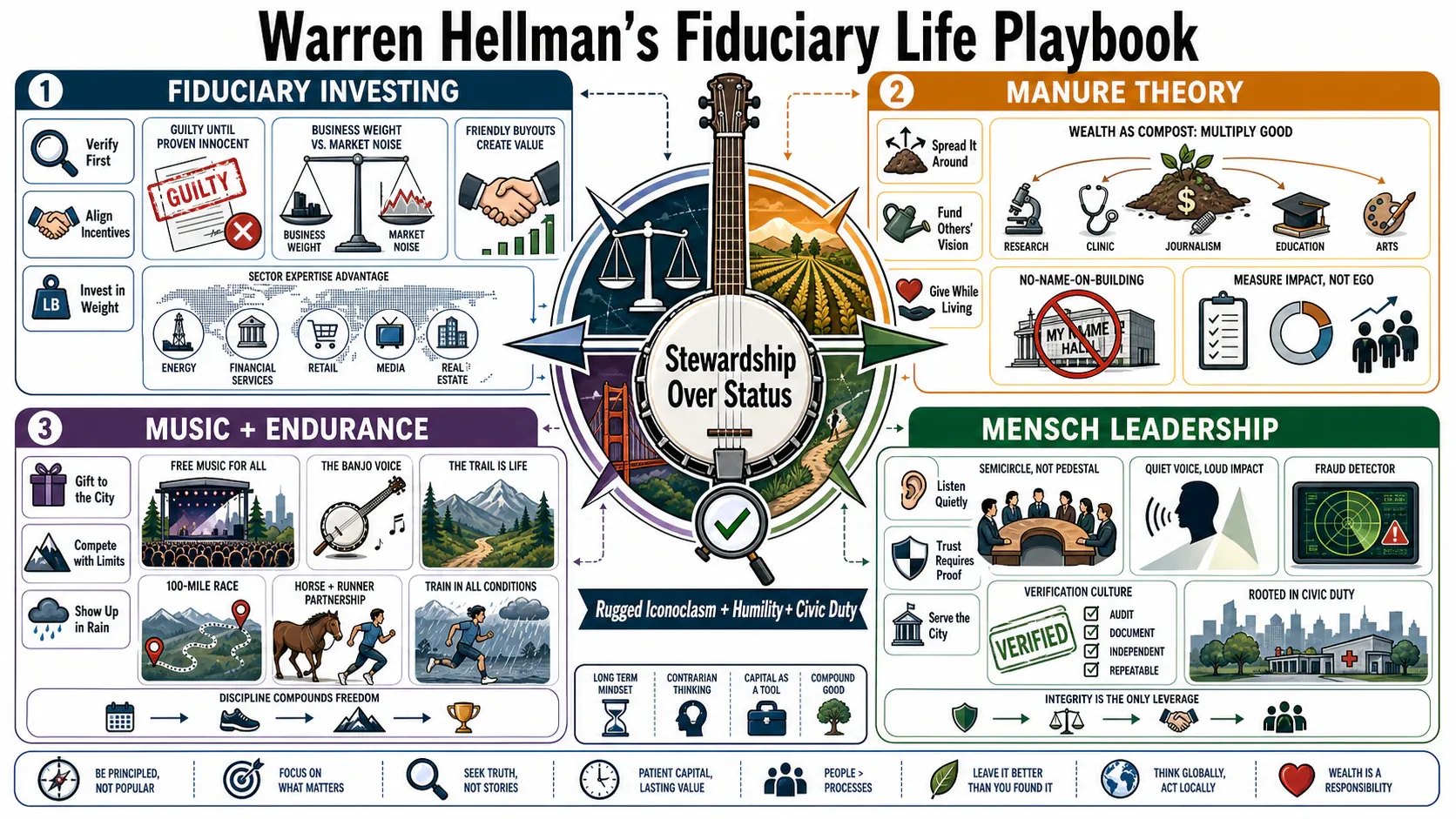
Part 1: The Architect of Private Equity
- On Investment Skepticism: "Every potential investment should be considered guilty until proven innocent." — Source: Hellman & Friedman
- On Strategic Long-Termism: "If you spread capital too thin, you lose the ability to nurture the soil; deep focus is what yields the harvest." — Source: Forbes
- On Friendly Buyouts: "Taking a company private, like our work with Levi Strauss, should feel like a homecoming for the founders' values, not an occupation." — Source: SFGate
- On Transaction Fees: "We don't charge transaction or monitoring fees because we believe our interests should be perfectly aligned with our partners, not our own balance sheet." — Source: Private Equity International
- On Global Ambition: "The best way to expand a firm is to hire people smarter than yourself and then have the courage to get out of their way." — Source: UC Berkeley
- On Sector Expertise: "Don't try to be everything to everyone; find the high-quality niches where you can become the world's leading expert." — Source: Harvard Business School
- On Fiduciary Duty: "Your reputation is the only currency that never devalues in a crisis." — Source: Hellman & Friedman
- On Economic Cycles: "The time to buy is when everyone else is running for the exits, provided you've done the math to know the building isn't actually on fire." — Source: Forbes
- On Professional Maturity: "I spent my youth trying to be the smartest guy in the room at Lehman; I spent my adulthood trying to find the smartest room to sit in." — Source: SF Chronicle
Part 2: The "Manure" Theory: A Masterclass in Philanthropy
- On the Nature of Wealth: "Money is like manure; if you spread it around, good things will grow—and if you pile it up, it just smells bad." — Source: Hellman Foundation
- On Giving Without Strings: "True philanthropy isn't about control; it's about providing the resources for someone else’s vision to take flight." — Source: The Bay Citizen
- On Local Impact: "Focus your giving where you live; you can’t solve the world’s problems if you ignore the neighbor who can't afford a doctor." — Source: SF Free Clinic
- On Avoiding Ego: "I don't want my name on buildings; I want the people inside them to be doing something that matters." — Source: UC Berkeley News
- On Risk-Taking in Charity: "Philanthropy should be the venture capital of the social sector, willing to take the risks that governments and corporations won't." — Source: Hellman Foundation
- On Journalistic Integrity: "A city without independent local news is like a man without a conscience; I fund journalism because I want San Francisco to have a conscience." — Source: The New York Times
- On the Responsibility of Success: "Billionaires should be measured not by what they've kept, but by what they've managed to give away while they were still alive to see the result." — Source: Forbes
- On Sustaining Arts: "The arts are not a luxury; they are the connective tissue of a civilized society." — Source: Hardly Strictly Bluegrass
- On Educational Access: "Talent is evenly distributed across zip codes, but opportunity is not; philanthropy’s job is to bridge that gap." — Source: Hellman Fellows Program
Part 3: Hardly Strictly Bluegrass: The Anti-Corporate Festival
- On the Gift to San Francisco: "Hardly Strictly is my present to the city that has given me everything." — Source: Hardly Strictly Bluegrass
- On Rejecting Sponsorship: "I don't want the audience to be bombarded with signage; I want them to be bombarded with music." — Source: SFGate
- On the Evolution of Sound: "We called it 'Strictly Bluegrass' until I realized that bluegrass is a big tent that welcomes anyone with a heart for the song." — Source: Rolling Stone
- On Financial Sustainability: "I’ve endowed the festival so it can keep playing long after the banjo falls from my hands." — Source: SF Chronicle
- On Community Atmosphere: "There is a special kind of magic in Golden Gate Park when 700,000 people gather and the only price of admission is a respect for the music." — Source: Hardly Strictly Bluegrass
- On Personal Performance: "I know I’m not the best banjo player on the stage, but I might be the one having the most fun." — Source: The Wronglers
- On the Festival’s Soul: "The festival isn't about me; it's about the artists who play and the people who listen." — Source: San Francisco Magazine
- On Commercial Pressure: "The moment you start charging for a beer or a ticket, the soul of the event changes from a gift to a transaction." — Source: SFGate
- On Curating Talent: "We hire the best musicians in the world and pay them well because their work is what makes the city beautiful." — Source: Hardly Strictly Bluegrass
- On the Persistence of Tradition: "Bluegrass is the music of the people; it doesn't need a fancy stage, just a story worth telling." — Source: Bluegrass Today
Part 4: The Athlete's Soul: Endurance, Risk, and the Mountains
- On the U.S. Ski Team: "Elite sport requires the same discipline as elite finance—the difference is in the snow." — Source: US Ski and Snowboard
- On Mental Toughness: "Your body will tell you to quit long before your mind should agree to it." — Source: SF Chronicle
- On Risk Management: "In skiing, as in investing, you have to lean forward; if you sit back, you've already lost control." — Source: Ski Racing Media
- On Physical Resilience: "I've broken more bones than I have bank accounts, and I've learned more from the breaks than the balances." — Source: Forbes
- On the Nature of Competition: "Compete against your own limits, not your neighbor’s trophies." — Source: Harvard Business School
- On Mountain Culture: "There is an honesty in the mountains that you can't find in a boardroom; the mountain doesn't care how much money you have." — Source: Stratton Mountain School
- On Endurance Training: "Success is the byproduct of showing up for the training on the days when it’s raining." — Source: Western States 100
Part 5: Leadership and the "Mensch" Mentality
- On Open Communication: "I replaced the hierarchy with a semi-circle of desks because good ideas don't care about titles." — Source: Hellman & Friedman
- On Professional Humility: "I've spent my career trying to avoid the 'Masters of the Universe' trap; we are stewards, not kings." — Source: SF Chronicle
- On Rewarding Talent: "If you want the best people to stay, give them a piece of the outcome and a voice in the process." — Source: Hellman & Friedman
- On Mentorship: "A leader's legacy isn't measured by their deals, but by the leaders they leave behind." — Source: UC Berkeley
- On Being a 'Mensch': "In business, it is better to be respected for your integrity than feared for your power." — Source: Jewish News of Northern California
- On Decision Making: "Listen to the quietest person in the room; they usually have the most interesting thing to say." — Source: HMI Capital
- On Organizational Culture: "A firm should be a place where people actually like coming to work; if they don't, you've failed as a partner." — Source: Hellman & Friedman
- On Facing Failure: "Admit your mistakes quickly and loudly; hiding them only makes the hole deeper." — Source: Forbes
Part 6: Skepticism, Con Men, and Intellectual Integrity
- On the Purity of Frauds: "I have a soft spot for con men because they are master students of human psychology—and if you don't understand how they work, you'll eventually work for them." — Source: YouTube / Warren Hellman Interview
- On Sam Antar: "I wanted to bring Sam Antar to our partners meeting because we need to know what a sociopath looks like before he's sitting across from us in a deal." — Source: Forbes
- On Bernie Madoff: "The only reason some people avoided Madoff was because they asked for the one thing he couldn't provide: a verifiable audit." — Source: The Bay Citizen
- On Due Diligence: "Due diligence isn't a checklist; it's an investigation into the soul of a company." — Source: Hellman & Friedman
- On Groupthink: "The most dangerous words in finance are 'Everyone else is doing it.'" — Source: Harvard Business School
- On Trust: "Trust is a wonderful thing, but in finance, trust is a byproduct of verification." — Source: Hellman & Friedman
- On Asking Hard Questions: "If you don't understand the business model in five minutes, it's either a bad business or a brilliant fraud." — Source: SFGate
- On Intellectual Honesty: "Don't fall in love with your own spreadsheets; they only tell you what you've programmed them to say." — Source: Hellman & Friedman
- On Fraud Prevention: "Complexity is the playground of the con artist; transparency is the only defense." — Source: UC Berkeley
Part 7: Civic Duty and San Francisco’s Social Fabric
- On Pension Reform: "I spent my money on Proposition C because I didn't want my city to go bankrupt while we were arguing about who should pay." — Source: SF Chronicle
- On Public Service: "Being a billionaire doesn't exempt you from your civic duty; it actually increases your bill." — Source: San Francisco Magazine
- On the Golden Gate Park Garage: "I wanted a parking garage underground so we could have more park above ground; sometimes you have to dig deep to go high." — Source: SFGate
- On Political Neutrality: "I don't care about parties; I care about what works for the people who live here." — Source: The Bay Citizen
- On Healthcare: "In a city as wealthy as San Francisco, nobody should be without a doctor; that’s why we started the clinic." — Source: SF Free Clinic
- On Urban Planning: "A city is a living thing; if you don't tend to its roots, its branches will wither." — Source: Hellman Foundation
- On Civil Discourse: "We can disagree on the details, but we must agree on the destination of a healthy, thriving city." — Source: SF Chronicle
- On Philanthropic Accountability: "If a project fails, let it fail; don't throw good money after bad just to save face." — Source: Hellman Foundation
- On Civic Pride: "San Francisco is a place for the rugged and the dreamers; my job is to make sure there is room for both." — Source: Hardly Strictly Bluegrass
Part 8: Life, Music, and the Pursuit of Meaning
- On the 5-String Banjo: "The banjo is the most honest instrument; you can't play it without showing your heart." — Source: The Wronglers
- On Aging: "Getting older just means your endurance shifts from your legs to your patience." — Source: SF Chronicle
- On Family Legacy: "My children are my greatest investment, and the returns there are measured in character, not cash." — Source: UC Berkeley
- On Materialism: "I have no interest in collecting stuff; you can only drive one car at a time, but you can fund a hundred dreams at once." — Source: Forbes
- On Music as Therapy: "Playing music with The Wronglers is the only time my brain stops calculating the internal rate of return." — Source: Rolling Stone
- On Living Well: "Live your life so that the people who know you best are the ones who respect you most." — Source: Jewish News of Northern California
- On Success: "Success is having the freedom to do what you love with the people you respect." — Source: Hellman & Friedman
- On the Future: "Don't worry about your legacy; if you do good work today, the legacy will take care of itself." — Source: UC Berkeley News
- On Finality: "I want to be remembered as a guy who tried to spread the manure around while the sun was still shining." — Source: SF Chronicle