Lessons from Wes Hall
Wes Hall is a Canadian businessman who grew up in a tin shack in Jamaica before moving to Toronto and founding Kingsdale Advisors, a prominent shareholder advisory firm. He is widely known for his role as an investor on CBC's Dragons' Den and for launching the BlackNorth Initiative to combat systemic racism in corporate Canada. This piece distills his core beliefs on proxy battles, executive leadership, and building opportunities when starting with nothing.
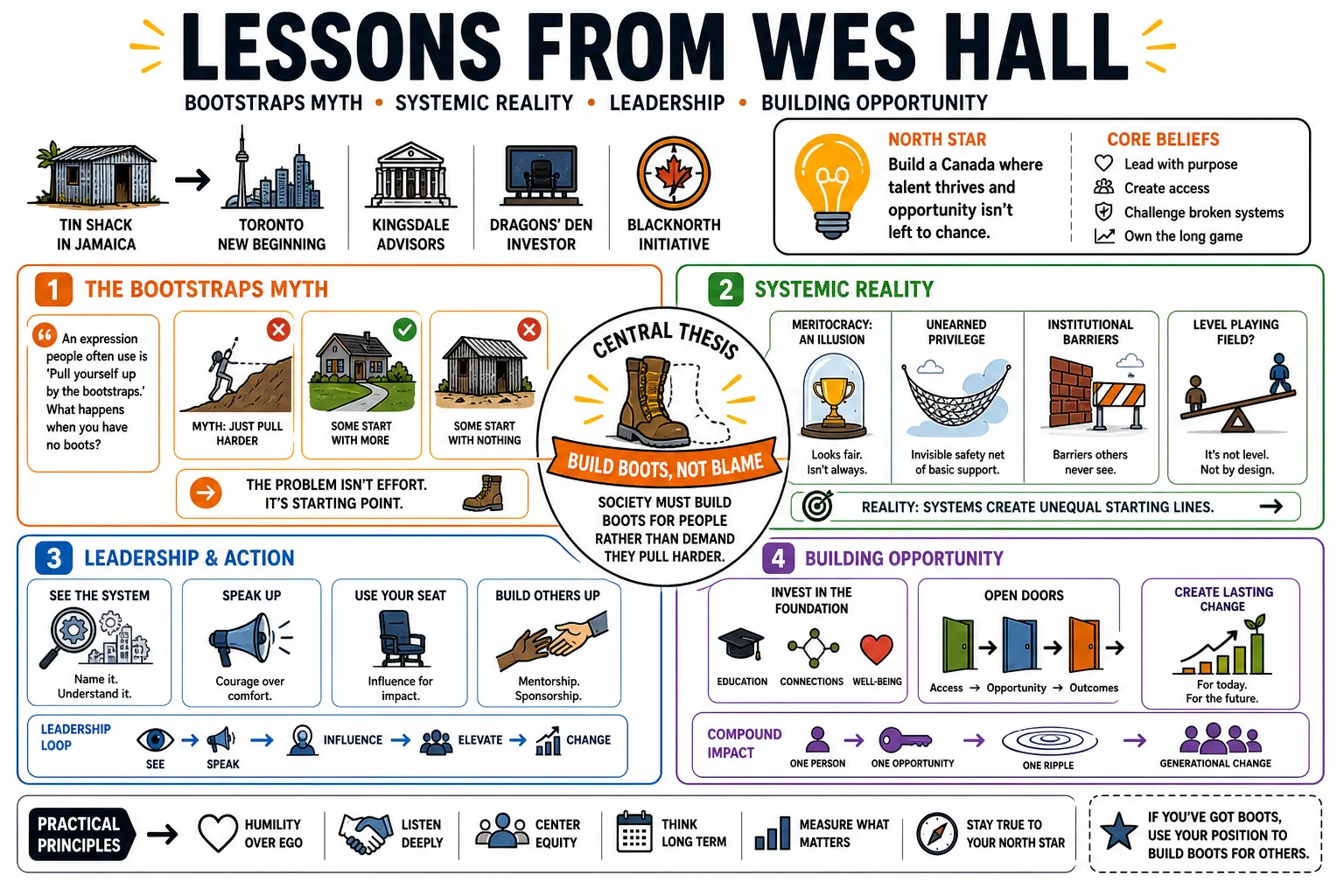
Part 1: The Bootstraps Myth and Systemic Reality
- On the Bootstrap Myth: "An expression people often use is 'Pull yourself up by the bootstraps.' What happens when you have no boots?" — Source: [University of Toronto]
- On the Starting Line: Success is evaluated differently when you start life in a tin shack rather than the suburbs. — Source: [Maclean's]
- On Meritocracy: It is an illusion for those who face institutional barriers others never have to see or think about. — Source: [CBC]
- On Unearned Privilege: Privilege is rarely just financial wealth; it is often the invisible safety net of basic support. — Source: [Maclean's]
- On the "Level Playing Field": Society must focus on building boots for people rather than simply demanding they pull harder. — Source: [University of Toronto]
- On Poverty: A childhood defined by scarcity fuels your drive, but it does not have to dictate your final destination. — Source: [Tangerine]
- On Hard Work vs. Access: Hard work is insufficient if you cannot get through the door to apply it. — Source: [CBC]
- On Being the First: Navigating corporate spaces is significantly harder when no one in your family has walked that path before you. — Source: [Maclean's]
- On Systemic Roadblocks: Structural inequalities are baked into the architecture of business, requiring active dismantling. — Source: [University of Toronto]
- On Dismantling Barriers: True achievement means fixing the broken system for the next generation. — Source: [CBC]
Part 2: Boardroom Battles and Kingsdale Advisors
- On the "Leadership Discount": "When you have great leaders, you accomplish great things. In the corporate world, poor leadership weighs on the value of the company." — Source: [The Gill Group]
- On Activist Targets: "Activists don’t go after poor companies, they go after poor leaders running great businesses." — Source: [Scotiabank]
- On Proxy Fights: Shareholder disputes are rarely just about the business model; they are fundamental crises of trust. — Source: [Wealth Professional]
- On Shareholder Activism: It serves as a necessary mechanism for accountability in public markets. — Source: [The Gill Group]
- On Board Complacency: A boardroom where everyone agrees quickly is a dangerous environment for shareholders. — Source: [Scotiabank]
- On the Value of a Company: The financial market ultimately ties a firm's value to the perceived integrity of its management team. — Source: [The Gill Group]
- On Preparation: In a proxy battle, the side that has anticipated every counter-argument usually wins. — Source: [Wealth Professional]
- On Defending a Company: Good public relations cannot permanently hide bad management decisions. — Source: [Scotiabank]
- On Executive Ego: Unchecked ego frequently blinds leaders to the reality their shareholders see clearly. — Source: [The Gill Group]
- On Corporate Governance: Strong governance is the non-negotiable bedrock of sustainable financial growth. — Source: [Wealth Professional]
Part 3: Empathy and Modern Leadership
- On Empathy: "Empathy and emotional intelligence—those are really what sets you apart. Your ability to understand your employee or your team and their needs." — Source: [Scotiabank]
- On Listening: Effective managers must learn to hear the concerns their employees are afraid to speak aloud. — Source: [The Gill Group]
- On Vulnerability: Sharing the difficult parts of your past builds deeper trust with your team than projecting a flawless image. — Source: [Tangerine]
- On the Cost of Callousness: A lack of basic empathy inevitably drives top talent to your competitors. — Source: [Scotiabank]
- On Inclusion vs. Diversity: "Diversity is getting people in the room. Inclusion means ensuring people are heard and valued by empathetic leaders." — Source: [The Gill Group]
- On Sympathy vs. Accountability: Expressing sympathy is an empty gesture if it does not lead to measurable corporate action. — Source: [Apple Podcasts: Wes Hall]
- On Emotional Intelligence: EQ separates competent day-to-day managers from leaders who can transform a company's culture. — Source: [Scotiabank]
- On Understanding Employees: A true leader views their job as fulfilling the underlying needs of their workforce. — Source: [The Gill Group]
- On Command and Control: Leading through fear is a fragile methodology that fails under pressure. — Source: [Wealth Professional]
- On Building Trust: Trust is earned in difficult moments, not dictated from a corner office. — Source: [Tangerine]
Part 4: The BlackNorth Initiative and DEI
- On Real DEI: "Diversity, equity, and inclusion are not buzzwords; they are the foundation of a just society." — Source: [University of Toronto]
- On Corporate Pledges: Moving past PR requires executives to sign binding agreements that affect their operations. — Source: [Apple Podcasts: Wes Hall]
- On Systemic Racism: Racism in business is a severe economic inefficiency that wastes human capital. — Source: [Maclean's]
- On the "Black Tax": Black professionals frequently carry an invisible burden of having to over-prove their basic competence. — Source: [CBC]
- On Being the "Only" in the Room: You can reframe professional isolation as a distinct opportunity to alter prejudices. — Source: [Tangerine]
- On Performative Allyship: After George Floyd's murder, the true test for CEOs was whether they would alter their hiring practices, not just issue statements. — Source: [Apple Podcasts: Wes Hall]
- On Generational Wealth: Closing the racial economic gap requires creating pathways to ownership and equity. — Source: [Maclean's]
- On Board Representation: A company with zero diversity at the board level is signaling an outdated worldview to the market. — Source: [University of Toronto]
- On Mentorship vs. Sponsorship: Minority professionals are often over-mentored but severely lack sponsors willing to spend political capital on them. — Source: [CBC]
- On the Duty of the Successful: Achieving power comes with the absolute obligation to send the elevator back down. — Source: [University of Toronto]
Part 5: The "Running Back" Mentality and Resilience
- On the "Running Back" Mindset: "If you get hit, you have to get up and you say, 'Good job, but that’s not going to stop me.' That’s the attitude you need to have. That’s being built like a running back." — Source: [MoneySense]
- On Rejection: Professional rejection is frequently just aggressive redirection toward a better outcome. — Source: [Tangerine]
- On "Strategic Naiveté": Sometimes not knowing how severely the odds are stacked against you is your greatest advantage. — Source: [Apple Podcasts: Wes Hall]
- On Overcoming Adversity: Every roadblock is a test of how badly you want the end goal. — Source: [MoneySense]
- On Pushing Boundaries: "You don’t know what your limitations are unless you push yourself." — Source: [Tangerine]
- On Embracing the Grind: Taking menial jobs early in life teaches the fundamental mechanics of discipline and work ethic. — Source: [Apple Podcasts: Wes Hall]
- On Fear of Failure: Being afraid to fail is a luxury those starting with absolutely nothing cannot afford. — Source: [MoneySense]
- On Endurance: Corporate success is frequently a game of attrition where the most resilient players inherit the board. — Source: [Tangerine]
- On Using Underestimation: When competitors underestimate you due to prejudice, they relax their standards. Use that gap to outwork them. — Source: [Maclean's]
Part 6: Identity and Authenticity
- On Superpowers: "To me, being Black is my superpower." — Source: [University of Toronto]
- On Authenticity on Bay Street: Professional excellence does not demand conformity to a rigid, Eurocentric standard of behavior. — Source: [CBC]
- On the Jamaican Accent: Choosing to keep his accent was a deliberate act of refusing to hide his origins. — Source: [Maclean's]
- On Fitting In: Trying too hard to blend into the corporate background guarantees you will be easily replaced. — Source: [Tangerine]
- On Standing Out: Being visibly different makes you highly memorable; the key is backing up that visibility with execution. — Source: [CBC]
- On Personal Brand: Your reputation is built entirely on what people say about your character when you leave the room. — Source: [Wealth Professional]
- On Roots: Remembering the conditions of the tin shack keeps an executive grounded when they reach the corner office. — Source: [Maclean's]
- On Colorful Clothing: Using personal style to disrupt sterile corporate environments is a quiet assertion of power. — Source: [CBC]
- On Code-Switching: Constantly altering your personality to suit others is exhausting; true freedom is bringing your whole self to work. — Source: [University of Toronto]
Part 7: Entrepreneurship and Dragons' Den
- On Perfection: "Never wait for the 'perfect' to do what you want to do, or what you're passionate about." — Source: [Wealth Professional]
- On Seizing Opportunity: "If someone gives you an amazing opportunity and you’re not sure you can do it, say yes, and figure out how to do it later." — Source: [Wealth Professional]
- On Value vs. Price: "Nowadays people know the price of everything, and the value of nothing." — Source: [CREA]
- On Quality: When you deliver undeniable quality, you earn the right to command the price you deserve. — Source: [Apple Podcasts: Wes Hall]
- On Long-Term Relationships: Smart negotiators will ignore short-term price concessions to secure a client for their entire career cycle. — Source: [CREA]
- On Pitching: Investors on a panel like Dragons' Den are evaluating the founder's personal grit before they evaluate the spreadsheet. — Source: [Wealth Professional]
- On Scale: Expanding a business too quickly before mastering the core product is a reliable path to bankruptcy. — Source: [CREA]
- On Valuation: Founders must pitch based on what their company is actually worth today, rather than their dreams for tomorrow. — Source: [Apple Podcasts: Wes Hall]
- On Early Mistakes: The early failures in a startup are simply the tuition required to learn how to run a business. — Source: [Wealth Professional]
Part 8: Legacy and Life Philosophy
- On Legacy: "It’s not the business achievements that I’m most proud of. I’m proud of the person that I became." — Source: [Tangerine]
- On "Dying Empty": Your goal should be to exhaust all your potential and talent while you are alive, rather than taking it to the grave. — Source: [Tangerine]
- On Wealth: Money is not a scoreboard to judge your peers; it is simply a tool required to execute good ideas. — Source: [Maclean's]
- On Integrity: "We have to have our principles and we have to live by them... because as soon as you start to compromise, the compromises get bigger and bigger." — Source: [University of Toronto]
- On Character: A person's true nature is forged and revealed in moments of high stress, never in times of comfort. — Source: [CREA]
- On Giving Back: The ultimate metric of a successful career is how many capable people you dragged up the ladder with you. — Source: [Apple Podcasts: Wes Hall]
- On Gratitude: Deep appreciation for those who instilled basic values, like a grandmother's insistence on faith and labor, is essential. — Source: [Maclean's]
- On the Ultimate Goal: Financial success is completely hollow if you cannot walk through your community in peace and with a clear conscience. — Source: [CBC]