Will Bryk is the co-founder and CEO of Exa, a company building search infrastructure for AI agents. He argues that traditional keyword search is broken for large language models because it misses semantic meaning. This piece covers his case for neural search, the difference between intelligence and knowledge, and why fixing retrieval matters.
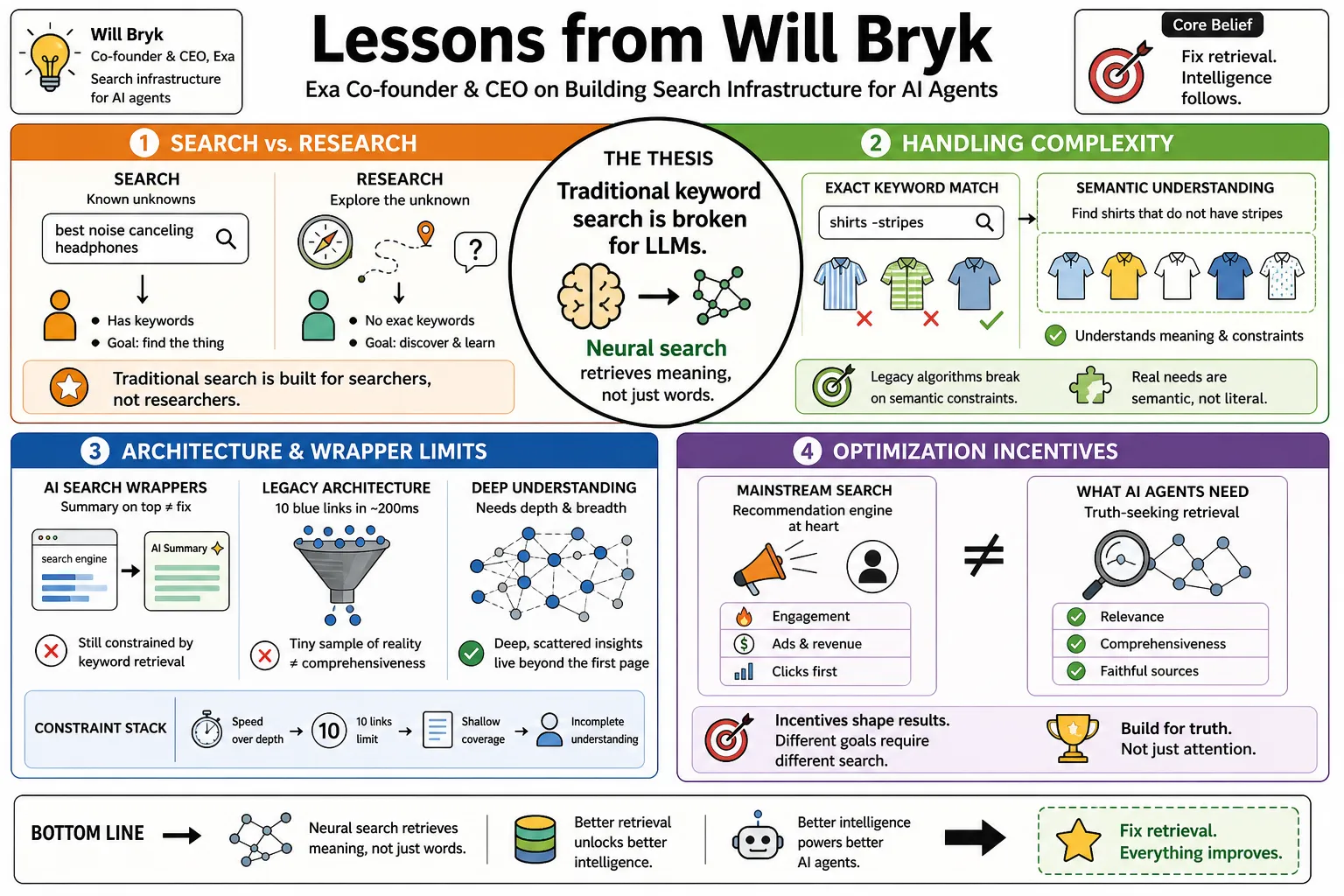
Part 1: The Limitations of Traditional Search
- On Search vs. Research: Traditional search engines are optimized for users who already know exactly what they are looking for, whereas research requires exploring the unknown and retrieving information without explicit keywords. — Reference: The Example Engine
- On Handling Complexity: Legacy search algorithms excel at simple keyword lookups, but they break down when faced with semantic constraints such as finding shirts that do not have stripes. — Reference: Perfect Web Search for AI Agents
- On AI Search Wrappers: Adding an AI-generated summary on top of a traditional search engine does not fix the underlying retrieval problem, because the language model remains constrained by the keyword-based engine feeding it data. — Reference: Perfect Web Search for AI Agents
- On Deep Understanding: When trying to build a comprehensive historical understanding of a topic, traditional search falls short because its architecture is designed to surface shallow, popular information rather than deep, scattered insights. — Reference: Building Search for AI Agents
- On Legacy Search Architecture: A search engine built around retrieving ten blue links within a few hundred milliseconds creates fundamental constraints on comprehensiveness, leaving users with an incomplete sample of reality. — Reference: Latent Space
- On Optimization Incentives: Mainstream search providers function more like recommendation engines optimized to generate ad revenue through clicks than objective databases designed to return exactly what a user requested. — Reference: RAISE Summit
Part 2: Building Search for AI Agents
- On a Different Kind of Reader: The web search ecosystem was constructed for human consumption, but AI agents are a different kind of user with different information-processing capabilities and needs. — Reference: Bloomberg Technology
- On Comprehensive Needs: While a human might settle for ten quick results, an autonomous agent often requires the entirety of available information on a topic to complete its task. — Reference: Building Search for AI Agents
- On Shifting Search Volume: The volume of web searches executed by AI agents is growing rapidly and could eventually eclipse the volume generated by human users. — Reference: RAISE Summit
- On Agent Workflows: Coding, financial-analysis, and sales agents all depend on reliable web search to gather context before executing their core work. — Reference: Bloomberg Technology
- On the Era of Answers: Search is shifting from showing users a list of hyperlinks to supplying highly relevant contextual data directly to a language model. — Reference: Latent Space
- On Scale and Depth: Because agents can process hundreds or thousands of documents, their infrastructure must reliably serve far larger result sets than human-oriented search. — Reference: Bloomberg Technology
- On Agentic Grounding: Traditional keyword search underperforms in multi-step agent workflows where semantic grounding and deeper context are required. — Reference: AI Engineer
Part 3: Building the Search Stack
- On the Neural Database: The goal of modern search is to turn the world's knowledge into a neural database that can be filtered dynamically to return the precise information requested. — Reference: The Example Engine
- On Variable Compute: "From the product perspective, like, not every query should require the same amount of compute. Like, Google has kind of made this assumption that, like, no matter what query you type in, it takes a few hundred milliseconds." — Source: The Example Engine
- On Flexible Retrieval Times: Instead of forcing every query to finish in under a second, advanced search engines can let difficult research tasks run longer to compile a much better result set. — Reference: Latent Space
- On Neural PageRank: Using link prediction as a training objective creates a neural version of PageRank that can map the many ways people refer to the same concept. — Reference: Latent Space
- On Precise Semantic Matching: Building a search engine that understands concepts requires custom embedding models rather than simple keyword matching. — Reference: Perfect Web Search for AI Agents
- On Granular Control: A strong search system behaves like a highly specific database, allowing users to apply complex filters, conjunctions, and negative constraints across the web. — Reference: Perfect Web Search for AI Agents
- On Multimodal Search: Because much of the web's value exists in images, video, and audio, comprehensive search must eventually query non-text media with semantic precision. — Reference: Perfect Web Search for AI Agents
- On Index Freshness: A search system for agents cannot treat the web as a periodic snapshot; Exa built its larger index to crawl and parse tens of billions of pages and refresh them every minute. — Reference: Exa 2.0
- On Training Retrieval Models: Better semantic search came from pretraining and fine-tuning an embedding model over the expanded index, including a month-long run on a 144-H200 cluster. — Reference: Exa 2.0
- On Serving Embeddings: Model quality is only useful if the database can serve it quickly, which led Exa to redesign its in-house vector store with new clustering, compression, and low-level optimizations. — Reference: Exa 2.0
- On Owning the Index: Building an independent document index and retrieval algorithm makes performance improvements possible that a product wrapping another search engine cannot control. — Reference: Exa 2.1
- On Hybrid Retrieval: Frontier search requires both semantic and lexical systems, backed by large-scale crawling infrastructure rather than a single ranking trick. — Reference: Exa 2.1
- On Test-Time Search: Some queries benefit from spending more compute at request time; Exa's Deep endpoint searches iteratively instead of treating retrieval as a single pass. — Reference: Exa 2.1
- On Following the Market: Exa launched its first search engine shortly before ChatGPT, then pivoted toward an API when early AI builders began asking for programmatic web access. — Reference: Exa Series B
Part 4: Product Design and Retrieval Economics
- On Different Service Levels: Search workloads have different constraints, so Exa separates fast, balanced, and deep retrieval instead of forcing every query into one latency-quality tradeoff. — Reference: Exa 2.0
- On Cumulative Latency: Agents often make several tool calls inside one request, which means even modest delays compound across the workflow. — Reference: Exa Series B
- On Keeping Pace with Models: As language models and voice interfaces respond faster, retrieval must accelerate proportionally or search becomes the user-visible bottleneck. — Reference: Exa Instant
- On Right-Sizing Models: Retrieval lets smaller models work with better context, reducing the need to spend the largest model on every subtask. — Reference: Building Search for AI Agents
- On Context Efficiency: Returning only the most relevant passages matters economically because every unnecessary input token adds cost to an agentic workflow. — Reference: Building Search for AI Agents
- On Product-Specific Retrieval: Search should adapt to the application, whether that means excluding thousands of domains, returning hundreds of results, or running a custom classifier on every query. — Reference: Exa Series B
- On Enterprise Privacy: Sensitive enterprise queries require true zero-data-retention infrastructure; a wrapper cannot offer that guarantee if an upstream search provider stores the request. — Reference: Exa Series B
- On Coding Freshness: Coding agents need current documentation and SDK knowledge because stale retrieval can turn an otherwise intelligent code-generation step into a critical error. — Reference: Building Search for AI Agents
Part 5: Evaluation and Customer Truth
- On Customer Ground Truth: Published benchmarks are useful signals, but the strongest evidence is a customer's own A/B test on the workflow and data that matter to them. — Reference: Building Search for AI Agents
- On Separating Evaluation Layers: Search quality should be tested both through downstream answer accuracy and through the relevance of the retrieved documents themselves. — Reference: Exa API Evals
- On Judge Limits: LLM-as-judge scoring can make black-box retrieval comparisons possible, but it remains an approximation rather than unquestionable ground truth. — Reference: Exa API Evals
- On Representative Benchmarks: A small set of familiar tests cannot represent the diversity of real search workloads, so evaluation must expand toward challenging, real-world use cases. — Reference: Exa API Evals
- On Research Following Need: Serving thousands of businesses exposes failure modes across people, companies, speed, and extraction, giving the research roadmap concrete problems instead of abstract novelty. — Reference: Building Search for AI Agents
Part 6: Knowledge vs. Intelligence
- On the Knowledge Bottleneck: "The world is far shorter on knowledge than intelligence right now." — Source: Knowledge vs. Intelligence
- On Defining the Terms: "Intelligence is reasoning over an input. Knowledge is retrieving from a data repository." — Source: Knowledge vs. Intelligence
- On Superknowledge: Before the industry can safely deploy superintelligence, it must first develop superknowledge—a system capable of handling complex retrieval requests across available data. — Reference: Knowledge vs. Intelligence
- On Accelerating Progress: Scientific and societal progress relies on learning what already exists and then attempting something new; better search removes friction from the learning phase. — Reference: Knowledge vs. Intelligence
- On the Dangers of Misinformed AI: If autonomous agents are forced to operate with flawed search tools, they will take actions based on an incomplete understanding of reality. — Reference: Knowledge vs. Intelligence
- On Combined Capabilities: Combining an advanced language model with strong retrieval could let a user analyze thousands of ideas and counterarguments quickly, compressing work that once required a large research group. — Reference: Knowledge vs. Intelligence
Part 7: Founding, Leadership, and Culture
- On Small-Team Leverage: AI-native techniques let a small team replace some legacy search work with learned rerankers and models, while agent use cases reduce the advantage of decades of human click data. — Reference: Building Search for AI Agents
- On Selective Detail: Bryk values going deep into product, engineering, office, and go-to-market details, but recognizes that leadership at scale means choosing deliberately where to dive. — Reference: Building Search for AI Agents
- On Letting Talent Move: When capable people become excited by a different problem, giving them room to learn and switch disciplines can produce better work than confining them to their previous specialty. — Reference: Building Search for AI Agents
- On Hiring for Agency: Bryk still interviews candidates and looks for genuine passion, believing that agentic tools increase the leverage of people who care intensely about the outcome. — Reference: Building Search for AI Agents
Part 8: The Future of Information and Society
- On Misinformed Anarchy: When search tools fail to provide deep, balanced overviews, the public is forced to navigate important issues with fragmented information. — Reference: RAISE Summit
- On Civilizational Infrastructure: High-quality information retrieval is required if artificial intelligence is to accelerate progress safely during a volatile historical period. — Reference: Exa Series C
- On True Comprehensiveness: If a search criterion matches exactly 387 entities in the world, a perfect search engine should return all 387 rather than an arbitrary sample. — Reference: Perfect Web Search for AI Agents
- On Building Trust: As society fragments and AI capabilities accelerate, neutral, comprehensive search can help establish a more objective understanding of reality. — Reference: Exa Series C
- On Connecting Humanity: Perfect search could turn the open web into a tailored social network, helping people find exact collaborators or specialized communities that traditional platforms obscure. — Reference: Perfect Web Search for AI Agents
- On Instant Research: An agent equipped with strong retrieval should compress a year of human research into a dramatically shorter workflow. — Reference: Bloomberg Technology
- On Unbiased Understanding: Granular search can help a researcher deliberately retrieve arguments across the political spectrum rather than relying on a single ranked narrative. — Reference: Perfect Web Search for AI Agents
- On the Purpose of Search: "Search is the gateway to the world's information. If you can make it perfect, then that has so many downstream positive implications for the world" — Source: Building Search for AI Agents