William Bridges (1933–2013) was an author, speaker, organizational consultant, and founder of William Bridges Associates. He developed a practical model for the human side of change: external events happen, but people must still let go of an old reality, move through an uncertain neutral zone, and establish a new beginning. His work remains influential in organizational transformation, leadership, and personal transition.
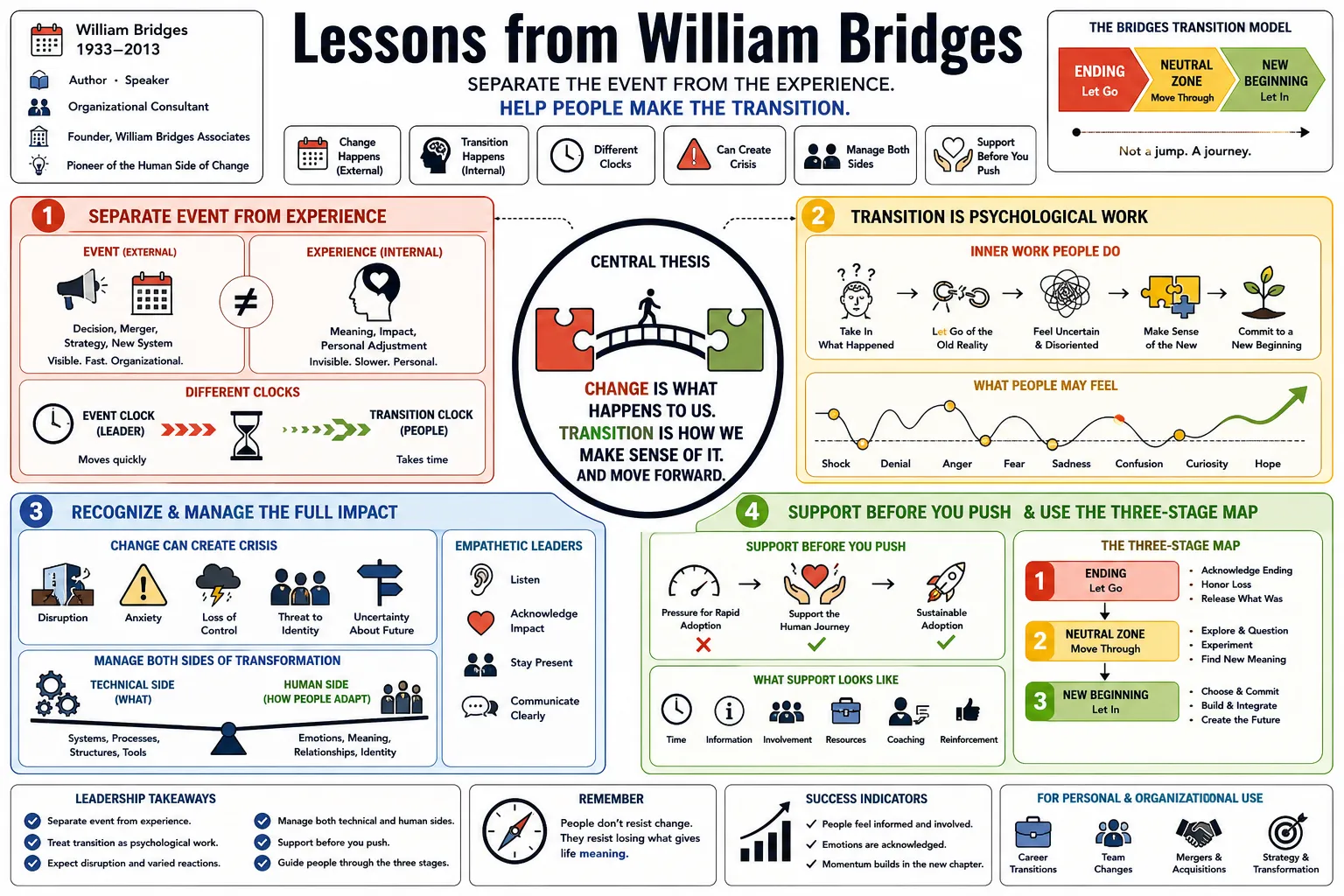
Change and Transition Are Different Problems
- On Separate the Event from the Experience: Change is an external event or situation, while transition is the internal process of absorbing and adapting to what the event means. — Reference: William Bridges Associates — The Bridges Transition Model
- On Treat Transition as Psychological Work: A new strategy, leader, merger, or product may be visible immediately, but the psychological reorientation it triggers follows a different clock. — Reference: William Bridges Associates — The Bridges Transition Model
- On Recognize That Change Can Create Crisis: Empathetic leaders do not assume that a sensible organizational decision will feel manageable to everyone affected by it. — Reference: William Bridges Associates — The Bridges Transition Model
- On Manage Both Sides of Transformation: A technically sound change can still fail when leaders ignore the transition people must make for the new situation to work. — Reference: William Bridges Associates — The Bridges Transition Model
- On Support Before You Push: Pressure for rapid adoption cannot substitute for helping people work through the human consequences of change. — Reference: William Bridges Associates — The Bridges Transition Model
- On Use the Three-Stage Map: The transition path moves through an ending, a neutral zone, and a new beginning rather than jumping directly from old state to new state. — Reference: William Bridges Associates — The Bridges Transition Model
- On Begin with the Old Reality: Transition starts when people release an old reality and identity, not when leaders announce the destination. — Reference: William Bridges Associates — Getting Them Through the Wilderness
- On Earn the New Beginning: A durable new beginning becomes possible only after people have worked through the ending and the neutral zone. — Reference: William Bridges Associates — Getting Them Through the Wilderness
- On Expect Transition to Outlast the Move: People may arrive in a new role or structure long before they feel psychologically at home there. — Reference: William Bridges Associates — Getting Them Through the Wilderness
Endings, Losses, and Letting Go
- On Start with What Is Ending: The practical starting point is not the desired outcome but what people must leave behind to reach it. — Reference: William Bridges Associates — The Bridges Transition Model
- On Name the Losses: The first phase improves when people can identify what they are losing and learn how to manage those losses. — Reference: William Bridges Associates — The Bridges Transition Model
- On Good Changes Still Carry Loss: Even welcome changes require releasing familiar methods, relationships, status, or identity, so positive framing does not eliminate grief. — Reference: William Bridges Associates — The Three Questions
- On Ask Who Loses What: A leader crosses from change management into transition management by asking exactly who will lose what. — Reference: William Bridges Associates — The Three Questions
- On Make Room Before Adding the New: People cannot fully adopt a new way of working until they have let go of the practices and assumptions they currently use. — Reference: William Bridges Associates — The Three Questions
- On Do Not Deny the Transition: Telling people that nothing meaningful is ending creates mistrust because it contradicts their lived experience. — Reference: William Bridges Associates — The Three Questions
- On Affirm the Experience: People move through transition more effectively when leaders validate what they are experiencing and help them deal with it. — Reference: William Bridges Associates — The Three Questions
- On Meet People Where They Are: Communication works better when it addresses the stage people actually occupy instead of insisting they should already be somewhere else. — Reference: William Bridges Associates — The Three Questions
- On Look for the Necessary Relinquishment: When change feels like a barrier, shift attention toward the inner connection, role, routine, or identity that has become time to release. — Reference: William Bridges Associates — Transition as the Way Through
Working Through the Neutral Zone
- On Accept the In-Between State: The neutral zone sits between the old reality and identity and the new one, so ambiguity is part of the process rather than evidence of failure. — Reference: William Bridges Associates — The Bridges Transition Model
- On Let Old Habits Go Dormant: The neutral zone gives obsolete behaviors and attitudes time to fade before new patterns become stable. — Reference: William Bridges Associates — Getting Them Through the Wilderness
- On Use the Window for Experimentation: When familiar arrangements loosen, innovations and experiments have an unusually good chance to take hold. — Reference: William Bridges Associates — Getting Them Through the Wilderness
- On Manage the Risks of Disintegration: Unmanaged transition can lead to terminal drift, external vulnerability, or the return of unresolved internal conflicts. — Reference: William Bridges Associates — Getting Them Through the Wilderness
- On Build Temporary Structures: Temporary policies, decision systems, and technical workarounds can provide cohesion while permanent arrangements are still forming. — Reference: William Bridges Associates — Getting Them Through the Wilderness
- On Stay in Close Contact: Leaders reduce the impulse to escape uncertainty by maintaining close and personal contact with people throughout the transition. — Reference: William Bridges Associates — Getting Them Through the Wilderness
- On Prefer Real Conversation to Staged Visits: Trust grows through honest face-to-face exchange and listening, not carefully managed appearances that screen out unpleasant information. — Reference: William Bridges Associates — Getting Them Through the Wilderness
- On Protect Creative Space: The combination of urgent need and open possibility creates fertile ground for ideas that normal operations may suppress. — Reference: William Bridges Associates — Getting Them Through the Wilderness
- On Allow Enough Time for Reorientation: Deep change requires time in the psychological wilderness for old attitudes to lose their hold and new ones to develop. — Reference: William Bridges Associates — Getting Them Through the Wilderness
- On Give the Experience a Name: People handle organizational uncertainty better when leaders explain transition and the neutral zone instead of leaving each person to interpret private distress alone. — Reference: William Bridges Associates — Getting Them Through the Wilderness
Creating a Real New Beginning
- On Change Understanding, Values, and Attitudes: A new beginning is more than a launch date; it involves new understanding, values, and attitudes. — Reference: William Bridges Associates — The Bridges Transition Model
- On Release Energy in a New Direction: A genuine beginning redirects energy and expresses a fresh identity rather than merely renaming the old state. — Reference: William Bridges Associates — The Bridges Transition Model
- On Clarify Purpose and Participation: People establish new roles more effectively when they understand the purpose, their part, and how they can contribute. — Reference: William Bridges Associates — The Bridges Transition Model
- On Build a New Outlook and Self-Image: The third phase brings new energy, purpose, outlook, and identity after the earlier phases have done their work. — Reference: William Bridges Associates — Getting Them Through the Wilderness
- On Change Leadership Style When the Phase Changes: The leader who guides a group through uncertainty may need a different, more consolidating style once the new order is ready to operate. — Reference: William Bridges Associates — Getting Them Through the Wilderness
- On Distinguish Pioneers from Consolidators: Transition leadership and settlement leadership are different jobs: one creates movement through uncertainty, while the other makes the new system durable. — Reference: William Bridges Associates — Getting Them Through the Wilderness
- On Treat Transition as a Path Forward: Instead of trying to climb over the wall created by change, use transition as the path into the next phase of life or work. — Reference: William Bridges Associates — Transition as the Way Through
Leading Organizational Transition
- On State the Change Simply: Leaders should be able to reduce a complex change to a clear core statement that people can understand in about a minute. — Reference: William Bridges Associates — The Three Questions
- On Establish the Problem Before the Solution: Build understanding of the challenge or opportunity before asking people to accept the proposed change. — Reference: William Bridges Associates — The Three Questions
- On Translate Strategy into Daily Differences: High-level plans remain abstract until people can see what will change in their jobs, decisions, relationships, and routines. — Reference: William Bridges Associates — The Three Questions
- On Make Concrete Differences a Planning Priority: The change team should clarify practical differences early instead of treating them as implementation details to discover later. — Reference: William Bridges Associates — The Three Questions
- On Explain Why the Change Is Needed: Transition management begins with a credible explanation of why the organization needs the change. — Reference: William Bridges Associates — The Bridges Transition Model
- On Educate Leaders About Human Effects: Managers need preparation for how the change will affect individuals, not only instruction on the new structure or process. — Reference: William Bridges Associates — The Bridges Transition Model
- On Monitor Progress Through the Stages: Leaders should track how people are moving through ending, neutral zone, and beginning rather than measuring only project milestones. — Reference: William Bridges Associates — The Bridges Transition Model
- On Listen More Than You Broadcast: A large share of useful transition communication comes from listening, because it reveals losses, resistance, and misunderstanding. — Reference: William Bridges Associates — The Three Questions
- On Mark the Boundary: A symbolic boundary event can make it clear that the old way is over and reduce the temptation to retreat into it. — Reference: William Bridges Associates — Getting Them Through the Wilderness
- On Honor What the Past Accomplished: Dismantle obsolete systems without denigrating the people who served them; the old way may have been right for its time. — Reference: William Bridges Associates — Getting Them Through the Wilderness
- On Create Visible Early Successes: Quick, concrete wins reassure doubters and show that the organization is genuinely moving toward the future. — Reference: William Bridges Associates — Getting Them Through the Wilderness
- On Prepare the Pivotal People: Identify and educate the people who will carry the new vision so they can begin forming a new identity, culture, and mission. — Reference: William Bridges Associates — Getting Them Through the Wilderness
- On Do Not Confuse Activity with Transformation: A change can be implemented on paper while daily behavior remains essentially the same, leaving everything changed but nothing different. — Reference: William Bridges Associates — Getting Them Through the Wilderness
- On Have the Courage to Endorse Disintegration: Transition leaders sometimes must tolerate the temporary falling apart of old arrangements because that disruption releases energy for the next chapter. — Reference: William Bridges Associates — Getting Them Through the Wilderness