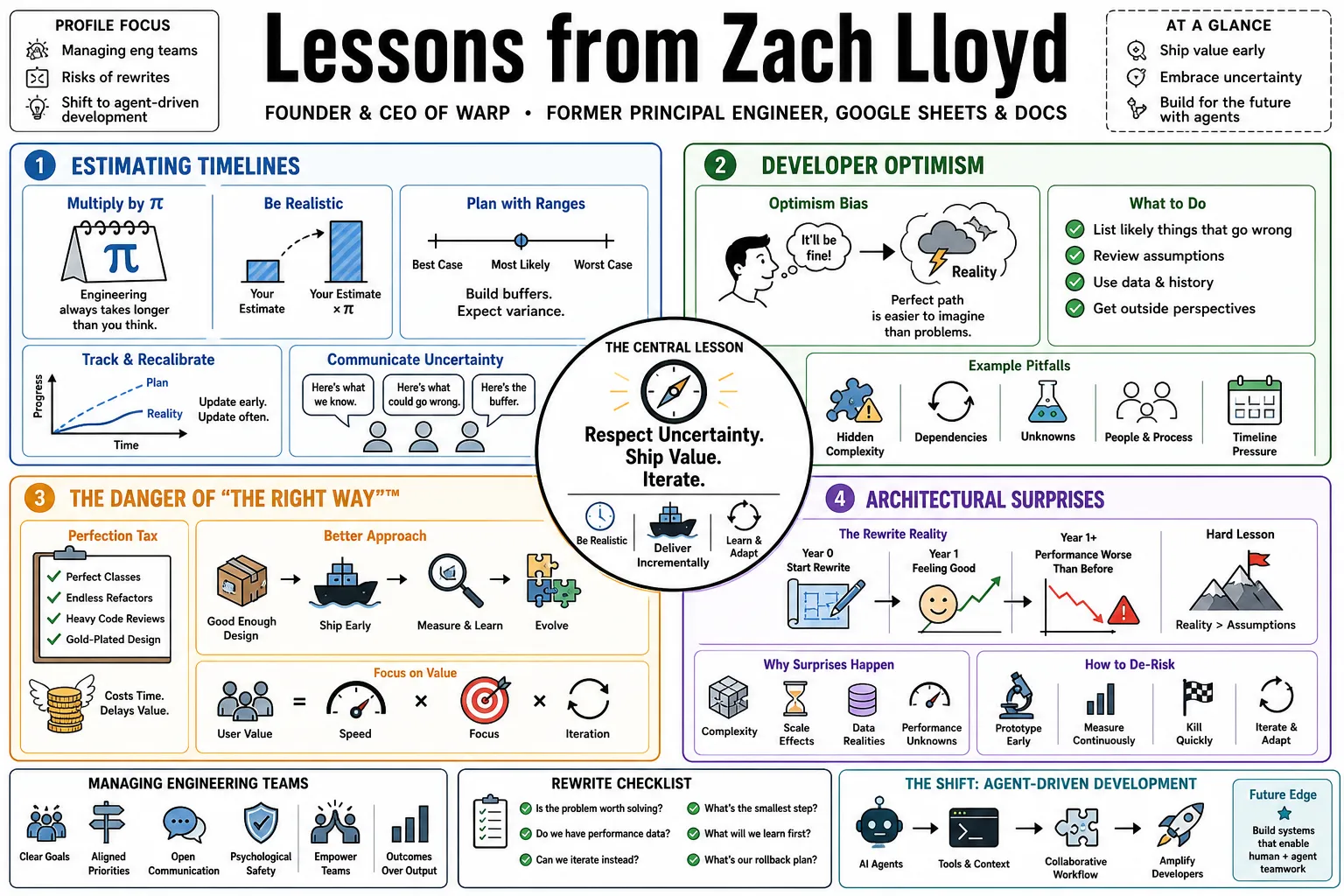
Lessons from Zach Lloyd
Zach Lloyd is the founder and CEO of Warp, an AI-integrated terminal for developers. He previously spent seven years as a Principal Engineer leading the Google Sheets and Docs teams. This profile covers his tactical advice on managing engineering teams, the risks of large code rewrites, and the shift toward agent-driven software development.
Part 1: The Google Sheets Rewrite & Estimation
- On Estimating Timelines: "Multiply by $\pi$. Engineering always takes longer than you think." — Source: [The ZBook]
- On Developer Optimism: "I, like most engineers, have a bias towards optimism in my coding ability... it’s just a lot easier to think of what you need to do if the project goes perfectly than if things go wrong." — Source: [The ZBook]
- On the Danger of The Right Way: "When we first started on the Sheets rewrite we wanted to do everything The Right Way™. All our classes were perfect. We agonized over code reviews. Of course, all of this 'perfection' came at a cost of time." — Source: [The ZBook]
- On Architectural Surprises: "A year into the project we realized the performance of our new architecture was actually way worse than expected, worse than the version we were replacing." — Source: [The ZBook]
- On the Value of Deadlines: "In retrospect, I wish our Sheets rewrite had a deadline. I bet we could have gotten it done at least six months sooner... we would have approached the whole project with a greater sense of urgency." — Source: [The ZBook]
- On Competitive Motivation: "Deadlines create competitive motivation. You don’t want to be the sole engineer on the team who makes the project ship late. Immovable deadlines really motivate." — Source: [The ZBook]
- On Scope Misjudgment: "I thought my and my team's code wasn't going to have as many bugs as it ended up having. I misjudged the number of tasks we had to complete." — Source: [The ZBook]
- On Rewrites vs. Iteration: Large-scale rewrites are inherently dangerous because they blind a team to incremental progress and immediate product impact. — Source: [InfoQ]
- On Perfection as a Trap: Focusing too heavily on perfect abstractions distracts teams from delivering immediate user value and meeting actual project milestones. — Source: [The ZBook]
Part 2: Product-First Engineering
- On the Core Job: "Programming is about building products that solve problems for users, not about writing beautiful code for its own sake." — Source: [The ZBook]
- On Code Quality: "If the product doesn’t work well, the code is not good." — Source: [The ZBook]
- On Technical Debt: "We will have to rewrite everything at some point, but it doesn’t matter right now because we haven’t even figured out the right thing to build." — Source: [The ZBook]
- On Speed to Market: "When I see programmers not launching features quickly, the issue is often over-engineering." — Source: [The ZBook]
- On Empathy for the User: "We are product-first engineers, which means we are constantly focusing on the user-experience, and make all of our engineering choices with the goal of building the best product we can for our users." — Source: [The ZBook]
- On Execution Complexity: "If you build something that's harder to build, you can get a little bit of advantage in terms of a moat around the product... it's a little bit harder to copy." — Source: [Sacra]
- On Defensibility: Spending the time to tackle deeply technical engineering problems creates a natural defense against competitors looking for quick wins. — Source: [Sacra]
- On Immediate Value: Tools should be product-obsessed and provide value to users the moment they open the application, rather than demanding a long learning curve. — Source: [PMF Show]
- On Fixing Bugs: "FIX YOUR BUGS. If you push a bug, fix it. If you create a bug somewhere else in the product because of your change, fix it or roll back your change." — Source: [The ZBook]
Part 3: The Pitfalls of Big Tech Culture
- On Promotion Mismatch: "The Google incentive structure... often rewards launching new things over maintaining or improving existing ones." — Source: [The ZBook]
- On the Promo-Culture Trap: Engineers often build new systems solely to justify their promotions, a behavior that ultimately harms the product and the end user. — Source: [The ZBook]
- On Isolation in Development: "Throughout my career, the biggest mistake I see engineers make is doing too much work on their own before looping in others." — Source: [The ZBook]
- On Shared Responsibility: "Great engineers are always fixing not only their own bugs but other bugs they find in the product." — Source: [The ZBook]
- On Continual Maintenance: "Code is almost never 'done.' There are always bugs that arise." — Source: [The ZBook]
- On the Google Bubble: "Google makes you a terrible startup founder... there are all these things that I didn't think about at Google. Engineers would just come in and they would be the best engineers in the world." — Source: [The Startup Project]
- On Assumed Distribution: "At Google, anything you launch gets millions of users. At a startup, the challenge isn't building—it's getting anyone to care." — Source: [The Startup Project]
- On Large-Scale Coordination: Scaling software requires shifting focus away from individual heroics and toward rigorous cross-team alignment. — Source: [The ZBook]
- On Avoiding Complacency: Big tech environments can mask a lack of product-market fit with sheer scale; founders must unlearn this comfort to survive in early-stage ventures. — Source: [The Startup Project]
Part 4: From Big Tech to Startup Realities
- On the CEO Mandate: "The number one job of a tech startup CEO is don't let your company fail... it's on you, no one else is going to stop it from failing." — Source: [Warp Dev]
- On Ambition and Vision: "How do you eat an elephant? It's like one bite at a time, but have at least the really big exciting vision, the big exciting market—that's going to serve you way better than 'I'm going to fix some small thing.'" — Source: [Warp Dev]
- On Startup Resilience: Startups force you to build your own distribution engine, unlike established companies where existing usage is virtually guaranteed. — Source: [The Startup Project]
- On the Transition to Founder: Moving from a Principal Engineer role to CEO means embracing responsibilities like marketing and hiring that were previously abstracted away by corporate machinery. — Source: [The Startup Project]
- On Rebuilding Tools: Experiencing the friction of legacy setups in new environments highlights exactly where modern tooling is failing the next generation of engineers. — Source: [No Priors]
- On Startup Hiring Constraints: You can no longer rely on a guaranteed pipeline of top-tier talent walking through the door; you have to sell the vision constantly to recruit. — Source: [The Startup Project]
- On the Value of Hard Problems: "I don't know how many people want to spend a year building something before it goes to market." Taking on deeply technical challenges filters out less committed competitors. — Source: [Sacra]
- On Legacy Modernization: His time at TIME magazine demonstrated that modernizing a stack involves changing an organization's digital metabolism rather than simply swapping out backend code. — Source: [Me.sh]
- On Iterative Product Discovery: The SelfMade experience underscored the necessity of finding what users immediately value instead of perfecting an unseen backend system. — Source: [Wikipedia]
Part 5: The Architecture of Collaboration
- On Cloud-Native Evolution: "My experience [on Google Docs] really made me believe that there's a lot of power if you can take an app that is not collaborative... and turn it into something that is cloud native and collaborative." — Source: [Warp Dev]
- On Google Docs for Code: "The code editor—think about it as like Google Docs for your code... and the terminal is where you are doing a lot of other developer stuff." — Source: [Warp Dev]
- On Multi-Player Tools: Adding multiplayer capabilities to isolated workflows dramatically accelerates how teams solve complex problems. — Source: [RedMonk]
- On State Synchronization: Building collaborative tools requires fundamentally rethinking architecture to prioritize real-time state synchronization over local-only execution. — Source: [InfoQ]
- On Breaking Silos: Shared interfaces reduce the friction of knowledge transfer among developers, eliminating the classic "it works on my machine" barrier. — Source: [RedMonk]
- On Transparent Context: A cloud-native tool allows a team to instantly share the context of an issue, shifting debugging from a solitary struggle to a shared exercise. — Source: [RedMonk]
- On Legacy Interfaces: Excluding core developer tools from cloud collaboration slows down engineering teams unnecessarily. — Source: [Warp Dev]
- On Collaborative Defaults: Systems should default to open, easily shareable states so that teaming up to solve a problem requires zero configuration overhead. — Source: [RedMonk]
- On Tool Longevity: The tools that define the next decade will be those that seamlessly bridge the gap between individual deep work and collective problem-solving. — Source: [RedMonk]
Part 6: Reimagining the Terminal
- On a Stagnant Interface: "The terminal stayed the same for almost 40 years (and still counting)! ... It is an interface for telling your computer to do things, and the computer does them for you." — Source: [Sacra]
- On Language Evolution: "You can do that in the language of terminal commands. Or you can do it in English or natural language." — Source: [Sacra]
- On Redefining Categories: "We do not call Warp a terminal anymore. Our product philosophy is to be the best place for developers to build software with agents." — Source: [Warp Dev]
- On Avoiding Binary Labels: "We are not trying to be in the terminal camp or the IDE camp. We are our own thing that supports agentic workflows." — Source: [Warp Dev]
- On the Terminal as a Workbench: "My belief is like neither of those tools [the traditional terminal and IDE] as they were is perfectly suited for developing with agents. And so we created a new category... a prompt-based 'workbench'." — Source: [Warp Dev]
- On Text as the Ideal Medium: The terminal's inherent text-in and text-out format makes it the perfect vessel for interacting with large language models. — Source: [Sequoia Capital]
- On Moving Past Local History: Instead of only logging local command history, terminals should act as a shared knowledge base of a team's entire workflow. — Source: [RedMonk]
- On Rust for Performance: Rebuilding the terminal in Rust ensures that adding modern UI and collaborative features doesn't sacrifice the raw speed developers expect from their tools. — Source: [Warp]
- On Visual Interactivity: Modernizing the command line involves adding structured visual blocks and rich outputs while preserving keyboard speed. — Source: [Warp]
- On Lowering the Barrier: A modern terminal can demystify command-line operations, making the environment accessible to junior developers while empowering power users with faster workflows. — Source: [RedMonk]
Part 7: The Era of Agentic Development
- On Ask and Adjust: "New paradigm in horizontal productivity apps is going to be Ask & Adjust: AIs will iteratively generate drafts or edits, and humans will tweak them." — Source: [The ZBook]
- On the AI Coding Phases: The industry has moved from simple autocomplete (Phase 1) to AI-assisted chat panels in IDEs (Phase 2), and is now entering the Agent-First era (Phase 3). — Source: [Sacra]
- On the End of Manual Coding: Coding will eventually be solved; the bottleneck is shifting away from writing syntax toward expressing clear technical intent. — Source: [Sequoia Capital]
- On Ambient Agents: Agents will soon run continuously in the background to autonomously fix bugs and manage routine background operations. — Source: [Sequoia Capital]
- On the IDE as a Typewriter: Traditional IDEs are built like word processors optimized for manual typing, which is fundamentally misaligned with an agent-driven development future. — Source: [Sacra]
- On Vibe Coding vs. Pros: While natural language development empowers non-technical users, professional developers will still require rigorous, specialized environments to build enterprise-grade software. — Source: [Sequoia Capital]
- On the Role of the Developer: The developer's primary job is evolving from the author of code to the reviewer and orchestrator of a swarm of autonomous agents. — Source: [Sacra]
- On Natural Language as Code: Natural language is effectively becoming a programming language, acting as the highest-level compiler for instructing machines. — Source: [Sacra]
- On the Need for Supervision: As agents take over execution, the tooling must evolve to provide clear mechanisms for human oversight and course-correction. — Source: [RedMonk]
- On Economic Value: The economic value in software engineering will remain with the professionals who can orchestrate these powerful tools to handle extreme architectural complexity. — Source: [Sequoia Capital]
Part 8: Leadership and Managing Engineers
- On Hiring Interns: "If you are an engineering manager and not hiring interns year round, you are making a mistake." — Source: [The ZBook]
- On Meaningful Intern Projects: "DO: Make this project something that your product actually needs. Interns should make a real impact... DO NOT: make this an experimental side project." — Source: [The ZBook]
- On Early-Stage Output: "The best way to get the most out of interns is to have them work like real engineers on real projects that you actually need." — Source: [The ZBook]
- On Guardrails for Execution: Leadership requires setting hard constraints instead of merely offering guidance, preventing a team from falling into endless refactoring loops. — Source: [The ZBook]
- On Setting Culture: A leader must enforce the rule that engineers are responsible for the overall health of the application instead of just their isolated components. — Source: [The ZBook]
- On Managing Motivation: Using strict, immovable deadlines isn't just about delivery schedules; it is a tactical tool to drive urgency within a team. — Source: [The ZBook]
- On Building Trust: Transparency about technical debt and past failures is necessary for earning the respect of a highly skilled engineering team. — Source: [The ZBook]
- On Balancing Priorities: Managers must actively fight promo-driven development by aligning compensation and recognition with true user value instead of new feature creation. — Source: [The ZBook]
- On Leading Through Transitions: Acting as an interim CTO involves managing digital transformation by shifting the organizational mindset before changing a single line of legacy code. — Source: [Me.sh]
- On Focusing Teams: The ultimate role of technical leadership is stripping away extraneous architectural debates and forcing a relentless focus on the end user's experience. — Source: [The ZBook]