Aaron Levie is the co-founder and CEO of Box, a leader in cloud content management that he famously started from a college dorm room. Known for his sharp wit and deep insights into the enterprise software landscape, he has become a definitive voice on how organizations can navigate the shift from legacy systems to a cloud-and-AI-first world. — McKinsey — Growing Fast.
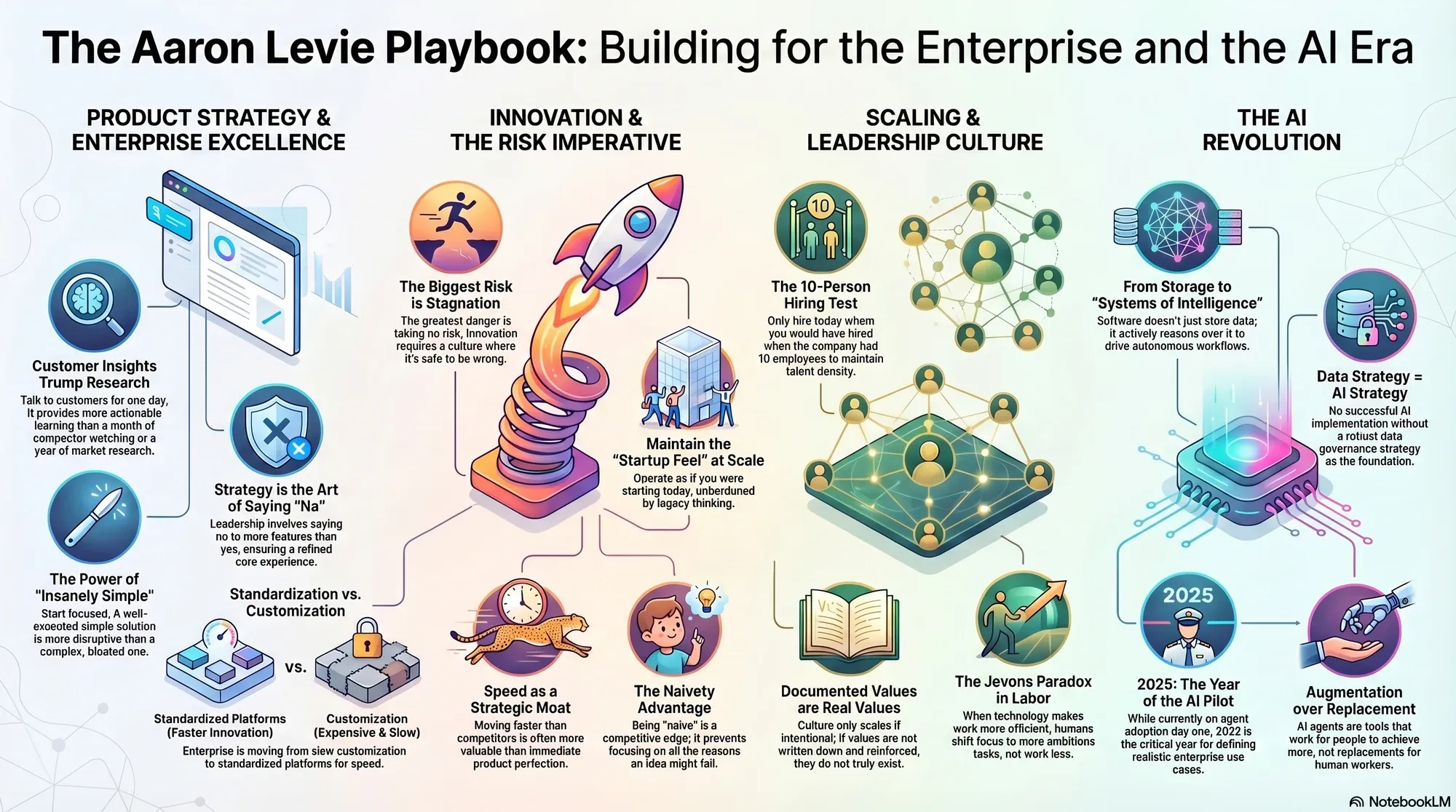
Part 1: Product Strategy and Enterprise Excellence
- On Customer Learning: Customer conversations often reveal more than internal analysis because they expose how people actually use and value the product. — McKinsey — Start Up & Scale Up.
- On Simplicity: Box began with a basic file-sharing proposition, proved demand cheaply, and expanded only after customers demonstrated that the product worked. — McKinsey — Start Up & Scale Up.
- On Disrupting Incumbents: Cloud economics created openings for startups because customers could adopt new tools without the cost and friction associated with legacy enterprise deployments. — Y Combinator — Building for the Enterprise.
- On Software Standardization: Enterprise software shifted from heavily customized deployments toward standardized, open platforms that customers can extend at a higher layer. — Y Combinator — Building for the Enterprise.
- On User-Led Adoption: Mobile and cloud software made enterprise adoption more user-led: employees bring tools into work before IT later adds control, security, and scale. — Y Combinator — Building for the Enterprise.
- On Feature Prioritization: A coherent strategy requires a stable customer-facing North Star and discipline about when a genuine pivot is warranted. — HBR IdeaCast — Pivoting to the Enterprise Market.
- On Product Involvement: Founder involvement in every product detail can help early on, but it becomes a bottleneck unless authority and operating processes scale with the company. — First Round Review — How to Scale 10x as a CEO.
- On Startup Friction: Lower cloud costs reduce adoption friction, allowing startups to reach both small businesses and large enterprises with the same underlying product. — Y Combinator — Building for the Enterprise.
Part 2: Innovation and the Risk Imperative
- On Taking Risks: Box made rapid experimentation and fast failure a stated operating value, while requiring individual experiments to remain aligned with the long-term vision. — McKinsey — Start Up & Scale Up.
- On the Freedom to Fail: Small teams need permission to fail and iterate, but the appropriate risk boundary depends on the process; safety-critical work cannot be treated like trivial software. — McKinsey — Start Up & Scale Up.
- On Avoiding Disruption: When technology changes, preserve the enduring customer mission while evolving how the company delivers it. — HBR IdeaCast — Pivoting to the Enterprise Market.
- On Tech Archetypes: Smaller companies can out-innovate larger competitors by iterating products faster and exploiting technological shifts that incumbents are slower to absorb. — Stanford eCorner — Delivering Innovation for the Enterprise.
- On Internal Innovation: Hackathons helped Box democratize experimentation and surface early machine-learning ideas before the company formed a dedicated working group. — HBR IdeaCast — Pivoting to the Enterprise Market.
- On Maintaining Agility: Scaling does not eliminate the need for agility: Box sought to combine enterprise-grade operations with the iteration cadence of a technology startup. — McKinsey — Growing Fast.
- On Speed as a Moat: Digital businesses must move quickly, but speed should be applied selectively and paired with rapid information sharing and accountability. — McKinsey — Start Up & Scale Up.
Part 3: Scaling, Culture, and Leadership
- On The 10-Person Test: Maintain the early-team hiring bar at scale by asking whether each candidate would have belonged among the company’s first ten employees. — First Round Review — How to Scale 10x as a CEO.
- On Scaling Culture: Culture does not reproduce itself automatically as headcount grows; leaders must reinforce it deliberately and repeatedly. — First Round Review — How to Scale 10x as a CEO.
- On Cultural Reinforcement: Culture is sustained through repeated communication, written context, management conversations, and daily behavior that matches the stated values. — First Round Review — How to Scale 10x as a CEO.
- On Hiring Leaders: At a fast-growing company, hire with future leadership in mind because strong individual contributors may become managers within months. — Stanford eCorner — Delivering Innovation for the Enterprise.
- On Continuous Learning: Levie builds decision-making models by studying competitors, strategic problems, corporate history, and executives who faced similar situations. — First Round Review — How to Scale 10x as a CEO.
- On CEO Learning: Learning from CEOs who have already faced a comparable scaling problem can help a founder recognize patterns and decide faster when data is incomplete. — First Round Review — How to Scale 10x as a CEO.
- On The Difficulty of Scaling: Building a company does not become steadily easier; economic, geopolitical, and technological changes repeatedly rearrange the problem. — GeekWire Podcast — AI Agents, Enterprise Data, and the Future of Work.
- On The Jevons Paradox in Labor: AI can save time while simultaneously revealing more worthwhile work, so greater efficiency may expand ambition rather than reduce workload. — GeekWire Podcast — AI Agents, Enterprise Data, and the Future of Work.
Part 4: The AI Revolution and the Future of Work
- On AI Agents: Enterprise agents combine models with search, files, permissions, and workflow-specific tools to perform multi-step work over company information. — Sequoia Capital — Reinventing Yourself in the AI Age.
- On Augmentation: As agents take on more background and asynchronous work, people increasingly review completed tasks instead of manually initiating every step. — Sequoia Capital — Reinventing Yourself in the AI Age.
- On Agent Adoption: Enterprise agent adoption remains at an early stage; Levie characterized 2025 as a period of pilots and experimentation with a narrower set of realistic use cases. — GeekWire Podcast — AI Agents, Enterprise Data, and the Future of Work.
- On Expanding Ambition: The productivity opportunity from AI is not only doing the same work faster; it can uncover additional useful work and raise what a team attempts. — GeekWire Podcast — AI Agents, Enterprise Data, and the Future of Work.
- On Data Governance: An AI strategy depends on a data strategy: information must be organized, connected, stored, and governed in a form that models can use. — McKinsey — Start Up & Scale Up.
- On Workflow Optimization: The gap between a general model and a useful enterprise result is filled by workflow design, domain context, permissions, retrieval, and task-specific tools. — Sequoia Capital — Reinventing Yourself in the AI Age.
- On AI in Knowledge Work: Applied agent systems are emerging across knowledge-work fields, with domain-focused companies encoding the workflows and context that general models lack. — Sequoia Capital — Reinventing Yourself in the AI Age.
Part 5: Entrepreneurship and Building the Future
- On The Founder’s Role: Levie continues to write his own social posts as a discipline for understanding subjects deeply enough to exercise better judgment. — GeekWire Podcast — AI Agents, Enterprise Data, and the Future of Work.
- On Adapting to Change: Company-building is continual adaptation: once the pieces appear settled, changes in markets, geopolitics, or technology can reset the board. — GeekWire Podcast — AI Agents, Enterprise Data, and the Future of Work.
- On Relentless Focus: During major strategic change, keep the company’s customer mission stable and alter the delivery model only when it advances that North Star. — HBR IdeaCast — Pivoting to the Enterprise Market.
- On The Purpose of Data: AI creates value from enterprise content by extracting structure and context that can drive analysis, routing, review, and security workflows. — McKinsey — Start Up & Scale Up.
- On Personal Productivity: Levie uses AI for strategy documents, market and customer research, content review, internal summaries, and early product prototypes. — GeekWire Podcast — AI Agents, Enterprise Data, and the Future of Work.
- On Intellectual Curiosity: Writing about a subject remains useful because deep understanding improves judgment when related decisions arise later. — GeekWire Podcast — AI Agents, Enterprise Data, and the Future of Work.
- On Long-term Value: Enterprise AI must work with permissions, access controls, retrieval, and security—not merely connect a model to unstructured content. — Sequoia Capital — Reinventing Yourself in the AI Age.
- On Transparency: Open information flow improves decisions: data should move upward, decisions downward, and employees should be able to challenge problems without fear. — First Round Review — How to Scale 10x as a CEO.
- On Efficiency vs. Demand: When AI reduces the effort required for a task, demand may rise because people discover more valuable work to pursue. — GeekWire Podcast — AI Agents, Enterprise Data, and the Future of Work.
- On Real-Time Operations: Modern work depends on smaller teams sharing data in real time across organizational boundaries, with greater transparency and accountability. — McKinsey — Start Up & Scale Up.
- Validate Before Scaling Capital: Prove that customers want the product and that its economics can work before investing heavily in growth; venture funding cannot manufacture product-market fit. — McKinsey — Start Up & Scale Up
- Bridge Customers to the Future: Balance what technology makes possible with how quickly customers can realistically change, helping them move from present workflows toward the future. — McKinsey — Growing Fast
- Compete and Collaborate Simultaneously: In a platform economy, compete where the company differentiates and partner where another organization’s technology is stronger instead of trying to control every layer. — McKinsey — Start Up & Scale Up