Amit Agarwal helped scale Datadog as chief product officer and later president before founding Standard Template Labs. His current work aims to move enterprise service management from recording tickets toward resolving requests with organizational context. — ICONIQ STLabs Launch Account.
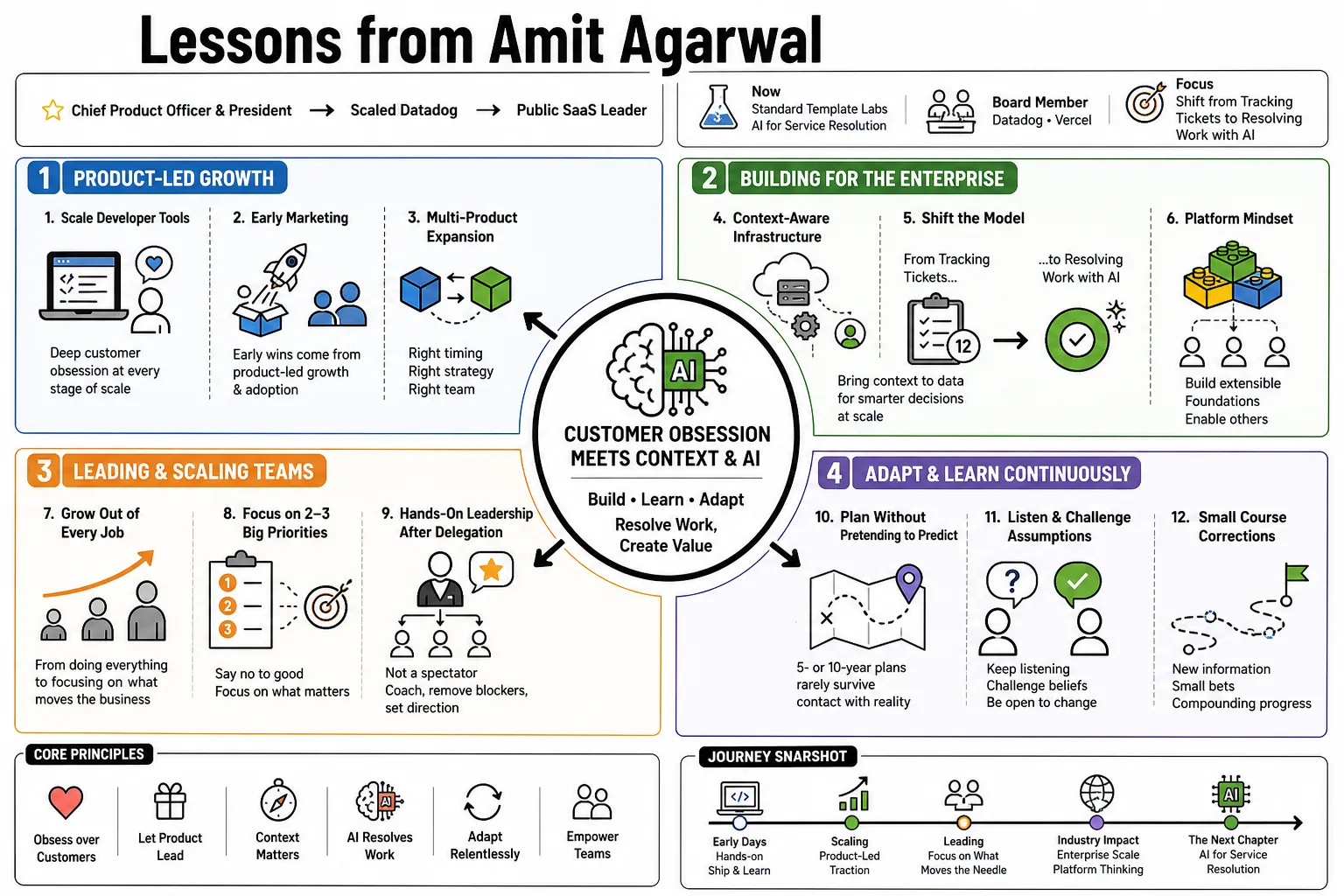
Part 1: Product-Led Growth and Scaling
- Keep Customer Obsession at Enterprise Scale: Vercel CEO Guillermo Rauch credits Agarwal with helping Datadog grow from a developer product into an enterprise standard without losing its customer focus. — Vercel Board Announcement.
- Plan, Then Keep Adjusting: Agarwal says five- or ten-year plans rarely unfold exactly as imagined; customer feedback and small course corrections matter as conditions change. — ICONIQ Leadership Interview.
- Delegate as the Company Grows: Agarwal describes doing everything in a tiny company, then hiring specialists and focusing his own effort on two or three priorities that move the business. — ICONIQ Leadership Interview.
- Stay Hands-On Where It Matters: After delegating, Agarwal still goes deep and takes responsibility for the few priorities he judges most consequential. — ICONIQ Leadership Interview.
- Model Honest Failure: Agarwal says admitting his own mistakes helps teams discuss what failed instead of relabeling failures as successes. — ICONIQ Leadership Interview.
Part 2: The Evolution of Enterprise Service Management
- Question Ticket-Centric IT: Agarwal describes service management as an area where older approaches still leave people routing tickets and navigating systems instead of resolving work. — TFN Launch Interview.
- Build for Resolution, Not Records: ICONIQ describes traditional service-management platforms as systems of record and routing, while STLabs aims to resolve requests. — ICONIQ STLabs Launch Account.
- Beware Brittle Customization: Agarwal argues that heavily customized legacy systems can become fragile and expensive to maintain rather than a durable moat. — ICONIQ Customization Interview.
- Recover Lost IT Context: Agarwal says IT teams spend time navigating systems, approvals and missing context; his design goal is to bring that context to the work. — TFN Launch Interview.
Part 3: Designing Agentic AI Platforms
- A Chatbot Is Not a New System: Agarwal argues that a chatbot attached to an old ticket workflow may speed filing without changing how problems are resolved. — TFN Launch Interview.
- Keep the Organizational Map Live: STLabs describes a continuously synced graph of people, devices, apps and access so its agents can act on current organizational context. — STLabs Product Overview.
- Automate Routine Resolution Carefully: STLabs describes self-service and automated workflows for common requests; any resolution-rate figure is the company’s claim, not independently verified performance. — STLabs Product Overview.
- Reserve Human Judgment: ICONIQ says STLabs aims to automate suitable requests while keeping people involved when judgment and oversight are required. — ICONIQ STLabs Launch Account.
- Shift Developers Toward Specs and Tests: Agarwal says coding agents shift some developer effort from writing code to specifying work, testing outputs and identifying tasks that can run in parallel. — ICONIQ AI Teams Interview.
- Make Agent Work Inspectable: Agarwal calls for AI products that people can inspect and supervise, with humans involved where the decision warrants it. — ICONIQ AI Teams Interview.
Part 4: Go-to-Market and Pricing Strategy
- Serve Both Early Adopters and Enterprises: Agarwal says Datadog served tiny startups and large enterprises differently, while retaining smaller customers as signals of emerging technologies. — Datadog Investor Day Transcript.
Part 5: Customer Obsession and Feedback
- Solve Sophisticated Customer Problems: In his Datadog essay, Agarwal frames product development around customers’ performance, security and cost challenges across varied technology stacks. — Amit Agarwal at Datadog.
- Treat Customer Feedback as Product Input: Agarwal says customer feedback informs analyst reports and helps Datadog improve the platform; an analyst placement alone is not proof of customer outcomes. — Amit Agarwal at Datadog.
- Listen for Manual Coordination Pain: ICONIQ reports that conversations with more than 100 CIOs and builders surfaced tickets, approvals and context gathering that consumed staff time. — ICONIQ STLabs Launch Account.
- Reduce Context Switching: Agarwal says his Datadog experience taught him to notice how customers switch among tools and to build products that reduce that friction. — ICONIQ Founder Interview.
- Measure Tangible Customer Value: Agarwal says a product should be assessed by the work and total cost it saves a customer, not just its license price. — Datadog Investor Day Transcript.
Part 6: Breaking Down Organizational Silos
- Unify Observability and Security Data: Agarwal argues that bringing observability and security data together lets teams diagnose issues instead of working in isolated silos. — Datadog Investor Day Transcript.
- Map Access Relationships: STLabs describes a live view of users, devices, apps and permissions as the context for service requests and access decisions. — STLabs Product Overview.
- Represent the Organization as a System: STLabs aims to connect people, systems, policies and devices so changes and requests can be understood in their wider operational context. — ICONIQ STLabs Launch Account.
Part 7: The Limitations of Legacy IT Systems
- Do Not Depend on Stale Records: STLabs contrasts its continuously synced organizational graph with a configuration database that may lag behind real changes. — STLabs Platform.
- Custom Code Can Become Operational Debt: Agarwal describes large IT teams repeatedly repairing hand-coded legacy automations; he sees context-aware adaptation as an alternative. — ICONIQ Customization Interview.
- Look at Time Lost to Service Work: ICONIQ reports that internal requests can take weeks and consume headcount through manual coordination, making service management a productivity problem. — ICONIQ STLabs Launch Account.
Part 8: Building Generational Companies
- Adapt a Loved Developer Platform: Agarwal praised Vercel for adapting its developer platform for AI-native builders rather than standing still during the AI shift. — Vercel Board Announcement.
- Support Long-Term Platform Building: On joining Vercel’s board, Agarwal said he wanted to help extend a platform developers already love into a lasting company; this is an aspiration, not an achieved result. — Vercel Board Announcement.
- Bring Operator Experience to the Board: Vercel appointed Agarwal to its board in August 2026 after his Datadog leadership through enterprise growth and its public-company years. — Vercel Board Announcement.
- Revisit Categories at Technology Shifts: ICONIQ says Agarwal saw AI as an opportunity to reconsider service management from first principles, rather than merely add automation to older workflows. — ICONIQ STLabs Launch Account.
- Learn from the Next Inflection Point: Agarwal says his ICONIQ year exposed him to founders building useful AI products quickly, helping convince him to start STLabs. — ICONIQ Founder Interview.