Behzod Sirjani founded Yet Another Studio, led research operations at Slack, and worked as a user researcher at Facebook. His work frames research as a company-wide practice of gathering evidence for better decisions. The lessons below cover customer understanding, shared research capability, and organizational decision-making. — Research That Scales — Behzod Sirjani.
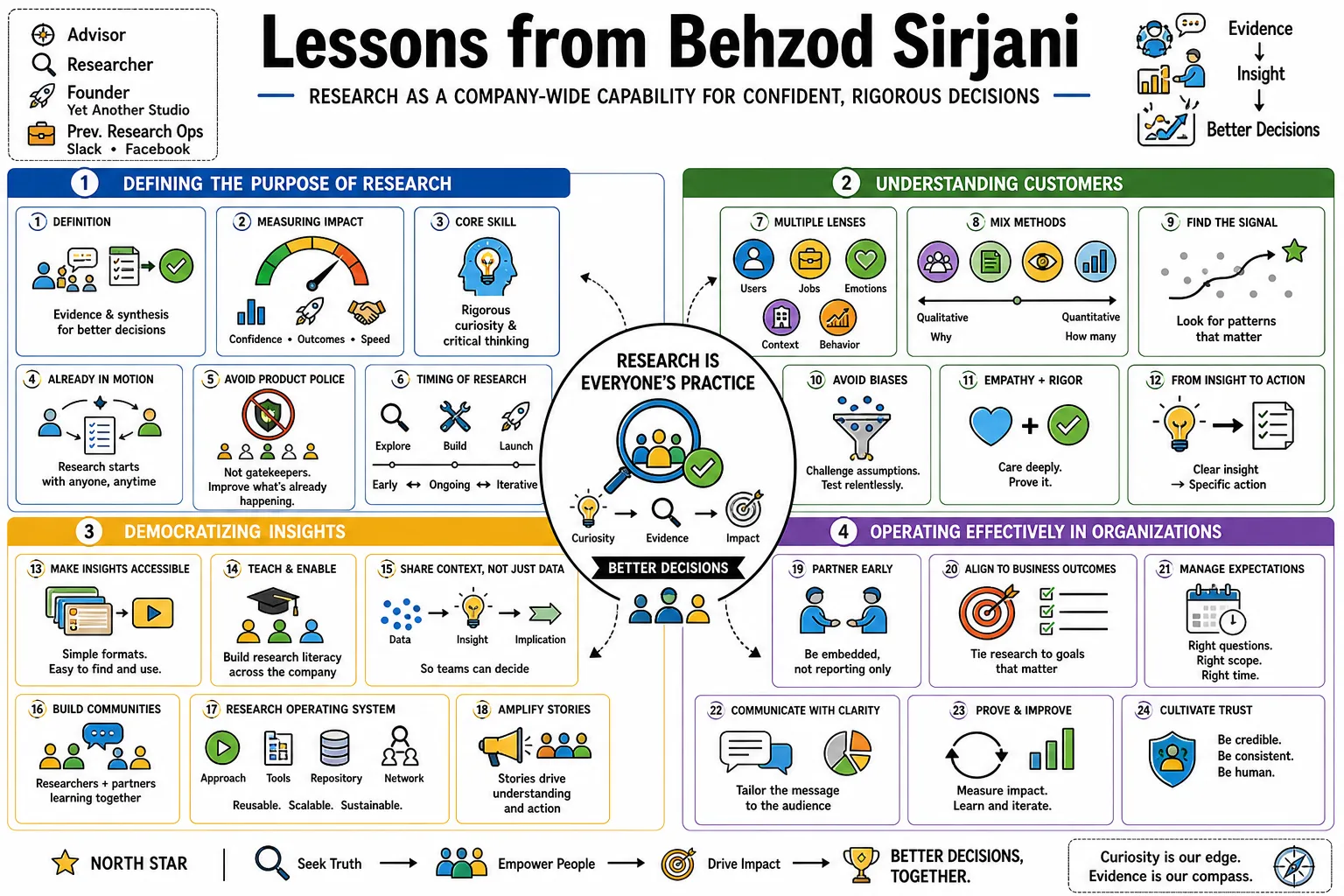
Part 1: Defining the Purpose of Research
- On the definition of research: User research is fundamentally about gathering and synthesizing evidence to help an organization make better decisions, rather than just talking to customers for the sake of learning. — Calyx — Making Better Decisions Through Research.
- On measuring impact: The success of a research team shouldn't be measured by the number of surveys sent or interviews conducted. Instead, it should be evaluated by whether the rest of the company is more confident in their decisions, whether product launches succeed, or if sales teams close deals faster. — Insights Unlocked — Research Across Your Organization.
- On the core skill of researchers: The unique value researchers bring is their rigorous curiosity and critical thinking, not simply the act of executing research tasks. — Behzod Sirjani — Year 03.5 in Review.
- On recognizing the research practice already in motion: A research practice begins as soon as someone has an idea for a company; it is the sum of everyone gathering evidence, not something that appears only after a formal research team is hired. — Behzod Sirjani — Year 03.5 in Review.
- On avoiding the product police trap: The mandate of a research team should not be to act as gatekeepers or product police, but rather to identify where research is already happening within the company and find ways to improve those activities. — Dscout — How to Be a Teacher, Not an Oracle.
- On the timing of research: Research can become an unwelcome interruption when teams bring it in after a project has momentum. Planning the evidence-gathering work earlier helps integrate it into the building cycle, even when the research itself takes considerable time or effort. — Insights Unlocked — Research Across Your Organization.
- On organizational anthropology: Study how your own organization works as well as its customers. Understanding internal social, cultural and technical challenges can help you design research systems that fit the teams using them. — Research That Scales — Behzod Sirjani.
Part 2: The Decision-First Framework
- On the Wheel of Fortune analogy: Organizational decision-making is like solving a puzzle with missing letters. Research is simply a method to uncover a few more letters on the board so the team feels confident enough to guess the solution. — Reforge — User Research AMA with Behzod Sirjani.
- On starting with intent: Before seeking customer feedback, teams must ask themselves why they are collecting the information and what specific actions they will take once they receive it. — Reforge — User Research AMA with Behzod Sirjani.
- On framing research needs: Founders can clarify their research goals by explicitly defining the project in question, the specific type of person they need to observe or hear from, and the exact action or statement that would increase their confidence. — Calyx — Making Better Decisions Through Research.
- On filtering research methods: Once a research goal is established, evaluate it against three constraints: Is it feasible to execute? Is the request reasonable for the participant? And is the expected insight worth the time and effort required? — Calyx — Making Better Decisions Through Research.
- On shipping vs. researching: For a change that can be shipped and reversed quickly, compare the value of more research with the time it would take. Sirjani recalls Slack sometimes choosing reversible shipping rather than spending weeks or months gaining additional confidence. — Calyx — Making Better Decisions Through Research.
- On alternatives to research: Confidence in a decision does not always require a formal user study. Talking to an expert, building a prototype or running an experiment may provide the evidence needed to move forward. — Calyx — Making Better Decisions Through Research.
Part 3: Asking the Right Questions
- On asking what users want: Instead of asking customers what features they want built, find the people experiencing the problem and ask them what alternative solutions they have already tried and how well those solutions worked. — Calyx — Making Better Decisions Through Research.
- On evaluating customer feedback: Weigh feedback by its usefulness and by how consistently it recurs among the people you interview. Helpful but inconsistent responses may signal that different customer segments need to be understood separately. — Calyx — Making Better Decisions Through Research.
- On avoiding yes/no questions: A yes-or-no answer to whether a feature would help rarely explains the customer’s reasoning. Ask how or why it would help when you need to understand the underlying problem, rather than treating every closed question as inappropriate. — Calyx — Making Better Decisions Through Research.
- On building for everyone: A common startup mistake is failing to define the target audience. If you listen to everyone who gives feedback without filtering for your ideal customer, you risk building a disjointed, Frankenstein product. — Calyx — Making Better Decisions Through Research.
- On shaping the roadmap: Invite customer-facing colleagues to help shape research questions and the roadmap, not just interpret finished findings. Unique or outlying customer behaviors can suggest what to investigate next: help decide what goes on the shopping list, rather than only cooking with what is already in the kitchen. — Reforge — User Research AMA with Behzod Sirjani.
Part 4: Democratizing Research
- On sharing responsibility: As companies scale, highly-qualified researchers should avoid hoarding tasks out of protectiveness. Democratizing research allows specialists to focus on the complex work they are uniquely qualified for. — Maze — Democratizing Research with Behzod Sirjani.
- On growing talent beyond credential filters: Instead of treating advanced degrees or years in industry as the only markers of research potential, organizations can build apprenticeship paths that turn rigorous curiosity and strong potential into independent practice. — Dscout — How to Be a Teacher, Not an Oracle.
- On giving away responsibility as the company grows: As a company grows, deliberately hand responsibilities to others and look for the next contribution you can make. Sirjani applies Molly Graham’s giving-away-your-Legos idea to sharing research capacity instead of holding every task yourself. — Dscout — How to Be a Teacher, Not an Oracle.
- On collective proximity: A small research team cannot speak to every customer. Helping colleagues conduct better conversations can bring more of the organization closer to customers’ lived experience. — Maze — Democratizing Research with Behzod Sirjani.
- On scaling through others: Rather than relying solely on a small research team, treat the entire company as junior researchers. Build programs that improve how they interact with customers at every existing touchpoint. — Dscout — How to Be a Teacher, Not an Oracle.
- On mitigating risks: Anticipate what could go wrong before opening research to inexperienced interviewers. Sirjani recommends researchers manage participant recruiting and create checks around which customers colleagues contact. — Maze — Democratizing Research with Behzod Sirjani.
- On educating the organization: Be transparent with the broader team about the high costs associated with storing, analyzing, and synthesizing data. This encourages people to think critically about whether their proposed research is actually worth doing. — Maze — Democratizing Research with Behzod Sirjani.
- On cross-functional training: Democratization includes teaching salespeople how to conduct better discovery calls or helping customer success teams design better post-training surveys, aligning research skills with organizational outcomes. — Insights Unlocked — Research Across Your Organization.
- On guiding inquiries: Before teammates conduct their own research, have them outline the decision they need to make, the evidence required, and what data they might already possess. — Maze — Democratizing Research with Behzod Sirjani.
- On using office hours as research infrastructure: Regular office hours give non-researchers a low-friction way to get guidance, improve their plans, and build capability without requiring the research team to execute every study itself. — Growthmates — User Research from Startup to Scale-up.
Part 5: Socializing Insights
- On audience-centric reporting: Share findings in the format your audience can best use, rather than whichever format is easiest for you to produce. — Reforge — User Research AMA with Behzod Sirjani.
- On bridging the context gap: The further an audience is from a problem, the more work the researcher must do to explain not just what was learned, but why it matters and what actions should be taken. — Reforge — User Research AMA with Behzod Sirjani.
- On using highlight reels: Short customer clips with brief write-ups can help remote colleagues understand a problem. Explain how representative each example is and why it matters so a memorable clip is not mistaken for the whole customer base. — Reforge — User Research AMA with Behzod Sirjani.
- On internal wikis: To avoid the trap of unusable research repositories, create concise, one-page documents answering fundamental questions about the customer base, so anyone in the company can consume them without digging through slide decks. — Reforge — User Research AMA with Behzod Sirjani.
- On joint share-outs: Coordinate with support and customer success teams to present unified themes across the user journey, ensuring the company doesn't artificially divide the customer experience to match internal org charts. — Reforge — User Research AMA with Behzod Sirjani.
- On providing roadmaps: Include customer quotes and supporting evidence in standard monthly or quarterly roadmap updates to consistently reinforce why specific priorities were chosen. — Reforge — User Research AMA with Behzod Sirjani.
Part 6: Startups and Scaling
- On early-stage feedback: Even when building a product for yourself, observe how other people approach the same problem. Their experience can challenge assumptions that your own use alone would not reveal. — Calyx — Making Better Decisions Through Research.
- On timing research in startups: Instead of researching each upcoming feature in order, identify two or three important decisions on the next six to twelve months of the roadmap. Work backward from the evidence that would increase confidence in those bets, without assuming every decision requires a study. — Calyx — Making Better Decisions Through Research.
- On learning inside an unfamiliar market: When a strategically important user segment is poorly understood, invest in being physically present with different customer groups; in-market observation can reveal context that is difficult to recover from behind a screen. — Insights Unlocked — Research Across Your Organization.
- On when to hire: Companies should consider hiring a dedicated researcher when the burden of conducting customer research begins to significantly detract from the team's other essential responsibilities. — Growthmates — User Research from Startup to Scale-up.
- On the first research hire: Ideally, a dedicated researcher should be brought on before there is a full-time workload of execution tasks, giving them the necessary time to set up foundational infrastructure and processes. — Growthmates — User Research from Startup to Scale-up.
- On integrating new researchers: When joining a company, researchers should map out the organization's current practices and find a balance between executing direct research, partnering with other teams, and enabling self-service research. — Growthmates — User Research from Startup to Scale-up.
- On raising the floor: Look for shared processes that improve the baseline quality of research. At Slack, aligning survey questions and answer scales through templates and a question bank made data collected by research and customer success more comparable. — Growthmates — User Research from Startup to Scale-up.
- On research operations as protection: Research operations should do more than create efficiency; its processes must protect customers and the business while making higher-quality research easier to conduct across teams. — Growthmates — User Research from Startup to Scale-up.
- On research driving growth: Research should directly tie into core business mechanics, contributing to customer acquisition, retention, and monetization strategies. — Growthmates — User Research from Startup to Scale-up.
Part 7: Advising and "Being Hired to Care"
- On the role of an advisor: Sirjani describes his advisory work as caring about the success of the whole company, rather than being hired only for a specified deliverable. That broader mandate lets him follow important problems across functional boundaries. — Behzod Sirjani — Being Hired to Care.
- On navigating the mess: Sirjani finds advisory work more useful when he can respond to ambiguous problems and work with different teams. He treats the scope as something that can evolve with the company’s needs, not a guarantee that greater freedom always produces greater impact. — Behzod Sirjani — Being Hired to Care.
- On optimizing for effectiveness: Optimize advisory work for effectiveness, not just visible output. Sirjani draws on Tom Critchlow’s distinction between making work legible through deadlines and deliverables and doing what will actually help the organization. — Behzod Sirjani — Being Hired to Care.
- On requesting deep access: Sirjani asks clients for access to their working tools, including Slack and Notion, so he can understand context and act with less friction. This describes his trusted advisory arrangements, not a requirement that every company grant every advisor unrestricted access. — Behzod Sirjani — Being Hired to Care.
- On transcending the org chart: Do not let the org chart become the automatic boundary of an advisory engagement focused on company-wide problems. When useful collaboration crosses departments, help build the connection rather than waiting for an existing path. — Behzod Sirjani — Being Hired to Care.
- On applying past experience: Clients see only the visible portion of an advisor’s experience. Draw on earlier thinking to solve the present problem, while avoiding unnecessary explanation of every theory or framework behind the work. — Behzod Sirjani — Being Hired to Care.
- On creating leverage: Build the client’s competence and confidence so they can sustain the practice without you. Sirjani describes his work increasingly as teaching and coaching, with the aim of becoming less necessary rather than creating dependence. — Behzod Sirjani — Year 03.5 in Review.
Part 8: Career Philosophy and Rules
- On bending vs. breaking rules: In Sirjani’s framing, bending rules means finding opportunities that serve the work and the company, while breaking them often serves one’s own ego. Use the purpose of the work to judge a departure from the usual process. — Off Menu — Moving Beyond the Job to Be Done.
- On looking beyond the job description: Look for useful work beyond the formal job description. At Facebook, Sirjani volunteered to improve onboarding communication and compile research updates for leadership, which helped him connect information across teams. — Off Menu — Moving Beyond the Job to Be Done.
- On playing the game on the field: Relying strictly on theoretical best practices is often ineffective. You have to adapt to the specific reality and constraints of the situation in front of you. — Off Menu — Moving Beyond the Job to Be Done.
- On reframing work as play: For Sirjani, treating nonlinear work as a series of possible moves makes it feel more like play. The frame encourages him to lean into creative problem-solving instead of expecting a fixed, linear path. — Off Menu — Moving Beyond the Job to Be Done.
- On letting evidence revise your professional identity: Periodic reviews of what actually consumed your time can reveal that your real practice differs from the label you have been using; treat that mismatch as useful evidence about where to focus next. — Behzod Sirjani — Year 03.5 in Review.
- On shifting economic eras: In his 2024 interview, Sirjani contrasted the easy spending of 2019–2020 with a more constrained environment. His advice was to prioritize the work and tools that matter most, even when that means saying no to otherwise good ideas. — Off Menu — Moving Beyond the Job to Be Done.