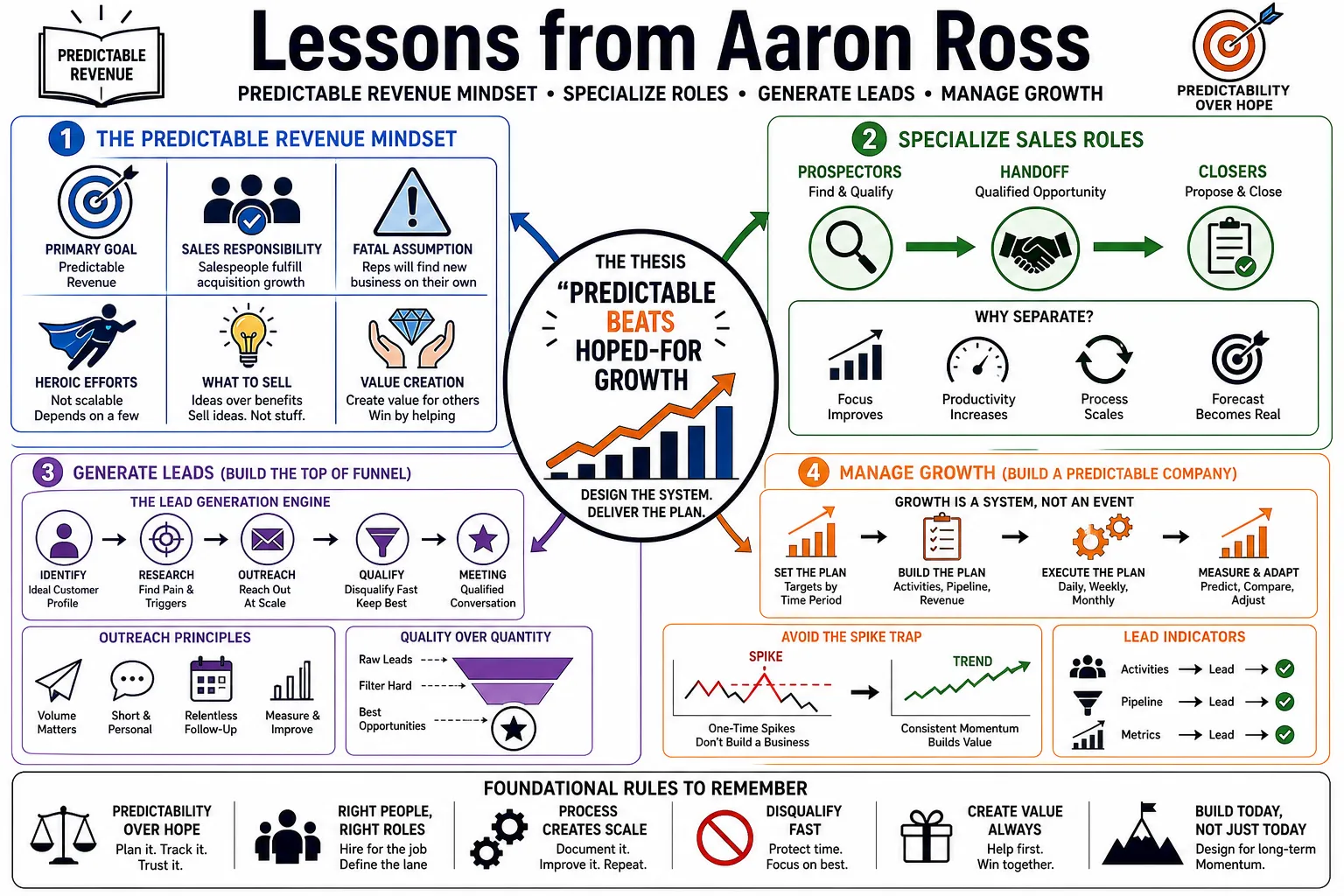
Lessons from Aaron Ross
Aaron Ross developed an outbound prospecting system at Salesforce and later documented the role-specialization and pipeline principles associated with Predictable Revenue. — For Entrepreneurs — Interview with Aaron Ross.
Part 1: The Predictable Revenue Mindset
- Predictability Matters: Revenue quality improves when the acquisition system is repeatable enough to forecast and improve. — Big Think — Seven Ingredients for Hypergrowth.
- Track Qualified Pipeline: Monthly qualified-pipeline creation is a leading indicator of future revenue, provided conversion quality remains sound. — SaaSholic — Aaron Ross on SaaS Sales.
- On Understanding Before Automation: Using AI to implement a sales idea without understanding why it works leaves a rep unable to adapt when a buyer goes off-script. — A total redo on Predictable Revenue
- On Activity Without Impact: AI can multiply polished sales activity while disguising the fact that meaningful pipeline impact has not improved. — A total redo on Predictable Revenue
- On Trust in an AI-Saturated Market: When competent-looking copy becomes abundant, generic polish stops creating credibility or differentiation. — A total redo on Predictable Revenue
Part 2: The Specialization of Sales Roles
- Specialize Sales Roles: Separate prospecting, closing, inbound qualification, and post-sale work so each role can develop focus and expertise. — SaaStr — Building a World-Class Outbound Team.
- Separate Inbound from Outbound: Once a team has enough coverage, inbound qualification and outbound prospecting should be owned by different people because the jobs require different rhythms. — SaaStr — Building a World-Class Outbound Team.
Part 3: Outbound Prospecting & Lead Generation
- Build a Predictable Pipeline: Growth becomes more manageable when the company has a repeatable system for creating qualified opportunities rather than relying on sporadic wins. — Big Think — Seven Ingredients for Hypergrowth.
- Prefer Quality Over Volume: Outbound should prioritize a smaller number of well-qualified opportunities over undifferentiated activity. — For Entrepreneurs — Specialized Sales Teams.
- Treat Referrals as Seeds: Referrals and word of mouth are distinct from inbound and outbound and should be measured as their own relationship-driven source. — SaaSholic — Aaron Ross on SaaS Sales.
- Treat Inbound as Nets: Inbound programs cast a broad net and should not be evaluated or routed in the same way as targeted outbound. — SaaSholic — Aaron Ross on SaaS Sales.
- Treat Outbound as Spears: Targeted outbound is a focused spear: it selects accounts deliberately and needs a dedicated prospecting process. — For Entrepreneurs — Specialized Sales Teams.
- Use Referral Emails to Find the Right Contact: Cold Calling 2.0 begins with a short email that asks for a referral to the relevant person instead of immediately pitching the executive. — For Entrepreneurs — Specialized Sales Teams.
- Use the 80/20 Trigger for Specialization: When a sales role spends more than roughly one-fifth of its time on a secondary function, consider separating that function into a dedicated role. — For Entrepreneurs — Specialized Sales Teams
- Interview Customers Before Buying More Tools: Direct customer conversations reveal language, priorities, and positioning problems that another sales application cannot discover for you. — SaaStr — Building a World-Class Outbound Team
- Use the Phone for Research and Follow-Up: The phone remains useful for research, mapping, and follow-up even when blind high-volume cold calling is not the primary outreach motion. — SaaStr — Building a World-Class Outbound Team
- On Emotional Agility: As AI absorbs more analytical work, creativity, intuition, and the ability to navigate uncertainty become stronger differentiators for sales leaders. — Predictable Revenue in Unpredictable Times
- Let Relationships Cut Through Noise: When generic outreach loses credibility, warm introductions and maintained relationships remain a durable way to earn attention. — Warm Revenue — Relationships Cut Through Noise
Part 4: Nailing a Niche
- Nail a Niche Before Scaling: A company is not ready to scale until it understands a specific customer, painful problem, and message that those buyers recognize. — Big Think — Seven Ingredients for Hypergrowth.
- Validate with Unaffiliated Customers: A niche is stronger when people without a prior relationship will buy, because that tests the offer beyond trust and referrals. — SaaStr — Building a World-Class Outbound Team.
- Win a Small Pond First: Focus on a narrow market where the company can become meaningfully relevant before expanding to adjacent segments. — Big Think — Seven Ingredients for Hypergrowth.
- Lead with Customer Pain: Positioning should begin with the customer problem and language, not an inventory of product features. — Big Think — Seven Ingredients for Hypergrowth.
- On Principles Outlasting Tactics: The tactics behind Predictable Revenue must evolve, but its core principles become more important as AI-generated noise increases. — Predictable Revenue in Unpredictable Times
- On Going Narrower in the AI Era: As AI makes campaigns and competitors cheaper to create, a deeply understood ideal customer becomes a more durable advantage. — Predictable Revenue in Unpredictable Times
Part 5: Navigating Hypergrowth & The Year of Hell
- Expect Growth to Take Longer: Important growth goals usually take years longer than hoped, so plans need enough time and resilience to survive the mismatch. — Big Think — Seven Ingredients for Hypergrowth.
- Sustaining Growth Is Harder Than Imagining It: The work is not only reaching a growth milestone but keeping the systems, people, and customers healthy afterward. — Big Think — Seven Ingredients for Hypergrowth.
- Growth Requires New Systems: Moving from modest growth to hypergrowth requires replacing practices that worked at the earlier stage. — SaaSholic — Aaron Ross on SaaS Sales.
- Do Not Accelerate Before the System Is Ready: Premature scaling can expose hiring, compensation, product, and process failures faster than the company can correct them. — Big Think — Seven Ingredients for Hypergrowth.
Part 6: Customer Success & Deal Strategy
- Bigger Deals Create Leverage: After establishing product-market fit, fewer larger and better-fit deals can make growth easier than serving many tiny accounts. — Big Think — Seven Ingredients for Hypergrowth.
- Show Value Before Telling: Demonstrating the result or customer outcome is more persuasive than relying only on claims about the product. — Big Think — Seven Ingredients for Hypergrowth.
- Create Pricing Room Early: It is operationally easier to reduce a high starting price than to retrain a market after setting the price too low. — SaaSholic — Aaron Ross on SaaS Sales.
- Make Customer Success a Growth Function: Customer success should improve retention, expansion, and realized outcomes rather than operate only as reactive support. — SaaSholic — Aaron Ross on SaaS Sales.
- Track the Revenue After the Sale: Measure churn, retention, and expansion so the revenue funnel includes what happens after acquisition. — SaaSholic — Aaron Ross on SaaS Sales.
- Optimize for Customer Outcomes: Closing is not the endpoint; the durable objective is helping the customer solve the problem that motivated the purchase. — SaaSholic — Aaron Ross on SaaS Sales.
- Sell the Solution, Not the Tool: Frame the offer around the business problem it resolves rather than the mechanics of the product. — Big Think — Seven Ingredients for Hypergrowth.
Part 7: Empowering Employees & CEOFlow
- Do Not Expect Employees to Behave Like Owners by Default: Employees do not hold the same incentives or control as founders, so ownership must be designed rather than demanded. — Big Think — Seven Ingredients for Hypergrowth.
- Build Emotional Ownership: People take greater responsibility when one person clearly owns an area, can make decisions, and is accountable for goals and deadlines. — Get Yourself Optimized — Aaron Ross Interview.
- Invest in Employees Who Want Ownership: Direct development toward people who want to learn, add value, and act on problems rather than merely complain about them. — Get Yourself Optimized — Aaron Ross Interview.
- Turn Complaints into Initiative: The difference between an entrepreneurial employee and a complainer is whether they act to improve the problem they see. — Get Yourself Optimized — Aaron Ross Interview.
- On Using AI to Remove Creative Friction: Use AI to structure raw thoughts and reduce intake friction, while keeping the output as the beginning of a conversation rather than outsourcing authorship. — Ramping Up By Removing Friction
Part 8: Personal Growth & Mindset
- Use Frustration to Define Direction: Instead of waiting for someone else to remove frustration, use it to clarify the future you want to build. — Big Think — Seven Ingredients for Hypergrowth.
- Use Public Commitments to Create Momentum: A specific public deadline can pull work forward before every implementation detail is known. — Get Yourself Optimized — Aaron Ross Interview.
- On Curiosity After Burnout: Curiosity is a smaller and safer way to recover engagement than demanding an immediate passion, plan, or income outcome. — Ramping Up By Removing Friction
- On Fear as a Signal: FOMO and fear of failure can create frantic motion or paralysis; noticing what they signal makes room for smaller experiments and reflection. — Two Fears Running Modern Life
Learn more: