Adam Neumann built WeWork into a global brand, presided over its failed 2019 public offering, and later returned to real estate with Flow. That history makes him a useful but complicated source on ambition, governance, community, and second acts. The lessons below draw mainly from two long-form conversations about Flow and from Andreessen Horowitz's investment thesis. They preserve the insights while treating Neumann's claims about his companies as his own account, not independent proof.
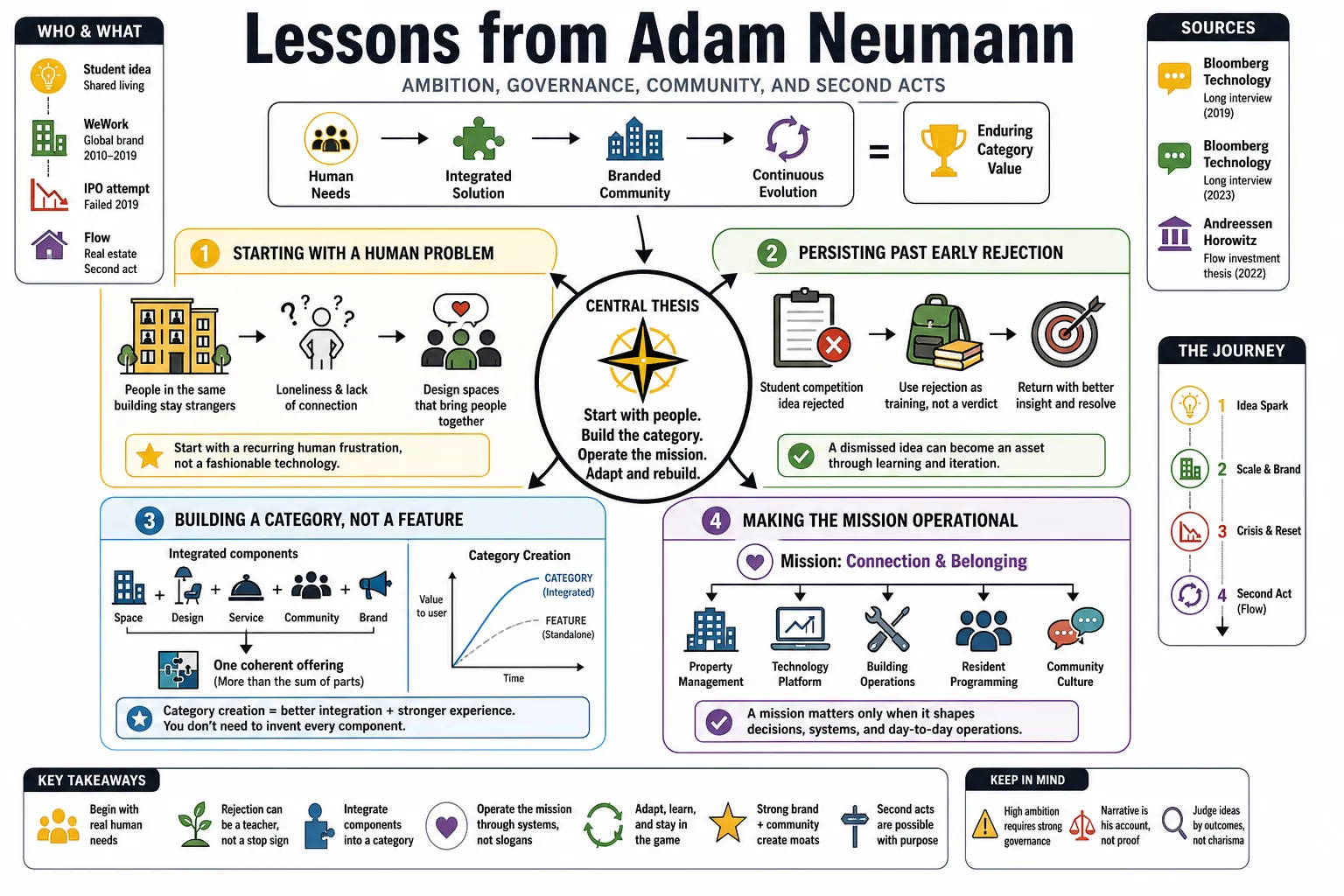
Part 1: Vision and Category Design
- On Starting With a Human Problem: Neumann's original interest in shared living began with a simple observation: people in the same apartment building often remain strangers. A category vision is strongest when it starts with a recurring human frustration rather than a fashionable technology. — Reference: Bloomberg Technology interview
- On Persisting Past Early Rejection: An entrepreneurship competition rejected his student-era shared-living concept. He now frames that rejection as evidence that a dismissed idea can still become useful experience, provided the founder learns instead of treating the verdict as final. — Reference: Bloomberg Technology interview
- On Building a Category, Not a Feature: WeWork combined space, design, service, community, and brand into one offering. The transferable lesson is that category creation often comes from integrating familiar components more coherently, not inventing every component from scratch. — Reference: Andreessen Horowitz's Flow investment thesis
- On Making the Mission Operational: Flow describes its mission in terms of connection and belonging, but Neumann links that aspiration to concrete choices: property management, technology, building operations, and resident programming. A mission matters only when it changes the operating model. — Reference: Bloomberg Technology interview
- On Letting the Problem Define the Technology: Neumann argues that conventional property software was designed around accounting and buildings rather than residents. His broader point is that inherited software architecture can quietly encode the priorities of the old business model. — Reference: a16z LP Summit conversation
- On Found from an unavoidable problem: Found a company because a problem feels unavoidable and burns from within, not because the status of being a founder sounds attractive. — The Ben & Marc Show — Adam Neumann interview
Part 2: Community as a Product
- On Designing for Repeated Interaction: Community is not produced by adding a lounge and hoping people meet. Flow tries to create repeated reasons for residents to interact through events, services, shared interests, and introductions. The product is the pattern of encounters, not merely the space. — Reference: Bloomberg Technology interview
- On Measuring Participation, Not Sentiment: Neumann points to event attendance and the share of events organized by residents as signs that a community is becoming self-sustaining. Participation is a more useful operating signal than vague claims that members feel connected. — Reference: Bloomberg Technology interview
- On Turning Residents Into Contributors: Flow's community-commerce concept lets residents offer services such as training or accounting to neighbors. A community becomes more durable when members can create value for one another instead of consuming programming supplied only by the operator. — Reference: a16z LP Summit conversation
- On Personalization With a Purpose: Learning a resident's interests can help surface relevant events and neighbors. The useful standard is whether data creates a better human experience, not whether the company can collect more data. — Reference: Bloomberg Technology interview
- On Making Participation Optional: Neumann describes an environment where residents can choose how much to engage. Healthy community design creates invitations and low-friction opportunities without turning belonging into mandatory corporate enthusiasm. — Reference: Bloomberg Technology interview
- On Retention as Community Infrastructure: Traditional landlords may prefer tenant turnover when a new lease can command higher rent. Flow's counterargument is that long-term residents carry relationships and local knowledge, making retention part of the community product as well as an economic variable. — Reference: a16z LP Summit conversation
- On Connecting Person to Place: Andreessen Horowitz's thesis argues that rental housing often fails to create either ownership-like security or a bond with the surrounding community. The broader product opportunity is to make a residence feel like a place people help shape rather than a temporary storage unit for their lives. — Reference: Andreessen Horowitz's Flow investment thesis
- On Engineering Inclusion: Drawing from his childhood strategy of moving often, Neumann observed that he would actively work to integrate marginalized peers. The broader implication is that community can be intentionally manufactured by focusing on integrating the periphery rather than catering only to the center. — Tetragrammaton Transcript on PodScripts
Part 3: Vertical Integration and Operating Systems
- On Owning the Feedback Loop: Flow combines property ownership or management, resident-facing software, payments, and brand. Vertical integration is valuable when it shortens the path from observing a resident problem to changing the service that residents receive. — Reference: a16z LP Summit conversation
- On Using Owned Operations as a Test Bed: Neumann describes Flow's buildings as a controlled environment for testing pricing, renewals, service design, and software. Owning the operating context can accelerate learning when outside customers would otherwise block or distort experimentation. — Reference: a16z LP Summit conversation
- On One Interface for a Fragmented Experience: Residents often need separate tools for payments, parking, guests, packages, and amenities. Consolidating those jobs into one interface can remove friction, but only if the underlying systems are integrated rather than hidden behind a cosmetic front end. — Reference: a16z LP Summit conversation
- On Building Architecture for Future Ideas: Neumann says his stream of product ideas requires a flexible technical foundation. The sober version of that lesson is to invest in extensibility where new use cases are likely, while resisting architecture built for every founder impulse. — Reference: Bloomberg Technology interview
- On Treating Technology as a Means: After WeWork's contested technology-company narrative, Neumann says Flow does not need the label. Technology earns its place by improving operations and resident experience; it does not change the economics of real estate merely because engineers are employed. — Reference: Bloomberg Technology interview
- On Winning the Basics First: Neumann says Flow is prioritizing profitable buildings and basic operational improvements before expanding the concept. Ambitious product layers are more credible when the underlying properties, renewals, service, and unit economics work. — Reference: a16z LP Summit conversation
- On Use AI to empower people: Use AI to empower people to become more capable rather than merely replacing their thinking. — Tetragrammaton with Rick Rubin — Adam Neumann transcript
- On Make architecture embody the mission: Make technical architecture embody the mission; systems optimized only for counting and revenue will produce a different company from systems designed around human connection. — Tetragrammaton with Rick Rubin — Adam Neumann transcript
Part 4: Leadership, Governance, and Dissent
- On Designing for Pushback: Neumann contrasts Flow's board discussions with a WeWork board where, by his account, decisions were repeatedly unanimous. Leaders should not interpret agreement as proof of quality; governance must make informed dissent normal and consequential. — Reference: Bloomberg Technology interview
- On Asking Partners to Speak Plainly: He says he explicitly asked Marc Andreessen to voice concerns directly. A useful partnership begins with permission for candor, but it becomes real only when criticism changes decisions or behavior. — Reference: a16z LP Summit conversation
- On Choosing Collaborative Investors: Neumann's account of Flow emphasizes investors who help with hiring, culture, and operating questions rather than appearing only for board votes and fundraising. Capital is more useful when the relationship supplies relevant judgment and practical support. — Reference: a16z LP Summit conversation
- On Aligning Through Shared Risk: Neumann and a16z each committed substantial capital to Flow, which he presents as alignment. Money alone cannot guarantee good governance, but meaningful shared exposure can make strategic disagreement more concrete. — Reference: a16z LP Summit conversation
- On Talking Last: Neumann recounts advice that a forceful founder should withhold an opinion until others have spoken. When the highest-status person leads with an answer, everyone else's information becomes less reliable. — Reference: Bloomberg Technology interview
- On Recruiting for Intellectual Independence: In describing Flow's CTO search, Neumann valued a candidate willing to show disagreement rather than merely mirror the founder. Senior hires should increase the organization's ability to correct itself, not extend the founder's preferences. — Reference: a16z LP Summit conversation
- On Letting Experts Change Your Choice: Neumann says Ben Horowitz preferred a different CTO finalist than he initially did, and he accepted the argument. Advice has little value if the founder seeks it only after the decision is emotionally settled. — Reference: a16z LP Summit conversation
- On Protect a small team's quality bar: Protect a small team's quality bar: one weak hire can lower expectations and eventually drive stronger people away. — Tetragrammaton with Rick Rubin — Adam Neumann transcript
- On Diligence investors and senior leaders: Diligence investors, senior hires, and technical leaders as seriously as they diligence you; moving quickly is not an excuse for skipping their histories. — The Ben & Marc Show — Adam Neumann interview
- On Explicitly invite criticism: Do not assume close partners will volunteer hard feedback; explicitly ask what you are doing wrong and what should change. — America Business Forum 2025 — Adam Neumann interview
- On Give advice eye to eye: Give advice eye-to-eye, without judging or idolizing the other person, and remain open to receiving advice in return. — America Business Forum 2025 — Adam Neumann interview
- On Repair mistakes without abandoning accountability: When you lose your composure, own the mistake directly while still addressing the underlying accountability problem. — America Business Forum 2025 — Adam Neumann interview
Part 5: Scale, Economics, and Boundaries
- On Separating Brand From Fundamentals: WeWork showed how a compelling narrative can accelerate expansion while obscuring the limits of the underlying business. Storytelling should clarify the economic model, not substitute for it. — Reference: Bloomberg Technology interview
- On Reading Operational Metrics Closely: In discussing his attempted WeWork bid, Neumann focused on occupancy, revenue per member, property margins, and cash flow. Whatever the merits of his bid, the habit is sound: turnaround plans should be tested against the operating assumptions required to make them true. — Reference: Bloomberg Technology interview
- On Matching Scale to Control Systems: Global expansion magnifies weak governance, poor financial discipline, and inconsistent execution. The faster a company grows, the earlier it needs controls that can surface bad news without waiting for a crisis. — Reference: Bloomberg Technology interview
- On Integrating Work and Home Carefully: Neumann argues that remote work makes the future of living inseparable from the future of work. The opportunity is real, but the design should expand residents' choices rather than turn the home into a permanent extension of the office. — Reference: Bloomberg Technology interview
- On Proving Claims With Operations: Neumann cites improved operating income at a Flow property and resident participation as evidence for the model. Founder-reported results are only a starting point; a durable company must eventually make its performance legible through consistent, independently credible metrics. — Reference: Bloomberg Technology interview
- On Growth outpacing personal capacity: When a company's hypergrowth exceeds the founder's own spiritual and emotional development, even well-intentioned controls and feedback loops will fail to keep the culture grounded. — Tetragrammaton with Rick Rubin
- On Pair market metrics with cultural fit: Evaluate international expansion with both quantitative signals and firsthand cultural fit; attractive numbers are only the opening hypothesis. — America Business Forum 2025 — Adam Neumann interview
Part 6: Failure and the Second Act
- On Preserving Achievement Without Denying Failure: Neumann acknowledges mistakes while defending the difficulty and scale of what the WeWork team built. Mature reflection can hold both ideas at once: the achievement was real, and so were the governance and financial failures. — Reference: Bloomberg Technology interview
- On Testing Growth in Familiar Stress: He suggests that personal growth is visible when a leader encounters the same pressure that previously triggered poor behavior. A second act should be judged less by the leader's new vocabulary than by decisions made under familiar strain. — Reference: Bloomberg Technology interview
- On Returning With Constraints: Flow returns Neumann to community-oriented real estate, but with outspoken board partners, a narrower operating base, and stated attention to profitable fundamentals. Reinvention is most credible when it adds constraints that directly address the failure modes of the first attempt. — Reference: a16z LP Summit conversation
- On Show up when others retreat: In a crisis, simply calling or showing up when others retreat can create asymmetric opportunity. — The Ben & Marc Show — Adam Neumann interview