Alex Korb is a neuroscientist, author and adjunct assistant professor at UCLA. In The Upward Spiral and his related program, he discusses how everyday actions, thoughts and relationships can interact with mood and brain circuits. His suggestions are not a substitute for individual clinical care. — Alex Korb Biography.
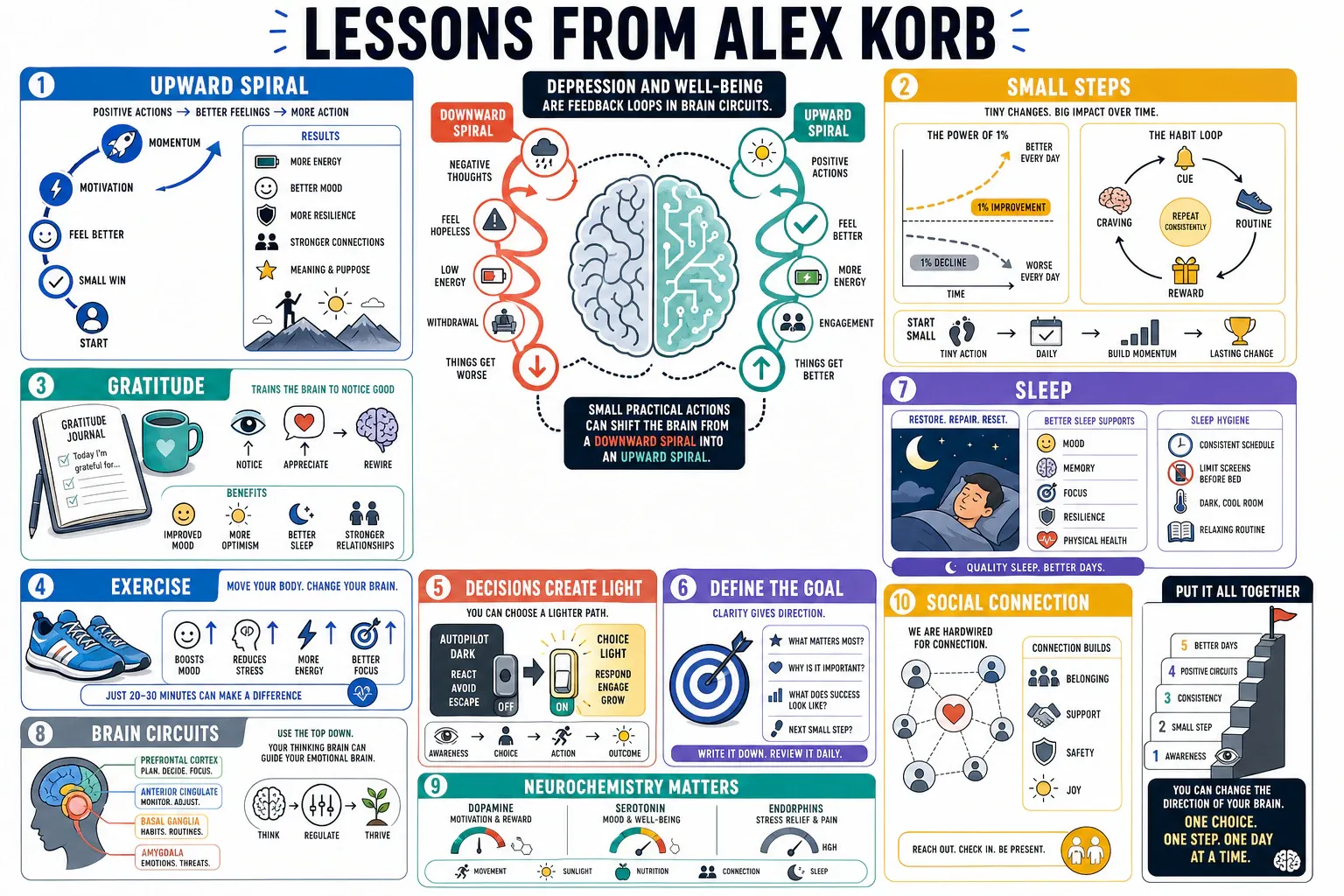
On the Nature of Depression
- The Downward Spiral: Korb describes depression as a self-reinforcing pattern: low mood can change thinking and behavior in ways that make the pattern harder to interrupt. — Bloomsoup Interview.
- Brain Circuits, Not a Broken Brain: He describes depression in terms of how thinking, feeling and action circuits interact, rather than saying that a person has a defective brain. — Bloomsoup Interview.
- Depression Is More Than Sadness: Depression is not simply constant sadness; Korb notes that it can also involve emptiness, low energy and reduced interest or pleasure. — Lawyers with Depression Interview.
- Many Contributing Causes: Korb compares depression to a traffic jam with many contributing causes: the combined dynamics matter more than any one isolated trigger. — Lawyers with Depression Interview.
- Ordinary Brain Systems: The circuits involved in anxiety and depression are ordinary human brain systems; Korb argues that their interactions, not a moral defect, can produce distressing patterns. — Bloomsoup Interview.
- Not a Character Flaw: Korb cautions against treating depression as a character flaw and recommends professional help when someone is depressed. — Lawyers with Depression Interview.
The Power of Small Changes and the Upward Spiral
- A Possible Upward Spiral: The upward-spiral idea is that modest changes can sometimes support further constructive changes; it is a framework for action, not a promise of recovery. — The Upward Spiral — Publisher.
- Actions and Circuits: Korb argues that changing what one repeatedly does and attends to can influence the circuits involved in mood over time. — Bloomsoup Interview.
- Small Steps Can Build: A small, manageable change can create an opportunity for another one, which is the positive-feedback pattern Korb calls an upward spiral. — Bloomsoup Interview.
- No Single Big Fix: Korb presents multiple small, practical actions rather than one universal fix for depression. — The Upward Spiral — Publisher.
- Start With a Manageable Action: Korb suggests starting with a manageable action, such as a short daily walk, instead of waiting for enough motivation to change everything at once. — Bloomsoup Interview.
On Exercise
- Movement and the Brain: Korb includes movement among the habits that can influence focus, stress and sleep; the specific neurotransmitter effects should not be inferred for an individual. — The Upward Spiral Method.
- Movement, Not a Serotonin Ranking: His movement module recommends getting the body moving as one way to support focus, sleep and stress management; it does not establish that one aerobic activity is best for serotonin. — The Upward Spiral Method.
- A Little Movement Counts: A modest bout of movement is worthwhile in Korb’s approach even when it does not solve every problem; he recommends attainable activity over all-or-nothing expectations. — Bloomsoup Interview.
- Exercise as Support: Korb presents exercise as one supportive behavior that can affect mood-related systems, without claiming that it alone treats depression. — The Upward Spiral Method.
On Gratitude
- Gratitude and Sleep: Korb reviews studies linking gratitude practice with better sleep and mood, while treating a gratitude journal as a supportive practice rather than a treatment guarantee. — The Grateful Brain.
- Remember to Look: For Korb, the useful first step in gratitude is remembering to look for something one appreciates, not forcing a particular feeling. — Lawyers with Depression Interview.
- Attention and Appreciation: Korb argues that directing attention toward what one appreciates can make positive experiences easier to notice; it need not erase difficult emotions. — The Grateful Brain.
- Acknowledge the Small Positive: Even when circumstances are difficult, a gratitude practice can make room to notice a smaller positive element without denying the larger difficulty. — The Grateful Brain.
- Gratitude and Relationships: Korb includes gratitude as a practice that can support relationships, as well as mood and sleep. — The Upward Spiral Method.
On Decision Making and Goals
- Decide on a Next Step: Korb encourages making a workable decision when indecision itself is keeping a person stuck. — Bloomsoup Interview.
- Define the Goal: Korb argues that clearer goals help organize attention and action; a vague goal makes progress harder to recognize. — The Upward Spiral Method.
- Goals Organize Attention: He describes clarified goals as a way to direct attention and resources toward a chosen outcome. — The Upward Spiral Method.
- Avoid Endless Optimization: When worry produces too many options, Korb suggests narrowing the choice and making a good-enough decision rather than endlessly optimizing. — Bloomsoup Interview.
- Choose a Viable Direction: His practical decision advice favors choosing a viable next direction when waiting for a perfect answer would prevent any progress. — Bloomsoup Interview.
On Habits
- Everyday Practices: Korb’s workbook groups practical exercises around movement, sleep, gratitude, mindfulness and social interaction, treating habits as one part of mental-health support. — The Upward Spiral Workbook.
- Repetition Builds Habits: Korb explains that repeated cues and actions strengthen habits; changing them requires practice and patience rather than a single declaration. — The Powerful Pull of Repeating Old Routines.
- Why Old Routines Persist: The dorsal striatum helps automate familiar routines, which is one reason an old habit can reappear under stress. — The Powerful Pull of Repeating Old Routines.
On Self-Compassion and Acceptance
- Patience With Habits: Korb recommends patience and self-compassion when retraining a habit, instead of adding stress through harsh self-criticism. — The Powerful Pull of Repeating Old Routines.
- Non-Judgmental Acceptance: Korb’s mindfulness module emphasizes acceptance and non-judgmental awareness of feelings rather than labeling the feelings themselves as failures. — The Upward Spiral Method.
- Compassion, Not Brokenness: He argues that calling oneself broken is less useful than treating oneself with compassion while taking practical steps. — Bloomsoup Interview.
- Respond to Setbacks Kindly: Korb recommends responding to setbacks with patience and self-compassion rather than turning them into evidence of personal failure. — Bloomsoup Interview.
- Interrupt Self-Criticism: His compassion module aims to interrupt recurring self-criticism and shame while retaining accountability for what is within one’s control. — The Upward Spiral Method.
On Mindfulness and Awareness
- Notice Without Judgment: Korb distinguishes noticing an experience from judging it; his mindfulness practice centers on non-judgmental awareness. — The Upward Spiral Method.
- Return to the Present: Korb presents mindfulness as a practice for returning attention to the present and managing stress, without promising a lasting reduction in anxiety for everyone. — The Upward Spiral Method.
- Practice Present-Moment Awareness: His mindfulness module asks participants to practice present-moment awareness and acceptance rather than automatically following a worried thought. — The Upward Spiral Method.
- Mindfulness and Stress: Korb describes mindfulness as one way to work with stress responses and anxious activity; the precise effect on any individual’s amygdala is not established here. — The Upward Spiral Method.
On Social Connection
- Start by Being Around Others: Korb says that social activity can begin with simply being around other people, before trying to build a deep new relationship. — Bloomsoup Interview.
- Strengthen the Support Network: His social module focuses on strengthening relationships and support networks as part of resilience to stress. — The Upward Spiral Method.
On Sleep
- Sleep Quality Matters: His sleep module treats improving sleep quality as a way to support mood and productivity, without a claim about a specific neurotransmitter level. — The Upward Spiral Method.
- Examine Sleep Habits: Korb’s workbook includes sleep hygiene as a practical topic; routines and environment are possible levers to discuss when sleep is poor. — The Upward Spiral Workbook.
- Sleep and Mood: Korb considers sleep quality an important part of mood management, not a standalone cure for depression. — The Upward Spiral Method.
On Worry and Anxiety
- Worry About the Wrong Choice: Korb describes worry about a possible wrong decision as one reason a person can remain stuck despite having several workable options. — Bloomsoup Interview.
- The Perfect-Choice Trap: He links some indecision and worry to trying to identify the perfect option, and recommends a workable choice instead. — Bloomsoup Interview.
- Good Enough Is Enough: His good-enough approach favors a realistic next step over maximizing every outcome. — Bloomsoup Interview.
- Anxiety Is Not a Character Flaw: Korb describes anxiety as arising from the interaction of ordinary brain circuits, not as proof that a person is weak or defective. — Bloomsoup Interview.
Learn more:
- Alex Korb, Ph.D. — About
- The Upward Spiral: Using Neuroscience to Reverse the Course of Depression, One Small Change at a Time — New Harbinger Publications
- Overcoming Depression: An In-Depth Interview With Dr. Alex Korb — Bloomsoup
- Your Brain on Depression: An Interview With Neuroscientist Dr. Alex Korb — Lawyers with Depression
- The Upward Spiral Workbook — Alex Korb, Ph.D.
- The Grateful Brain — Psychology Today
- The Powerful Pull of Repeating Old Routines — Psychology Today
- The Upward Spiral Method — Alex Korb, Ph.D.