Annie Duke is a former professional poker player, author, and decision scientist focused on making better choices under uncertainty. A Special Partner at First Round Capital and co-founder of the Alliance for Decision Education, she completed her Ph.D. in cognitive psychology at the University of Pennsylvania in 2023. Drawing on poker, behavioral science, and her books Thinking in Bets, How to Decide, and Quit, Duke offers practical tools for separating decisions from outcomes, forecasting explicitly, learning from feedback, and knowing when to walk away.
Decision Quality and Uncertainty
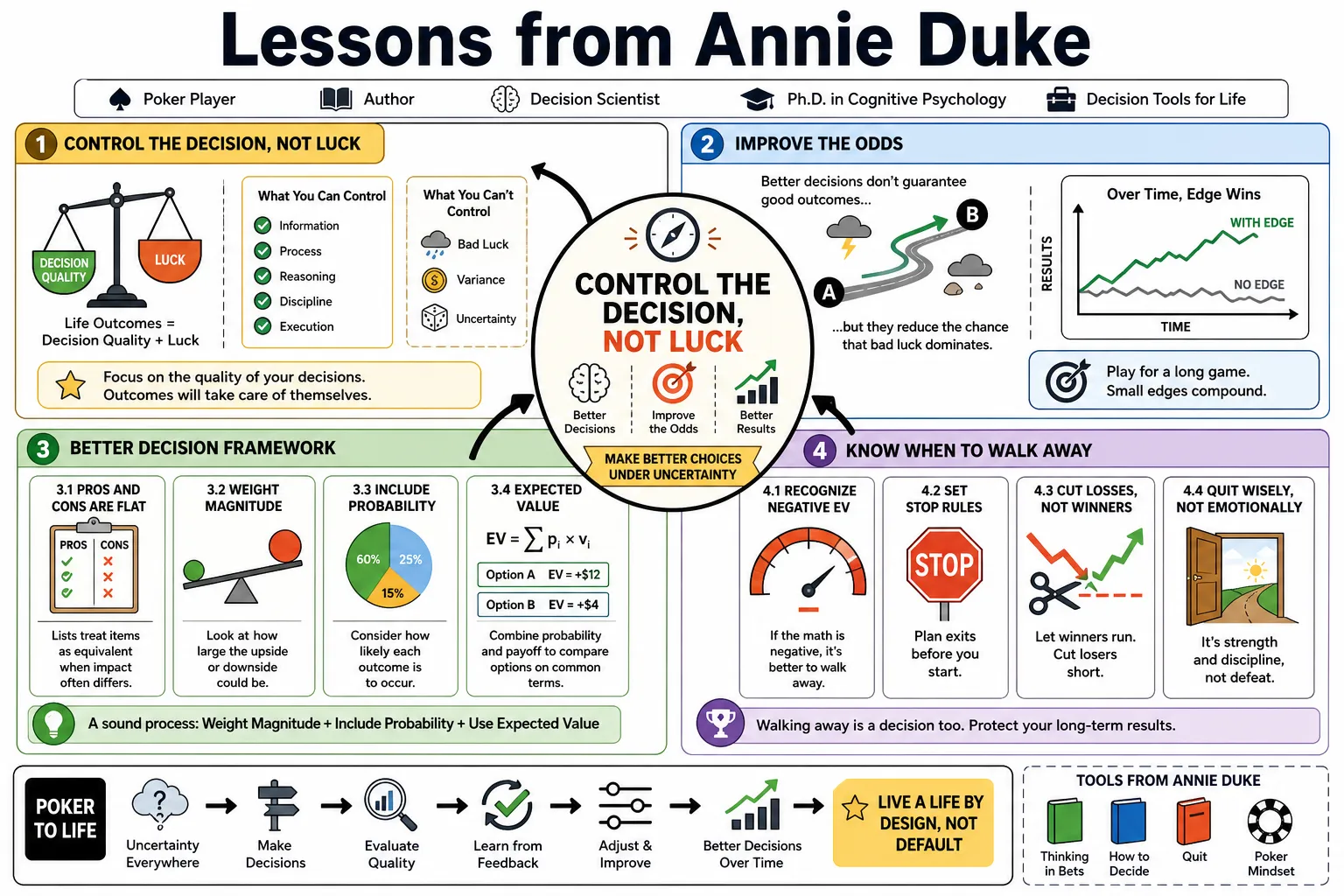
- On Control the Decision, Not Luck: Life outcomes reflect both luck and decision quality; only the quality of the decision is meaningfully under your control. — Reference: Clearer Thinking — Annie Duke interview transcript
- On Improve the Odds: Better decisions cannot guarantee good outcomes, but they can reduce the chance that bad luck dominates your life. — Reference: Clearer Thinking — Annie Duke interview transcript
- On Pros and Cons Are Flat: A conventional pros-and-cons list treats items as equivalent even when their possible impact differs dramatically. — Reference: Clearer Thinking — Annie Duke interview transcript
- On Weight Magnitude: A sound decision process distinguishes the magnitude of an upside or downside instead of merely counting list entries. — Reference: Clearer Thinking — Annie Duke interview transcript
- On Include Probability: Evaluate both how large an outcome might be and how likely it is to occur. — Reference: Clearer Thinking — Annie Duke interview transcript
- On Expected Value: Expected value combines probability and payoff, allowing options with different risks and rewards to be compared on common terms. — Reference: Clearer Thinking — Annie Duke interview transcript
- On Make Forecasts Explicit: Every decision contains a forecast; writing it down turns hidden reasoning into an object that can be examined and improved. — Reference: Clearer Thinking — Annie Duke interview transcript
- On Expose Reasoning to Others: Explicit reasoning lets other people identify flaws and contribute information you do not possess. — Reference: Clearer Thinking — Annie Duke interview transcript
- On Two Forms of Uncertainty: Separate randomness from missing knowledge: luck is aleatory uncertainty, while epistemic uncertainty is what you do not know. — Reference: Clearer Thinking — Annie Duke interview transcript
- On Unknown Unknowns: The universe of missing knowledge includes both things you know you do not know and things you have not realized are missing. — Reference: Clearer Thinking — Annie Duke interview transcript
- On Use Heuristics Deliberately: Rules of thumb are useful shortcuts that speed everyday decisions, provided you understand what they omit. — Reference: Clearer Thinking — Annie Duke interview transcript
- On Separate Sorting from Picking: Decision-making first sorts good options from bad ones, then picks among the remaining good choices. — Reference: Clearer Thinking — Annie Duke interview transcript
- On Sorting Does the Heavy Work: Most decision value comes from defining constraints and eliminating poor options; the final selection often matters less. — Reference: Clearer Thinking — Annie Duke interview transcript
- On Do Not Result: A bad outcome does not prove that a decision was bad; rare adverse outcomes still occur after sound reasoning. — Reference: Clearer Thinking — Annie Duke interview transcript
- On Close the Feedback Loop: Record the original rationale so new information can improve later decisions rather than rewriting the past. — Reference: Clearer Thinking — Annie Duke interview transcript
- On Start with the Monkey: On a difficult project, test the hardest uncertain component before building the easy supporting infrastructure. — Reference: Clearer Thinking — Annie Duke interview transcript
- On Solve the Bottleneck First: The most uncertain component deserves attention first because the rest of the project has no value if that bottleneck cannot be solved. — Reference: Clearer Thinking — Annie Duke interview transcript
Learning and Belief Calibration
- On Get Comfortable Not Knowing: Admitting uncertainty is a prerequisite for better judgment, not evidence of weakness. — Reference: AnnieDuke.com — Thinking in Bets excerpts
- On Judge the Process: A great decision is defined by a good process that accurately represents what you knew at the time, not by a favorable result. — Reference: AnnieDuke.com — Thinking in Bets excerpts
- On Beliefs Expire: Because learning never stops, information once treated as fact may become obsolete. — Reference: AnnieDuke.com — Thinking in Bets excerpts
- On Experience Requires Interpretation: Experience teaches only when you actively examine what happened instead of treating exposure alone as learning. — Reference: AnnieDuke.com — Thinking in Bets excerpts
- On Account for Luck: Explaining an outcome well begins by recognizing that luck may have contributed alongside skill. — Reference: AnnieDuke.com — Thinking in Bets excerpts
- On Avoid All-or-Nothing Attribution: Outcomes are rarely entirely caused by luck or entirely caused by skill. — Reference: AnnieDuke.com — Thinking in Bets excerpts
- On Watch Self-Serving Bias: Attributing wins to skill and losses to luck blocks the lessons that experience might otherwise provide. — Reference: AnnieDuke.com — Thinking in Bets excerpts
- On Small Corrections Compound: Recognizing a few additional learning opportunities can create large long-term gains as small corrections accumulate. — Reference: AnnieDuke.com — Thinking in Bets excerpts
- On Invite Error Detection: Other people often spot errors in your reasoning more readily than you can. — Reference: AnnieDuke.com — Thinking in Bets excerpts
- On Seek Disagreement: Belief improvement benefits from people and information sources you are likely to disagree with. — Reference: AnnieDuke.com — Thinking in Bets excerpts
- On Review Before Outcomes: Deconstruct a decision before its result is known so outcome knowledge cannot distort the evaluation. — Reference: AnnieDuke.com — Thinking in Bets excerpts
- On Practice Cooperative Skepticism: Skepticism works best as a civil, cooperative investigation that asks why a claim might not be true. — Reference: AnnieDuke.com — Thinking in Bets excerpts
Quitting and Project Design
- On Treat Sunk Costs as Irrelevant: Resources already spent should not determine whether you invest additional time, money, or identity in a project. — Reference: Clearer Thinking — Annie Duke interview transcript
- On Recognize Status Quo Bias: People naturally prefer leaving things as they are, even when switching would improve the future. — Reference: Clearer Thinking — Annie Duke interview transcript
- On Omission Still Chooses: Not acting feels less blameworthy than acting, but an omission is still a decision with consequences. — Reference: Clearer Thinking — Annie Duke interview transcript
- On Switching Losses Feel Larger: Losses caused by a visible change feel more intense than losses caused by staying put, which makes quitting harder. — Reference: Clearer Thinking — Annie Duke interview transcript
- On Quitting Usually Comes Late: Sunk costs, status quo bias, and omission bias combine to keep people in failing efforts longer than they should. — Reference: Clearer Thinking — Annie Duke interview transcript
- On Use Premortems: Before beginning, imagine failure and identify the warning signs that would have predicted it. — Reference: Lenny's Podcast — Annie Duke interview and takeaways
- On Set Kill Criteria in Advance: Commit before launch to reassess or pivot when specific red flags appear, while judgment is less distorted by ownership and sunk costs. — Reference: Lenny's Podcast — Annie Duke interview and takeaways
- On Run the Start-Today Test: If quitting crosses your mind, ask whether you would begin the same project today given everything you now know. — Reference: Lenny's Podcast — Annie Duke interview and takeaways
- On A Free-Roll Decision: When an action has meaningful upside and no real downside, uncertainty about the exact size of the win is not a reason to avoid it. — Reference: Brainfluence — Annie Duke explains how to decide
- On Confront Persistent Uncertainty: The world was never predictable; recent disruption has made its uncertainty harder to ignore. — Reference: Annie Duke Substack — What happens when your career has quit on you
Group Decisions and Communication
- On Discover Independently: Collect individual opinions before group discussion so early speakers do not anchor everyone else. — Reference: Lenny's Podcast — Annie Duke interview and takeaways
- On Discuss Disagreement: Use group discussion to understand differences in assumptions rather than forcing premature consensus. — Reference: Lenny's Podcast — Annie Duke interview and takeaways
- On Decide After Discussion: After sharing perspectives, make the final judgment independently to reduce conformity pressure. — Reference: Lenny's Podcast — Annie Duke interview and takeaways
- On Acknowledge and Proceed: The word nevertheless can recognize another person's perspective while preserving a clear decision or stance. — Reference: Lenny's Podcast — Annie Duke interview and takeaways
- On Replace Combat with Curiosity: Saying that you do not understand invites explanation more effectively than declaring that someone is wrong. — Reference: Lenny's Podcast — Annie Duke interview and takeaways
- On Let People Feel Heard: People are more likely to accept a decision they opposed when they can see that their reasoning contributed to the process. — Reference: Lenny's Podcast — Annie Duke interview and takeaways