Alexandr Wang co-founded Scale AI, building data infrastructure for AI developers, and moved to Meta in 2025 to lead its superintelligence work. His essays and interviews connect the quality of AI data to technical progress, while his later public positions address agents, leadership, and how powerful AI should serve people. — TIME — Alexandr Wang Interview.
On Vision and Strategy
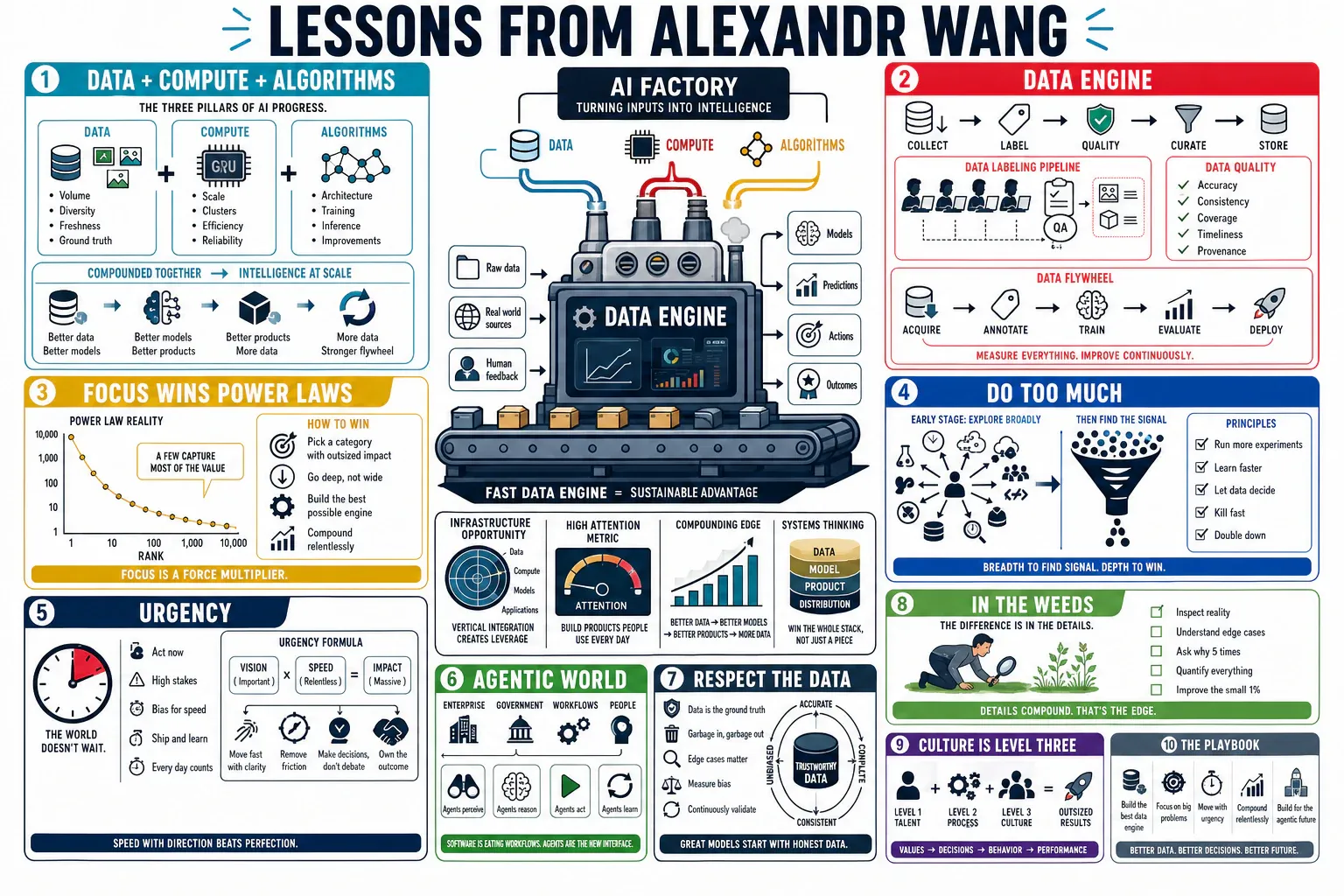
- On three inputs to AI progress: Wang names data, compute and algorithms as three interdependent inputs to AI progress, with Scale concentrating on the data bottleneck. — TIME — Alexandr Wang Interview.
- On taking data seriously: Wang says high-quality data was an underappreciated bottleneck and describes Scale as treating it as a first-class technical problem. — TIME — Alexandr Wang Interview.
- On data infrastructure: Wang describes Scale as a data infrastructure provider for major AI developers; the old claim that literally every LLM depends on Scale is removed. — Accel — Alexandr Wang Interview.
- On entering an emerging market: Wang tells founders to notice infrastructure needs while a market is developing rather than waiting until the opportunity looks fashionable. — Accel — Alexandr Wang Interview.
- On agentic institutions: Wang expects agents to alter business and government work, while stressing that infrastructure and policy choices will shape how that future unfolds. — TIME — Alexandr Wang Interview.
- On multimodal capabilities: Wang expected AI models to improve beyond text across more modalities; this is a prediction from his recorded Accel conversation, not a measured result. — Accel — Alexandr Wang Interview.
- On opportunism: In his 2023 reflections, Wang argues that fast-moving AI developments reward responsiveness to opportunities more than rigid plans. — What I Learned in 2023.
- On power-law focus: Wang writes that, where outcomes are highly unequal, much of the work is finding the one consequential problem on which to focus. — What I Learned in 2023.
- On U.S.–China AI competition: Wang argues that the United States should prioritize AI leadership in its competition with China; this is his policy position, not a neutral description of a literal war. — CNBC — Alexandr Wang Interview.
- On a conditional AGI timeline: Wang speculates that AGI could be a few years away under his remote-computer-worker definition; this is his contingent forecast, not a settled timeline. — CNBC — Alexandr Wang Interview.
- On locally relevant AI: At the India AI Impact Summit, Wang argued that AI tools should reflect countries’ languages and local needs rather than use one uniform model for every market. — Economic Times — India AI Impact Summit.
- On health as a product focus: At Bloomberg Tech, Wang described consumer health as important to Meta’s models as they scale; this is an announced product priority, not medical validation. — Bloomberg Tech — Wang on AI and Health.
On Leadership and Building a Company
- On levels of leadership: Wang distinguishes completing immediate tasks, choosing the right tasks and shaping organizational culture as separate leadership responsibilities. — TIME — Alexandr Wang Interview.
- On detailed leadership: Wang describes his management style as detail-oriented, urgent and closely involved in the company’s critical problems. — TIME — Alexandr Wang Interview.
- On the leader’s upper bound: Wang writes that a leader sets a ceiling for how much care and effort others will bring; “do too much” is his deliberately demanding management philosophy. — DO TOO MUCH.
- On language for intensity: Wang’s “DO TOO MUCH” essay reframes overcommunication, overdelivery and prioritization as ordinary requirements of ambitious leadership; it is his opinion, not universal management law. — DO TOO MUCH.
- On exceptional teams: Wang urges founders to fight for exceptional teammates, arguing that unusual combinations of people can produce results no individual could alone. — What I Learned in 2023.
- On protecting team quality: In an original a16z interview, Wang discusses the difficulty of keeping a high-performing team and integrating executives as a startup grows; replace the Glasp summary as evidence. — a16z — Human Data Is Key to AI.
- On different innovation advantages: Wang argues that startups benefit from speed and idea recombination, while large companies can succeed by executing a clear, earlier mission. — What I Learned in 2023.
- On momentum: Wang’s 2023 essay says small teams with momentum can exceed what headcount alone would predict; the slogan is a perspective, not a measured rule. — What I Learned in 2023.
- On useful naïveté: Wang tells Accel that a novice viewpoint can help a founder question assumptions entrenched firms accept; it is an advantage in some situations, not a substitute for expertise. — Accel — Alexandr Wang Interview.
- On changing Scale’s focus: Wang says Scale shifted much of its team toward data for large language models within months of the 2022 generative-AI wave; the change illustrates responsiveness. — DO TOO MUCH.
- On cross-institution AI policy: The Wang-coauthored policy paper calls for coherent strategy and cooperation around superintelligence risk; the profile’s unattributed wish about personal industry animosities is removed. — Superintelligence Strategy.
On Personal Growth and Learning
- On beginner’s mind: Wang warns that past expertise can become a trap in novel situations and urges a willingness to learn like a novice. — What I Learned in 2023.
- On prolific practice: Wang urges builders to produce and practice repeatedly rather than wait for the perfect idea; this is his advice, not an empirical claim about every great person. — What I Learned in 2023.
- On filtering advice: Wang argues that most advice will not fit a particular situation, yet useful fragments can be extracted from it. — What I Learned in 2023.
- On discomfort in competition: Wang writes that winning often requires tolerating discomfort; his sports analogy should not be presented as a guarantee that pain produces success. — What I Learned in 2023.
- On doubling down on strengths: Wang advises people to identify distinctive strengths and build around them instead of only repairing weaknesses. — What I Learned in 2023.
- On compounding pursuits: Wang contrasts durable investments in technology and teams with more perishable status rewards, favoring activities whose benefits compound. — What I Learned in 2023.
- On minimizing regret: In a 2016 first-person essay, Wang says he pursued time-sensitive opportunities he found absorbing, framing his decision to start a company as regret minimization. — What I Learned in 2016.
- On learning by making: Wang’s YC reflection says founders learn by building and speaking with users; the experience was not a magical substitute for doing the work. — What I Wish I Had Known Before YC.
- On his own learning curve: Wang reports that his learning accelerated during intense early engineering work; this is his retrospective experience, not a general superlinear law. — What I Learned in 2016.
On the Future of AI and Humanity
- On human-led AI: In his 2022 TEDx talk, Wang argues for AI guided by human judgment and values; this is his outlook, not proof that all future systems will stay human-led. — TEDxBerkeley — Why AI Will Never Replace Humans.
- On aligning systems with people: Wang argues that training data and human feedback help steer models toward truthful and fair behavior, while acknowledging mistakes and the continuing need for oversight. — TEDxBerkeley — Why AI Will Never Replace Humans.
- On augmenting human work: Wang describes AI as potentially taking repetitive work off people’s hands so they can focus on ideas and judgment; his 2022 talk makes a normative case, not a categorical forecast. — TEDxBerkeley — Why AI Will Never Replace Humans.
- On skills beyond prompting: In a recorded WaitWhat/Intel discussion, Wang identifies prompt use but also sustained reasoning and technical fundamentals as valuable skills; the advice is his forecast. — WaitWhat/Intel — Alexandr Wang Conversation.
- On limits of multi-step reasoning: Wang says contemporary models can stumble several steps into a reasoning task; the observation was time-bound to the models discussed in that interview. — WaitWhat/Intel — Alexandr Wang Conversation.
- On technical fundamentals: Wang stresses math, physics and other technical foundations alongside AI tools in his recorded skills discussion. — WaitWhat/Intel — Alexandr Wang Conversation.
- On humans managing agents: Wang imagines a more agentic economy in which people supervise AI agents; this is a future scenario, not an established terminal economic state. — Y Combinator Lightcone — Alexandr Wang.
- On continued invention: Wang’s 2023 essay expresses optimism that people will continue to pursue scientific and technical breakthroughs despite AI-related concerns. — What I Learned in 2023.
- On superintelligence risk: In a coauthored strategy paper, Wang and colleagues liken superintelligence to a national-security challenge and argue for deliberate safeguards; their analogy does not establish a measured risk level. — Superintelligence Strategy.
- On data and fairness: Wang’s TEDx talk argues that human guidance and the quality of training data influence whether AI reflects human intentions; the slogan about fairness is recast as this bounded position. — TEDxBerkeley — Why AI Will Never Replace Humans.
- On personal AI: Wang says Meta wants agents that understand users’ goals and can act on their behalf across its products; it is a proposed direction, not a fully realized personal superintelligence. — Economic Times — Wang Interview.
- On trust for personal AI: Meta’s published vision says a personal agent handling sensitive context needs privacy and security controls; this is the company’s promise, not an independently verified feature or direct Wang quote. — Meta — Personal Superintelligence.
On Entrepreneurship and Startups
- On founding within current capability: Wang advises AI founders to build for capabilities they can plausibly use now rather than rely entirely on unresolved model problems disappearing. — Accel — Alexandr Wang Interview.
- On founding Scale: Scale’s own transition announcement identifies Wang as its founder; his early account describes starting the company after studying at MIT rather than completing a degree. — Scale AI — Next Phase Announcement.
- On an early autonomous-vehicle market: Wang recounts Scale’s early work serving computer-vision and autonomous-vehicle data needs before LLM training became a major focus. — Y Combinator Lightcone — Alexandr Wang.
- On what YC cannot supply: Wang’s firsthand YC essay says the accelerator reinforced hard work, user conversations and making something people want, but founders still had to do those things themselves. — What I Wish I Had Known Before YC.
- On effort and ambition: Wang’s leadership essay states that extraordinary outcomes require more than ordinary effort; this is his founder philosophy, now cited to the original rather than a newsletter summary. — DO TOO MUCH.
- On human input to AI: Wang’s TEDx talk explains that expert human annotation and feedback are important to building reliable datasets and steering model behavior. — TEDxBerkeley — Why AI Will Never Replace Humans.
- On reacting to a new model wave: Wang says Scale moved much of its team toward LLM-scaling data within about six months as generative AI accelerated in 2022. — DO TOO MUCH.
- On a scientific upbringing: Accel’s original conversation identifies Wang’s Los Alamos upbringing with two physicist parents; he links that environment to an early interest in technical work. — Accel — Alexandr Wang Interview.
- On a refrigerator-camera experiment: Wang recalls trying an AI-assisted fridge camera and discovering that the amount of data needed was harder to gather than expected; the story illustrates his early attention to data. — TEDxBerkeley — Why AI Will Never Replace Humans.
- On conviction before consensus: In a Y Combinator conversation, Wang advises founders to develop a well-grounded view of an important future before the idea becomes popular and to stay oriented by that conviction. — Y Combinator Startup School — Alexandr Wang.
Learn more:
- Former Scale AI CEO Alexandr Wang on AI’s Potential and Its Deficiencies — TIME Interview
- Scale AI’s Alexandr Wang on the Most Powerful Technological Advancement of Our Time — Accel Interview
- What I Learned in 2023 — Alexandr Wang
- Alexandr Wang on the U.S.–China AI Race — CNBC Interview
- DO TOO MUCH — Alexandr Wang
- Why Human Data Is Key to AI — a16z Interview with Alexandr Wang
- Building Scale AI, Working With Agents and Competing With China — Y Combinator Lightcone
- What I Learned in 2016 — Alexandr Wang
- What I Wish I Had Known Before YC — Alexandr Wang
- Why AI Will Never Replace Humans — Alexandr Wang at TEDxBerkeley
- AI Skills for the Future — WaitWhat/Intel Conversation with Alexandr Wang
- Superintelligence Strategy: Expert Version — Hendrycks, Schmidt and Wang
- AI for Local Needs — Alexandr Wang at the India AI Impact Summit
- Scale AI Announces Its Next Phase of Company Evolution
- Alexandr Wang on This Past Weekend with Theo Von, Episode 563