Allen Shim joined Slack when it had about twenty employees, became its first CFO, guided the company through its 2019 direct listing and remained through Salesforce’s $27.7 billion acquisition. After advising startups from Singapore, he was named President and CFO of Multiplier in August 2026. — Multiplier CFO Announcement.
Part 1: The Modern CFO: Leadership and Strategic Finance
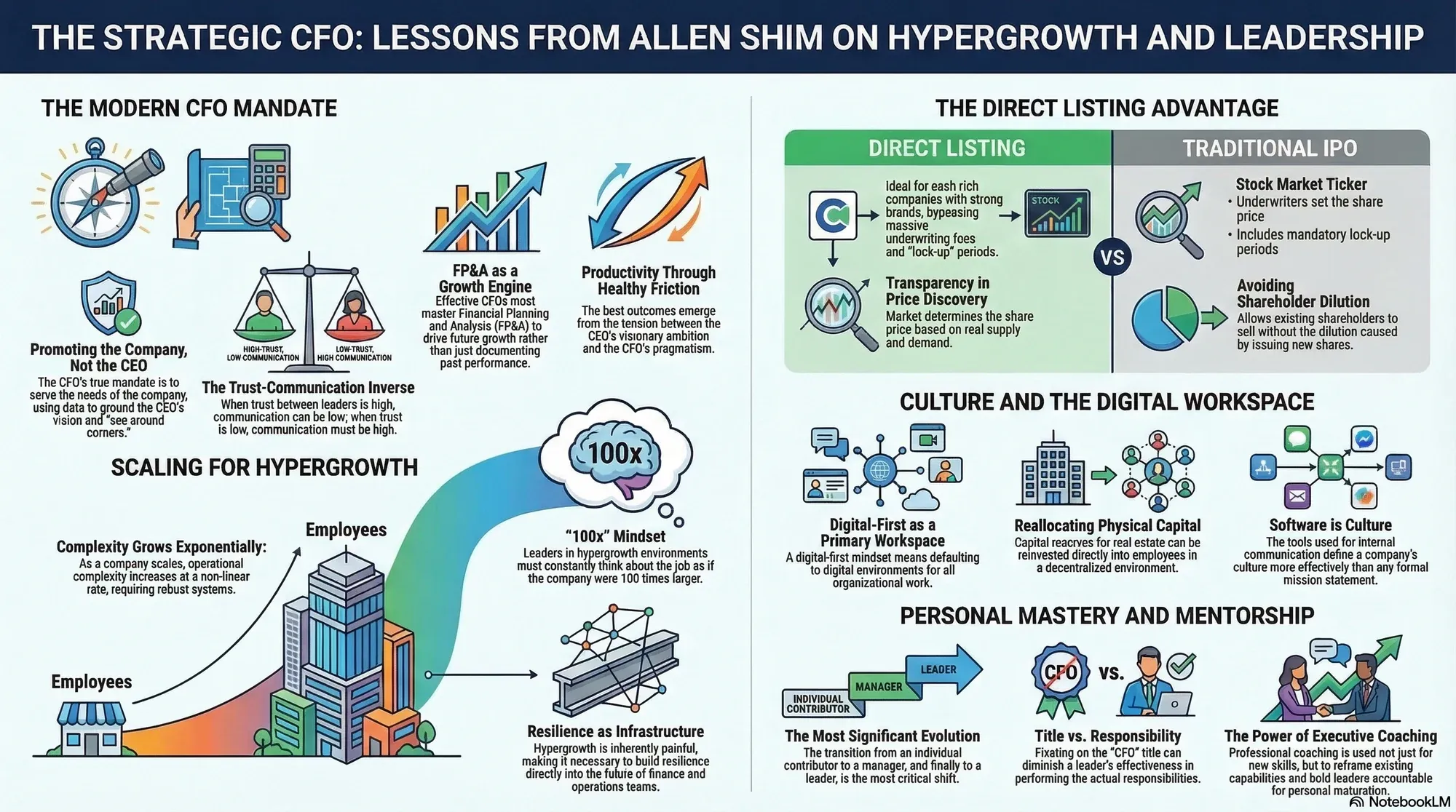
- CEO–CFO trust: Shim describes trust and the ability to challenge each other as central to a strong CEO–CFO relationship. — Aspire CFO Talks Interview.
- Trust changes communication: In Shim’s account, low trust requires more frequent communication, while high trust allows more efficient check-ins. — Aspire CFO Talks Interview.
- The CFO serves the company: Shim says a CFO must represent the company’s needs, including the interests of shareholders, rather than simply serve the CEO. — Aspire CFO Talks Interview.
- Finance looks ahead: For Shim, finance weighs today’s operating needs against investments that will support the company’s future growth. — How to Grow Your Company and Career in Lockstep.
- A predictable operating rhythm: Shim describes rhythm, predictability and a non-negotiable schedule as part of preparing to operate as a public company. — Aspire CFO Talks Interview.
- Finance as an enabler: Shim argues that a high-growth finance team should help colleagues achieve their goals within established constraints, not merely gatekeep spending. — How to Grow Your Company and Career in Lockstep.
- Capital-allocation partnership: Finance can give teams a shared view of where the company is investing capital and which operating procedures may become costly. — How to Grow Your Company and Career in Lockstep.
- Controls support strategy: Shim recommends building financial discipline and controls before an IPO so a company is already operating with public-company rigor. — How to Grow Your Company and Career in Lockstep.
Part 2: Scaling Hypergrowth: From Startup to Enterprise
- Plan for the next scale: At Slack’s early growth rate, Shim urged teams to ask how operations would change at twice or five times current revenue, rather than assume today’s systems would last. — How to Grow Your Company and Career in Lockstep.
- Product-led growth: Shim describes Slack as an early example of product-led growth, with user experience helping word-of-mouth adoption. — Singapore Global Network Interview.
- Joining at twenty employees: Shim joined Slack as its twentieth employee and initially managed a broad set of operational duties alongside finance. — Singapore Global Network Interview.
- Scale changes the job: Shim says the informal, all-hands style of a twenty-person startup becomes unsustainable as a company enters hypergrowth. — How to Grow Your Company and Career in Lockstep.
- Build systems for future growth: Shim moved Slack from QuickBooks to NetSuite earlier than seemed necessary because the intermediate migration would have been quickly outgrown. — How to Grow Your Company and Career in Lockstep.
- From startup to acquisition: Shim joined Slack when it had about twenty employees; Salesforce later acquired the company in a deal announced at $27.7 billion. — Singapore Global Network Interview.
- Document growing operations: As teams scale, Shim advises documenting practices and controls to improve onboarding and reduce avoidable operational mistakes. — How to Grow Your Company and Career in Lockstep.
- Prepare the geographic footprint: Shim includes geographic footprint among the decisions that may take quarters or years to build during hypergrowth. — How to Grow Your Company and Career in Lockstep.
Part 3: Public Company Readiness and the Direct Listing Path
- Prepare to be public: Shim distinguishes the event of going public from the continuing processes, deadlines and controls required to function as a public company. — How to Grow Your Company and Career in Lockstep.
- Slack did not raise new capital: In Slack’s 2019 direct listing, registered shareholders could sell existing shares, and the company would receive no proceeds from those sales. — Slack 2019 Prospectus.
- No new shares in the listing: Slack’s direct listing involved existing shares rather than issuing new shares in the listing itself; this describes Slack’s transaction, not every direct listing. — Slack Earnings-Call Transcript.
- A direct listing still has costs: Slack avoided a conventional underwriting process but disclosed approximately $34 million in one-time direct-listing expenses, including advisory, legal and accounting costs. — Slack Earnings-Call Transcript.
- No contractual lock-up: Slack disclosed that its shareholders had no contractual lock-up agreement, while warning that substantial selling could depress the public price. — Slack 2019 Prospectus.
- How Slack’s opening price was set: Slack said the NYSE opening price would be determined from buy and sell orders, with the designated market maker consulting a financial adviser. — Slack 2019 Prospectus.
- Brand awareness and opening trades: Slack warned that its existing brand awareness might affect the opening price and volatility; it did not claim a strong brand guaranteed a successful listing. — Slack 2019 Prospectus.
- Banks as advisers, not underwriters: Slack’s filing names financial advisers while stating that the direct listing had no underwriters or traditional bookbuilding process. — Slack 2019 Prospectus.
- Investor education without a roadshow: Slack held an investor day and other investor-education meetings instead of a traditional underwritten IPO roadshow. — Slack 2019 Prospectus.
Part 4: Redefining Work: Culture, Transparency, and Digital-First
- More than a chat tool: Shim describes Slack as a way to foster openness and change workplace culture, beyond its messaging function. — Singapore Global Network Interview.
- A digital headquarters: In his 2020 essay, Shim argues that distributed teams need a shared digital place for information, decisions and social connection. — Slack: Channeling Change.
- Transparency helps build trust: Shim recommends public work channels and visible leadership communication as ways to foster transparency and trust among employees. — Slack: Channeling Change.
- Public leadership on anti-Asian hate: Shim signed a 2021 open letter calling for business leaders to speak against anti-Asian violence and help create cross-community dialogue. — Stand With Asian Americans Open Letter.
- Forums for difficult questions: Shim suggests ask-me-anything channels and open discussion spaces where leaders can address employee concerns and difficult topics. — Slack: Channeling Change.
- Potential gains from digital work: Shim argued that rethinking tools and working norms could create efficiency and productivity opportunities; his essay does not establish a universal measured gain. — Slack: Channeling Change.
- AAPI employee support: The 2021 open letter signed by Shim pledged support for AAPI employee resource groups and stronger representation; it does not establish implementation at Slack. — Stand With Asian Americans Open Letter.
- Distributed and asynchronous work: Shim argues that distributed teams need both synchronous and asynchronous ways to work, with decisions accessible beyond a single meeting or email chain. — Slack: Channeling Change.
- Tools and norms together shape culture: Shim says organizations should rethink both the tools employees use and the cultural norms governing their work, not treat software as a substitute for culture. — Slack: Channeling Change.
Part 5: The Journey of Growth: Personal Mastery and Mentorship
- Coaching as leadership development: Shim used an executive coach and experienced CFO mentors while preparing for the broader responsibilities of the CFO role. — How to Grow Your Company and Career in Lockstep.
- Coaching helps unlock potential: Shim says coaching can help develop homegrown leaders, although he cautions that it is not a silver bullet. — Singapore Global Network Interview.
- Maturity beyond technical skill: Shim writes that public-company executive work requires perspective, accountability and maturity beyond strong individual performance. — How to Grow Your Company and Career in Lockstep.
- The title fixation lesson: Shim recounts being told that his focus on becoming CFO was impeding his effectiveness, prompting self-reflection about the work and people. — How to Grow Your Company and Career in Lockstep.
- From department to company: Shim describes the CFO transition as a shift from department-specific goals to company-wide responsibility and perspective. — How to Grow Your Company and Career in Lockstep.
- An adviser’s coaching approach: After moving to Singapore, Shim said he tried to help founders break down challenges rather than prescribe direct answers. — Singapore Global Network Interview.
- The Singapore perspective: Shim moved to Singapore in 2021 and used the location to advise and invest in Southeast Asian technology companies. — Singapore Global Network Interview.
- Sharing scale experience: Shim said his experience with a later-stage technology company could help younger regional founders navigating growth and possible public listings. — Singapore Global Network Interview.
- Think beyond today’s scale: Shim recommends considering how a company should operate at twice or five times current revenue before making long-lived investments. — How to Grow Your Company and Career in Lockstep.
- Give people clarity: Shim describes inspiration, clarity and direction as part of a CFO’s company-wide leadership responsibilities. — How to Grow Your Company and Career in Lockstep.