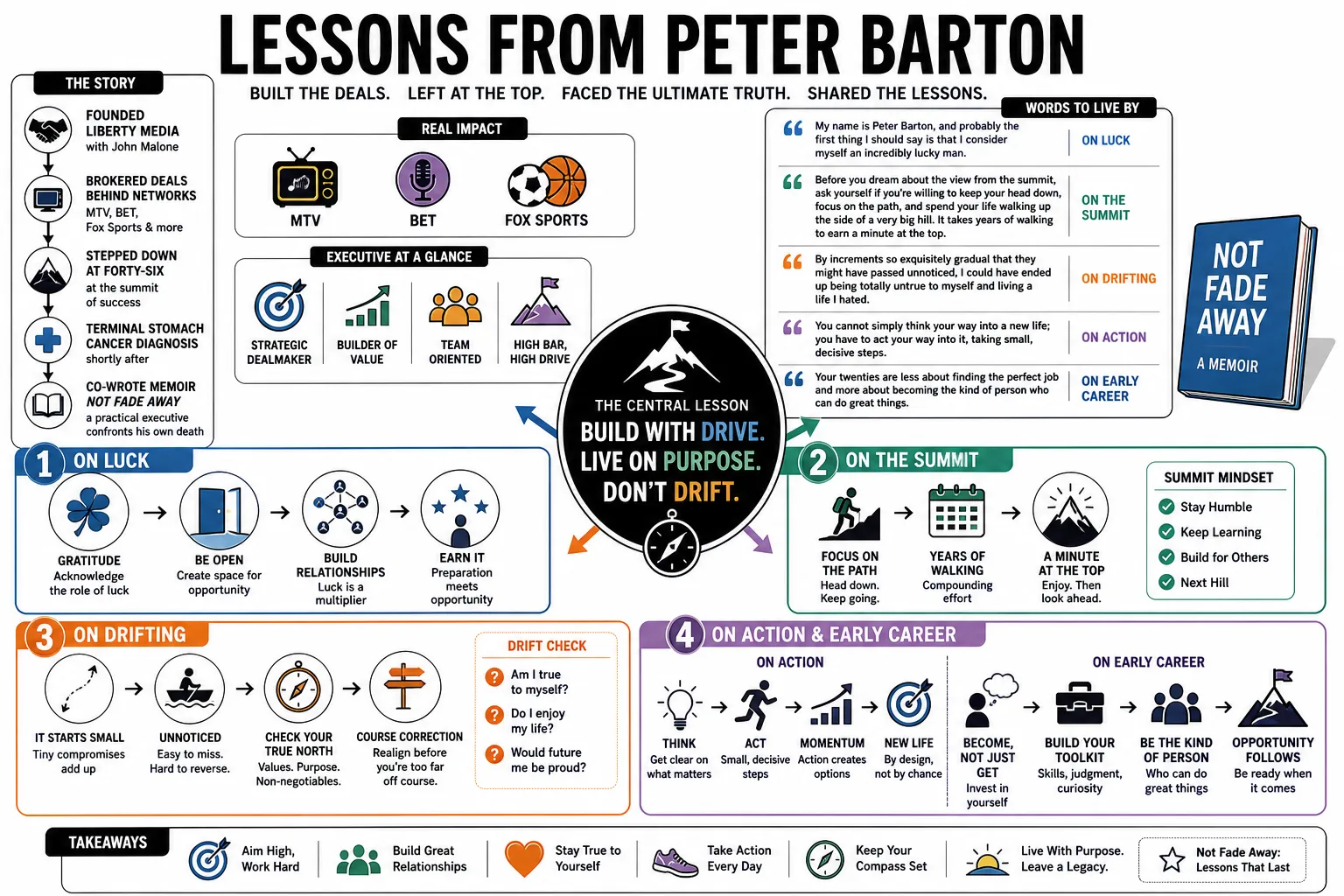
The items below are things Peter Barton said in an oral history interview and wrote in a memoir about cable programming, deal-making and a short life. — Peter Barton, Oral History interview with Jim Keller, The Hauser Oral History Project, Cable Center (March 23, 1999).
In a 1999 oral history interview, Barton said: "It taught me about not getting out of sync with technology and the evolution of technology". — Peter Barton, Oral History interview with Jim Keller, The Hauser Oral History Project, Cable Center (March 23, 1999).
In a 1999 oral history interview, Barton said: "we focused on a strategy that everyone understood, which was we’ve got to get big". — Peter Barton, Oral History interview with Jim Keller, The Hauser Oral History Project, Cable Center (March 23, 1999).
In a 1999 oral history interview, Barton said: "Our theory of making money was very similar to the Berkshire one but the big difference was, we were very focused". — Peter Barton, Oral History interview with Jim Keller, The Hauser Oral History Project, Cable Center (March 23, 1999).
In a 1999 oral history interview, Barton said: "the willingness and ability to operate under cloak of darkness so that you didn’t have a lot of people trying to emulate our strategy". — Peter Barton, Oral History interview with Jim Keller, The Hauser Oral History Project, Cable Center (March 23, 1999).
In a 1999 oral history interview, Barton said: "my lesson was we announced it before we had it done". — Peter Barton, Oral History interview with Jim Keller, The Hauser Oral History Project, Cable Center (March 23, 1999).
In a 1999 oral history interview, Barton said: "it’s the last time I’ll ever make that mistake of coming out early". — Peter Barton, Oral History interview with Jim Keller, The Hauser Oral History Project, Cable Center (March 23, 1999).
In a 1999 oral history interview, Barton said: "We were very good at helping these people without interfering with them". — Peter Barton, Oral History interview with Jim Keller, The Hauser Oral History Project, Cable Center (March 23, 1999).
In a 1999 oral history interview, Barton said: "Give people a few really good programming services that they really want and they’re going to buy cable". — Peter Barton, Oral History interview with Jim Keller, The Hauser Oral History Project, Cable Center (March 23, 1999).
In a 1999 oral history interview, Barton said: "The problem with businesses that just start out as defensive businesses is that people forget about that pretty quick". — Peter Barton, Oral History interview with Jim Keller, The Hauser Oral History Project, Cable Center (March 23, 1999).
In a 1999 oral history interview, Barton said: "the theory is less is more". — Peter Barton, Oral History interview with Jim Keller, The Hauser Oral History Project, Cable Center (March 23, 1999).
In a 1999 oral history interview, Barton said: "We were always trying to wring a little bit more efficiency out of our purchasing unit". — Peter Barton, Oral History interview with Jim Keller, The Hauser Oral History Project, Cable Center (March 23, 1999).
In a 1999 oral history interview, Barton said: "money is an instrumental component of being useful in public service because it gives you enough financial independence that you are by definition incorruptible". — Peter Barton, Oral History interview with Jim Keller, The Hauser Oral History Project, Cable Center (March 23, 1999).
In a 1999 oral history interview, Barton said: "I’d done everything I could do in television, that I wanted to do". — Peter Barton, Oral History interview with Jim Keller, The Hauser Oral History Project, Cable Center (March 23, 1999).
In a 1999 oral history interview, Barton said: "we bought 16 of them for less than 50 cents on the dollar when they all failed". — Peter Barton, Oral History interview with Jim Keller, The Hauser Oral History Project, Cable Center (March 23, 1999).
In the memoir Not Fade Away, Barton wrote: "Money needed to be worked for but not fretted over". — Peter Barton, excerpt from Not Fade Away: A Short Life Well Lived (co-written with Laurence Shames), published by TODAY (September 2003).
In the memoir Not Fade Away, Barton wrote: "there are no unimportant details in life". — Peter Barton, excerpt from Not Fade Away: A Short Life Well Lived (co-written with Laurence Shames), published by TODAY (September 2003).
In the memoir Not Fade Away, Barton wrote: "the big things in life are best understood by way of small things". — Peter Barton, excerpt from Not Fade Away: A Short Life Well Lived (co-written with Laurence Shames), published by TODAY (September 2003).
In the memoir Not Fade Away, Barton wrote: "Ignore the small ones, and the big ones just seem like fancy words, slogans without the truth of something you really know, and really feel". — Peter Barton, excerpt from Not Fade Away: A Short Life Well Lived (co-written with Laurence Shames), published by TODAY (September 2003).
In the memoir Not Fade Away, Barton wrote: "What I like is creating things, adding value, shaping the big picture". — Peter Barton, excerpt from Not Fade Away: A Short Life Well Lived (co-written with Laurence Shames), published by TODAY (September 2003).
In a 1999 oral history interview, Barton said: "The big factor in this, the famous factor, that people talk about all the time is that I offered to work for free for 90 days". — Peter Barton, Oral History interview with Jim Keller, The Hauser Oral History Project, Cable Center (March 23, 1999).
In a 1999 oral history interview, Barton said: "That technological difference made me relatively uncompetitive and it taught me a lot". — Peter Barton, Oral History interview with Jim Keller, The Hauser Oral History Project, Cable Center (March 23, 1999).
In a 1999 oral history interview, Barton said: "He is always unwilling to accept any status quo or any conventional wisdom". — Peter Barton, Oral History interview with Jim Keller, The Hauser Oral History Project, Cable Center (March 23, 1999).
In a 1999 oral history interview, Barton said: "Every single thing at COMB that we had thought was a useful back office turned out to be useless and not only useless, an encumbrance because it was in the way". — Peter Barton, Oral History interview with Jim Keller, The Hauser Oral History Project, Cable Center (March 23, 1999).
In a 1999 oral history interview, Barton said: "Hopefully our scale would continue to build because we’d have more and more of a delta between what we pay and what everyone else pays as time went on". — Peter Barton, Oral History interview with Jim Keller, The Hauser Oral History Project, Cable Center (March 23, 1999).
In a 1999 oral history interview, Barton said: "We also encouraged all the programming services that we were involved with to clone themselves". — Peter Barton, Oral History interview with Jim Keller, The Hauser Oral History Project, Cable Center (March 23, 1999).
In a 1999 oral history interview, Barton said: "If you’re going to drive with your foot on the brake and the accelerator, you’re not for us". — Peter Barton, Oral History interview with Jim Keller, The Hauser Oral History Project, Cable Center (March 23, 1999).
In a 1999 oral history interview, Barton said: "If you can get an audience, then you will have the power, the brand power, to raise both sets of rates: your affiliate fees and your advertising rates and then you will become successful". — Peter Barton, Oral History interview with Jim Keller, The Hauser Oral History Project, Cable Center (March 23, 1999).
In a 1999 oral history interview, Barton said: "Occasionally it would stall because of various silly, non-substantive reasons but we were in business to make our shareholder unconscionably wealthy and that’s what we got up every morning to do". — Peter Barton, Oral History interview with Jim Keller, The Hauser Oral History Project, Cable Center (March 23, 1999).
In a 1999 oral history interview, Barton said: "I had to find a way of making sports have leverage so it could raise its rates and not get creamed by ESPN in the purchasing part of this business". — Peter Barton, Oral History interview with Jim Keller, The Hauser Oral History Project, Cable Center (March 23, 1999).
In a 1999 oral history interview, Barton said: "If you don’t have any distribution and whatever distribution you have nobody’s watching it because all the programming on both sides of it is unwatchable, it’s the tree falling in the woods". — Peter Barton, Oral History interview with Jim Keller, The Hauser Oral History Project, Cable Center (March 23, 1999).
In a 1999 oral history interview, Barton said: "We were accumulating any time a programming service was for sale, or even wasn’t for sale, I was out running around trying to buy it". — Peter Barton, Oral History interview with Jim Keller, The Hauser Oral History Project, Cable Center (March 23, 1999).
In a 1999 oral history interview, Barton said: "In order to have a reasonable story, we had to take all the wheat and all the chaff and make it into one pile". — Peter Barton, Oral History interview with Jim Keller, The Hauser Oral History Project, Cable Center (March 23, 1999).