Claude Guillemot was a co-founder of Ubisoft and the longtime leader of Guillemot Corporation, where he directed the development of gaming hardware and audio equipment. He died in a plane crash near La Baule-Escoublac, France, on June 19, 2026, at age 69. While his brother Yves became the public face of Ubisoft’s software operations, Claude worked quietly to build Thrustmaster and Hercules into recognized peripheral brands. This profile outlines his operational approach, focusing on his belief that physical interfaces are exactly as critical to digital immersion as the games themselves. — [Source: PC Gamer]
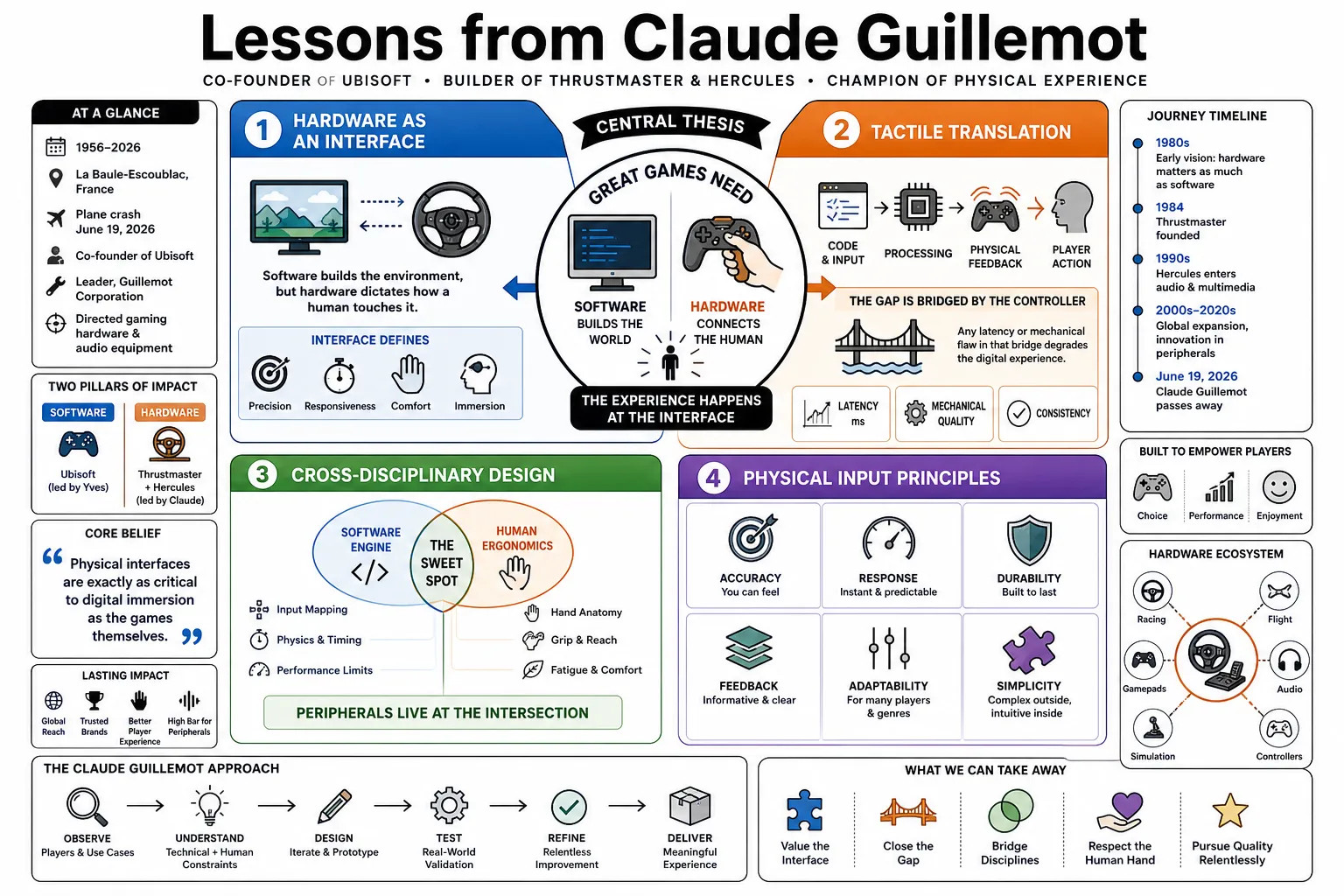
Part 1: The Integration of Hardware and Software
- On Hardware as an Interface: “Software builds the environment, but hardware dictates how a human touches it; a game is only as effective as the physical tools used to navigate it.” — [Source: Guillemot Corporation]
- On Tactile Translation: “The gap between code and player action is bridged entirely by the controller. Any latency or mechanical flaw in that bridge degrades the digital experience.” — [Source: Guillemot Corporation]
- On Cross-Disciplinary Design: “Creating a peripheral requires understanding both the constraints of the software engine and the physical ergonomics of the user’s hands.” — [Source: Thrustmaster]
- On Physical Inputs: “As game mechanics become more complex, standard inputs reach their limits. Specialized hardware is necessary to unlock specialized gameplay.” — [Source: Thrustmaster]
- On Ecosystem Synergy: “A strong gaming ecosystem treats the peripheral as an extension of the core hardware rather than isolating the console from its accessories.” — [Source: Guillemot Corporation]
- On Peripheral Independence: “Operating a hardware division separate from software development ensures that the hardware can evolve independently, serving multiple platforms.” — [Source: Ubisoft Corporate History]
- On Software Reliance: “Hardware without optimized software support is useless plastic. The relationship requires close coordination with game developers to ensure inputs map correctly.” — [Source: Thrustmaster]
- On The PC Platform: “The open nature of the PC market allowed us to experiment with niche hardware configurations that closed console ecosystems initially could not support.” — [Source: Guillemot Corporation]
- On Visual versus Tactile Output: “Graphics get the most attention in game development, but tactile output through force feedback provides the physical grounding that graphics lack.” — [Source: Thrustmaster]
- On Peripheral Evolution: “Controllers have to evolve at the same pace as game engines. When games added verticality and three-dimensional space, controllers had to add analog sticks.” — [Source: Guillemot Corporation]
Part 2: Strategic Governance and Operations
- On Quiet Leadership: “Operations require focus instead of public attention. The stability of the business depends on the work done away from the press.” — [Source: Ubisoft Corporate History]
- On Managing Scale: “As a company expands globally, the challenge shifts from inventing new ideas to ensuring the supply chain can reliably deliver them across continents.” — [Source: Ubisoft Investor Relations]
- On Manufacturing Discipline: “Consumer electronics demand strict cost control and defect management; a software patch can fix code, but hardware flaws require physical recalls.” — [Source: Guillemot Corporation]
- On Long-Term Stability: “Financial health in the hardware sector requires planning product cycles years in advance, absorbing the risks of component shortages and changing consumer trends.” — [Source: Ubisoft Investor Relations]
- On Corporate Delegation: “Building an international business means trusting regional managers. You cannot control operations in fifty countries from a single desk in France.” — [Source: Ubisoft Corporate History]
- On Risk Mitigation: “Diversifying product lines protects the business against cyclical downturns in specific gaming genres.” — [Source: Guillemot Corporation]
- On Board Governance: “A board must balance the creative risks of game development with the realities of quarterly financial targets and shareholder expectations.” — [Source: Ubisoft Investor Relations]
- On Supply Chain Resilience: “Sourcing components for electronics requires multiple fail-safes. Relying on a single supplier for a critical microchip introduces unacceptable risk.” — [Source: Guillemot Corporation]
- On Operational Efficiency: “Creative companies still require industrial efficiency. Without rigorous logistics, the best products will sit in warehouses instead of reaching consumers.” — [Source: Ubisoft Corporate History]
- On Expansion Strategy: “Entering new markets requires understanding local distribution networks. Hardware sales depend entirely on getting shelf space and establishing local partnerships.” — [Source: Guillemot Corporation]
Part 3: The Philosophy of Peripherals
- On Flight Simulation: “Aviation enthusiasts do not want a toy; they want a replica. The grip, the resistance, and the button placement must mirror an actual cockpit.” — [Source: Thrustmaster]
- On Racing Wheels: “Driving a digital car with a thumbstick is a compromise. A proper wheel and pedal set restores the physics of steering and braking.” — [Source: Thrustmaster]
- On DJ Equipment Accessibility: “Professional audio gear is often intimidating. Our goal with DJ controllers is to make the tactile experience of mixing accessible to beginners without removing technical depth.” — [Source: Hercules Audio]
- On Niche Markets: “Enthusiast communities are small but highly dedicated. Building high-end gear for these players creates a brand loyalty that mass-market products rarely achieve.” — [Source: Guillemot Corporation]
- On Mechanical Durability: “Racing simulation involves aggressive physical input. The internal belts, gears, and motors must be engineered to withstand years of intense torque.” — [Source: Thrustmaster]
- On Brand Licensing: “Partnering with Ferrari or the US Air Force provides access to the engineering schematics required to build authentic replicas.” — [Source: Thrustmaster]
- On Modular Design: “Players should not have to buy a completely new setup when they upgrade. Modular wheel bases and interchangeable rims allow the hardware to grow with the user.” — [Source: Thrustmaster]
- On Audio Fidelity: “Sound is half the experience of any media. Building quality audio interfaces ensures that the digital signal translates cleanly to the physical speaker.” — [Source: Hercules Audio]
- On Ergonomic Function: “If a controller causes fatigue after an hour, it has failed. The physical shape must accommodate natural resting positions while keeping inputs accessible.” — [Source: Guillemot Corporation]
- On Product Iteration: “Hardware evolves slowly compared to software. Each generation of a peripheral must solve a specific mechanical problem from the previous version.” — [Source: Thrustmaster]
Part 4: The Family Business Dynamics
- On Brotherly Partnership: “Running a business with family requires clear boundaries. Each brother took control of a specific domain, preventing overlap and ensuring decisive action.” — [Source: Ubisoft Corporate History]
- On Rural Origins: “Growing up in a farming business taught us logistics and supply before we ever touched a computer. Delivering goods on time is a universal business principle.” — [Source: Ubisoft Corporate History]
- On Unified Vision: “While operations are divided, the overarching goal remains shared. Disputes on execution are resolved by aligning on the long-term health of the group.” — [Source: Ubisoft Investor Relations]
- On Trust: “The speed at which a family business can make decisions is its greatest advantage. There is no need for internal politics when you trust the people at the table.” — [Source: Ubisoft Corporate History]
- On Independence: “Maintaining control over the company prevents outside entities from imposing short-term financial priorities over long-term creative investments.” — [Source: Ubisoft Investor Relations]
- On Passing the Baton: “Succession planning is critical. Transitioning leadership to the next generation must happen gradually to preserve institutional knowledge and stability.” — [Source: Guillemot Corporation]
- On Collective Risk: “When the company takes a major financial risk, it is a risk taken by the family. That shared exposure forces a higher level of scrutiny on every deal.” — [Source: Ubisoft Investor Relations]
- On Avoiding the Spotlight: “Not everyone needs to be the face of the company. Having operators who prefer the background allows the executives in the spotlight to do their jobs effectively.” — [Source: Ubisoft Corporate History]
- On Resilience: “The games industry is volatile. A family structure provides a foundation of patience, allowing the business to weather bad years without panicking.” — [Source: Ubisoft Investor Relations]
- On Shared Equity: “Equity is more than financial value; it is a mechanism for keeping the founders aligned and invested in the same outcomes over decades.” — [Source: Ubisoft Investor Relations]
Part 5: Fostering Immersion and Simulation
- On Virtual Reality: “Virtual reality provides the visual immersion, but without specialized hardware in the hands, the player remains disconnected from the environment.” — [Source: Guillemot Corporation]
- On E-sports Equipment: “Competitive gaming turns peripherals from entertainment devices into sports equipment. The requirement for precision and low latency becomes absolute.” — [Source: Thrustmaster]
- On Magnetic Sensors: “Moving from physical potentiometers to magnetic sensors in joysticks eliminated mechanical wear and drastically increased precision over the lifespan of the device.” — [Source: Thrustmaster]
- On Democratizing Creation: “Digital tools should allow anyone to mix music or fly a plane. The hardware acts as the translator, turning complex software into intuitive physical actions.” — [Source: Hercules Audio]
- On Customization: “No two players have the same hands or play styles. Allowing users to adjust tension, swap buttons, and remap inputs is essential for modern hardware.” — [Source: Guillemot Corporation]
- On Wireless Latency: “The convenience of wireless controllers was only acceptable once the radio protocols could guarantee latency indistinguishable from a wired connection.” — [Source: Guillemot Corporation]
- On the Physical Connection: “In an increasingly digital world, the controller is the last physical anchor. It is the only tangible object linking the player to the game.” — [Source: Guillemot Corporation]
- On Ecosystem Constraints: “Cross-platform compatibility is an ongoing challenge. Hardware manufacturers must navigate the closed protocols of console makers to provide universal solutions.” — [Source: Thrustmaster]
- On Direct Drive Wheels: “Removing the belts and gears and connecting the steering rim directly to the motor provides a level of force feedback that perfectly mimics real road conditions.” — [Source: Thrustmaster]
- On Peripheral Specialization: “The keyboard and mouse are tools for data entry adopted for gaming. True immersion requires hardware designed specifically for the action taking place on screen.” — [Source: Guillemot Corporation]