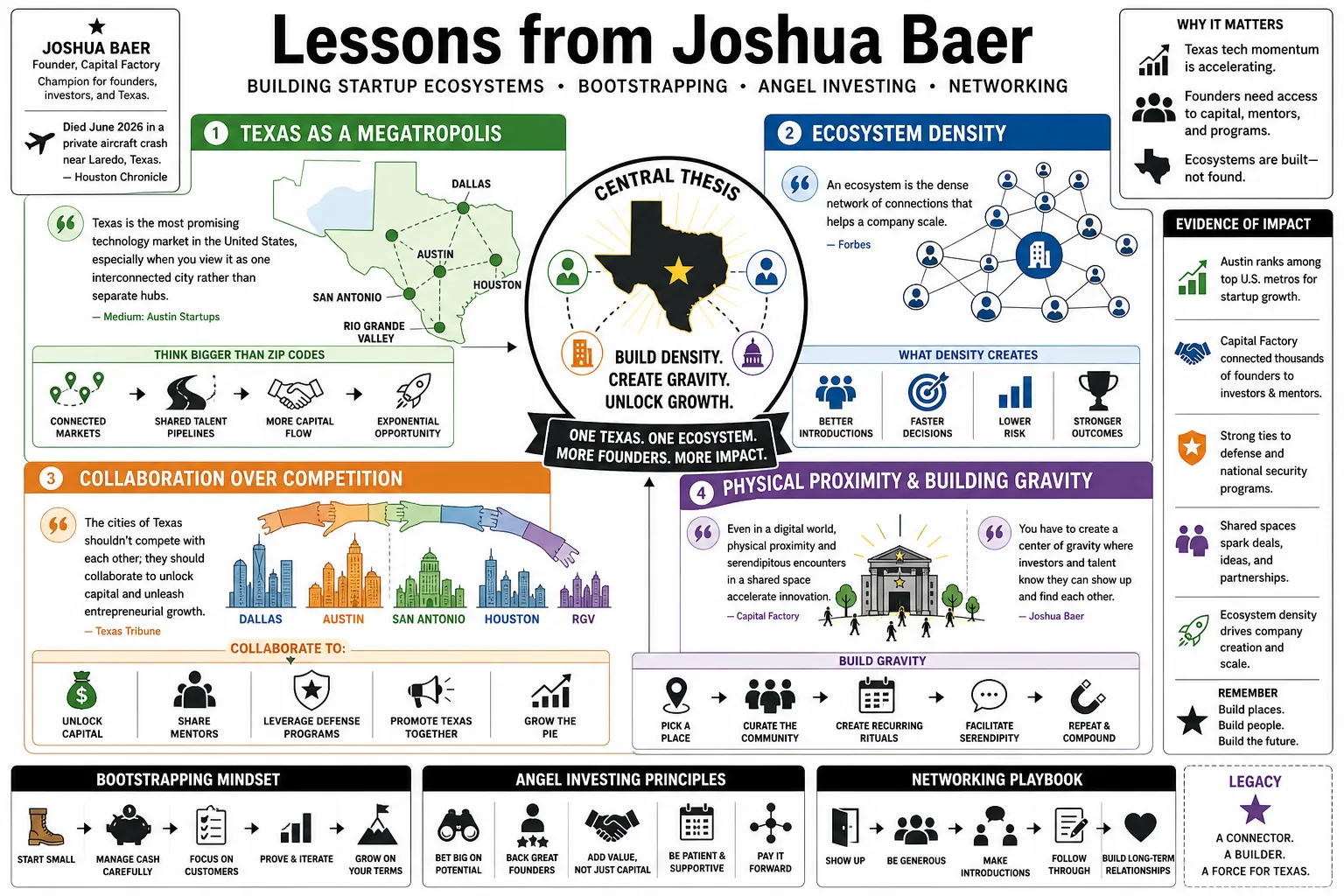
Joshua Baer founded Capital Factory to connect Austin's early-stage founders with investors, mentors, and defense programs. He died in June 2026 after a private aircraft crash near Laredo, Texas, according to the Houston Chronicle. This collection focuses on the practical advice he left behind on bootstrapping, angel investing, and networking.
Part 1: Building Startup Ecosystems
- On Texas as a Megatropolis: "Texas is the most promising technology market in the United States, especially when you view it as one interconnected city rather than separate hubs." — Source: Medium: Austin Startups
- On Ecosystem Density: "An ecosystem is the dense network of connections that helps a company scale." — Source: Forbes
- On Collaboration over Competition: "The cities of Texas shouldn't compete with each other; they should collaborate to unlock capital and unleash entrepreneurial growth." — Source: Texas Tribune
- On Physical Proximity: "Even in a digital world, physical proximity and serendipitous encounters in a shared space accelerate innovation." — Source: Capital Factory
- On Building Gravity: "You have to create a center of gravity where investors and talent know they can show up and find each other." — Source: Medium: Austin Startups
- On Retaining Talent: "The goal of a strong local network is making sure your best founders don't feel they have to move to the coasts to succeed." — Source: Startup Grind
- On Ecosystem Stages: "Startup ecosystems evolve from isolated nodes to connected networks, and eventually to self-sustaining engines of talent and capital." — Source: Medium: Austin Startups
- On Civic Engagement: "Entrepreneurs need to engage with local legislation, like voting on Prop 1, because municipal rules directly impact innovation." — Source: Texas Tribune
- On The Role of Universities: "A university like UT Austin is the foundational engine of a tech hub, constantly injecting fresh talent and new research into the market." — Source: UT Austin
- On Inter-city Connectivity: "If we connect Austin, Dallas, Houston, and San Antonio, we create a larger, more collaborative nexus that rivals any global tech center." — Source: Forbes
Part 2: Mentorship & Paying It Forward
- On the Core Strategy: "Plant lots of seeds. Water everyone's. Repeat." — Source: Forbes
- On Super-Mentoring: "A super-mentor acts as an investor who actively brings in a broader network of mentors to support founders, rather than merely providing individual advice." — Source: CBS News
- On the Right Introduction: "The right introduction at the exact right moment can completely change the trajectory of a company." — Source: Forbes
- On Generosity: "The most successful networks are built on a culture where established entrepreneurs dedicate time to mentor the next generation without expecting immediate return." — Source: Capital Factory
- On Feedback: "Mentors who sugarcoat their feedback aren't helping you. You need the ones who will tell you why your idea might fail." — Source: Startup Grind
- On Time Commitment: "A good mentor gives you an hour; a great mentor opens their address book." — Source: Capital Factory
- On Reciprocity: "When someone helps you scale your company, your eventual obligation is to do the same for the founder two steps behind you." — Source: Mixergy Interview
- On Choosing Mentors: "Ignore the big names. Look for the mentors who have recently solved the exact problem you are facing right now." — Source: Forbes
- On Community Value: "The greatest value I can provide is simply building a space where founders can connect with the right people." — Source: Medium: Austin Startups
Part 3: Bootstrapping & Early Stage Growth
- On Customer Funding: "The best source of capital is revenue. Find a clear path to cash flow by letting your customers fund your early growth." — Source: Mixergy Interview
- On Resourcefulness: "Bootstrapping forces you to solve problems with creativity rather than cash, which builds a much more resilient company." — Source: Startup Grind
- On Premature Scaling: "Raising too much money before you have product-market fit is the fastest way to kill a good idea." — Source: Capital Factory
- On Pricing: "Founders almost always underprice their initial product. Charge more so you can afford to deliver a better experience." — Source: Mixergy Interview
- On Early Sales: "In the beginning, do things that don't scale. Get on a plane, meet the customer, and close the deal yourself." — Source: Mixergy Interview
- On Keeping Control: "When you bootstrap, you retain control of your destiny and your equity until you absolutely need outside capital." — Source: Startup of the Year Podcast
- On B2B Focus: "Selling to other businesses is often a faster path to profitability because they have actual budgets to solve painful problems." — Source: Mixergy Interview
- On Validating Ideas: "Don't build the whole product first. Sell the concept, see if someone will pay for it, and then build it." — Source: Startup Grind
- On Dorm Room Startups: "You don't need a fancy office to start. The best companies often begin in a dorm room with a laptop and a clear focus on a single problem." — Source: Capital Factory
Part 4: Angel Investing & Venture Capital
- On Starting to Invest: "Start writing checks to startups, and not too large in the beginning. It won't take long for other angels and startups to find you." — Source: CBS News
- On Evaluating Founders: "I invest in the entrepreneur more than the idea, because the idea is almost certainly going to change." — Source: Forbes
- On Portfolio Size: "Angel investing is a volume game. You need a large portfolio because the majority of returns will come from one or two companies." — Source: Capital Factory
- On Investor Value: "If an investor is only giving you money, you are getting shortchanged. They should bring new talent and future funding along with their initial check." — Source: Startup of the Year Podcast
- On Local Capital: "To build a great tech hub, you need local wealth willing to take risks on local founders at the earliest stages." — Source: Texas Tribune
- On Pattern Recognition: "After seeing thousands of pitches, you start to recognize the specific intensity and clarity that marks a founder who will figure it out." — Source: Forbes
- On Passing on Deals: "Saying 'no' quickly is a form of respect. The worst thing an investor can do is drag a founder through months of maybe." — Source: Capital Factory
- On Co-investing: "Investing alongside people you trust reduces your blind spots and helps the founder get a broader support base." — Source: Medium: Austin Startups
- On Valuations: "Don't obsess over the valuation in your seed round; obsess over finding the partners who will increase your chances of reaching the next round." — Source: Capital Factory
Part 5: Taking Action & Perseverance
- On Asking for Help: "Ask mentors and advisors for help until they explicitly say 'no'. Many founders are too timid and underestimate how willing others are to assist." — Source: Medium: Austin Startups
- On Outrageous Requests: "Turn your thinking upside down and ask for the most outrageous thing that would make the biggest impact on your business." — Source: Medium: Austin Startups
- On The Role of Luck: "Luck is about 75% of success. Way more than most people think. Don't be afraid to try lots of different things so you can get lucky." — Source: Quora
- On Pitch Practice: "Elevator pitches improve significantly over time through practice and by actively seeking critical feedback." — Source: Medium: Austin Startups
- On Rejection: "Every 'no' gets you closer to the 'yes' that actually matters. You have to build an immunity to rejection." — Source: Startup Grind
- On Speed of Execution: "The speed at which you test a bad idea and move on is a competitive advantage." — Source: Mixergy Interview
- On Perfectionism: "Shipping an imperfect product today is better than shipping a perfect product next year." — Source: Capital Factory
- On Difficult Conversations: "Have the hard conversations early. Whether it's with a co-founder or an investor, delaying bad news only makes it worse." — Source: Forbes
- On Showing Up: "Half of success in the startup world is simply showing up to the events, meetings, and spaces where serendipity happens." — Source: Medium: Austin Startups
- On Momentum: "Momentum is the most precious resource a startup has. Once you have it, do everything in your power not to lose it." — Source: Startup of the Year Podcast
Part 6: Deep Tech & The Future
- On Hard Problems: "We need to back founders who are building solutions to the hardest problems, particularly in deep technology and national security." — Source: Capital Factory
- On Defense Tech: "Connecting innovative startups with government entities like the U.S. Army accelerates deployment of critical defense technologies." — Source: Forbes
- On Robotics: "The next wave of technology involves robotics and AI interacting with the physical world." — Source: Driving Alpha Podcast
- On AI Integration: "Artificial intelligence is a horizontal layer that will fundamentally alter how every startup operates." — Source: Capital Factory
- On Patient Capital: "Deep tech requires patient capital. You can't expect a robotics company to iterate as quickly as a consumer app." — Source: Forbes
- On Government as a Customer: "The government is the largest customer in the world. Startups that learn to navigate public sector procurement unlock massive scale." — Source: Capital Factory
- On Augmented Audio: "Technologies like augmented audio represent the transition from screens to ambient interfaces that blend seamlessly with our environment." — Source: Medium: Austin Startups
- On Dual-Use Technology: "The most successful defense startups will build dual-use technologies that have direct commercial applications alongside their military utility." — Source: Driving Alpha Podcast
- On Building an Abundant Future: "Investing in deep tech builds an abundant future where technology solves foundational human challenges." — Source: Driving Alpha Podcast
Part 7: Community & Human Infrastructure
- On Human Infrastructure: "We are building the human infrastructure that connects ambitious founders with the resources they need." — Source: Forbes
- On Diversity: "A healthy startup ecosystem must intentionally build bridges to diverse founders, or it will miss out on massive untapped potential." — Source: Capital Factory
- On Creating Collisions: "Design physical spaces and events specifically to force collisions between people who wouldn't normally interact." — Source: Medium: Austin Startups
- On Community First: "Put the community first, and the business outcomes will follow. If you try to extract value before creating it, you will fail." — Source: Capital Factory
- On Accessibility: "The barrier to entry for the startup community should be as low as possible. Anyone with drive should be able to walk in and get started." — Source: Medium: Austin Startups
- On the Role of Events: "Events are the heartbeat of a community. They provide the rhythm that keeps people engaged and moving forward." — Source: Startup Grind
- On Shared Knowledge: "When one founder figures out a complex problem, the entire community benefits if that knowledge is shared openly." — Source: Medium: Austin Startups
- On Welcoming Newcomers: "A growing city must embrace newcomers. Every new arrival brings fresh perspective or capital to the existing network." — Source: Forbes
- On Alumni Networks: "The strength of an accelerator is measured by the engagement of its alumni. They are the ultimate proof of concept." — Source: Capital Factory
- On Long-term Horizon: "Building human infrastructure is a decades-long project. You have to commit to a city for the long haul." — Source: Forbes
Part 8: The Entrepreneurial Journey
- On the Ultimate Goal: "I help people quit their jobs and become entrepreneurs." — Source: Capital Factory
- On Taking the Leap: "The hardest part of starting a company is simply deciding to let go of the safety net and jump." — Source: Medium: Austin Startups
- On Purpose: "Entrepreneurship is what I was put on the Earth to do. It brings financial independence and the skills to create positive change." — Source: Forbes
- On Burnout: "You have to treat entrepreneurship like a marathon. If you sprint the first mile, you will burn out before you find product-market fit." — Source: Startup Grind
- On Co-founders: "Choosing a co-founder is like a marriage. You must have complete trust and complementary skill sets." — Source: Mixergy Interview
- On Continuous Learning: "The moment you think you know exactly how the market works, a new technology will emerge and disrupt your assumptions." — Source: Driving Alpha Podcast
- On Self-Awareness: "Great founders know what they are bad at and actively hire people who are smarter than them to fill those gaps." — Source: Forbes
- On Managing Psychology: "The hardest part of being a CEO isn't the competition or the product; it's managing your own psychology through the extreme highs and lows." — Source: Startup of the Year Podcast
- On Leaving a Legacy: "Ultimately, your legacy won't be the companies you sold, but the people you helped succeed along the way." — Source: CBS News