Alan Stein Jr. is a performance coach, speaker and author who spent years coaching basketball players, including a young Kevin Durant, and observing established stars at major basketball events. He now applies lessons from sport to leadership, habits and performance in business. — Leaders in the Trenches Interview.
His books Raise Your Game and Sustain Your Game connect sports-derived practice and leadership habits with the challenge of sustaining performance through stress, stagnation and burnout. — Sustain Your Game Book.
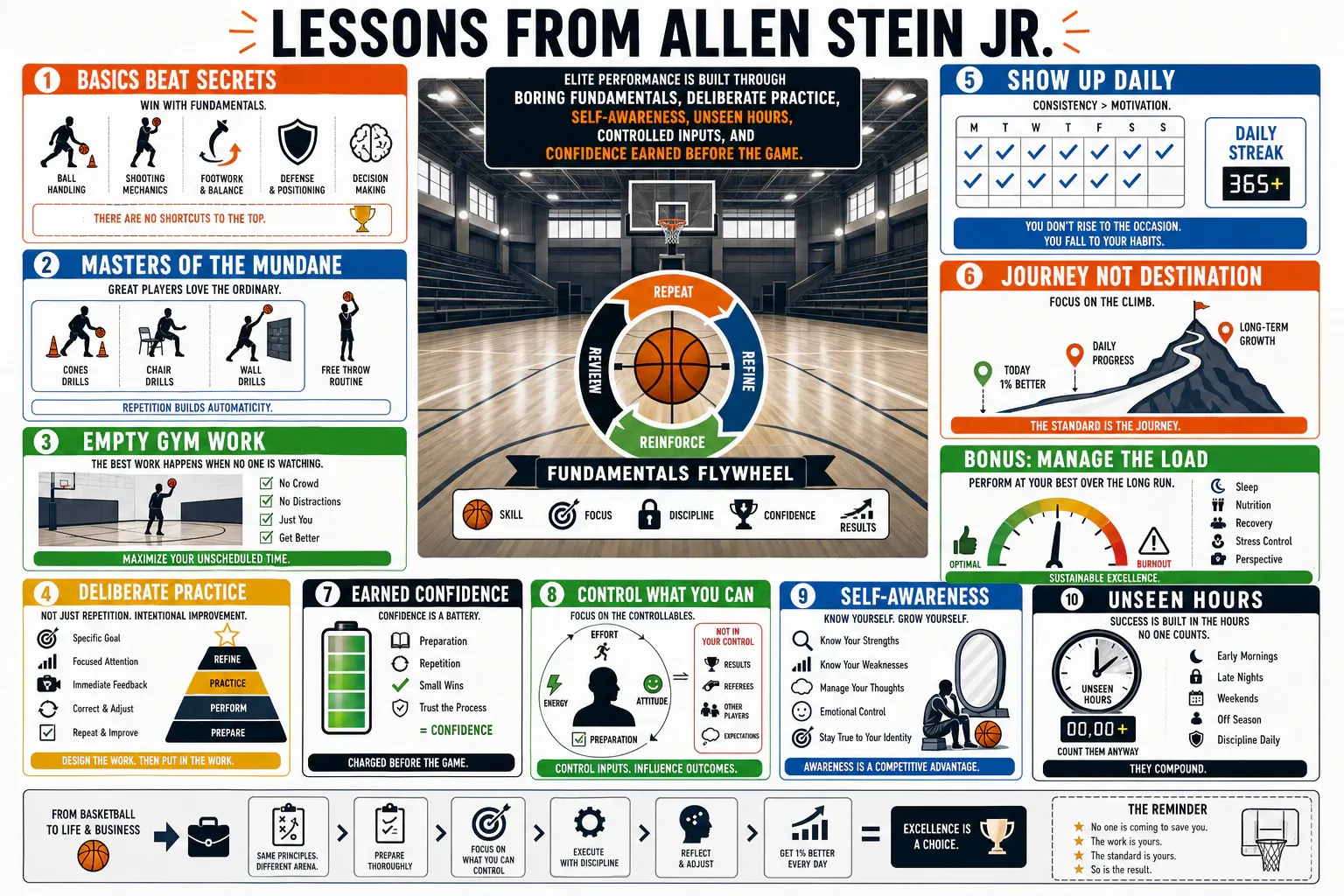
On Fundamentals and the Process
- Respect the process: Stein urges people to focus on controllable daily work and progress rather than obsess over the final scoreboard. — Kansas Football Talk Transcript.
- Kobe and the basics: Stein recalls watching elite players practise ordinary drills and argues that leaders, too, should deliberately master their role’s fundamentals. — TalentGrow Interview Transcript.
- Repeat the unglamorous work: Stein says intentionally repeating fundamentals and staying consistent can produce extraordinary results over time. — Stop Chasing Hacks and Master the Basics.
- Practice with purpose: Stein asks leaders to identify the fundamentals of their role and improve them through deliberate, purposeful repetition. — TalentGrow Interview Transcript.
- Do not skip the work: Stein warns against shortcuts that bypass the process and the basic work required to improve. — Leaders in the Trenches Interview.
- Show up consistently: Stein treats disciplined decisions made day after day as more reliable than waiting for a feeling of motivation. — Kansas Football Talk Transcript.
- Use the unseen hours: Stein emphasizes practice outside public view as a place to build competence and confidence. — Kansas Football Talk Transcript.
On Mindset and Self-Awareness
- Train your self-talk: Stein tells athletes that how they speak to themselves can strengthen or weaken confidence. — Kansas Football Talk Transcript.
- Start with self-awareness: Stein includes self-awareness and an intentional self-improvement system among the first questions he asks leaders. — Six Leadership Questions.
- Earn confidence in practice: Stein says confidence develops from consistent disciplined choices and demonstrated performance during practice. — Kansas Football Talk Transcript.
- Focus on what you control: Stein directs performers to their effort, attitude, preparation and conditioning rather than rankings or outside commentary. — Kansas Football Talk Transcript.
- Ordinary actions matter: Stein says excellence is built in ordinary moments and that leaders’ example carries more weight than advice alone. — 50 Lessons I’ve Learned in 50 Years.
- Keep ego in check: In his own list of life lessons, Stein calls ego costly and treats humility and receptiveness to feedback as strengths. — 50 Lessons I’ve Learned in 50 Years.
- Use manageable discomfort: Stein describes physical-training discomfort as part of adaptation, while emphasizing recovery before the next session; this is his coaching analogy, not a general medical claim. — TalentGrow Interview Transcript.
- Take responsibility first: Stein says people can choose their response to adversity even when they cannot control the event itself. — Kansas Football Talk Transcript.
On Habits and Consistency
- Build better habits: Stein lists habits as more important than goals and says repeated practice shapes future performance. — 50 Lessons I’ve Learned in 50 Years.
- Prepare before the moment: Stein urges teams to make preparation their differentiator because they can control it even when they cannot control talent or outcomes. — Kansas Football Talk Transcript.
- Choose discipline over motivation: Stein contrasts fluctuating motivation with decisions aligned to one’s goals and standards. — Kansas Football Talk Transcript.
- Let small improvements compound: Stein advises improving a little at a time and explicitly lists small improvements as compounding over time. — 50 Lessons I’ve Learned in 50 Years.
On Leadership and Teamwork
- Invest in teammates: Stein asks leaders whether they invest time and resources in teammates’ development and support their goals. — Six Leadership Questions.
- Culture is tolerated behavior: Stein defines culture by the alignment of stated values and actual behavior; leaders must correct violations, even from top performers. — High-Performance Culture Essay.
- Model the teammate you want: Stein emphasizes leading by visible example and making teammates feel supported rather than relying on advice alone. — 50 Lessons I’ve Learned in 50 Years.
- Recharge to lead others: Stein says leaders need practices that replenish their own energy if they want to contribute effectively to others. — TalentGrow Interview Transcript.
- Communicate a lived culture: Stein asks leaders to articulate culture clearly and reinforce it through day-to-day beliefs and behaviors, not posted statements alone. — Six Leadership Questions.
- Align around shared standards: Stein asks whether team members would describe the same culture and whether they practise role-relevant basics together. — Six Leadership Questions.
- Hold standards with care: Stein says teammates should practise accountability while leaders pair firm discipline with care and trust. — TalentGrow Interview Transcript.
- Leadership is service: Stein describes servant leadership as a higher-ranking leader serving and empowering more people, not collecting more people to serve them. — Leaders in the Trenches Interview.
- Lead by example: Stein asks leaders to model their commitment to self-improvement and says example is louder than advice. — Six Leadership Questions.
- Praise aligned behavior: Stein says acknowledging and praising behavior that reflects a team’s values helps reinforce the culture the leader wants. — High-Performance Culture Essay.
On Sustaining High Performance
- Avoid burnout as a performance strategy: Stein frames his second book around sustaining performance while managing short-term stress, mid-term stagnation and long-term burnout. — Sustain Your Game Book.
- Build recovery into the cycle: Stein argues that recharging through sleep, nutrition and daily renewal helps leaders contribute effectively, instead of treating constant exertion as a virtue. — TalentGrow Interview Transcript.
- Audit where energy goes: Stein recommends comparing energizing activities with actual morning and evening routines to expose a gap between intention and behavior. — How to Be Awesome at Your Job Interview.
- Balance effort and recovery: In discussing athletic training, Stein describes deliberate discomfort followed by rebuilding for the next session; the principle is a coaching analogy, not a guaranteed burnout treatment. — TalentGrow Interview Transcript.
- Check whether effort is productive: Stein suggests looking for stagnation when energy is spent without progress, then changing inputs instead of simply working harder. — How to Be Awesome at Your Job Interview.
- Reconnect with purpose: Stein presents clarity of purpose as part of sustaining performance over the longer term; the book page does not establish an exact quotation. — Sustain Your Game Book.
- Stay curious and coachable: Stein lists open-mindedness, feedback and learning from mistakes among the habits he wants to carry forward. — 50 Lessons I’ve Learned in 50 Years.
- Pivot before stagnation: Stein organizes his sustainability framework around managing stress, pivoting away from stagnation and preventing burnout. — Sustain Your Game Book.
- Measure impact on people: Stein describes lasting impact and supporting others’ development as part of sustained excellence and leadership. — Sustain Your Game Book.