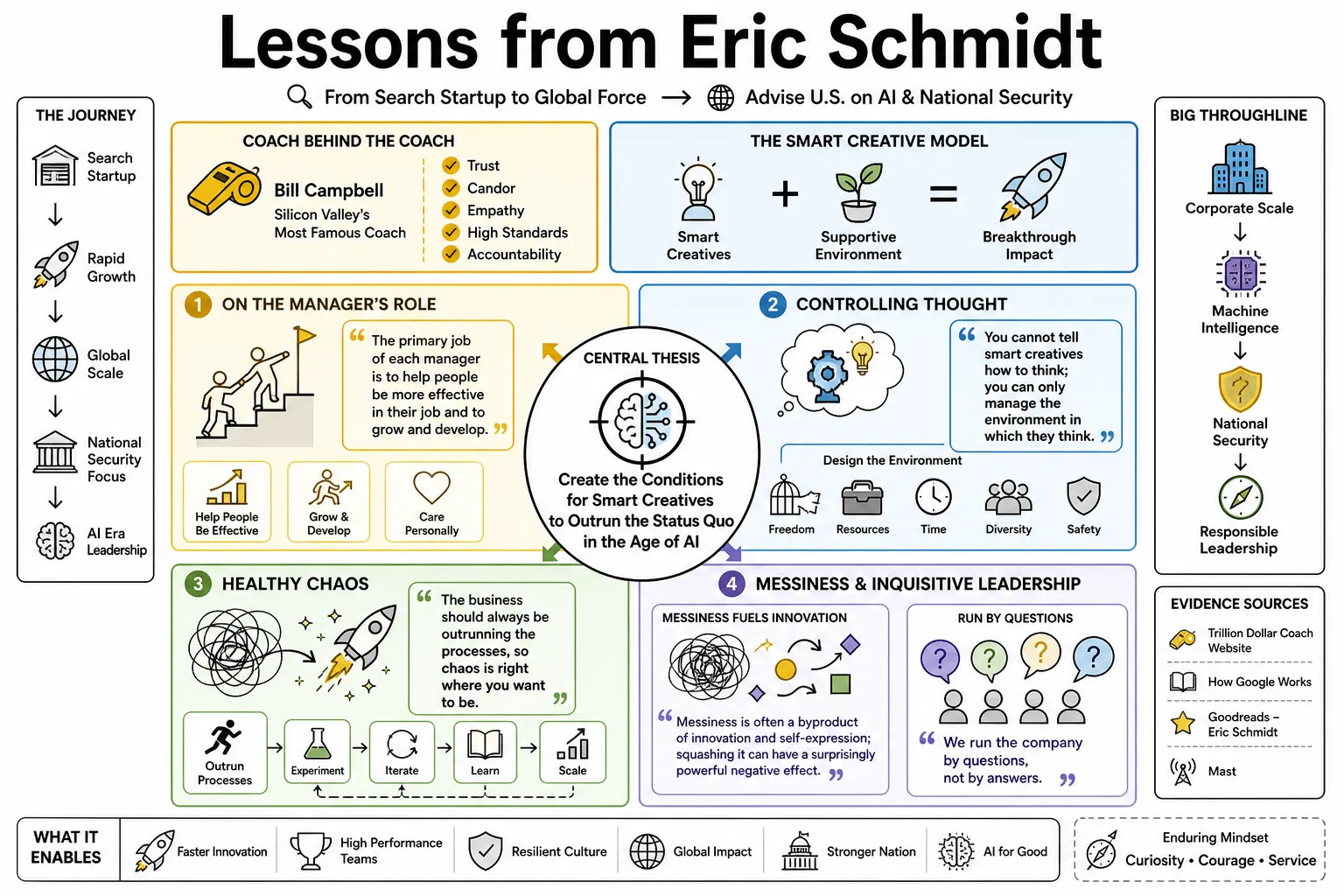
Lessons from Eric Schmidt
Eric Schmidt helped lead Google's growth from a startup into a global technology company and later founded the Special Competitive Studies Project, focused on U.S. AI and technology competitiveness. This profile examines his management, coaching and AI-policy lessons. — SCSP — Eric Schmidt Biography.
Part 1: Management & The "Smart Creative" Culture
- On Helping Self-Driven People: Schmidt described a manager's role with passionate employees as helping them do work they are already motivated to pursue, while providing structure where it improves collaboration. — McKinsey — Eric Schmidt on Business Culture.
- On Giving Smart Creatives Room: Schmidt argued that managers should give passionate, capable employees scope to develop ideas within the company's goals instead of prescribing each move. — Diane Rehm — Eric Schmidt Interview.
- On Structure Around Initiative: Schmidt said Google's talented employees often moved work forward with little direction, but managers still had to address hiring quality, interpersonal friction and the processes needed to reach decisions. — McKinsey — Eric Schmidt on Business Culture.
- On Passionate Work: When asked about messy desks, Schmidt used them to discuss employees absorbed in work they cared about; his management point was to support that initiative, not to impose a rule about office tidiness. — Diane Rehm — Eric Schmidt Interview.
- On Question-Led Meetings: Schmidt recalled early Google staff meetings as extended exchanges of questions and ideas; his contribution was to add business procedures without removing that inquiry-driven culture. — Masters of Scale — Innovation Is Managed Chaos.
- On Enabling Innovation: Schmidt said managers should let self-motivated smart creatives pursue promising ideas inside the company rather than try to command creativity task by task. — Diane Rehm — Eric Schmidt Interview.
- On Knowing the Details: Schmidt admired executives who knew the facts of their business precisely and could answer questions crisply; he singled out this discipline when comparing Google with Intel. — WIRED — Eric Schmidt Interview.
- On Managing Inventive Chaos: Reid Hoffman described Schmidt's Google experience as managing inventive chaos: leaving room for unexpected ideas while adding enough decision discipline to operate at scale. — Masters of Scale — Innovation Is Managed Chaos.
- On Operating Systems for Teams: Schmidt described concrete management routines at Google—careful recruiting, debate followed by a deadline, and limits on interview rounds—as ways to make a creative organization function at scale. — McKinsey — Eric Schmidt on Business Culture.
Part 2: Hiring, Talent, and The "Airport Test"
- On Persistence and Curiosity: Schmidt said Google looked for persistence and curiosity when hiring: people who keep trying, adapt their approach and remain interested in learning. — Masters of Scale — Innovation Is Managed Chaos.
- On Generalists in Changing Industries: In the coauthors' account of Google's hiring, Rosenberg favored people who could learn and change roles over narrow specialists when industry conditions were shifting quickly. — HBR IdeaCast — How Google Manages Talent.
- On Deliberate Hiring: Schmidt urged companies to invest seriously in hiring quality, use a committee rather than leave decisions to a manager's personal preference, and avoid excessive interview rounds. — McKinsey — Eric Schmidt on Business Culture.
- On Talent and Conduct: In How Google Works, Schmidt and Rosenberg distinguish difficult, high-value contributors from people whose conduct damages the organization; their maxim urges leaders not to confuse the two. — How Google Works — Publisher Description.
- On People Under Strategic Uncertainty: Schmidt said that when industry shifts left him without a clear answer, his most important move was assembling capable people in the right roles to work through the problem. — HBR IdeaCast — How Google Manages Talent.
- On Learning Capacity: Rosenberg said the ability to learn and move into a new role could matter more than prior experience when a company faces rapid change; Schmidt and Rosenberg presented this as part of Google's hiring approach. — HBR IdeaCast — How Google Manages Talent.
- On the Airport Test: Schmidt described an LAX-airport thought experiment for hiring: after hours with a candidate, would their curiosity and ideas still hold your interest? He paired that with technical capability and business judgment. — HBR IdeaCast — How Google Manages Talent.
- On Hiring Responsibility: Schmidt said a leader cannot know every answer to a strategic problem, but can assemble exceptional people in the right positions to work through it. — HBR IdeaCast — How Google Manages Talent.
- On Employee Discretion: Schmidt described Google's 20% time as a way for employees to pursue promising ideas outside their assigned work, giving them some discretion independent of a manager's immediate priorities. — Masters of Scale — Innovation Is Managed Chaos.
Part 3: Leadership & The Art of Coaching
- On Leadership Through Coaching: Schmidt credited Bill Campbell with helping leaders earn trust by coaching a team of capable people through competing goals and egos, rather than relying on a title alone. — Tim Ferriss Show — Eric Schmidt on Bill Campbell.
- On Working the Team: In Schmidt's account, Campbell treated the executive team itself as the first coaching problem: experienced people still needed help aligning their goals and resolving internal competition. — Tim Ferriss Show — Eric Schmidt on Bill Campbell.
- On Coaching as Management Work: In their account of Bill Campbell's leadership principles, Schmidt, Rosenberg and Eagle emphasize developing people through prepared one-on-ones, active coaching and trust, rather than treating people development as an afterthought. — Trillion Dollar Coach — Authors' Slide Deck.
- On Coachability: Schmidt and his coauthors report that Bill Campbell invested in people willing to be coached—those showing honesty, humility, perseverance, hard work and openness to learning. — Trillion Dollar Coach — Authors' Slide Deck.
- On Undivided Listening: Schmidt said Campbell listened without checking email or a phone and let people work through a concern at their own pace; he saw that attention as part of effective coaching. — Tim Ferriss Show — Eric Schmidt on Bill Campbell.
- On Candor With Care: The authors describe Campbell's feedback as candid and prompt, while pairing criticism with care and delivering negative feedback privately. — Trillion Dollar Coach — Authors' Slide Deck.
- On Psychological Safety in Google's Teams: Google's Project Aristotle study identified psychological safety as the highest-ranked of five dynamics associated with effective teams in its sample; people on such teams felt able to ask questions, admit mistakes and offer ideas without embarrassment or punishment. — Google re:Work — Team Effectiveness Research.
- On Difficult High Performers: Schmidt and his coauthors argue that a difficult high performer may merit support only when their conduct is neither unethical nor abusive and their contribution exceeds the toll imposed on colleagues and the team. — Trillion Dollar Coach — Authors' Slide Deck.
- On Encouraging Courage: The Campbell principles distilled by Schmidt and his coauthors ask leaders to express confidence in people, push them toward courageous action and visibly celebrate their work. — Trillion Dollar Coach — Authors' Slide Deck.
- On Caring for the Whole Person: Schmidt said Campbell made meetings more human by asking about travel, family and personal concerns; the lesson he drew was to lead colleagues as whole people, not only as job holders. — Tim Ferriss Show — Eric Schmidt on Bill Campbell.
Part 4: Strategic Decision-Making & Innovation
- On Dissension Before Consensus: Schmidt and Rosenberg's How Google Works treats constructive dissent as part of reaching a sound decision; Schmidt separately recalled that vigorous debate with Google's founders attracted him to the company. — How Google Works — Publisher Description.
- On Thinking Tenfold: How Google Works presents thinking 10X rather than 10% as a management maxim: consider a much larger improvement instead of limiting the discussion to incremental gains. — How Google Works — Publisher Description.
- On Technical Talent Over Data: Schmidt argued in 2020 that simply holding the most data would not guarantee a lasting advantage in AI; he expected capable engineers developing better algorithms to matter more. — McKinsey — In Disruptive Times, the Power Comes from People.
- On Product-Led Renewal: Schmidt and Rosenberg put superior products at the center of their management account; Schmidt argued that new product innovation mattered as established sources of advantage weakened. — HBR IdeaCast — How Google Manages Talent.
- On Dissent and Deadlines: Schmidt said a meeting leader should draw out disagreement, especially from quieter participants, then set a deadline so the debate produces a decision. — McKinsey — Eric Schmidt on Business Culture.
- On Being Corrected: Schmidt recalled entering his first meeting with Google's founders certain his Novell technical position was right, then learning they had correctly seen how internet adoption would undermine it. — Economic Club — Eric Schmidt Transcript.
- On CEO-Led Innovation: Schmidt argued that a CEO should take responsibility for innovation and look several years ahead for new products and competitive threats, rather than leave reinvention to a detached specialist function. — Diane Rehm — Eric Schmidt Interview.
- On Google's 70/20/10 Allocation: In a 2011 interview, Schmidt described Google using a 70/20/10 allocation principle for core, adjacent and other work, moving people among categories as priorities changed. — McKinsey — Eric Schmidt on Business Culture.
- On Freedom to Fail: Schmidt described the freedom to test ideas and fail during Google's 20% time as part of what employees received from the company beyond pay; its value was the autonomy to experiment without every attempt succeeding. — Masters of Scale — Innovation Is Managed Chaos.
Part 5: The Philosophical & Human Impact of AI
- On AI's Historical Stakes: In a 2025 TED interview, Schmidt predicted that advances from today's AI toward more general and possibly superintelligent systems could rank among the most consequential developments of the past several centuries, and urged careful stewardship of that possibility. — TED — The AI Revolution Is Underhyped.
- On AI and Human Reason: Schmidt compared AI's emergence with the historical transition from faith to reason, while emphasizing that we do not yet know whether AI will replace human reasoning or extend it. — Masters of Scale — You Should Be Running Toward AI.
- On Discoveries Beyond Familiar Reasoning: Schmidt pointed to AI systems finding unfamiliar game strategies and asked whether similar systems might reveal patterns that humans could not readily discern or explain; he presented this as an open question. — Masters of Scale — You Should Be Running Toward AI.
- On AI's Explainability Problem: In a joint interview about their book, Henry Kissinger warned that AI can reach conclusions without offering reasons people understand; Schmidt agreed that technologists must examine its human impact. — TIME — Kissinger and Schmidt on AI.
- On the Limits of AI Explainability: Schmidt raised the possibility that an AI system could identify a principle it cannot explain in terms people understand, making interpretation and human oversight part of the challenge. — Masters of Scale — You Should Be Running Toward AI.
- On Compressed Thinking Time: Schmidt argued that accelerating information can overwhelm people's time to think; he proposed AI assistants to help sort what deserves attention while warning about dependence on those systems. — TIME — Kissinger and Schmidt on AI.
- On Understanding AI Before Scaling It: Schmidt warned that AI agents coordinating in ways people cannot understand would pose a serious control problem, and argued for monitoring and limits as more capable systems emerge. — Noema — Schmidt on AI's Rapid Advance.
- On Unanticipated Consequences: Schmidt acknowledged that he had not anticipated some harmful uses of internet platforms, including election interference and misinformation, and urged earlier attention to potential AI misuse. — TIME — Kissinger and Schmidt on AI.
- On an AI Governance Framework: After Kissinger raised the absence of a guiding framework, Schmidt called for scientists and policy experts to develop shared principles and limits for powerful AI systems. — TIME — Kissinger and Schmidt on AI.
Part 6: Geopolitics, Security, and The New Digital Age
- On Physical and Virtual Spaces: Schmidt described people as participating in both physical jurisdictions and online communities, each able to influence or check conduct in the other. — WIRED — Schmidt and Cohen Interview.
- On the Internet as an Ungoverned Space: In The New Digital Age, Schmidt and Jared Cohen describe the internet as a vast space without a single top-down authority, enabling broad expression and creativity alongside scams, bullying and other harms. — The New Digital Age — Book Excerpt.
- On Dual-Use Technology: Schmidt warned that tools built for legitimate purposes can also be misused, and argued that inventors should account for those risks rather than assume good intentions determine outcomes. — Noema — Schmidt on AI's Rapid Advance.
- On the Speed of Digital Adoption: In The New Digital Age, Schmidt and Jared Cohen described communication technologies spreading globally at unusual speed, enabling far more people to create and distribute content without traditional intermediaries. — The New Digital Age — Published Book Excerpt.
- On Data Permanence: In an afterword to The New Digital Age, Schmidt and Cohen warned that posts and records created when someone is young may remain discoverable years later, with consequences for privacy and reputation. — WIRED — The Privacy Talk.
- On Shared Security Responsibility: Schmidt framed online privacy and security as shared responsibilities: platforms must protect user data, while individuals also need to protect their accounts. — WIRED — Schmidt and Cohen Interview.
- On Virtual Statehood as a Possibility: Schmidt and Cohen's The New Digital Age explores virtual statehood and internet asylum as possible ways for displaced or oppressed groups to sustain identity and connection; it presents them as scenarios, not existing sovereign rights. — The New Digital Age — Publisher Description.
- On Two Arenas of Foreign Policy: In an interview about their coauthored book, Jared Cohen argued that states may need separate foreign-policy approaches for physical and virtual arenas because their power can differ between them. — WIRED — Schmidt and Cohen Interview.
- On Unequal Connectivity: Cohen explained the coauthors' digital-caste concern: wider access to phones and information may help people, but it does not erase differences in bandwidth, devices, income or basic services. — Gulf News — Jared Cohen Interview.
- On Connectivity and Closed Societies: In a discussion of The New Digital Age, Cohen argued that new information can introduce doubt into tightly controlled societies; Schmidt agreed that smartphones expand individual power, while both acknowledged that autocracies would persist. — Claremont McKenna — The New Digital Age Conversation.
Part 7: Engineering, Systems, and Technical Moats
- On CUDA's Software Ecosystem: In a 2024 Stanford talk, Schmidt argued that NVIDIA's AI-computing advantage rested not just on GPUs but on years of CUDA optimization and software libraries that competing chipmakers would struggle to replicate quickly. — Stanford AI Talk — Archived Transcript.
- On AI's Hardware Constraint: Schmidt said frontier AI training has made software research far more dependent on expensive computing hardware, leaving universities at a resource disadvantage to the largest technology firms. — Noema — Schmidt on AI's Rapid Advance.
- On Frontier AI's Hardware Costs: Schmidt contrasted software's historically low capital needs with frontier-model training's growing demand for expensive hardware, warning that universities need access to compute if they are to keep contributing research. — Noema — Mapping AI's Rapid Advance.
- On the Transparent Battlefield: Schmidt and Greg Grant reported that pervasive drone surveillance near Ukraine's front line has made troop movement easier to spot and strike, reducing the scope for large visible maneuvers. — Foreign Affairs — The Dawn of Automated Warfare.
- On Drones and Warfare: Schmidt and Greg Grant described inexpensive drones as increasingly central to Ukraine's combat and reconnaissance, while treating fully automated warfare as an emerging possibility rather than an accomplished replacement of manned systems. — Foreign Affairs — The Dawn of Automated Warfare.
- On Semiconductor Leadership: In 2021, Schmidt said the U.S. AI commission urged the country to stay two hardware generations ahead of China and strengthen domestic chipmaking; he framed this as a national-security objective, not a measured current lead. — Brookings — National Strategy for AI Innovation Transcript.
- On Systematizing Scale: As Google grew, Schmidt worked to make hiring, strategy and product development repeatable processes while adjusting each system to the company's scale. — Conversations with Tyler — Eric Schmidt.
- On Mapping Technical Change: Schmidt advised people assessing technology to map where entrepreneurs and new activity are clustering before forming a strategic view, especially in fields they do not yet understand well. — Conversations with Tyler — Eric Schmidt.
Part 8: Career Mindsets & The Power of "Yes"
- On Saying Yes: Schmidt urged graduates to say yes to opportunities to travel, meet people and learn, including those outside their comfort zone; he framed the habit as a way to keep growing. — Stanford GSB — Just Say Yes.
- On Turnaround Priorities: Schmidt said a turnaround requires leaders to focus an organization on immediate goals and address inherited people problems, rather than treating it like ordinary company building. — Masters of Scale — How Great Cultures Are Built and Rebuilt.
- On the Window for Cultural Change: Drawing on advice he credits to Lou Gerstner, Schmidt said a new turnaround leader has roughly six to nine months to change a company's culture; he presented it as a practical rule from his experience, not a universal law. — Masters of Scale — How Great Cultures Are Built and Rebuilt.
- On Strategic Persistence: Schmidt distinguished persistence from repeating the same failed move: keep pursuing the objective, but change tactics when the first approach does not work. — Masters of Scale — Innovation Is Managed Chaos.
- On Learning From 20% Time: Schmidt said Google's 20%-time projects were expected to fail sometimes; employees gained room to test ideas, learn from attempts and change tactics rather than persist with a failing approach. — Masters of Scale — Innovation Is Managed Chaos.
- On Deciding Under Pressure: Schmidt said piloting taught him to make timely decisions under uncertainty, a habit he carried into company turnarounds rather than waiting for perfect information. — Masters of Scale — Innovation Is Managed Chaos.
- On Shared Ownership of Ideas: Schmidt said his father taught him to make a proposed course of action feel like the team's own idea; he linked that shared ownership to motivating people who can organize and carry work forward themselves. — Conversations with Tyler — Eric Schmidt.