David Risher is the CEO of Lyft and the founder of the nonprofit Worldreader. This collection gathers his own words from interviews and shareholder letters. — CEO David Risher's letter to shareholders (Lyft, 2024).
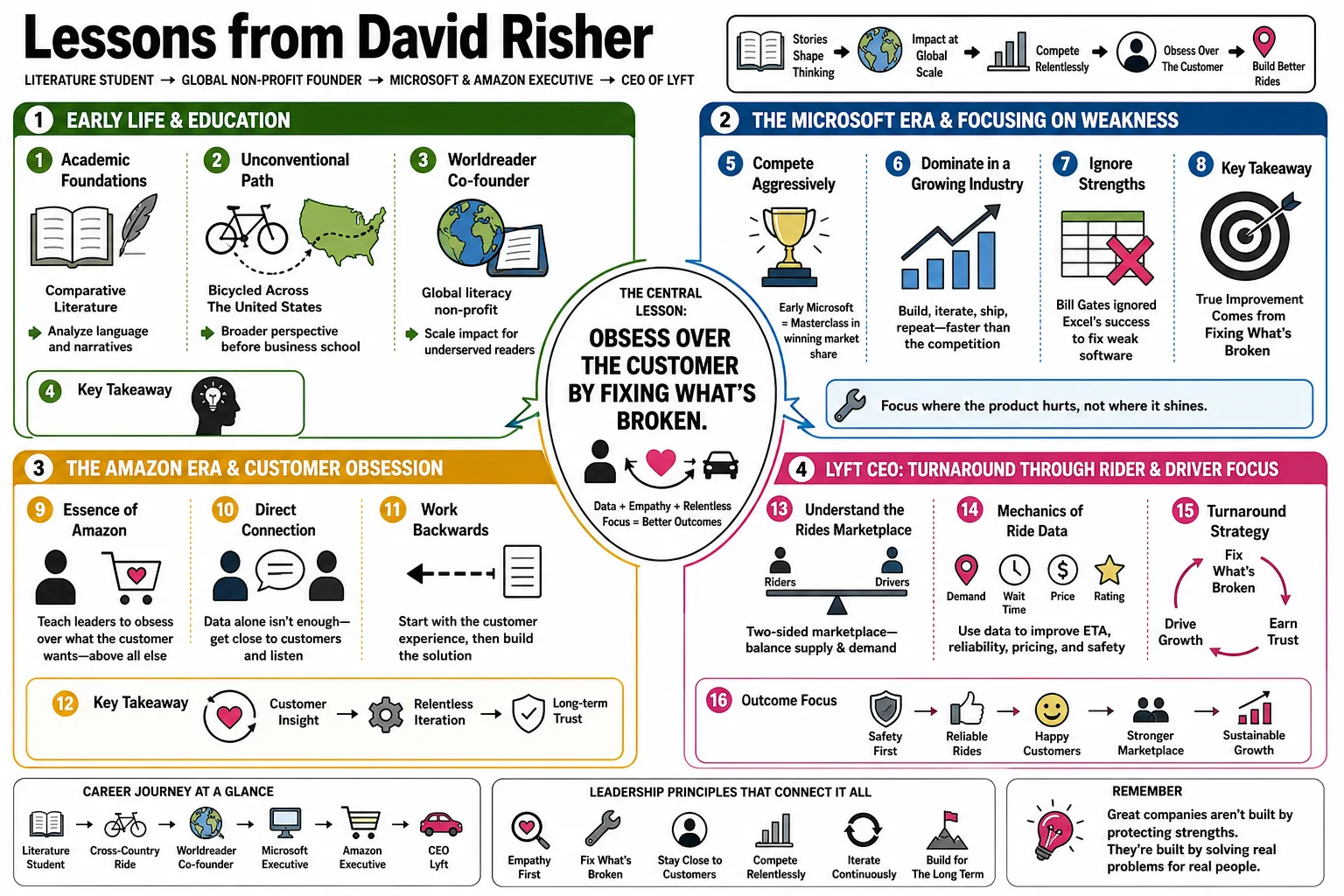
Part 1: Early Life and Education
- On a computer and a high school English teacher: David Risher: "And so when I used the computer to print out stuff for my high school English teacher, she could finally read what I was writing." — Masters in Business (Ritholtz transcript, Risher's turns).
- On platform shifts: David Risher: "Okay, so you’re making me realize that there’s a theme of my life I hadn’t really thought of before, which is platform shifts." — Masters in Business (Ritholtz transcript, Risher's turns).
Part 2: The Microsoft Era and Focusing on Weakness
- On competing at Microsoft: David Risher: "You know, I also learned a lot about competing at Microsoft, and even at Worldreader — nonprofits, people sort of look at them and think they’re not very much, but it’s very, very difficult to actually scale a nonprofit, because the funding is always tight and so forth." — Masters in Business (Ritholtz transcript, Risher's turns).
- On things to fix: David Risher: "It was the time, frankly, to be saying, okay, we’ve got some things to fix, and let’s really focus on that." — Masters in Business (Ritholtz transcript, Risher's turns).
Part 3: The Amazon Era and Customer Obsession
- On loving technology and a bookstore: David Risher: "I left because it was technology which I learned to love at Microsoft and it was a bookstore which I’ve loved forever." — Fortune Leadership Next (Risher's turns).
- On a team that knows the customer better: David Risher: "Then, when you do end up diving deep, they’ll show up with data, ready to debate your hypotheses because they know the customer that much better than you do." — CEO David Risher's annual letter to shareholders.
- On a reference check from Jeff: David Risher: "My phone rings one day at Microsoft, and it’s this guy Jeff, and he’s doing a reference check of a woman who used to work, actually, at Microsoft in the personal finance group." — Masters in Business (Ritholtz transcript, Risher's turns).
Part 4: Worldreader and Purpose-Driven Scale
- On the idea behind Worldreader: David Risher: "As I said, I moved overseas, but then I got super excited about this idea of using digital books to help kids read." — Fortune Leadership Next (Risher's turns).
- On being focused as a nonprofit: David Risher: "And so if you are a nonprofit leader and running a successful, high-functioning nonprofit, you have to be very smart about making decisions that are very focused." — Fortune Leadership Next (Risher's turns).
- On readers reached: David Risher: "We’ve got about 22 million kids who have read on the platform, it’s all digital reading, all on cell phones now." — Fortune Leadership Next (Risher's turns).
- On the structural advantages of the nonprofit world: David Risher: "The nonprofit world has very few of those structural advantages, but a lot of the same problems, maybe even bigger problems." — Fortune Leadership Next (Risher's turns).
Part 6: Lyft's Turnaround and Pricing Strategy
- On surge pricing: David Risher: "And it just made me realize how much surge pricing is customer hostile." — Masters in Business (Ritholtz transcript, Risher's turns).
- On liquid marketplaces: David Risher: "We aspire to keep the driver/rider marketplace liquid through low rider pricing and fair driver earnings." — CEO David Risher's letter to shareholders.
- On a customer who tells their friends: David Risher: "There’s a difference between a customer begrudgingly choosing you and a customer having such a great experience they tell their friends about it." — CEO David Risher's annual letter to shareholders.
- On a mistake being your problem: David Risher: "And I want people really to understand that when you’re the leader of the organization, someone makes a mistake, it’s your problem." — Fortune Leadership Next (Risher's turns).
- On taking out surge pricing: David Risher: "So that’s what’s led us to take about $50 million a year out of surge pricing." — Masters in Business (Ritholtz transcript, Risher's turns).
Part 7: Autonomous Vehicles and The Future of Mobility
- On the hybrid network: David Risher: "But these are gonna be some of the building blocks of the self-driving — or, I really should say, hybrid — network of the future." — Masters in Business (Ritholtz transcript, Risher's turns).
- On Waymo and Baidu: David Risher: "We’ve built partnerships with the two global AV leaders – Waymo and Baidu – and a growing suite of other great AV partners." — CEO David Risher's annual letter to shareholders.
- On technology and living your best life: David Risher: "You know, I’m gonna come back to the basic role that technology plays in people’s lives, to help them live their absolute best lives." — Masters in Business (Ritholtz transcript, Risher's turns).
- On self-driving arriving gradually: David Risher: "‘Cause that’s the last thing I’ll say, just as sort of intro: self-driving cars are gonna come little by little by little." — Masters in Business (Ritholtz transcript, Risher's turns).
- On the data drivers must absorb: David Risher: "Drivers have to absorb and process a ton of data when deciding whether to accept a ride —how far away the pickup is, how long the ride itself is, how much they’ll get paid, and how that breaks down per minute and mile." — CEO David Risher's annual letter to shareholders.
Part 8: Leadership, Decision-Making, and Operational Discipline
- On Falcon Mode: David Risher: "In last year’s letter to shareholders, I wrote about what I called Falcon Mode, staying high to see the big picture and then swooping down to get into details." — CEO David Risher's annual letter to shareholders.
- On thinking about one competitor: David Risher: "And frankly, if you spend too much of your time thinking about that one competitor, you’re probably losing the script." — Masters in Business (Ritholtz transcript, Risher's turns).
- On blind spots: David Risher: "There are all kinds of things that it’s doing as an organization that I couldn’t have gotten it to do because I have my own blind spots and now vice versa with John [Zimmer] and Logan [Green], the founders of Lyft. they have been so incredibly gracious." — Fortune Leadership Next (Risher's turns).
- On the data not giving the full story: David Risher: "But when we trained our eyes on the problem and swooped down into the details, it became clear the data wasn’t giving us the full story." — CEO David Risher's annual letter to shareholders.
- On the earnings drumbeat: David Risher: "Add to that a quarterly earnings drumbeat that focuses attention on the short term, and the temptation to focus more on your competitor than your customer." — CEO David Risher's annual letter to shareholders.
Part 9: Scaling Beyond the Turnaround
- On low-margin marketplaces: David Risher: "That’s why rideshare — like all marketplace businesses — is structurally low-margin." — CEO David Risher's annual letter to shareholders.
- On the timing of information: David Risher: "By being more thoughtful about what information we shared and when we shared it, and in particular by showing drivers how much they could expect to earn and where the drop-off was, we saw dramatic changes." — CEO David Risher's annual letter to shareholders.
- On a defensive posture: David Risher: "As one of my martial-arts loving brothers, Michael, reminds me, it’s actually helpful to drop into a defensive posture." — CEO David Risher's annual letter to shareholders.
- On both sides of the marketplace: David Risher: "Drivers want to earn more; riders want to pay less." — CEO David Risher's annual letter to shareholders.
- On productive hours: David Risher: "We measure that in terms of the number of hours a vehicle is productive on the road each day, and the cost of maintenance across an expected life of 3 years and roughly 300,000 miles." — CEO David Risher's annual letter to shareholders.
- On stepping back: David Risher: "I didn’t tell anyone, but I intentionally tried stepping back to empower the leaders around me in different ways." — CEO David Risher's annual letter to shareholders.
- On leaving Worldreader: David Risher: "After all, I was already serving on the Board and loved my job at Worldreader, a nonprofit organization I’d founded and led for 13 years." — CEO David Risher's letter to shareholders.
- On a global platform: David Risher: "I’m hell bent on transforming Lyft into a global platform that connects people to the physical world — one that leads the industry." — CEO David Risher's annual letter to shareholders.