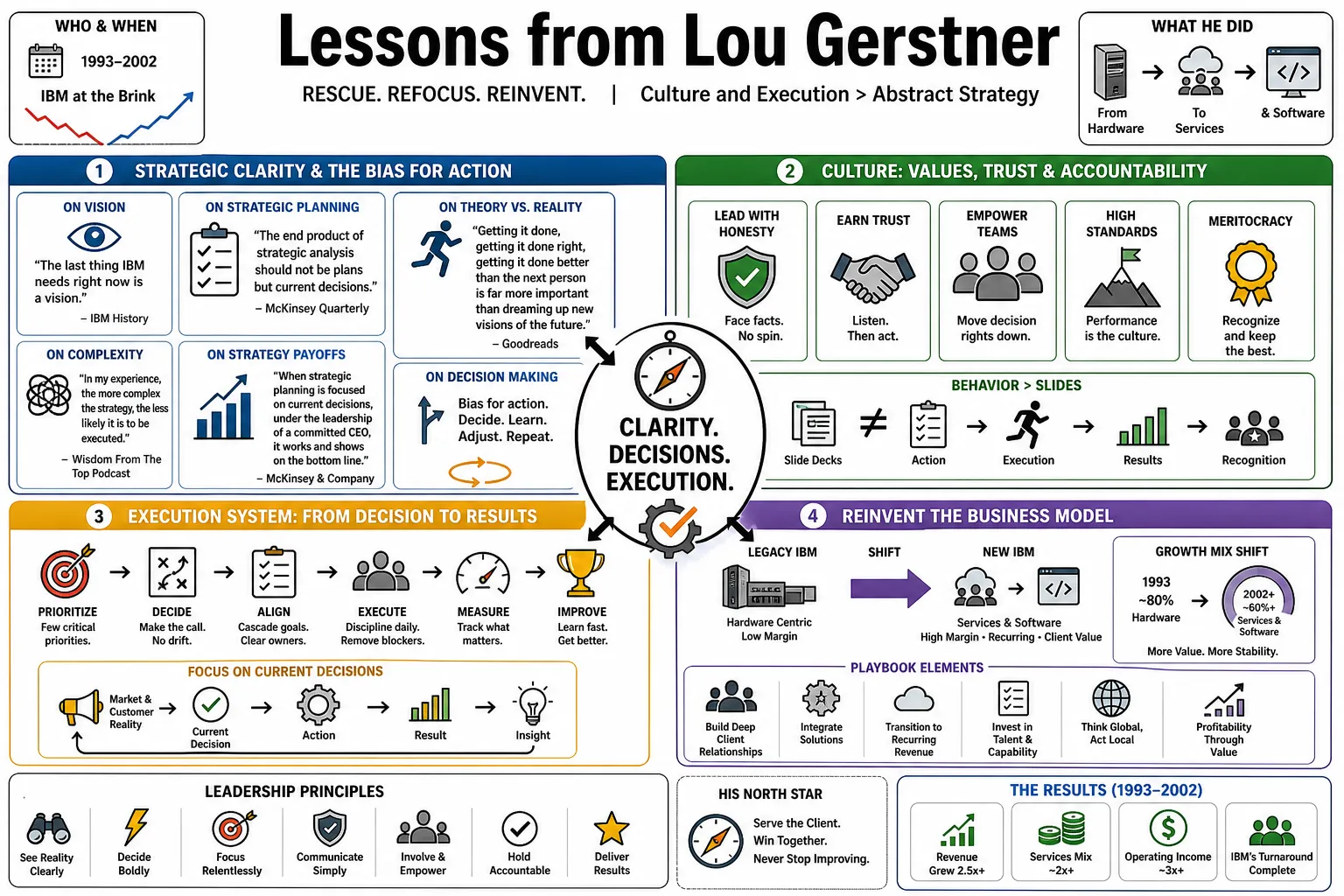
Lessons from Lou Gerstner
Lou Gerstner pulled IBM back from the brink in the 1990s by dragging the hardware giant into services and software. He famously argued that culture and execution matter far more than abstract strategy when a company's survival is at stake. This profile examines his practical approach to leading a massive organization through an existential crisis.
Part 1: Strategic Clarity and the Bias for Action
- On Vision: "The last thing IBM needs right now is a vision." — Source: IBM History
- On Strategic Planning: "The end product of strategic analysis should not be plans but current decisions." — Source: McKinsey Quarterly
- On Theory vs. Reality: "Getting it done, getting it done right, getting it done better than the next person is far more important than dreaming up new visions of the future." — Source: Goodreads
- On Complexity: "In my experience, the more complex the strategy, the less likely it is to be executed." — Source: Wisdom From The Top Podcast
- On Strategy Payoffs: "When strategic planning is focused on current decisions, under the leadership of a committed CEO, it works and shows on the bottom line." — Source: McKinsey & Company
- On Decision Making: "I believe in making the tough calls early; waiting for more data often just means waiting for the crisis to get worse." — Source: Stanford GSB Interview
- On the Strategic Process: "Strategy is not a yearly retreat; it is the daily discipline of choosing what not to do." — Source: HBR Case Study
- On Market Realities: "The marketplace is the driving force behind everything we do; internal opinions are secondary to customer behavior." — Source: Who Says Elephants Can't Dance?
- On Simplicity: "If you can't explain your strategy in three minutes, you don't have one." — Source: Leaders Podcast
- On Competitive Positioning: "It isn't a question of whether elephants can prevail over ants. It's a question of whether a particular elephant can dance." — Source: IBM Archives
Part 2: Culture as the Ultimate Competitive Advantage
- On the Importance of Culture: "I came to see, in my time at IBM, that culture isn't just one aspect of the game—it is the game." — Source: HBR
- On Managing Culture: "Management doesn't change culture. Management invites the workforce itself to change the culture." — Source: McKinsey Quarterly
- On Rituals: "Culture is not what you say; it is what you do and what you reward." — Source: Wisdom From The Top
- On Dress Codes: "I changed the dress code not to be casual, but to signal that we were focusing on the customer’s world, not our own internal white-shirt tradition." — Source: Who Says Elephants Can't Dance?
- On Values as Words: "Too many corporate values are just words on a plaque; if the practices don't drive the values, people don't get it." — Source: AzQuotes
- On Bureaucracy: "I wanted to replace a culture of 'non-concurrence'—where anyone could veto a project—with a culture of teamwork and speed." — Source: Stanford GSB
- On Internal Fiefdoms: "Fiefdoms are the death of a large company; you must force people to work for the whole enterprise, not just their unit." — Source: HBR
- On Incentives: "Incentives drive behavior. If you want people to work together, you have to pay them based on the company's total performance." — Source: McKinsey Quarterly
- On Corporate Character: "An organization is nothing more than the collective capacity of its people to create value." — Source: Quotefancy
- On Performance Standards: "You have to create a culture that is intolerant of mediocrity." — Source: Stanford Graduate School of Business
Part 3: The Discipline of High-Performance Execution
- On Inspection: "People don't do what you expect but what you inspect." — Source: AzQuotes
- On Activity vs. Results: "Never confuse activity with results." — Source: Goodreads
- On Urgency: "No institution undergoes fundamental change unless it believes it is in deep trouble and needs to survive." — Source: McKinsey Quarterly
- On Speed: "We had to move from a five-year mainframe cycle to an eighteen-month cycle; speed is a competitive weapon." — Source: Who Says Elephants Can't Dance?
- On Implementation: "Execution—getting the task done, making it happen—is the most unappreciated skill of an effective leader." — Source: Goodreads
- On Forecasting: "You don't get points for predicting rain. You get points for building arks." — Source: AzQuotes
- On Accountability: "I look for people who take personal ownership of the end result, not just their part of the process." — Source: Stanford GSB
- On Perfectionism: "Don't let the perfect be the enemy of the good and the fast." — Source: Leaders Podcast
- On Follow-Through: "Strategy is 5% of the challenge; 95% is the rigorous follow-through required to make it a reality." — Source: HBR
- On Risk: "Watch the turtle. He only moves forward by sticking his neck out." — Source: Wake Forest University
Part 4: Building a Customer-Obsessed Organization
- On Listening: "Customer complaints are the schoolbooks from which we learn." — Source: Who Says Elephants Can't Dance?
- On Direction: "Everything starts with the customer. We built this company from the customer back, not from the company out." — Source: AzQuotes
- On Customer Needs: "The customer doesn't care about your internal structure; they care about their problems being solved." — Source: Wisdom From The Top
- On Prestige: "At American Express, we learned that 'membership has its privileges' was more than a slogan—it was a promise of elite service." — Source: NYT Archive
- On Direct Engagement: "I required my senior managers to meet with customers and submit reports of those meetings directly to me." — Source: Who Says Elephants Can't Dance?
- On Value Creation: "If you aren't helping a customer solve a problem or capture an opportunity, you aren't creating value." — Source: McKinsey Interview
- On Market Focus: "The marketplace is the only place where you find out if your strategy is working." — Source: Stanford GSB
- On Relationship Management: "In a service business, the relationship is the product." — Source: NYT
- On Loyalty: "Customer satisfaction is a leading indicator of future financial performance." — Source: IBM Archives
- On Market Intelligence: "You have to spend more time with your customers than with your colleagues." — Source: Who Says Elephants Can't Dance?
Part 5: Leadership, Character, and Accountability
- On Solving Problems: "I look for people who work to solve problems and help colleagues; I sack politicians." — Source: AzQuotes
- On Personal Responsibility: "See yourself as a driver rather than as a box on an organization chart." — Source: Goodreads
- On Character: "Computers are tools, but no machine can replace the human spark of spirit and compassion." — Source: Wake Forest University
- On Leading People: "Inventories can be managed but people must be led." — Source: Grokipedia
- On Executive Style: "I moved away from a 'presiding' style to a 'driving' style where leaders dig into the details." — Source: McKinsey Quarterly
- On Managing Debt: "At RJR Nabisco, I learned that managing a balance sheet for private equity is very different from running a growth company." — Source: Grokipedia
- On Confidence: "Leaders must project a sense of calm and confidence, especially when they don't know the answer yet." — Source: Stanford GSB
- On Tough Decisions: "You can't be a leader and be loved by everyone; your job is to be respected for doing what's right for the institution." — Source: HBR
- On Communication: "I used 'Dear Colleague' emails to bypass management layers and speak directly to 300,000 employees." — Source: Who Says Elephants Can't Dance?
Part 6: Navigating Crises and Organizational Change
- On the Burning Platform: "No organization will change unless it feels the fire at its feet." — Source: Wisdom From The Top
- On Radical Transformation: "Sometimes you have to break the machine to fix it." — Source: Leaders Podcast
- On Continuous Change: "Successful companies change when they are successful, not just when they are in crisis." — Source: McKinsey Quarterly
- On Cultural Inertia: "The hardest part of a turnaround is not the financial engineering; it is changing the minds of the people." — Source: Stanford GSB
- On the Price of Staying: "The cost of staying the same must be made higher than the cost of changing." — Source: Who Says Elephants Can't Dance?
- On Transparency: "In a crisis, the only thing worse than bad news is hidden news." — Source: IBM Archives
- On Momentum: "You have to find small wins early to prove to the organization that change is possible." — Source: McKinsey Quarterly
- On Institutional Fear: "Healthy paranoia about losing your edge is better than comfortable complacency." — Source: Wisdom From The Top
- On Long-term Survival: "Companies don't die from external competition; they die from internal rot." — Source: Stanford GSB
Part 7: The IBM Turnaround and the Power of Integration
- On Keeping IBM Together: "The value of IBM was its ability to integrate complex technology for the customer; breaking it up would have destroyed that edge." — Source: IBM History
- On the Services Shift: "We moved from selling boxes to selling outcomes; IBM Global Services became our most important product." — Source: Who Says Elephants Can't Dance?
- On Software Strategy: "I decided we would not build another operating system; we would build the middleware that connected everything." — Source: Leaders Podcast
- On E-Business: "We branded the internet era 'e-business' to show customers that the web was a tool for their existing operations." — Source: IBM Archives
- On Global Scale: "Scale is only an advantage if you use it to move faster and provide deeper expertise than a small competitor." — Source: Stanford GSB
- On Technology Standards: "Proprietary systems are the past; open standards and integration are the future of enterprise IT." — Source: 1996 National Education Summit Speech
- On Mainframes: "The mainframe wasn't dead; it was overpriced. We slashed prices to save the ecosystem." — Source: Who Says Elephants Can't Dance?
- On R&D Alignment: "We shifted research from 'pure' science to 'market-driven' science that solved real customer problems." — Source: McKinsey Quarterly
- On the 'One IBM' Goal: "I wanted a customer in Tokyo to have the same high-quality experience as a customer in New York." — Source: IBM History
Part 8: Timeless Advice for Managers and Careers
- On Lifelong Learning: "No matter what you do next, don't stop discovering. Don't stop learning." — Source: Wake Forest University
- On Education Reform: "We need national standards and testing; what gets measured gets done in schools just as in business." — Source: 1996 National Education Summit
- On Biscuits and Tech: "Joining IBM lets me combine my two great loves—technology and biscuits." — Source: Grokipedia
- On Success Trap: "The more successful you are, the more you try to codify what made you great, and suddenly you're inward-thinking." — Source: Wisdom From The Top
- On Career Planning: "Don't plan your career too rigidly; look for the hardest problems and try to solve them." — Source: McKinsey Interview
- On Technology as a Tool: "Technology is not a silver bullet; it is a means to an end." — Source: AzQuotes
- On Persistence: "In a turnaround, you have to be more persistent than the culture's desire to stay the same." — Source: Who Says Elephants Can't Dance?
- On Human Potential: "Technology has limitations on what it can accomplish. You do not." — Source: Wake Forest University