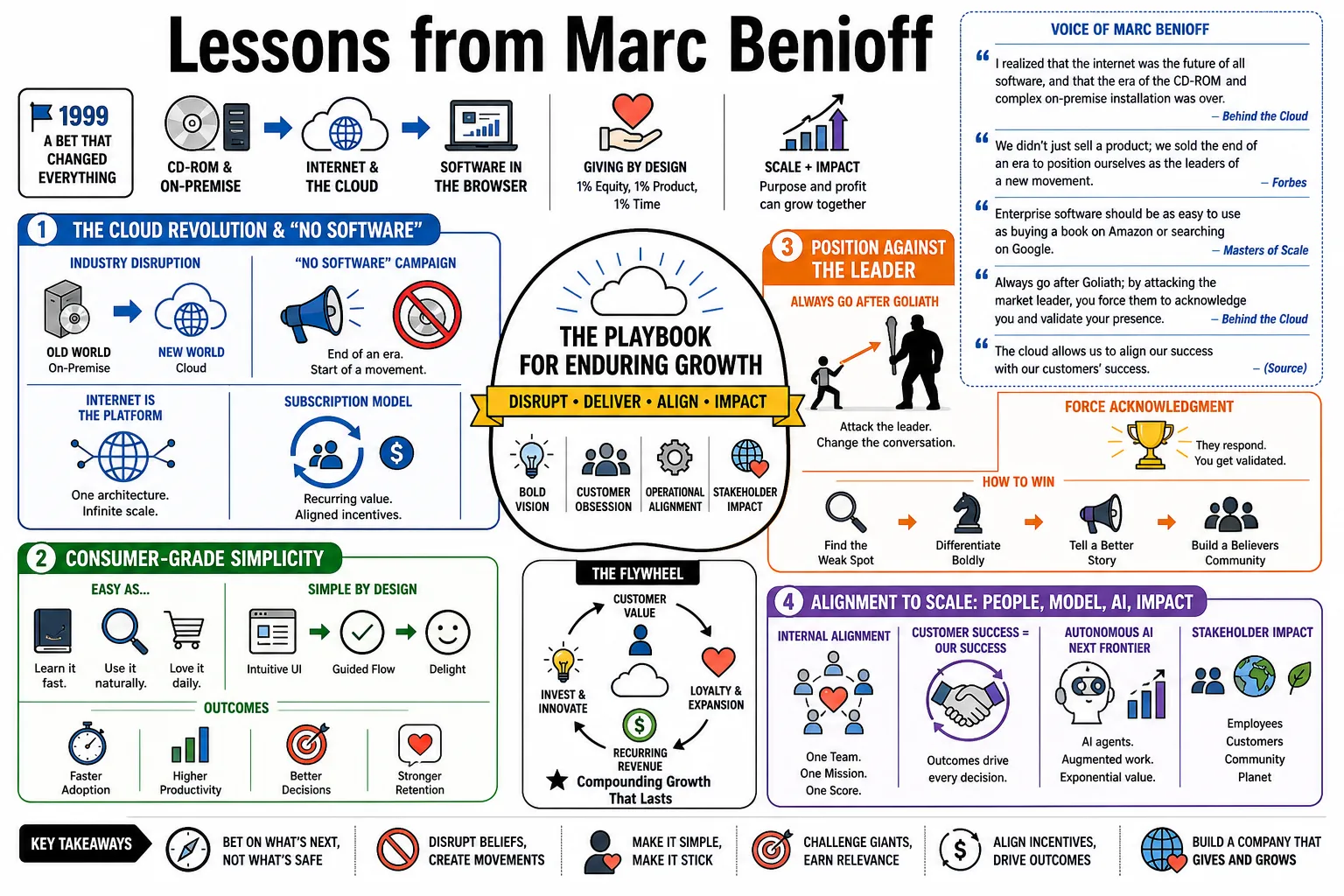
Lessons from Marc Benioff
In 1999, Marc Benioff bet that business software belonged in the browser rather than on a disk, a move that launched the cloud industry. He made corporate giving a core requirement from the start, proving that social impact and scale can coexist. This profile breaks down his playbook for growth, from his focus on internal alignment to his recent push into autonomous AI.
Part 1: The Cloud Revolution and "No Software"
- On Industry Disruption: "I realized that the internet was the future of all software, and that the era of the CD-ROM and complex on-premise installation was over." — Source: Behind the Cloud
- On the "No Software" Campaign: "We didn't just sell a product; we sold the end of an era to position ourselves as the leaders of a new movement." — Source: Forbes
- On Consumer-Grade Simplicity: "Enterprise software should be as easy to use as buying a book on Amazon or searching on Google." — Source: Masters of Scale
- On Position Against the Leader: "Always go after Goliath; by attacking the market leader, you force them to acknowledge you and validate your presence." — Source: Behind the Cloud
- On Subscription Models: "The cloud allows us to align our success with the customer's success through a recurring model rather than a one-time transaction." — Source: Salesforce Blog
- On Early Skepticism: "When we started, people laughed at the idea of putting sensitive corporate data on the public internet, which told me we were onto something truly disruptive." — Source: Rapid Response Podcast
- On Infrastructure-as-a-Service: "Because the cloud didn't exist yet, we had to build our own server farms from scratch to prove that SaaS was technically viable." — Source: Behind the Cloud
- On The End User: "B2B software must focus on the person actually using the tool, not just the executive who signs the check." — Source: From Founder to CEO
- On Defining a New Category: "One idea alone is a tactic, but if it can be executed in multiple ways to define a category, it becomes a strategy." — Source: Behind the Cloud
Part 2: Strategic Alignment and the V2MOM
- On the V2MOM Framework: "The V2MOM is our secret weapon for management; it ensures that every person in the company is aligned with the same vision and values." — Source: Salesforce Blog
- On Vision: "A vision must be a clear statement of what you want to achieve, providing a destination for every employee." — Source: Trailblazer
- On Values in Alignment: "Values are the guideposts that tell us how we will achieve our vision without compromising our integrity." — Source: Salesforce News
- On Methods: "Methods represent the specific actions and steps we will take to move toward our goals." — Source: Trailblazer
- On Obstacles: "You must explicitly identify what is standing in your way so that the team can collaborate to remove those barriers." — Source: Salesforce Blog
- On Measures: "Measures are how we know we are successful; without them, a vision is just a dream without accountability." — Source: Trailblazer
- On Continuous Updating: "We rewrite our V2MOMs every six months because the market moves too fast for a static annual plan." — Source: Masters of Scale
- On Top-Down vs. Bottom-Up: "Alignment requires a combination of leadership direction and staff input to ensure the plan is actually executable." — Source: Behind the Cloud
- On Simplicity in Management: "If you can’t fit your strategic plan on a single page, it’s too complex for your employees to follow." — Source: Salesforce News
Part 3: The 1-1-1 Model and Stakeholder Capitalism
- On Integrated Philanthropy: "I realized that I didn't have to make a choice between doing business and doing good; the two could be integrated." — Source: Global Citizen
- On 1% Equity: "By setting aside 1% of founding stock for a foundation, the company's social impact grows automatically as its valuation increases." — Source: Salesforce Philanthropy
- On 1% Product: "Donating our technology to nonprofits helps them scale their impact using the same world-class tools as Fortune 500 companies." — Source: Pledge 1%
- On 1% Time: "Giving employees paid time off to volunteer makes philanthropy part of the daily culture rather than an afterthought." — Source: Salesforce News
- On Starting Early: "It is much easier to integrate giving back when you are a three-person startup than when you are a 50,000-person corporation." — Source: Trailblazer
- On Stakeholder Capitalism: "The business of business is improving the state of the world, not just maximizing shareholder profit." — Source: New York Times
- On the Friedman Doctrine: "The idea that a corporation's only responsibility is to its shareholders is a narrow view that no longer fits the modern world." — Source: Trailblazer
- On Doing Well by Doing Good: "Values create value; purpose-driven companies attract better talent and build deeper customer loyalty." — Source: Salesforce News
- On Global Impact: "The goal of the Pledge 1% movement is to create a new standard where every startup integrates social impact into its DNA." — Source: Pledge 1%
- On The Moral Compass: "In the Fifth Industrial Revolution, technology must be guided by a moral compass to ensure it benefits all of humanity." — Source: World Economic Forum
Part 4: Building the "Ohana" and Corporate Culture
- On the Ohana Culture: "Ohana means family, and it represents our commitment to treating employees, customers, and partners with mutual respect." — Source: Salesforce Careers
- On Trust as the Highest Value: "Trust has to be your highest value; if it's not, and you prioritize growth over integrity, something bad will happen." — Source: Goodreads
- On Transparency: "Transparency is a brand-builder; when things go wrong, being open about the failure builds more trust than hiding it." — Source: Behind the Cloud
- On Gender Equality: "We spent millions to close the gender pay gap because equality is a core value that requires active, financial commitment." — Source: Business Insider
- On The Recruiting Culture: "Everyone in the company should be a recruiter; you are selling the vision to potential talent as much as you sell the product to customers." — Source: Behind the Cloud
- On Cultural DNA: "You must inject local leaders with your corporate DNA when expanding globally to maintain a unified identity." — Source: Behind the Cloud
- On Employee Feedback: "The modern workforce is a moral community that expects their employer to listen and reflect their personal values." — Source: New York Times
- On The Importance of Mahalo: "Cultivating a culture of gratitude and 'Mahalo' improves morale and strengthens the bonds within the Ohana." — Source: Behind the Cloud
- On High Standards: "Do not settle for 'B' players as you scale; your culture is defined by the people you choose to hire and keep." — Source: Trailblazer
Part 5: The Platform Playbook and Ecosystem Scaling
- On Steve Jobs’ Advice: "Steve Jobs told me I needed to build an application economy, which led directly to the creation of the AppExchange." — Source: TechCrunch
- On The AppExchange: "By building a platform where others can sell their own software, we turned Salesforce from an application into an ecosystem." — Source: Behind the Cloud
- On "Land and Expand": "Get into a company through a single division or team; once you prove success there, expansion across the enterprise becomes much easier." — Source: Behind the Cloud
- On The Whale Client: "Secure a high-profile 'whale' client early on to provide the credibility needed to win over the rest of the market." — Source: Behind the Cloud
- On Word-of-Mouth: "The most effective selling is done by customers who talk about your product when you aren't in the room." — Source: From Founder to CEO
- On Customer Success: "We cannot grow unless our customers are growing; their success is the primary metric for our own health." — Source: Salesforce News
- On Partnering with Competitors: "Business is temporal, but relationships are eternal; you might compete one day and partner the next." — Source: Masters of Scale
- On Data as the Moat: "In the cloud era, your moat isn't just your software; it's the trust and data you manage for your customers." — Source: Trailblazer
- On Scaling Without Overspending: "Use internet-based models to reduce your own operational costs while you focus capital on customer acquisition." — Source: Behind the Cloud
- On Winning Partner Loyalty: "Treat your first customers like partners in your innovation; their feedback should shape the product roadmap." — Source: Behind the Cloud
Part 6: The Third Wave of AI and Agentic Software
- On the Evolution of AI: "We have moved from predictive AI to generative AI, and now we are entering the third wave: autonomous agents." — Source: Salesforce News
- On Agentforce: "Agentforce is what AI was meant to be—autonomous agents that can reason, plan, and take action without human supervision." — Source: Rapid Response Podcast
- On Microsoft Copilot: "Microsoft has done a disservice to the industry with Copilot; it’s Clippy 2.0 and it spews data all over the floor." — Source: Business Insider
- On Digital Labor: "We are meeting our growth demands through digital labor and AI-driven productivity rather than just hiring more developers." — Source: Cloud Wars
- On The Agentic Enterprise: "In the future, traditional software interfaces will fade away, replaced by conversational interactions within platforms like Slack." — Source: YouTube - Salesforce Keynote
- On The Data Cloud: "AI is only as good as the data it accesses; our Data Cloud provides the metadata context that prevents hallucinations." — Source: Salesforce News
- On The "DIY AI" Fantasy: "Building custom LLMs from scratch is a fantasy that has failed to deliver ROI for most companies; the platform approach is superior." — Source: GeekWire
- On The Renaissance of the Generalist: "AI will end the era of hyper-specialized coding, giving rise to generalists who orchestrate agents to build systems." — Source: Rapid Response Podcast
- On Human-in-the-Loop: "Even as agents become autonomous, we must maintain human-in-the-loop systems to ensure accuracy and ethical use." — Source: Salesforce AI Research
Part 7: The CEO as Activist and Public Leadership
- On The Activist CEO: "Taking a stand is no longer optional for CEOs; you must use your platform to address societal issues." — Source: Trailblazer
- On LGBTQ+ Rights: "We threatened to reduce investment in states passing discriminatory laws because equality is a non-negotiable value." — Source: New York Times
- On The Homelessness Crisis: "I supported San Francisco’s Proposition C to tax big business for homeless services because our community's health is part of our responsibility." — Source: Wired
- On Environmental Stewardship: "Climate change is the greatest challenge of our time; we are leading the 'Trillion Trees' initiative to sequester carbon." — Source: World Economic Forum
- On Ethical Technology: "We must ensure that the Fourth Industrial Revolution does not widen the gap between the haves and the have-nots." — Source: Trailblazer
- On Rooting Out Complacency: "The first rule of building a sustainable business is learning how to root out complacency in your own leadership." — Source: Trailblazer
- On Corporate Advocacy: "Businesses have the power to move legislation; when we speak up as a collective, we can drive social change faster than government alone." — Source: Salesforce News
- On Values as a Shield: "A culture rooted in values creates a company that can withstand any storm or economic downturn." — Source: Goodreads
- On Listening to Stakeholders: "My employees often push me to take stands that I might have missed; listening to them is essential for modern leadership." — Source: New York Times
Part 8: The Beginner's Mind and Mentorship (The Ellison Lessons)
- On Shoshin (Beginner's Mind): "We strive to maintain a beginner's mind, which is the openness to learn that often disappears with expertise." — Source: Masters of Scale
- On Tearing Up the Plan: "Every six months, you should be willing to tear up the master plan and redesign your role based on the current market." — Source: Behind the Cloud
- On The Larry Ellison Playbook: "Larry Ellison taught me that a leader must have a clear vision and the passion to pursue it obsessively." — Source: Behind the Cloud
- On Future Tense: "Ellison spoke about future innovations as if they were already here; this helps manifest the desired outcome into reality." — Source: Behind the Cloud
- On Confidence: "Act confident even when you aren't; self-assurance is a tool to inspire belief in others during the dark days of a startup." — Source: Behind the Cloud
- On Maintaining Power: "Don’t give others your power, ever; you must stay in control of your narrative and your decision-making." — Source: Behind the Cloud
- On Resilience: "Success in business requires an unbelievable level of resilience; the chokehold on growth is always the leader's psychology." — Source: AZ Quotes
- On Mentorship: "He was our first investor and first board member; there is no one I’ve learned more from than Larry Ellison." — Source: Inc.
- On The Pivot to Profit: "Huge call out to Larry Ellison for giving me the Oracle playbook on how to increase margins and focus on profitability." — Source: CNBC
- On Eternal Relationships: "Relationships are eternal, whereas business is temporal; you must treat your rivals with the respect you give your friends." — Source: QuoteFancy