Geneticist David Reich uses ancient DNA to reconstruct how populations moved, adapted, and mixed. His lab's work shows why migration and interbreeding are central to human history, while his recent research extends the field into natural selection, language, and the ethics of studying human remains.
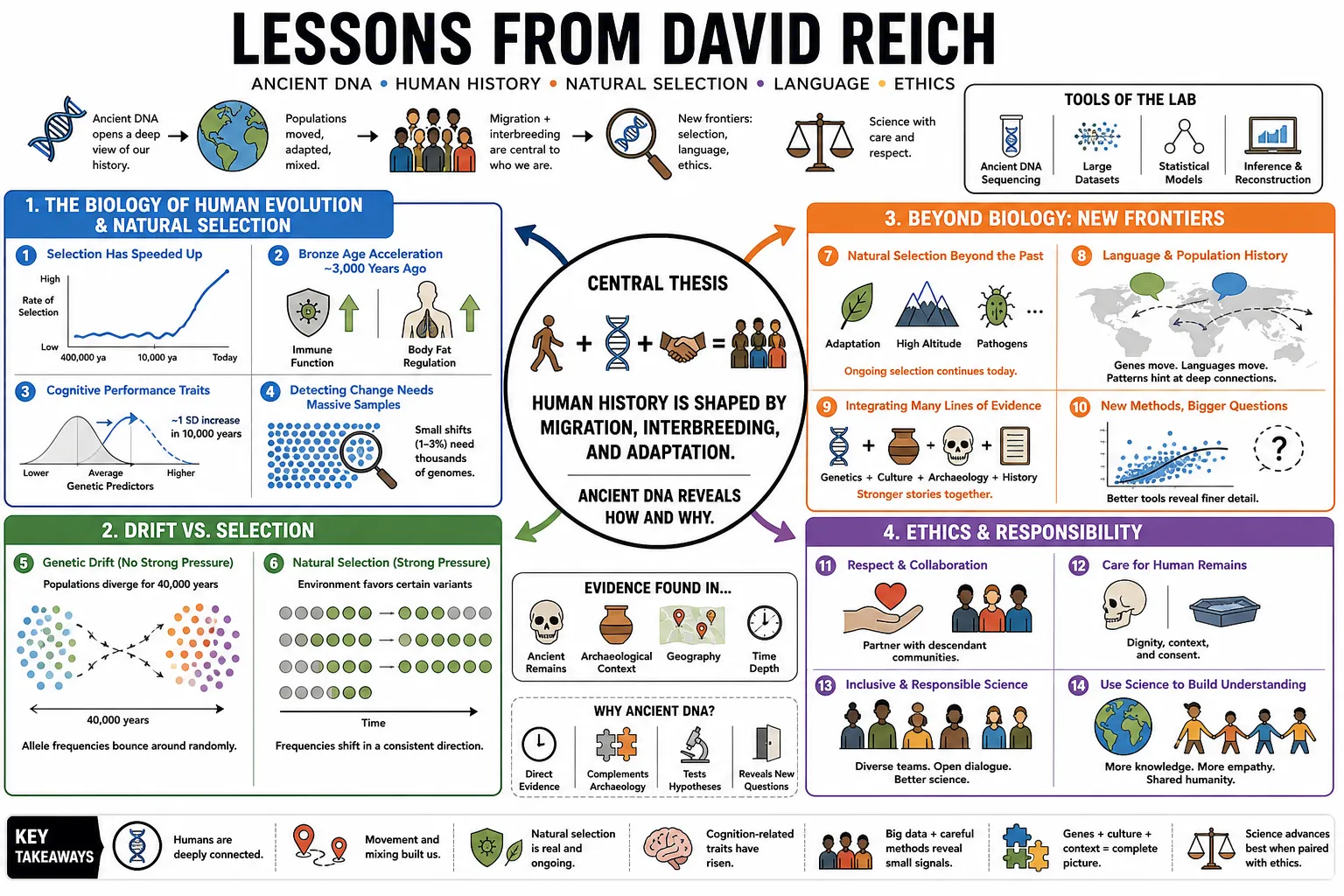
Part 1: The Biology of Human Evolution and Natural Selection
- On natural selection's pace: For decades, scientists assumed natural selection in humans slowed down or stopped over the last several hundred thousand years, but ancient DNA shows it has actually sped up. — Reference: David Reich – Why the Bronze Age was an inflection point in human evolution
- On the Bronze Age acceleration: Natural selection intensified remarkably around 3,000 years ago during the Bronze Age, drastically shifting gene frequencies related to immune function and body fat. — Reference: David Reich – Why the Bronze Age was an inflection point in human evolution
- On cognitive performance traits: Over the past 10,000 years, natural selection pushed the genetic predictors for cognitive performance higher by about a full standard deviation, primarily happening between 4,000 and 2,000 years ago. — Reference: David Reich – Why the Bronze Age was an inflection point in human evolution
- On detecting biological change: Tracking how genetic variants change in frequency requires massive sample sizes because slight shifts of a few percent cannot be distinguished from chance in small data sets. — Reference: Dwarkesh Podcast - David Reich – Why the Bronze Age was an inflection point in human evolution Transcript and Discussion
- On genetic drift vs selection: If populations diverge for 40,000 years without strong environmental pressures, genetic variants bounce around randomly in a process called genetic drift, resulting in relatively minor frequency differences. — Reference: David Reich – Why the Bronze Age was an inflection point in human evolution - Dwarkesh Podcast | Wave AI Podcast Notes
- On experiments of nature: Environmental shifts, like adopting agriculture or migrating to high altitudes, create pressures that can be seen mathematically when specific genetic variants systematically shift in frequency faster than chance allows. — Reference: David Reich – Why the Bronze Age was an inflection point in human evolution
Part 2: Ancient DNA Lab Methodology and Preservation
- On the limits of ancient DNA preservation: DNA generally cannot be preserved longer than a million years, meaning it is better suited for interrogating recent events in human history rather than ancient mammalian dispersals. — Reference: 179 | David Reich on Genetics and Ancient Humanity – Sean Carroll
- On the best bone for DNA extraction: The petrous bone, which holds the inner ear and cochlea, contains about a hundred times more DNA on average than other parts of the human skeleton. — Reference: How Ancient DNA Changed Everything We Thought We Knew About Human History. With David Reich
- On avoiding contamination: Clean rooms use positive pressure to keep out external air, and researchers wear double gloves and clean suits to prevent their own DNA from contaminating tiny ancient samples. — Reference: How Ancient DNA Changed Everything We Thought We Knew About Human History. With David Reich
- On DNA extraction quantities: Researchers only need a tiny amount of material, roughly 40 milligrams of bone powder equivalent to a fraction of the weight of a paperclip, to successfully extract ancient DNA. — Reference: How Ancient DNA Changed Everything We Thought We Knew About Human History. With David Reich
- On reading single genomes: A single ancient person's genome acts as a repository for tens of thousands of their ancestors, allowing researchers to accurately position that individual within human history. — Reference: Dwarkesh Podcast - David Reich – Why the Bronze Age was an inflection point in human evolution Transcript and Discussion
- On applying quantitative physics: A background in physics provides the quantitative foundation necessary to develop new data-driven methodologies for analyzing large-scale genetic datasets. — Reference: 179 | David Reich on Genetics and Ancient Humanity – Sean Carroll
- On misleading preservation: Mummies from Egypt might appear perfectly preserved to the naked eye, but they generally yield very poor ancient DNA results compared to bone. — Reference: How Ancient DNA Changed Everything We Thought We Knew About Human History. With David Reich
Part 3: Interbreeding and Adaptive Introgression
- On acquiring advantageous genes: As early humans migrated into new territories, they adapted quickly to unfamiliar pathogens and climates by mating with established archaic species and adopting their helpful DNA. — Reference: How Neanderthal DNA Helps Humanity | Quanta Magazine
- On the genetic origins of high-altitude tolerance: Native Tibetans carry a unique variant of the EPAS1 gene that helps them survive in low-oxygen environments, a trait inherited directly from Denisovan ancestors. — Reference: How Neanderthal DNA Helps Humanity | Quanta Magazine
- On Neanderthal genes in modern Europeans: The BNC2 gene, which influences skin pigmentation and freckling, is derived from Neanderthals and is carried by nearly 70 percent of Europeans today. — Reference: How Neanderthal DNA Helps Humanity | Quanta Magazine
- On questioning the Neanderthal lineage: Rather than being a completely separate archaic sister species, Neanderthals may actually be the result of a small early human population that migrated into Europe and was genetically swamped by local archaic hominins. — Reference: David Reich – Why the Bronze Age was an inflection point in human evolution
- On mitochondrial divergence: While standard genetic models suggest Neanderthals and modern humans separated over 500,000 years ago, maternal mitochondrial DNA indicates a shared ancestor much more recently, between 300,000 and 400,000 years ago. — Reference: Dwarkesh Podcast: w/ Ancient DNA Geneticist David Reich (Transcript) – The Singju Post
- On deep substructures in modern DNA: Modern human genomes possess such deep structural divisions that explaining current African genetic diversity requires invoking ancient population mixtures just as complex as those between early humans and Neanderthals. — Reference: Dwarkesh Podcast: w/ Ancient DNA Geneticist David Reich (Transcript) – The Singju Post
- On ghost populations: Genetic signals frequently point to the past existence of ghost populations, groups of people who left behind no direct descendants today, but whose DNA is partially preserved in the genomes of others. — Reference: 179 | David Reich on Genetics and Ancient Humanity – Sean Carroll
Part 4: Population Turnover and Migration
- On continuous population turnover: The assumption that modern inhabitants of a region are the direct descendants of its ancient populations is almost always false due to constant historical migrations. — Reference: Veritalk: David Reich on migration, mixed ancestries, and ancient DNA - YouTube
- On the Yamnaya expansion: Around 5,000 years ago, Yamnaya horse nomads swept outward, replacing over 90 percent of the existing population in Europe and heavily impacting the Indus Valley. — Reference: David Reich — How one small tr… - Dwarkesh Podcast - Apple Podcasts
- On admixture over the last ten millennia: Rather than populations existing in isolation, human history over the past 10,000 years is characterized by continuous and intensive genetic admixture. — Reference: Five Corrections to The New York Times | David Reich Lab
- On recurrent mass migrations: Sweeping population mixtures, similar in scale to those seen in the Americas over the last 500 years, have repeatedly occurred across Europe, Africa, and South Asia throughout ancient history. — Reference: Veritalk: David Reich on migration, mixed ancestries, and ancient DNA - YouTube
- On rejecting complete replacement narratives: Although dramatic turnovers occurred, genetic evidence consistently demonstrates that total population replacement never happened; mixture and integration are central to every documented historical event. — Reference: Five Corrections to The New York Times | David Reich Lab
- On the frequency of demographic shifts: The genetic history of Britain reveals that the island experienced at least five major migratory waves within the last 10,000 years, three of which resulted in near-total population turnovers. — Reference: Telling Humanity’s Story through DNA | Harvard Magazine
- On ancestors vanishing from the genetic record: Going back ten generations, an individual has over a thousand ancestors, but due to how DNA recombines, they inherit genetic segments from only about 750 of them. — Reference: Telling Humanity’s Story through DNA | Harvard Magazine
Part 5: Race, Culture, and Genetic Determinism
- On race as a broken biological concept: Because every human group is essentially a mixture of earlier mixtures, the biological concept of race falls apart completely when viewed through the lens of ancient DNA. — Reference: Telling Humanity’s Story through DNA | Harvard Magazine
- On the correlation of ancestry and race: Genetic ancestry differences can correlate with present-day racial categories even though race itself remains a social construct rather than a precise biological classification. — Reference: Developing: Debate on ‘Race’ and Genomics – Science & Justice Research Center
- On dismissing racist narratives: The comprehensive genetic record provided by ancient DNA research actively undermines and renders historically untenable colonialist and racist narratives about human purity. — Reference: Developing: Debate on ‘Race’ and Genomics – Science & Justice Research Center
- On cultural over biological advantages: There is no evidence suggesting that genetic superiority allowed some human populations to expand at the expense of others; cultural structures and social organization are the deciding factors. — Reference: Telling Humanity’s Story through DNA | Harvard Magazine
- On Roman societal expansion: The Romans successfully dominated their neighbors not due to biological fitness, but because their social framework was organized heavily around military service and expansionism. — Reference: Telling Humanity’s Story through DNA | Harvard Magazine
- On economic drivers of conquest: In 19th-century Sudan, the Nuer expanded into Dinka territory because the high cost of marriage in Nuer culture drove young men to systematically raid their neighbors for cattle and captives. — Reference: Telling Humanity’s Story through DNA | Harvard Magazine
- On the legacy of intergroup encounters: When two ancient human populations met, their resulting genetic mixture frequently left behind signatures of severe inequality and sex bias, indicating that these encounters were rarely on equal terms. — Reference: Telling Humanity’s Story through DNA | Harvard Magazine
- On separating behavioral traits from politics: Studying genetic differences in populations, including traits related to behavior or adaptation, does not inherently carry social or political implications unless societies choose to apply them maliciously. — Reference: Developing: Debate on ‘Race’ and Genomics – Science & Justice Research Center
Part 6: Measuring Selection Through Time
- On building a biological time series: The 2026 study compared nearly 16,000 ancient genomes spanning more than 10,000 years, turning scattered samples into a dataset large enough to track systematic changes in allele frequency. — Reference: Massive ancient-DNA study reveals natural selection has accelerated in recent human evolution
- On expanding the catalogue of selection: Earlier research had found only 21 clear cases of directional selection, while the larger time-series approach identified hundreds of variants whose changes were too consistent to explain as chance. — Reference: Massive ancient-DNA study reveals natural selection has accelerated in recent human evolution
- On separating selection from migration: A changing gene frequency does not by itself prove adaptation because incoming populations can alter frequencies; the statistical method had to model relatedness and population movement before attributing a trend to selection. — Reference: Why the Bronze Age was an inflection point in human evolution
- On interpreting present-day disease links: Variants selected in ancient environments can now correlate with conditions such as schizophrenia or type 2 diabetes, but modern diagnostic categories do not reveal what advantage those variants provided in the past. — Reference: Massive ancient-DNA study reveals natural selection has accelerated in recent human evolution
Part 7: Industrializing Ancient-DNA Science
- On scaling the laboratory: Reich's lab deliberately industrialized ancient-DNA production so that questions requiring thousands of genomes could become experimentally tractable rather than remaining speculative. — Reference: Why the Bronze Age was an inflection point in human evolution
- On recovering fragmented molecules: Ancient DNA often survives only in fragments 20 to 50 letters long, so extraction and sequencing methods must retain pieces that conventional genomic workflows would lose. — Reference: How Ancient DNA Changed Everything We Thought We Knew About Human History
- On the quality hidden in old bone: With optimized sampling and chemistry, a large share of 5,000-year-old Danish remains can yield data approaching the quality of a modern consumer ancestry sample. — Reference: How Ancient DNA Changed Everything We Thought We Knew About Human History
Part 8: Scientific Judgment and Model Change
- On changing fields when the data changes: Reich moved from prostate-cancer genetics into ancient DNA after Neanderthal sequences created a new way to study human history. — Reference: Claims of pure bloodlines? Ancestral homelands? DNA science says no
- On distrusting a dramatic result: When the first analysis suggested modern humans and Neanderthals had interbred, the research team initially assumed the signal reflected an error. — Reference: Claims of pure bloodlines? Ancestral homelands? DNA science says no
- On the value of corrected histories: Discovering that a community's inherited account of its origins is wrong can be humbling without being threatening; the correction replaces a tidy story with a more accurate shared history. — Reference: Claims of pure bloodlines? Ancestral homelands? DNA science says no
- On recognizing scientific epicycles: When a model requires repeated special exceptions to explain mitochondrial, Y-chromosome, and whole-genome evidence, it may be time to test a fundamentally different account rather than add another patch. — Reference: How one small tribe conquered the world 70,000 years ago
Part 9: Language, Migration, and Cultural Identity
- On locating Indo-European origins: Genetic evidence places the ancestral population associated with proto-Indo-European languages among Caucasus-Lower Volga people living about 6,500 years ago in what is now Russia. — Reference: Landmark studies track source of Indo-European languages
- On language outlasting ancestry: Modern Uralic speakers retain radically different amounts of the eastern ancestry linked to the language family's early spread, from nearly all in some Siberian groups to almost none in Hungarians. — Reference: Ancient DNA solves mystery of Hungarian and Finnish language origins
- On finding a missing linguistic link: Caucasus-Lower Volga ancestry connects the Yamnaya with ancient Anatolian populations that spoke related languages despite lacking the later Yamnaya genetic profile. — Reference: Landmark studies track source of Indo-European languages
- On tracing Uralic origins eastward: Ancient genomes place the ancestral population associated with Uralic languages in Yakutia roughly 4,500 years ago, much farther east than many linguistic models had proposed. — Reference: Ancient DNA solves mystery of Hungarian and Finnish language origins
Part 10: Ethics of Research on Human Remains
- On following local authority: Ancient-DNA projects must comply with the laws and regulations of both the place where researchers work and the place from which the remains originated. — Reference: Ethics of DNA research on human remains
- On planning before sampling: Researchers should agree on the scientific purpose, sampling strategy, permissions, and stewardship plan before a study begins. — Reference: Ethics of DNA research on human remains
- On minimizing irreversible damage: Because DNA extraction consumes part of a human remain, the research design must limit physical damage to what the scientific question actually requires. — Reference: Ethics of DNA research on human remains
- On making findings auditable: Publishing the underlying genetic data allows other researchers to re-examine conclusions rather than treating an interpretation as final. — Reference: Ethics of DNA research on human remains
- On involving stakeholders early: Engagement with descendant communities, curators, archaeologists, and other stakeholders should begin when a study is designed, not after results are ready to announce. — Reference: Ethics of DNA research on human remains
Part 11: Variation Behind the Global Pattern
- On declining human diversity: Living humans are genetically more similar to one another than the distinct human groups that coexisted tens of thousands of years ago. — Reference: Claims of pure bloodlines? Ancestral homelands? DNA science says no
- On uneven replacement: Steppe ancestry became dominant in parts of northern Europe but remained much lower in Iberia, showing that the same expansion produced different demographic outcomes by region. — Reference: Five Corrections to The New York Times
- On sex-biased migration: In Iberia, incoming groups contributed a minority of total ancestry while replacing earlier male Y-chromosome lineages, revealing that mixture can conceal extreme inequality between men and women. — Reference: Claims of pure bloodlines? Ancestral homelands? DNA science says no