Chieh Huang launched the mobile gaming studio Astro Ape before co-founding Boxed, an online bulk retailer that adapted the warehouse club model for smartphones. He built a competitive e-commerce business against industry giants by targeting mobile shoppers and funding unusual employee perks like college tuition and wedding expenses. This profile covers his approach to startup leadership, supply chain flexibility, and how AI affects the workforce.
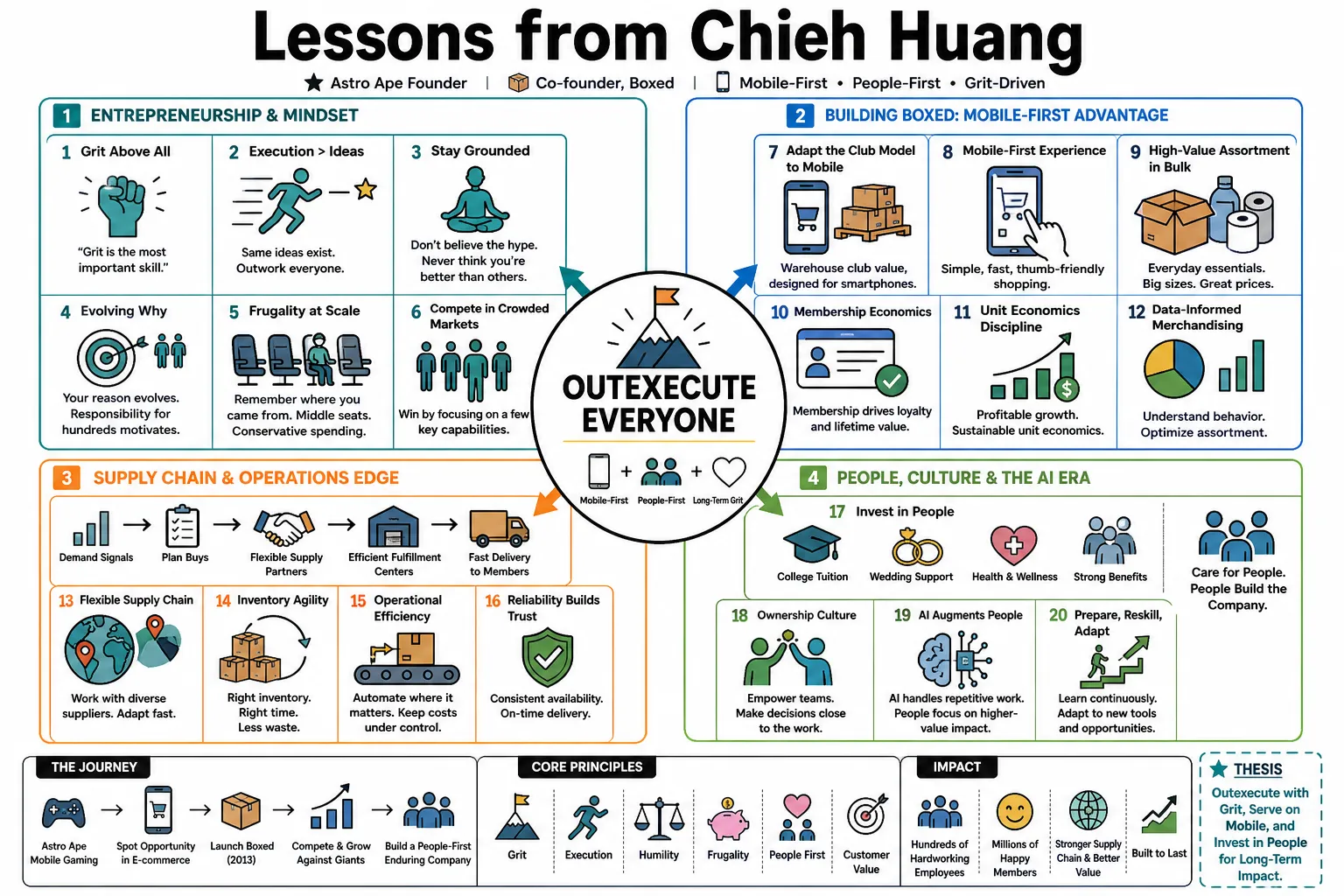
Part 1: Entrepreneurship and Mindset
- On the importance of grit: "Grit is the most important skill that I recommend other entrepreneurs practice." — Source: Authority Magazine
- On execution over ideas: Many people will have the exact same novel business idea as you, so success ultimately comes down to having the guts, strength, and work ethic to outpace everyone else attempting the same thing. — Reference: Authority Magazine
- On staying grounded: A valuable piece of early investor advice is to avoid believing your own hype and to never fall into the trap of assuming you are better than others. — Reference: Authority Magazine
- On finding motivation: Your core reason for running a business can evolve over time; a startup founder might begin with one goal but eventually find motivation in bearing the responsibility for hundreds of hardworking employees. — Reference: Authority Magazine
- On maintaining startup frugality: It is important to remember where you came from as you grow, which includes maintaining conservative spending policies on work outings and travel, even if it means executives sit in middle seats on long flights. — Reference: Authority Magazine
- On entering a crowded space: Rather than searching for an uncontested market, it is possible to build a successful business against entrenched competitors by relying on a few key consumer behavioral insights. — Reference: How I Built This
- On career expectations: Growing up as the child of immigrants often comes with the expectation to pursue safe and prestigious careers, leading him initially to a corporate law job before fully embracing an entrepreneurial path. — Reference: How I Built This
- On early gambles: Boxed started as a gamble that consumers would shift toward buying bulk groceries on their smartphones rather than in physical stores. — Reference: How I Built This
Part 2: Hiring and Building Company Culture
- On avoiding arrogant hires: "The last thing you need is someone with a huge ego and that's super smart but that's just a complete a--hole" — Source: Business Insider
- On judging conversational ability: During interviews, asking candidates to describe themselves without mentioning their resume is an effective way to gauge their openness, curiosity, and ability to hold a genuine conversation. — Reference: Business Insider
- On testing thought processes: When evaluating potential hires, it helps to ask a difficult hypothetical question with no correct answer—not to hear the specific response, but to see if they can think deeply on the spot rather than freezing or blurting out the first thought. — Reference: Business Insider
- On self-awareness in tech: Asking a job candidate to rate their knowledge of technology trends on a scale of one to ten is a helpful trap; anyone who answers a nine or ten reveals a red flag, as the industry changes too fast for true mastery and those who feel they know everything are often condescending. — Reference: Business Insider
- On workplace environments: "The reality is we spend more time, more waking hours with our coworkers than we do with friends and family. If you have a full-time job, that's the reality" — Source: Business Insider
- On providing employee benefits: When executives see employees struggling to afford basic needs or major life events, they have an obligation to help; offering college tuition payments for employees' children and subsidizing weddings builds a company culture that consumers can feel. — Reference: Authority Magazine
- On brand loyalty and culture: "Consumers who know that a brand that does right by its employees will do right by them." — Source: World Retail Congress
Part 3: Competing in the Retail Market
- On product curation: A major way to differentiate from retail giants is to carefully curate a limited selection of products rather than offering everything, minimizing the time shoppers spend sifting through options. — Reference: World Retail Congress
- On finding a niche: A successful e-commerce strategy against massive competitors can involve offering fewer items while maintaining competitive prices and adding personal touches, like handwritten notes in early orders. — Reference: How I Built This
- On defining retail: "Retail is the business of making genuine, lasting connections with customers and creating the best, most curated shopping experience possible for every shopper." — Source: World Retail Congress
- On addressing unfair pricing: Retailers have an opportunity to build trust by actively combating pricing inequalities, such as absorbing the costs of upcharges placed on women's hygiene products compared to male equivalents. — Reference: World Retail Congress
- On adapting to payment trends: How customers pay is continually evolving, and retailers need to adapt to new methods, such as enabling group-payment capabilities for bulk purchases. — Reference: Authority Magazine
- On owning technology: To compete as a modern retailer, a business must operate like a technology company at heart, utilizing in-house engineering and robotics teams to develop solutions for mobile commerce and fulfillment. — Reference: World Retail Congress
- On B2B technology licensing: Retail innovators can open new lines of business by licensing their proprietary technology, fulfillment platforms, and purchasing data to traditional brick-and-mortar grocers and direct-to-consumer brands. — Reference: World Retail Congress
Part 4: Supply Chain and Crisis Management
- On supply chain flexibility: "The single most important lesson is that the strongest chains are actually flexible – being able to react and be nimble was incredibly important and will continue to be so in the coming years." — Source: FMI
- On navigating a crisis: "The bad thing is everything has changed. The good thing is everything has changed." — Source: FMI
- On transparent communication: During supply chain disruptions, being transparent with shoppers about item availability and alerting them when hot items are fully restocked can significantly reduce panic buying. — Reference: FMI
- On the digital shift: The pandemic permanently altered the retail landscape by turning digital shopping into a necessity rather than an optional convenience. — Reference: FMI
- On the future of online grocery: The next major technological advancement in digital grocery is simply perfecting the customer experience, as buying groceries online is currently not as seamless as other digital transactions due to data and inventory challenges. — Reference: FMI
- On lasting consumer habits: The tendency for consumers to stock up on household goods will likely remain a long-term habit, as the global crisis embedded a collective memory of scarcity. — Reference: FMI
- On warehouse automation: Improving fulfillment efficiency requires deploying autonomous guided vehicles and proprietary hardware to move items seamlessly through warehouses. — Reference: Authority Magazine
Part 5: Artificial Intelligence and the Future of Work
- On the AI transition: "There’s so many companies that are well-funded that are producing technology that will eventually take people’s jobs. But there’s very few companies saying, okay, how do we train these folks or how do we get them ready so that we’re not all just sitting on a couch collecting UBI checks?" — Source: Venture5
- On the elimination of junior roles: A concerning trend in the current technological shift is that the roles companies are actively seeking to eliminate through automation are largely in their junior ranks. — Reference: Venture5
- On the broken career ladder: If companies successfully automate their entry-level positions, they create a massive societal problem because the first rung of the career ladder—where young professionals learn through daily mentorship—will disappear. — Reference: Venture5
- On historical parallels to AI: The artificial intelligence revolution is likely to follow a similar trajectory to the internet and the outsourcing boom of the 1990s and 2000s; while some jobs will be destroyed, entirely new and unpredictable business categories will also emerge. — Reference: Venture5
- On the speed of disruption: The societal and workforce transition brought on by artificial intelligence will resemble past technological shifts, but it will happen in a significantly more compressed timeframe. — Reference: Venture5
- On proactive reskilling: Society cannot afford to wait for universal basic income to solve job displacement; businesses must actively build the infrastructure required to transition workers into new roles. — Reference: Venture5
Part 6: Additional lessons on Additional lessons on The Entrepreneurial Journey
- On humble beginnings: A massive, industry-disrupting e-commerce brand can start with nothing more than a few founders scrambling to pack boxes in a New Jersey garage. — Reference: Apple Podcasts
- On navigating the early struggles: Founders must brace for the emotional toll of early days, such as the panic of launching a platform and seeing zero orders for consecutive days. — Reference: Podscripts
- On the reality of being a CEO: "Being a CEO is like trying to be the greatest of all time in a broken glass eating competition." — Source: YouTube
Part 7: Additional lessons on Market Strategy & Competitive Positioning
- On focusing on a narrow selection: An efficient and profitable e-commerce retailer can be built by offering a narrow band of commonly purchased items rather than trying to carry the hundreds of thousands of items found in a typical superstore. — Reference: Podscripts
- On unpredictability in consumer business: Unlike enterprise software that grows steadily through client acquisition, consumer businesses are unpredictable and can be drastically influenced by a single viral moment. — Reference: YouTube
- On expanding the audience: An online wholesale model can successfully expand the traditional warehouse club demographic by targeting younger people without cars and consumers living outside the range of physical stores. — Reference: SmartHustle.com
Part 8: Additional lessons on Product Curation & Customer Connection
- On listening to feedback: Modern consumers have rapidly shifting needs, so a successful business must take careful steps to gather feedback and diversify its inventory, such as adding exclusive partnerships or specific pack sizes. — Reference: World Retail Congress
- On seamless digital experiences: Providing a seamless, omnichannel experience is essential; the true differentiator in retail is meeting customers seamlessly in the digital spaces where they already are. — Reference: World Retail Congress
Part 9: Additional lessons on Building a Purpose-Driven Culture
- On discovering company purpose: A company's true purpose often isn't perfectly defined on day zero; it evolves organically over time as the team grows and faces hard decisions together. — Reference: YouTube
- On authentic culture: Real company culture is defined by what happens when just two people are in a room making a big decision with no rulebook to guide them. — Reference: YouTube
- On treating workers well: Treating employees generously, rather than viewing them merely as replaceable cogs in a machine, is the secret to long-term competitive advantages and productivity. — Reference: Business Insider
Part 10: Additional lessons on The Perils of Micromanagement & Leadership
- On the nature of micromanagement: Micromanagement is the act of bringing in great, imaginative people and crushing their souls by dictating minor details like font sizes. — Reference: The Singju Post
- On why managers micromanage: The typical career progression—from doing the work, to managing the workers, to managing the managers—causes leaders to lose control over the output, which they instinctively try to regain by over-managing. — Reference: The Singju Post
- On letting go of the reins: When you give employees a mission and the tools to achieve it, you must step back and let them execute it in their own creative ways. — Reference: The Singju Post
Part 11: Additional lessons on Supply Chain & Operational Agility
- On long-term behavioral shifts: The global crisis instilled a memory of scarcity, meaning that the consumer habit of stocking up on essential goods is likely to remain permanent. — Reference: FMI
Part 12: Additional lessons on Navigating Automation & Robotics
- On the economic reality of robotics: Robotics are increasingly necessary to turn a reliable profit because they do not take sick days and pose fewer safety risks in massive fulfillment centers. — Reference: Business Insider
- On corporate responsibility: Corporate leaders should recognize a duty to support the frontline workers who actively generate shareholder value, a conversation that is often missing in business culture. — Reference: Business Insider
Part 13: Additional lessons on Fundraising & Growth Challenges
- On venture funding inconsistency: While raising an initial seed round might be easier with a track record of past entrepreneurial success, subsequent fundraising rounds will still pose significant challenges due to the unpredictable nature of venture capital. — Reference: YouTube
- On the pressure of the public market: Taking a company public reveals that public market dynamics and investor relationships require entirely different approaches than running a private startup. — Reference: YouTube