Anand Daniel, a partner at Accel, is a key figure in the Indian startup ecosystem, with a particular focus on consumer technology, online marketplaces, and enterprise software. His journey from an engineering and management operator at Intel to a leading venture capitalist gives him a grounded, empathetic perspective that founders highly value. He has been a crucial partner to category-defining companies, including Swiggy, Spinny, BlackBuck, and Vedantu — Accel Partner Profile: Anand Daniel.
His insights on building global companies from India, navigating the founder's journey, and identifying deep, structural market shifts are a wellspring of wisdom for entrepreneurs.
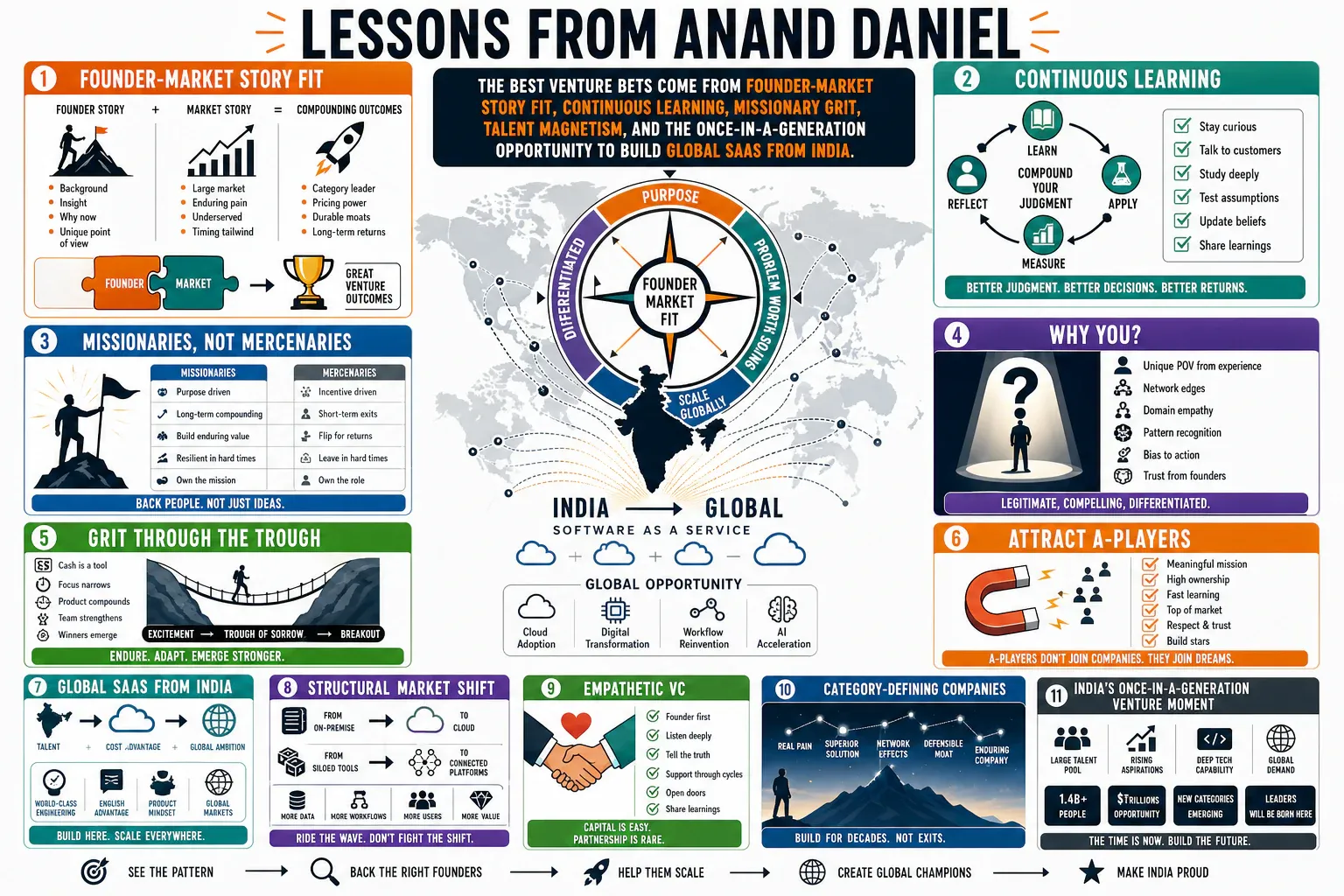
On Founders and Leadership
- Founder-Market Story Fit: When evaluating early-stage teams, the primary filter is whether the founders possess a personal connection to the problem that gives them an authentic and durable advantage in their chosen market. — SeedToScale Specials: How Investors Evaluate Startups.
- Founders as Continuous Learning Machines: A founder must evolve faster than the organization itself, demonstrating an exceptional capacity to learn, unlearn, and scale personal judgment across every phase of growth. — SeedToScale Specials: How Investors Evaluate Startups.
- Attracting Domain Experts: Exceptional startup leaders compensate for early organizational constraints by attracting functional domain experts whose capabilities significantly surpass the founders' own in their respective areas. — SeedToScale Specials: How Investors Evaluate Startups.
- Operational Grit: Venture-scale execution requires navigating repeated setbacks and market troughs, making sustained resilience and focus the foundational requirement for long-term survival. — Anand Daniel: Venture Investing & Entrepreneurship.
- Mission-Driven Commitment: Enduring enterprises are built by founders motivated by deep problem solving rather than short-term liquidity, ensuring persistence across extended market cycles. — Anand Daniel: Venture Investing & Entrepreneurship.
- Articulating the Right to Win: Early-stage founders must clearly articulate why their specific team possesses the structural insight and execution capability to win against incumbents in a target market. — SeedToScale Specials: How Investors Evaluate Startups.
On SaaS and Building from India
- India's Global Software Opportunity: India's startup ecosystem has reached an inflection point where world-class talent, digital infrastructure, and capital efficiency enable local teams to build category-leading global platforms. — Anand Daniel: Rise of Indian Marketplaces.
- Moving Beyond Labor Arbitrage: The next generation of software companies from India competes on product innovation, user experience, and architectural depth rather than cost arbitrage. — Anand Daniel: Rise of Indian Marketplaces.
- Transitioning from PMF to Go-to-Market Fit: Achieving early product traction requires different organizational capabilities than scaling distribution; expanding beyond initial product-market fit demands a disciplined go-to-market engine. — SeedToScale Specials: How Investors Evaluate Startups.
- Building a Distinct Market Point of View: Differentiated companies articulate an opinionated view of how workflows should function, establishing category leadership through customer education rather than feature checklists. — Anand Daniel: Rise of Indian Marketplaces.
- Net Revenue Retention as Core Validation: Compounding growth and enduring unit economics are fundamentally driven by high net retention, validating that existing accounts expand their consumption over time. — Anand Daniel: Rise of Indian Marketplaces.
- Founder-Led Initial Sales: In the earliest stage, founders must personally close the first customer accounts to absorb unfiltered feedback and iterate on product messaging before building sales teams. — SeedToScale Specials: How Investors Evaluate Startups.
- Selling Vision Before Feature Completeness: Early adopters do not purchase a fully matured product suite; they commit to a shared vision of where the platform and partnership are heading. — SeedToScale Specials: How Investors Evaluate Startups.
On Investment Philosophy and Strategy
- Focus on Outlier Magnitude: Venture capital returns follow an extreme power law where a handful of transformative companies drive overall portfolio performance, requiring investors to maximize upside rather than minimize loss frequency. — Anand Daniel: Venture Investing & Entrepreneurship.
- First Institutional Cheque Partnership: Entering at the earliest formation stage allows investors to help founders clarify customer discovery, governance, and early executive hiring from inception. — Accel Team: Anand Daniel.
- Prioritizing Team and Motivation Over Static Ideas: Because early product concepts inevitably pivot as customer feedback accumulates, early-stage conviction centers primarily on founder capability and core motivations. — SeedToScale Specials: How Investors Evaluate Startups.
- Market Scale and Addressable Depth: Achieving venture scale requires operating in large, expanding markets that can sustainably support a multi-billion-dollar standalone enterprise. — Anand Daniel: Indian Urban Mass - Market Opportunity.
- Building Investment Conviction Incrementally: Investment conviction is not a single revelatory moment but an accumulation of data points, reference calls, and micro-interactions that test a founder's consistency and depth. — SeedToScale Specials: How Investors Evaluate Startups.
- Long-Term Patience Across Venture Horizons: Building durable market leaders requires patient capital and governance that support founders through inevitable platform and economic cycles over a decade or more. — Accel Team: Anand Daniel.
On Company Building
- Executive Talent Leverage: Attracting senior executive talent that elevates organizational execution is the highest-leverage strategic priority for scaling founders. — SeedToScale Specials: How Investors Evaluate Startups.
- Culture Shaped by Daily Trade-Offs: Company culture is defined not by aspirational statements but by the cumulative choices leadership makes during difficult personnel, product, and ethical dilemmas. — Anand Daniel: Venture Investing & Entrepreneurship.
- Obsessing Over Controllable Inputs: External valuations and macro cycles cannot be controlled; operational focus must stay centered on product velocity, customer onboarding, and retention. — Anand Daniel: Rise of Indian Marketplaces.
- Fostering an Experimental Learning Culture: Early-stage organizations must operate as continuous learning environments, testing explicit hypotheses against real-world customer usage rather than relying on unvalidated assumptions. — SeedToScale Specials: How Investors Evaluate Startups.
- Fixing Funnel Leaks Before Capital Expansion: Scaling customer acquisition before securing retention simply pours capital into a leaky bucket; underlying conversion and churn must be stabilized first. — Anand Daniel: Rise of Indian Marketplaces.
On the Founder-VC Partnership
- Serving as Sparring Partners, Not Supervisors: Constructive venture partnerships function as peer sparring relationships that challenge strategic assumptions while leaving executive autonomy with the founder. — Accel Team: Anand Daniel.
- Board Meetings as Forums for Honest Vulnerability: The most effective boards cultivate an environment where founders can openly unpack operational bottlenecks and strategic uncertainties without defensive posturing. — SeedToScale Specials: How Investors Evaluate Startups.
- Permanent Partnership Beyond Individual Funds: While fund cycles have contractual boundaries, high-trust investor-founder relationships persist across multiple ventures and decades of company building. — Accel Team: Anand Daniel.
- Asking Inquiring Questions Over Prescribing Answers: Valuable board contributors provide leverage by framing clarifying questions that expand a founder's perspective rather than attempting to direct daily operations. — SeedToScale Specials: How Investors Evaluate Startups.
- Reputation with Founders as the Primary Asset: In a closely networked startup ecosystem, an investor's reputation for integrity, fair dealing, and long-term support during downturns is their most vital competitive asset. — Accel Team: Anand Daniel.