Andrew Carnegie, a Scottish-American industrialist and philanthropist, rose from poverty to become one of the wealthiest men in history. His life and writings offer a wealth of wisdom on success, wealth, leadership, and the responsibility of the affluent.
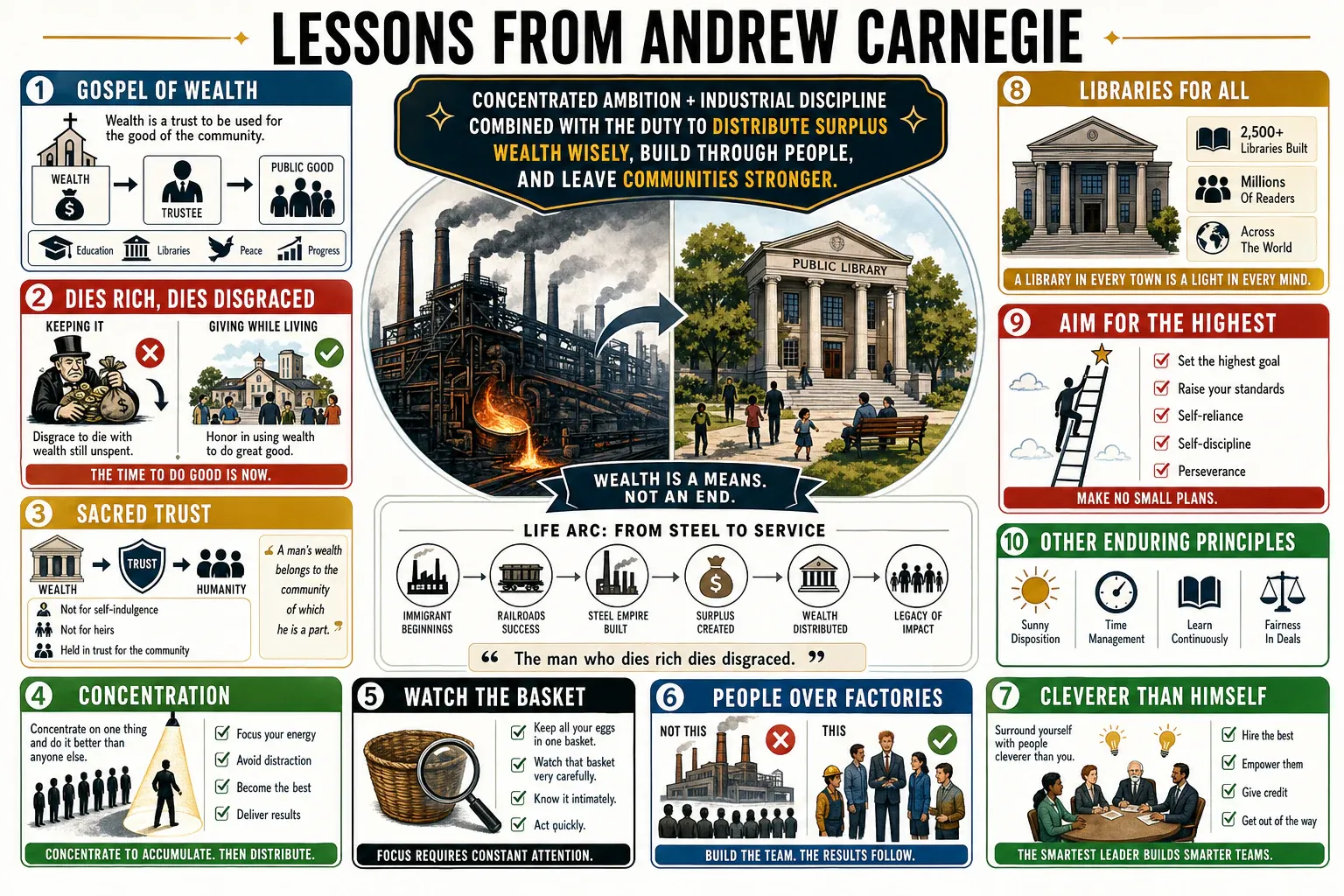
Top Quotes from Andrew Carnegie
On Wealth and Philanthropy
- "The man who dies thus rich dies disgraced."
- Source: The Gospel of Wealth (1889), the closing verdict of his essay "Wealth." — Reference: Andrew Carnegie, The Gospel of Wealth and Other Timely Essays (1901), Internet Archive.
- "Whatever surplus wealth may come to him is to be regarded as a sacred trust, which he is bound to administer for the good of his fellows." — Andrew Carnegie, The Empire of Business (1902), Internet Archive.
- Source: The Empire of Business (1902), "Thrift as a Duty." — Reference: Andrew Carnegie, The Empire of Business (1902), Internet Archive.
- "In bestowing charity, the main consideration should be to help those who will help themselves."
- Source: The Gospel of Wealth (1889), on the right way to give. — Reference: Andrew Carnegie, The Gospel of Wealth and Other Timely Essays (1901), Internet Archive.
- "I would almost as soon leave a young man a curse as burden him with the almighty dollar." — Andrew Carnegie, The Empire of Business (1902), Internet Archive.
- Source: The Empire of Business (1902), "The Road to Business Success: A Talk to Young Men." — Reference: Andrew Carnegie, The Empire of Business (1902), Internet Archive.
- "I resolved to stop accumulating and begin the infinitely more serious and difficult task of wise distribution."
- Source: Autobiography of Andrew Carnegie (1920), chapter XIX, on living up to The Gospel of Wealth. — Reference: Autobiography of Andrew Carnegie (1920), Project Gutenberg.
- "A man's first duty is to make a competence and be independent. But his whole duty does not end here. It is his duty to do something for his needy neighbours who are less favoured than himself." — Andrew Carnegie, The Empire of Business (1902), Internet Archive.
- Source: The Empire of Business (1902), "Thrift as a Duty." — Reference: Andrew Carnegie, The Empire of Business (1902), Internet Archive.
- On wealth as idolatry: In a December 1868 memorandum to himself, printed in his autobiography, he wrote that "the amassing of wealth is one of the worst species of idolatry" and resolved to cease business within two years and spend his surplus on benevolent purposes. — Reference: Autobiography of Andrew Carnegie (1920), Project Gutenberg.
On Success and Hard Work
- "'Don't put all your eggs in one basket' is all wrong. I tell you 'put all your eggs in one basket, and then watch that basket.'" — Andrew Carnegie, The Empire of Business (1902), Internet Archive.
- Source: The Empire of Business (1902), "The Road to Business Success"; he repeats the principle in his Autobiography. — Reference: Andrew Carnegie, The Empire of Business (1902), Internet Archive.
- "Perform your whole duty in it and a little more — the 'little more' being vastly important." — Andrew Carnegie, The Empire of Business (1902), Internet Archive.
- Source: The Empire of Business (1902), advice to young men choosing a line of work. — Reference: Andrew Carnegie, The Empire of Business (1902), Internet Archive.
- "Aim for the highest."
- Source: The Empire of Business (1902), his summary advice in "The Road to Business Success." — Reference: Andrew Carnegie, The Empire of Business (1902), Internet Archive.
- "There is no line of business in which success is not attainable… as with every profession so in every line of business, there is plenty of room at the top." — Andrew Carnegie, The Empire of Business (1902), Internet Archive.
- Source: The Empire of Business (1902), "A Secret of Success." (The previously cited 1903 newspaper could not be located.) — Reference: Andrew Carnegie, The Empire of Business (1902), Internet Archive.
On Life and Character
- "There is very little success where there is little laughter." — Andrew Carnegie, The Empire of Business (1902), Internet Archive.
- Source: The Empire of Business (1902): "My young partners did the work and I did the laughing." — Reference: Andrew Carnegie, The Empire of Business (1902), Internet Archive.
- "You cannot push any one up a ladder unless he be willing to climb a little himself."
- Source: The Empire of Business (1902), "Wealth and Its Uses." — Reference: Andrew Carnegie, The Empire of Business (1902), Internet Archive.
- "A sunny disposition is worth more than fortune."
- Source: Autobiography of Andrew Carnegie (1920), chapter I; he adds that it "can be cultivated." — Reference: Autobiography of Andrew Carnegie (1920), Project Gutenberg.
- "He that cannot reason is a fool, He that will not a bigot, He that dare not a slave." — Autobiography of Andrew Carnegie (1920), Project Gutenberg.
- Source: Not his own words: an inscription he admired on a mantel in Mr. Stokes's library and later had carved over his own library mantel (Autobiography, 1920). — Reference: Autobiography of Andrew Carnegie (1920), Project Gutenberg.
- "To try to make the world in some way better than you found it is to have a noble motive in life." — Andrew Carnegie, The Empire of Business (1902), Internet Archive.
- Source: The Empire of Business (1902), "Thrift as a Duty." — Reference: Andrew Carnegie, The Empire of Business (1902), Internet Archive.
- "The Kingdom of Heaven is within you."
- Source: Autobiography of Andrew Carnegie (1920): after his round-the-world trip these words "had a new meaning" for him, meaning heaven is "now and here." — Reference: Autobiography of Andrew Carnegie (1920), Project Gutenberg.
Key Learnings from Andrew Carnegie
Carnegie's writings and life story reveal a set of core principles that guided his success in business and philanthropy.
- Never Stop Learning: As a working boy he borrowed a book every Saturday from Colonel James Anderson's four-hundred-volume library, and he credited Anderson with a taste for literature he "would not exchange for all the millions that were ever amassed." — Reference: Autobiography of Andrew Carnegie (1920), Project Gutenberg.
- Embrace Innovation and Technology: He watched the Bessemer process closely, reasoning that if it succeeded "iron was destined to give place to steel." — Reference: Autobiography of Andrew Carnegie (1920), Project Gutenberg.
- Focus Your Efforts: He went against the adage and put "all good eggs in one basket," believing the road to preeminent success is to become master of one line rather than scatter resources. — Reference: Autobiography of Andrew Carnegie (1920), Project Gutenberg.
- Seize the Opportunity: Offered a messenger's job he said he could stay "now," an answer he thought young men should ponder: "It is a great mistake not to seize the opportunity." — Reference: Autobiography of Andrew Carnegie (1920), Project Gutenberg.
- Control Costs Relentlessly: He insisted on weighing and accounting throughout his works so he could know the cost of each process and what each man was doing: who saved material, who wasted it and who produced the best results. — Reference: Autobiography of Andrew Carnegie (1920), Project Gutenberg.
- The "Gospel of Wealth": His doctrine held that the rich should administer surplus wealth in their lifetimes for the community, giving in ways that help those who will help themselves; the man who dies rich "dies disgraced." — Reference: Andrew Carnegie, The Gospel of Wealth and Other Timely Essays (1901), Internet Archive.
- Go Beyond Your Duties: "The great aim of every boy should be to do something beyond the sphere of his duties—something which attracts the attention of those over him." — Reference: Autobiography of Andrew Carnegie (1920), Project Gutenberg.
- Take Responsibility: As a young clerk, with his boss absent and trains stalled after an accident, he issued train orders in Scott's name knowing it could mean "dismissal, disgrace, perhaps criminal punishment" if he erred—"Death or Westminster Abbey." — Reference: Autobiography of Andrew Carnegie (1920), Project Gutenberg.
- Go Easy on Young Mistakes: After nearly losing a package of railroad payroll, recovered only by luck, "I have never since believed in being too hard on a young man, even if he does commit a dreadful mistake or two." — Reference: Autobiography of Andrew Carnegie (1920), Project Gutenberg.
- Start Saving Early: He treated thrift as a duty: the saving man, he wrote, is usually a temperate, law-abiding citizen, "nor need the saving be great," and proven savings earn a young man credit from partners. — Reference: Andrew Carnegie, The Empire of Business (1902), Internet Archive.
These quotes and learnings from Andrew Carnegie continue to resonate today, offering timeless guidance on achieving success and living a life of purpose and contribution.
Learn more: