Andrew S. Grove, the former CEO and chairman of Intel, was a pioneering figure in the technology industry and a revered management theorist. His leadership transformed Intel into a global powerhouse, and his writings have influenced generations of entrepreneurs and executives. Grove's philosophy, forged by his experiences as a refugee from Hungary and his career at the forefront of the semiconductor revolution, emphasizes discipline, strategic foresight, and a healthy dose of paranoia. — Wired, "Andy Grove's Rational Exuberance," interview by John Heilemann (2001). — Andrew S. Grove, High Output Management (1983; Vintage edition 1995).
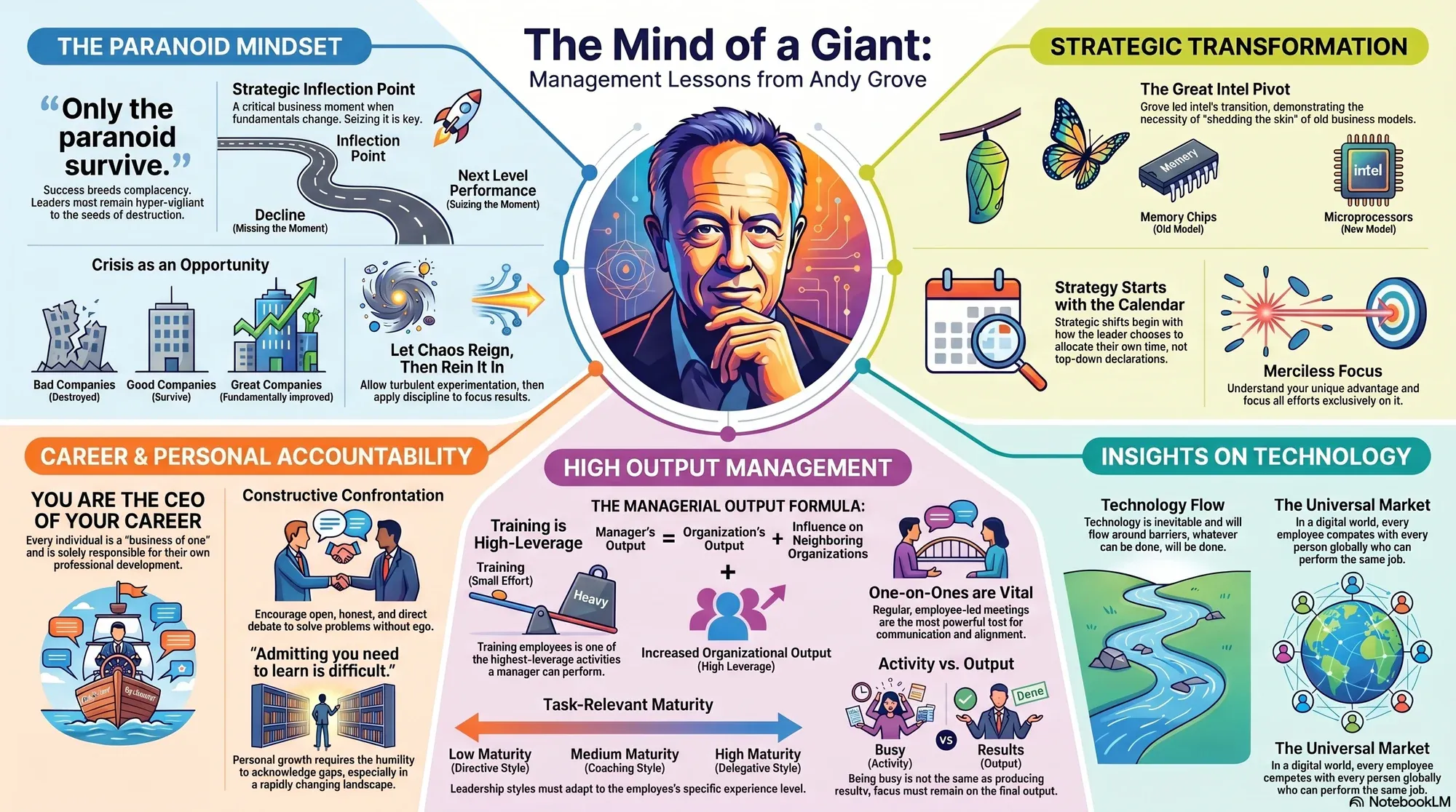
On Paranoia and Crisis
Grove's most famous dictum, "Only the paranoid survive," encapsulates his belief that success is a fragile state and that leaders must remain hyper-vigilant to threats and changes in the business environment.
- On Complacency: "Success breeds complacency. Complacency breeds failure. Only the paranoid survive." He repeated the line in his Esquire "What I've Learned" interview. — Reference: Andrew S. Grove, Only the Paranoid Survive (Currency, 1996/1999).
- On the Value of Paranoia: "I believe in the value of paranoia. Business success contains the seeds of its own destruction. The more successful you are, the more people want a chunk of your business." — Reference: Andrew S. Grove, Only the Paranoid Survive (Currency, 1996/1999).
- On Strategic Inflection Points: A strategic inflection point is "a time in the life of a business when its fundamentals are about to change." That change can open an opportunity to rise to new heights, or signal the beginning of the end. — Reference: Andrew S. Grove, Only the Paranoid Survive (Currency, 1996/1999).
- On Standing Still: Indecision is the real threat: "The greatest danger is in standing still." — Reference: Andrew S. Grove, Only the Paranoid Survive (Currency, 1996/1999).
- On Chaos and Direction: Strategic change works as a dialectic in which top management can "alternately let chaos reign and then rein in chaos," letting bottom-up experimentation run before imposing clear direction. — Reference: Andrew S. Grove, Only the Paranoid Survive (Currency, 1996/1999).
On Management and Leadership
Grove's "High Output Management" is a foundational text in Silicon Valley, advocating for a disciplined, results-oriented approach to leadership.
- On a Manager's Output: A manager's output = the output of his organization + the output of the neighboring organizations under his influence. — Reference: Andrew S. Grove, High Output Management (1983; Vintage edition 1995).
- On Time: "The single most important resource that we allocate from one day to the next is our own time." — Reference: Andrew S. Grove, High Output Management (1983; Vintage edition 1995).
- On Wasted Meeting Time: "Just as you would not permit a fellow employee to steal a piece of office equipment worth $2,000, you shouldn't let anyone walk away with the time of his fellow managers." — Reference: Andrew S. Grove, High Output Management (1983; Vintage edition 1995).
- On Output over Activity: Focus on output, not activity: "stressing output is the key to improving productivity, while looking to increase activity can result in just the opposite." — Reference: Andrew S. Grove, High Output Management (1983; Vintage edition 1995).
- On Training: "Training is, quite simply, one of the highest-leverage activities a manager can perform." — Reference: Andrew S. Grove, High Output Management (1983; Vintage edition 1995).
- On One-on-Ones: At Intel the one-on-one is "the principal way" a supervisor–subordinate relationship is maintained, and "its main purpose is mutual teaching and exchange of information." — Reference: Andrew S. Grove, High Output Management (1983; Vintage edition 1995).
- On Constructive Confrontation: Intel developed "a style of ferociously arguing with one another while remaining friends," which it called "constructive confrontation." — Reference: Andrew S. Grove, Only the Paranoid Survive (Currency, 1996/1999).
- On Delegation: Because it is easier to monitor something familiar, "if you have a choice you should delegate those activities you know best." — Reference: Andrew S. Grove, High Output Management (1983; Vintage edition 1995).
- On Catching Problems Early: "Detect and fix any problem in a production process at the lowest-value stage possible," such as rejecting the rotten egg on delivery rather than letting the customer find it. — Reference: Andrew S. Grove, High Output Management (1983; Vintage edition 1995).
- On Passion and Fear: "The most important role of managers is to create an environment in which people are passionately dedicated to winning in the marketplace." He argued fear plays a major role in sustaining that passion. — Reference: Andrew S. Grove, Only the Paranoid Survive (Currency, 1996/1999).
- On Meetings: He titled a chapter of High Output Management "Meetings—The Medium of Managerial Work." — Reference: Andrew S. Grove, High Output Management (1983; Vintage edition 1995).
- On Task-Relevant Maturity: Management style should depend on a subordinate's task-relevant maturity: close structure for someone new to a task, and more delegation as their maturity on that task rises. — Reference: Andrew S. Grove, High Output Management (1983; Vintage edition 1995).
- On Keeping Your Spirits Up: "If you are depressed, you can't motivate your staff to extraordinary measures. So you have to keep your own spirits up even though you well understand that you don't know what you're doing." — Reference: HBS Working Knowledge, "Andy Grove on the Confident Leader" (2003).
- On Objectives and Key Results: A successful objectives system needs only to answer two questions: "Where do I want to go?" (the objective) and "How will I pace myself to see if I am getting there?" (the key results). — Reference: Andrew S. Grove, High Output Management (1983; Vintage edition 1995).
- On the Limiting Step: Build a production flow around its limiting step: start with the longest (or most difficult, sensitive or expensive) step and work back from it. — Reference: Andrew S. Grove, High Output Management (1983; Vintage edition 1995).
- On the Right Kind of Ambition: Ben Horowitz credits Grove with defining the right kind of ambition as "ambition for the company's success with the executive's own success only coming as a by-product of the company's victory." — Reference: Ben Horowitz, "The Right Kind of Ambition," a16z (2010).
On Career and Personal Responsibility
Grove believed in individual accountability and that every person is the CEO of their own career.
- On Owning Your Career: "Nobody owes you a career. Your career is literally your business. You own it as a sole proprietor." — Reference: Andrew S. Grove, Only the Paranoid Survive (Currency, 1996/1999).
- On Being a Business of One: Think of yourself as a business: "You have one employee: yourself. You are in competition with millions of similar businesses." — Reference: Andrew S. Grove, Only the Paranoid Survive (Currency, 1996/1999).
- On Learning: "Admitting that you need to learn something new is always difficult." It is harder still for senior managers used to automatic deference. — Reference: Andrew S. Grove, High Output Management (1983; Vintage edition 1995).
- On Being a Micro CEO: "As a middle manager, of any sort, you are in effect a chief executive of an organization yourself." As a "micro CEO," you can improve your group's performance without waiting for the top. — Reference: Andrew S. Grove, High Output Management (1983; Vintage edition 1995).
On Strategy and Change
Grove's leadership was marked by his ability to navigate massive strategic shifts, most notably Intel's transition from memory chips to microprocessors.
- On the Winds of Change: "We all need to expose ourselves to the winds of change": to customers, including the ones we may lose, and to lower-level employees. — Reference: Andrew S. Grove, Only the Paranoid Survive (Currency, 1996/1999).
- On Transformation: "A corporation is a living organism; it has to continue to shed its skin. Methods have to change. Focus has to change. Values have to change. The sum total of those changes is transformation." — Reference: Esquire, "Andy Grove: What I've Learned" (May 2000).
- On Commitment: "Most companies don't die because they are wrong; most die because they don't commit themselves. They fritter away their momentum and their valuable resources while attempting to make a decision." — Reference: Andrew S. Grove, Only the Paranoid Survive (Currency, 1996/1999).
- On Your Calendar: "Strategic change doesn't just start at the top. It starts with your calendar." — Reference: Andrew S. Grove, Only the Paranoid Survive (Currency, 1996/1999).
- On 10X Forces: "When a change in how some element of one's business is conducted becomes an order of magnitude larger than what that business is accustomed to, then all bets are off." He called this a "10X" force. — Reference: Andrew S. Grove, Only the Paranoid Survive (Currency, 1996/1999).
- On Losing Customers: Businesses fail "either because they leave their customers," arbitrarily changing a strategy that worked, "or because their customers leave them." — Reference: Andrew S. Grove, Only the Paranoid Survive (Currency, 1996/1999).
- On Sensing Change: A strategic inflection point is "like sailing a boat when the wind shifts on you but for some reason, maybe because you are down below, you don't even sense that the wind has changed until the boat suddenly heels over." — Reference: Andrew S. Grove, Only the Paranoid Survive (Currency, 1996/1999).
- On Emotional Distance: "People who have no emotional stake in a decision can see what needs to be done sooner." He tied this to the high turnover of CEOs during inflection points. — Reference: Andrew S. Grove, Only the Paranoid Survive (Currency, 1996/1999).
- On Thinking Like an Outsider: Grove asked Gordon Moore, "If we got kicked out and the board brought in a new CEO, what do you think he would do?" Moore answered, "He would get us out of memories." Grove replied, "Why shouldn't you and I walk out the door, come back and do it ourselves?" — Reference: Andrew S. Grove, Only the Paranoid Survive (Currency, 1996/1999).
On Technology and the Future
As a key architect of the digital age, Grove had profound insights into the nature of technology and its impact on business and society.
- On Internet Companies: "I have been quoted saying that, in the future, all companies will be Internet companies. I still believe that. More than ever, really." — Reference: Wired, "Andy Grove's Rational Exuberance," interview by John Heilemann (2001).
- On Technological Solutions: "Not all problems have a technological answer, but when they do, that is the more lasting solution." — Reference: Esquire, "Andy Grove: What I've Learned" (May 2000).
- On Inevitability: "In technology, whatever can be done will be done. We can't stop these changes. We can't hide from them." — Reference: Andrew S. Grove, Only the Paranoid Survive (Currency, 1996/1999).
- On What the Internet Doesn't Change: "The Internet doesn't change everything. It doesn't change supply and demand." — Reference: Wired, "Andy Grove's Rational Exuberance," interview by John Heilemann (2001).
- On Privacy: "Privacy is one of the biggest problems in this new electronic age. At the heart of the Internet culture is a force that wants to find out everything about you." — Reference: Esquire, "Andy Grove: What I've Learned" (May 2000).
Other Notable Insights
- On Opinions and Facts: "Altogether too often, people substitute opinions for facts and emotions for analysis." He added that data describe the past, while strategic inflection points are about the future. — Reference: Andrew S. Grove, Only the Paranoid Survive (Currency, 1996/1999).
- On Missing the Microprocessor: On the microprocessor's early days: "I was running an assembly line designed to build memory chips. I saw the microprocessor as a bloody nuisance." Intel later gave up memories and committed to microprocessors. — Reference: Wired, "Andy Grove's Rational Exuberance," interview by John Heilemann (2001).
The wisdom of Andy Grove continues to be a vital resource for anyone navigating the complexities of modern business. His emphasis on vigilance, disciplined execution, and personal accountability remains as relevant today as it was during his tenure at Intel.
Learn more:
- 5 Life and Leadership Lessons From Andy Grove - Inc. Magazine
- High Output Management: 3 Key Concepts From The Book - The Marketing Student
- Summary of High Output Management by Andrew Grove | Thrive Street Leadership Library
- 13 Amazing Andy Grove Quotes from High Output Management - Lighthouse
- 13 Insightful Quotes From Intel Visionary Andy Grove - Inc. Magazine
- Top Takeaways from Andy Grove's High Output Management | by Ian Tien | Medium
- The Top 10 Lessons for Stellar Leadership from Andy Grove's High Output Management | by Donald H. Kim | Jul, 2025 | Medium
- Silicon Valley's confrontational management style started with Andy Grove - Quartz
- Andy Grove: The Legendary CEO Behind Intel's Turnaround - WarTime CEO Stories
- Five Principles of Career Success from Intel's Andy Grove - Right Attitudes
- Three Leadership Secrets Of Andy Grove - Forbes
- Andrew Grove - Wikipedia
- 5 Lessons from "High Output Management" - Alex and Books
- High Output Management by Andrew Grove - Underdog Founder
- How Andy Grove's Legacy at Intel Shaped a Culture of Measurable, Fearless Goals
- The Godfather of great management & Silicon Valley management practices | by Ross Sheil | Medium