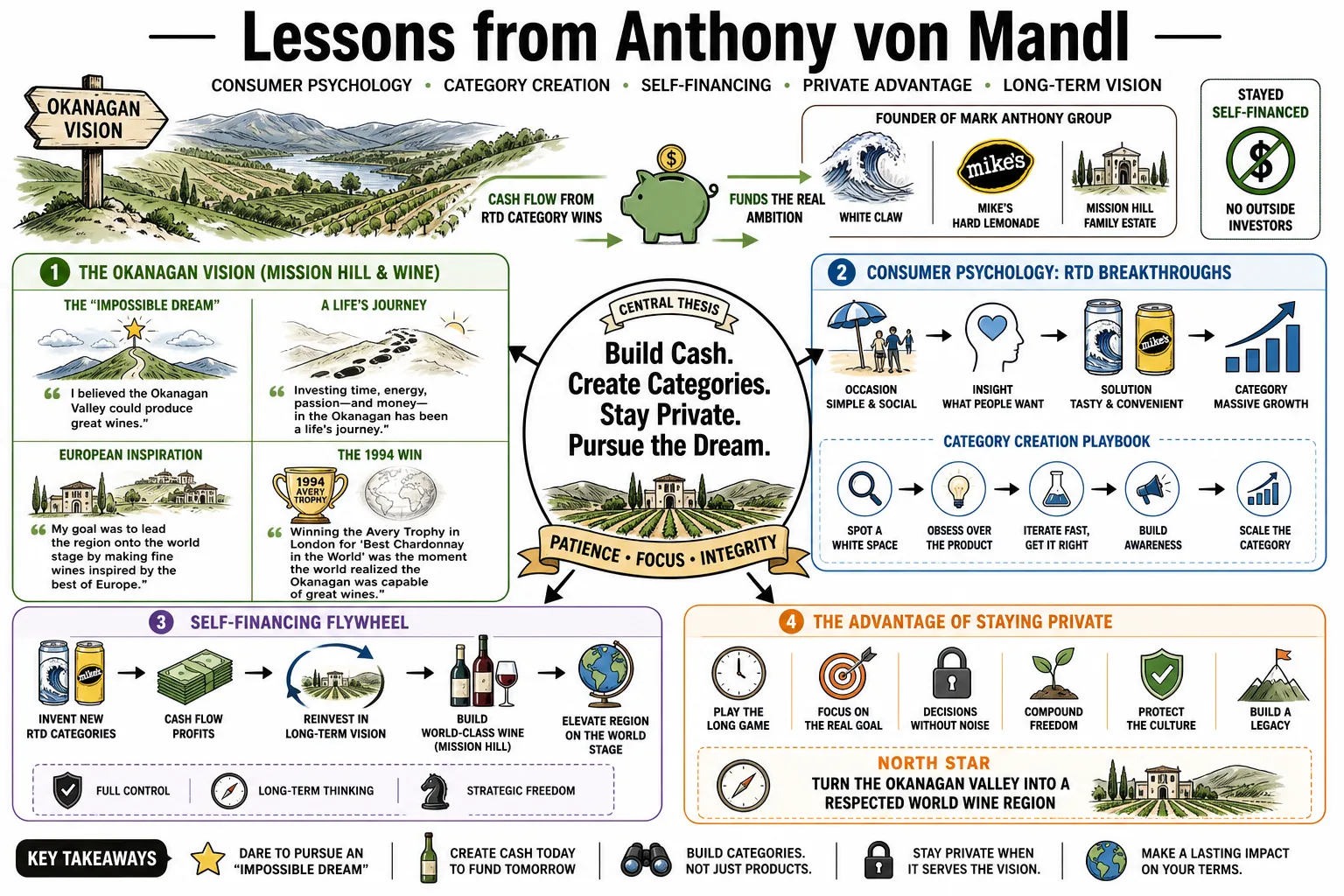
Lessons from Anthony von Mandl
Anthony von Mandl founded Mark Anthony Group, the business behind Mike's Hard Lemonade and White Claw, and pursued his wine ambitions at Mission Hill Family Estate in the Okanagan. Profits from beverage brands helped finance that work, although the early winery purchase also involved borrowing. These lessons examine his approach to consumer needs, innovation, regional development and long-term ownership. — Canadian Press — White Claw Interview. — UBC Okanagan — 2018 Convocation Address.
Part 1: The Okanagan Vision (Mission Hill & Wine)
- On The "Impossible Dream": Von Mandl chose the Okanagan over the established Napa market because he believed the lesser-known region could produce fine wines. — NUVO — 40 Years of Okanagan Wineries.
- On A Life's Journey: He describes his investment in the Okanagan as a lifelong pursuit, with no final point of perfection. — NUVO — 40 Years of Okanagan Wineries.
- On European Inspiration: His ambition was to bring the Okanagan onto the international wine stage with wines inspired by Europe's best. — NUVO — 40 Years of Okanagan Wineries.
- On The 1994 Win: Mission Hill's 1994 Chardonnay trophy gave von Mandl confidence that the winery could compete internationally. — NUVO — A Rare Vintage.
- On Early Doubts: After buying the run-down winery, he recalls losing sleep over whether the purchase had been a serious mistake. — ideacity — Creating a World Class Winery.
- On Mentorship: He credits Robert Mondavi's mentorship and willingness to exchange knowledge with helping his development as a vintner. — NUVO — 40 Years of Okanagan Wineries.
- On Terroir and Soil: Understanding the soils beneath each vineyard helps match grape varieties to particular sites rather than treating the valley as uniform. — NUVO — 40 Years of Okanagan Wineries.
- On Patience: Cash reserves give the winery room to wait and reject work that does not meet its quality standards. — Wine Anorak — Mission Hill.
- On Organic Farming: He treats organic farming as a baseline responsibility to the land, not a guarantee that the grapes are better. — NUVO — 40 Years of Okanagan Wineries.
Part 2: Category Creation (Mike's Hard Lemonade)
- On The Genesis of Mike's: Mike's addressed a perceived unmet need for a sweet alcoholic drink that men would feel comfortable drinking publicly. — Beverage Industry — A Hard Act to Follow.
- On Gender Norms in Beverage: The brand used an irreverent, approachable personality rather than an aspirational image to reduce the social barrier he saw around coolers. — Beverage Industry — A Hard Act to Follow.
- On Self-Financing: He developed businesses outside fine wine to generate the cash flow needed for his capital-intensive winery ambition; the initial purchase also involved borrowing. — UBC Okanagan — 2018 Convocation Address.
- On Product Differentiation: A neutral malt-alcohol base let the team develop cocktail-style products with different packaging and positioning from conventional beer. — Beverage Industry — A Hard Act to Follow.
- On Survival Through Innovation: When financing tightened, he turned the winery's cider sideline into a more appealing fruit-flavoured product to help keep the business alive. — ideacity — Creating a World Class Winery.
- On Scaling Rapidly: The strong response to Mike's in Canada and then the US helped fund the winery while its long construction project was under way. — UBC Okanagan — 2018 Convocation Address.
- On Unspoken Needs: He looks for products consumers have not yet asked for, describing anticipation of changing tastes as central to his work. — Canadian Press — White Claw Interview.
- On Competing with Giants: He favoured a guerrilla marketing approach rather than trying to match the advertising resources of the major beer companies. — Beverage Industry — A Hard Act to Follow.
Part 3: The Hard Seltzer Revolution (White Claw)
- On The White Claw Phenomenon: In 2019, he argued that White Claw consumers would not simply return to older beer brands. This was his market thesis, not a guaranteed forecast. — Brewbound — 2019 NBWA Address.
- On Gender-Neutral Branding: White Claw executive Davin Nugent described the brand's positioning as premium and gender-neutral, with appeal to both men and women. — Just Drinks — Davin Nugent Interview.
- On The Shift in Drinking Culture: Von Mandl saw demand from people seeking an alternative to beer and believed lower sugar and carbohydrate content appealed across ages. — Canadian Press — White Claw Interview.
- On Starbucks as a Model: He compared White Claw's disruption of drinking habits with Starbucks' effect on coffee, using it as an analogy for the brand's ambition. — Canadian Press — White Claw Interview.
- On Purity and Wellness: He linked White Claw's appeal to flavour, convenience and moderation-oriented consumer preferences—not to a demonstrated health benefit from drinking alcohol. — Brewbound — 2019 NBWA Address.
- On The White Claw Summer: He called the 2019 surge an extraordinary experience, while acknowledging that demand had outpaced supply. — Canadian Press — White Claw Interview.
- On Refusing Outside Capital: In September 2019, he said the business had no debt and planned to fund its next production investment internally. These are dated statements, not current audited finances. — Beer Marketer’s Insights — 2019 Distributor Q&A.
- On Dominating the Market: Nugent argued that product appeal and taste mattered more than winning an advertising shoot-out with much larger competitors. — Just Drinks — Davin Nugent Interview.
Part 4: Entrepreneurial Persistence & Risk
- On Belief and Purpose: He urged graduates to pursue a meaningful ambition and make a difference rather than treat earning money as the purpose itself. — UBC Okanagan — 2018 Convocation Address.
- On Guarding Your Dream: He urged graduates to protect their dream without settling or compromising their integrity. — UBC Okanagan — 2018 Convocation Address.
- On Small Teams: He argued that a small, committed and passionate team can challenge far larger organizations. — UBC Okanagan — 2018 Convocation Address.
- On the Entrepreneurial Desert: He recalls six early years of lean finances and missed meals while trying to keep the wine-importing business alive. — Horatio Alger — Anthony von Mandl.
- On Making Decisions Under Pressure: He credits his father with teaching him not to make strategic decisions under duress, but to search for a creative way forward. — ideacity — Creating a World Class Winery.
- On Constant Motion: He treats perseverance, innovation and continually raising standards as necessary in a competitive global market. — UBC Okanagan — 2018 Convocation Address.
- On The Value of Naivety: He entered the wine trade with confidence but little understanding of its buying system; the setbacks forced him to learn how the market worked. — ideacity — Creating a World Class Winery.
Part 5: Brand Building & Marketing
- On Building Authentic Brands: His 2021 student presentation connected authentic brands with quality products that address gaps in consumer demand. — Times Colonist — UVic Entrepreneur Address.
- On Selling the Story: Mike's built its personality around familiar drinks presented with irreverent humour, rather than a grand aspirational story. — Beverage Industry — A Hard Act to Follow.
- On Word-of-Mouth Marketing: He said White Claw did not fund its viral fan video, and credited consumer enthusiasm while distancing the brand from irresponsible unofficial messaging. — Canadian Press — White Claw Interview.
- On Premiumization: He invested in packaging details that made Mike's look more premium and consistent on the shelf. — Beverage Industry — A Hard Act to Follow.
- On Category Naming: The team used the name progressive adult beverages to describe its expanding malt-based offering, rather than limiting it to the older category label. — Beverage Industry — A Hard Act to Follow.
- On Adapting to Growth: His 2021 student talk emphasized keeping a growing company nimble and innovative. — Times Colonist — UVic Entrepreneur Address.
- On Brand Purity: He treated laboratory testing and production quality control, including investments at contract brewers, as important parts of building the brand. — Beverage Industry — A Hard Act to Follow.
Part 6: Architecture & Aesthetics
- On Transcending North America: He wanted Mission Hill's design to connect North American and European sensibilities rather than feel exclusively North American. — Wine Anorak — Mission Hill.
- On Working with Tom Kundig: He worked with Tom Kundig on architecture that fits the landscape while serving the practical needs of winemaking. — JustLuxe — Martin’s Lane Interview.
- On The 12-Story Bell Tower: The tower's bells carry family dedications, making the estate's architecture part of its personal heritage. — ideacity — Creating a World Class Winery.
- On Designing for the Ages: He wanted the winery's architecture to remain relevant for centuries, making endurance part of the design brief. — UBC Okanagan — 2018 Convocation Address.
- On The Experience of Space: He wanted a visit to slow people down and turn their attention inward; the approach to the estate deliberately supports that transition. — NUVO — A Rare Vintage.
- On Art and Patronage: He incorporated art and music into the estate as expressions of the heritage that shaped his vision. — ideacity — Creating a World Class Winery.
- On Creating a Cultural Hub: He added performance and culinary spaces to give visitors reasons to come beyond tasting the wine. — ideacity — Creating a World Class Winery.
- On Details Mattering: He asked the builders to treat the project as their own lasting legacy, including the craftsmanship of individual architectural details. — ideacity — Creating a World Class Winery.
Part 7: Distribution & The "Three-Tier" System
- On Overcoming Blacklists: After being blacklisted by liquor boards, he found that Canadian airlines could buy directly and used that alternative channel to survive. — Horatio Alger — Anthony von Mandl.
- On Leveraging Distributors: He saw room to grow Mike's by reaching more retail accounts, not merely by being present in every state. — Beverage Industry — A Hard Act to Follow.
- On Supply Chain Mastery: The company moved from contract filling toward its own plants when demand exposed capacity and variety-pack bottlenecks. — KHS — Always One Step Ahead.
- On Strategic Import Alliances: Importing taught him to secure lasting supplier agreements; after losing handshake arrangements, he required long-term contracts. — ideacity — Creating a World Class Winery.
- On The Power of Shelf Space: He argued for more shelf space by pointing wholesalers to the portfolio's sales growth and potential profits. — Brewbound — 2019 NBWA Address.
- On Agility in Manufacturing: The production team used rapid decisions and close supplier collaboration to bring new capacity online under an aggressive schedule. — KHS — Always One Step Ahead.
- On Treating Distributors as Partners: He pitched the portfolio in terms of the profits it could generate for wholesalers and retailers, rather than volume alone. — Brewbound — 2019 NBWA Address.
Part 8: Legacy & Long-Term Thinking
- On Generational Stewardship: He framed the organic transition as stewardship for future generations, not a short-term profit exercise. — MONTECRISTO — Organic Farming Interview.
- On The Horizon of the Wine Industry: He describes wine as a risky, capital-intensive, long-term undertaking, requiring commitments that cannot be judged on quick returns. — UBC Okanagan — 2018 Convocation Address.
- On Staying Private: He valued private ownership's freedom to develop projects before disclosing them publicly. — Vancouver Sun — Mission Hill Vision.
- On His Parents' Resilience: He connects his gratitude for Canada and education with his parents' escape from Europe and the sacrifices they made for their children. — Horatio Alger — Anthony von Mandl.
- On Future Growth: Even after major successes, his 2024 honorary-degree account describes him as focused on what remains to be accomplished. — Royal Roads — Anthony von Mandl.
- On the Ecosystem of the Valley: He envisioned an Okanagan wine region with wineries, tourism and supporting businesses, not an isolated estate. — UBC Okanagan — 2018 Convocation Address.
- On Refusing to Sell: At a 2019 distributor Q&A, he described the company as a family business and indicated that he still had more to do rather than sell it. — Beer Marketer’s Insights — 2019 Distributor Q&A.
- On Empowering the Next Generation: Production leader John Sacksteder credits von Mandl with trusting him to manage the factory-building programme and enabling fast decisions. — KHS — Always One Step Ahead.
- On Philanthropy: He favours charitable causes where he believes his support can have a tangible effect, including education, arts and health research. — Horatio Alger — Anthony von Mandl.