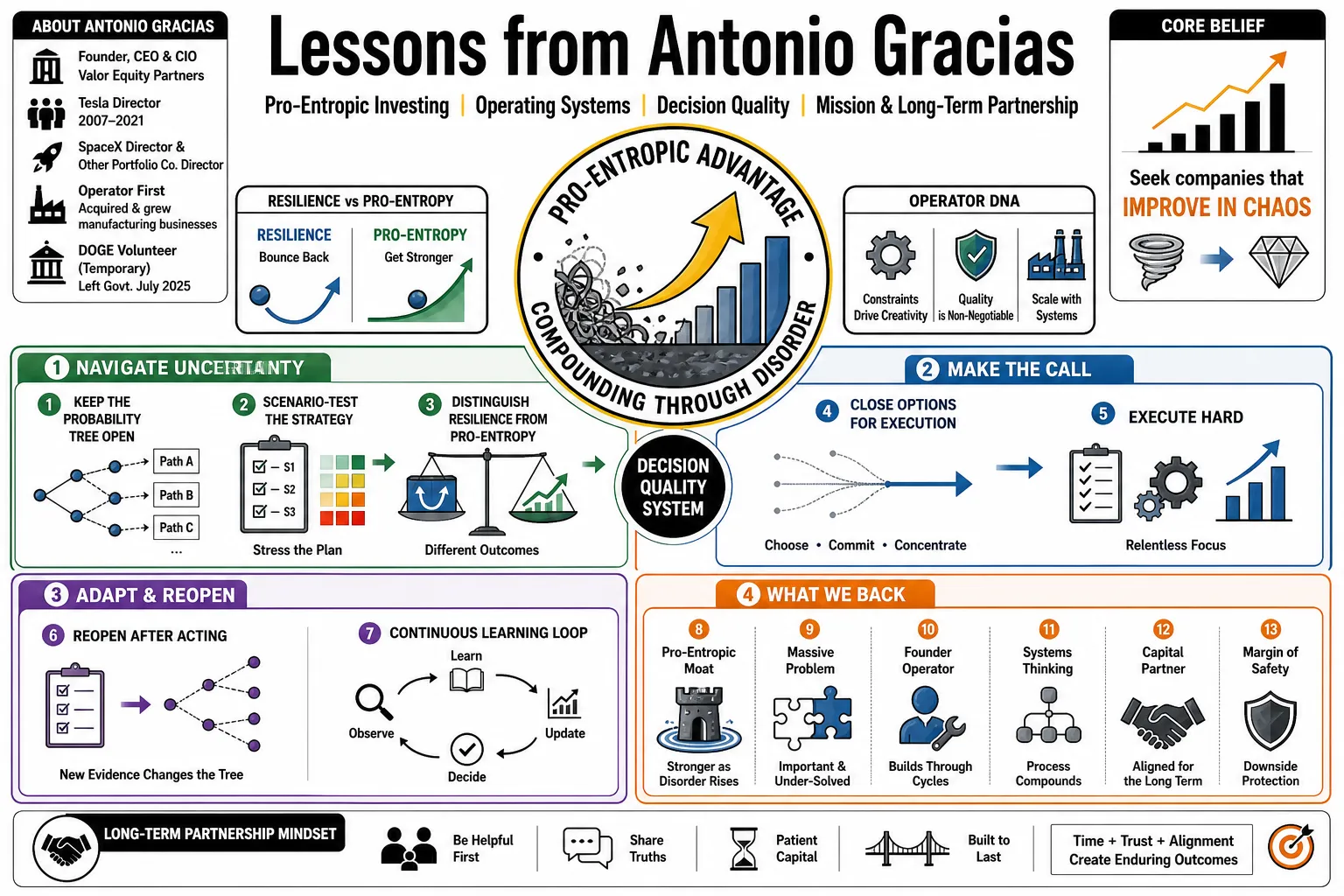
Antonio Gracias is the founder, CEO, and CIO of Valor Equity Partners. He served as a Tesla director from 2007 to 2021 and remains a director of SpaceX and other Valor portfolio companies. Before building Valor, he acquired and operated manufacturing businesses, experience that shaped the firm’s hands-on approach to constraints, quality, and scale. According to Valor’s email reported by NBC News, his DOGE volunteering ended July 1, 2025. These lessons cover pro-entropic investing, operating systems, decision quality, mission, and long-term partnership. — Valor — Antonio Gracias. — NBC News — Antonio Gracias Leaves DOGE.
Pro-Entropic Investing and Uncertainty
- On Seek Companies That Improve in Chaos: A pro-entropic company does more than recover from disruption; its position becomes stronger as disorder rises. — Invest Like the Best — Pro-Entropic Investing.
- On Distinguish Resilience from Pro-Entropy: Resilience describes fast recovery after a shock, while pro-entropy describes a strategy that benefits from the altered environment. — Invest Like the Best — Pro-Entropic Investing.
- On Keep the Probability Tree Open: Strong leaders preserve several plausible paths while uncertainty remains high instead of prematurely committing to one forecast. — Invest Like the Best — Pro-Entropic Investing.
- On Close Options for Execution: Optionality has value only until the moment arrives to choose a path, concentrate effort, and execute hard. — Invest Like the Best — Pro-Entropic Investing.
- On Reopen After Acting: After a committed execution phase, leaders should reopen the probability tree as new evidence changes the environment. — Invest Like the Best — Pro-Entropic Investing.
- On Scenario-Test the Strategy: Underwriting should ask how the business responds across recessions, pandemics, technological shifts, and other plausible disruptions. — Invest Like the Best — Pro-Entropic Investing.
- On Start from Stable Human Demand: Gracias looks for disruptive companies serving durable human needs, even when their products or delivery methods change substantially. — Invest Like the Best — Pro-Entropic Investing.
- On Improve Product and Value Together: In Gracias’s model, disruption improves both the product and its value for money; a better product need not have a lower absolute price. — Invest Like the Best — Pro-Entropic Investing.
- On Reject Fragile Businesses: Gracias distinguishes pro-entropic, resilient, and durable businesses and excludes fragile ones from his investment framework. — Invest Like the Best — Pro-Entropic Investing.
Constraints, Lean Operations, and Scale
- On Find the Slowest Limiter: Gracias applies bottleneck thinking to operations: identify the slowest element limiting throughput before deciding where to improve the system. — Invest Like the Best — Pro-Entropic Investing.
- On Ask What Makes the Whole System Faster: Management attention should go to the part whose improvement raises total throughput rather than to the most visible local problem. — Invest Like the Best — Pro-Entropic Investing.
- On Make Service Capacity the Fund Constraint: Portfolio size should be limited by the ability to provide useful operating support, not merely by the amount of capital available. — Invest Like the Best — Pro-Entropic Investing.
- On Treat the Portfolio Company as the Customer: An investment firm with an operating team should design its service around the needs of the company receiving the capital. — Invest Like the Best — Pro-Entropic Investing.
- On Map Current and Future States: Operational improvement becomes concrete when a team documents the present process, defines the desired process, and builds the steps between them. — Invest Like the Best — Pro-Entropic Investing.
- On Pair Constraints with Quality: Gracias describes lean operations as combining constraint-based thinking with quality improvement, rather than treating faster throughput as the only goal. — Invest Like the Best — Pro-Entropic Investing.
- On Deploy Specialists Against Real Problems: Ask founders for their three biggest operating problems, then match experienced practitioners to the specific function that needs work. — Invest Like the Best — Pro-Entropic Investing.
- On Use Idle Time as a Bottleneck Signal: During Tesla’s Model 3 ramp, Gracias’s team combined final quality checks and fixes with charging, reducing the time cars waited between those stages. — Invest Like the Best — Pro-Entropic Investing.
- On Forward-Deploy to Reduce Pain and Risk: Experienced operating teams can make a first-time founder's recurring problems faster, easier, and less risky without replacing the founder. — Invest Like the Best — Pro-Entropic Investing.
Staged Capital, Information, and Partnership
- On Begin with a Small Check: A modest first investment creates time to observe the company, build trust, and learn before increasing exposure. — Invest Like the Best — Pro-Entropic Investing.
- On Build a Two-Way Information Advantage: Working alongside the company improves it while giving both parties better information about whether the partnership should deepen. — Invest Like the Best — Pro-Entropic Investing.
- On Pay More After Risk Falls: Gracias is willing to pay a higher later valuation when knowing the company better has improved the risk-reward tradeoff. — Invest Like the Best — Pro-Entropic Investing.
- On Optimize Risk-Reward, Not Entry Price Alone: A later investment may offer a lower return rate or multiple yet a better risk-reward tradeoff if new information has substantially reduced the risk. — Invest Like the Best — Pro-Entropic Investing.
- On Allow Time to Reveal Values: Six to nine months of real interaction can show whether humility, integrity, responsibility, and excellence are actually shared. — Invest Like the Best — Pro-Entropic Investing.
- On Expect Forecast Misses but Measure Their Size: Gracias expects optimistic founders to miss some forecasts, but treats the size of a miss as important evidence rather than dismissing every miss as normal. — Invest Like the Best — Pro-Entropic Investing.
- On Choose Partners for Good and Bad Times: A long investment relationship resembles a durable professional friendship: trust matters because both sides will face adversity together. — Invest Like the Best — Pro-Entropic Investing.
- On Prefer Help-Seeking Fit over Universal Appeal: Valor is a better match for founders who want more than capital and worse for those who reject operating support by design. — Invest Like the Best — Pro-Entropic Investing.
Decision Quality, Mission, and Leadership
- On Keep Thinking Under Pressure: Gracias values executives who can think clearly under severe pressure while continuing to respect facts and ethical boundaries. — Invest Like the Best — Pro-Entropic Investing.
- On Do Not Let Mission Override Evidence: A worthy purpose can create emotional attachment strong enough to hide warning signs, so mission-driven investors need explicit checks on themselves. — Invest Like the Best — Pro-Entropic Investing.
- On Identify Emotional Bias Directly: Decision reviews should examine security, control, affirmation, and ego in addition to familiar cognitive biases. — Invest Like the Best — Pro-Entropic Investing.
- On Use Partners as Bias Checks: Gracias asks partners to challenge his reasoning and emotional motives, using explicit conversations and decision checks to expose possible bias. — Invest Like the Best — Pro-Entropic Investing.
- On Start with Ground Truth: Gracias starts decisions with observable facts about the numbers, product, engineering, and process, then separates those facts from judgments the team must make. — Invest Like the Best — Pro-Entropic Investing.
- On Practice Epistemic Humility: Intellectual humility means caring more about the right answer than defending the view held before the evidence arrived. — Invest Like the Best — Pro-Entropic Investing.
- On Use Mission to Sustain Long Work: People can endure years of difficulty when the work serves a purpose larger than financial compensation. — Invest Like the Best — Pro-Entropic Investing.
- On Align the Team's Vectors: A shared direction lets individual decisions compound into forward movement; countervailing efforts dissipate the organization's force. — Invest Like the Best — Pro-Entropic Investing.
SpaceX, Defense Technology, and Legacy
- On Hold Generational Missions for the Long Term: Gracias said he intended to hold his personal SpaceX stake as long as possible; he distinguished that intention from decisions about holdings owned by the firm’s clients. — CNBC — SpaceX and Long-Term Investing.
- On Think in Integrated Infrastructure Stacks: Gracias described his SpaceX investment vision as an integrated system spanning energy, compute, launch, and orbital compute, rather than a set of unrelated businesses. — CNBC — SpaceX and Long-Term Investing.
- On Value Coherent Compute: Gracias emphasized networking and cluster coherence when evaluating compute, arguing that hardware quantity alone does not capture the quality of the system. — CNBC — SpaceX and Long-Term Investing.
- On Let Mission Create the Next Product: Gracias credited SpaceX’s team with finding new products and capabilities in pursuit of the larger mission, rather than relying on a fixed product roadmap. — CNBC — SpaceX and Long-Term Investing.
- On Back Defense Entrepreneurship: At the Pennsylvania Defense and Innovation Summit, Gracias credited changes at the defense department with helping defense-technology companies accelerate and encouraging American entrepreneurship. — White House — Pennsylvania Defense and Innovation Summit.
- On Use a Temporary Public-Service Role: Valor told NBC News that Gracias’s DOGE volunteering ended July 1, 2025, and that he remained actively involved in managing the firm during that period. — NBC News — Antonio Gracias Leaves DOGE.
- On Build Fellowship for Institutional Continuity: A durable firm needs partners who grow, share purpose, respect one another, and can carry the culture after the founder. — Invest Like the Best — Pro-Entropic Investing.
- On Let Courage Clarify Action: Gracias recalls his mother expressing her love and urging him to be courageous near the end of her life; he returns to that memory when deciding what is right. — Invest Like the Best — Pro-Entropic Investing.