Eben Upton is a computer scientist and the co-founder of Raspberry Pi. He is known for designing an affordable, highly capable microcomputer that revitalized computer science education and unexpectedly became an industrial standard. This profile explores his approach to hardware architecture, cost-engineering, and the philosophy of giving users a "licence to tinker" with the tools they own.
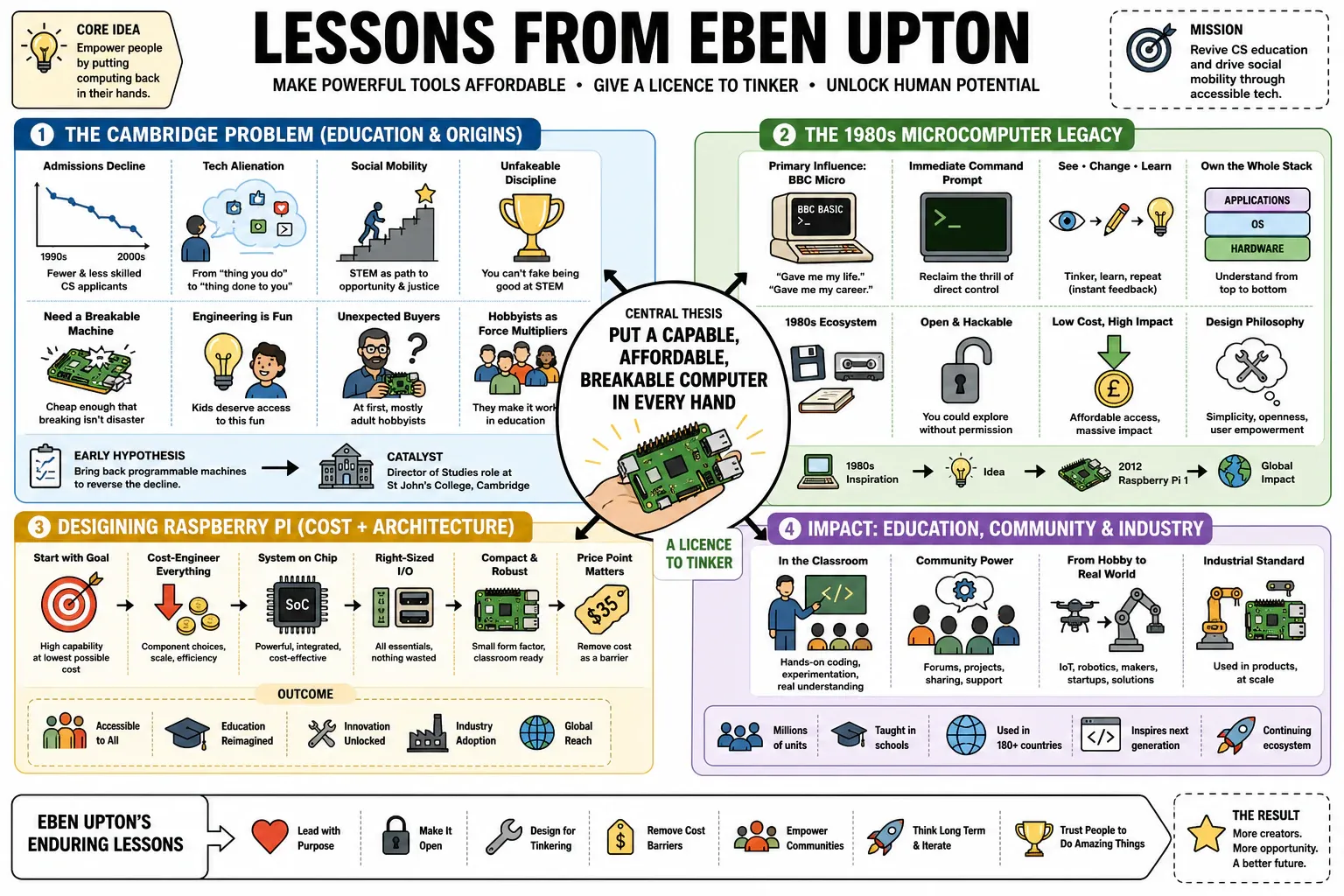
Part 1: The Cambridge Problem (Education & Origins)
- On the admissions decline: Upton noted that the number and skill level of students applying to study computer science at Cambridge plummeted in the early 2000s, moving from deep programming knowledge to basic web design. — Source: [University of Cambridge]
- On modern tech alienation: He observed that technology had become separated from the user, transitioning from being a "thing you do" to a "thing that is done to you." — Source: [Raspberry Pi Foundation]
- On the goal of social mobility: Upton views STEM education not just as a technical pipeline, but as a driver of social justice and mobility. — Source: [YouTube Interview]
- On STEM as an unfakeable discipline: "The great thing about STEM subjects is that you can't fake being good at them," making it a meritocratic ladder for disadvantaged children. — Source: [YouTube Interview]
- On the need for a breakable machine: He realized students needed a device cheap enough that if they broke it while experimenting, it wasn't a household disaster. — Source: [The Guardian]
- On engineering as fun: "We're doing this because engineering is an enormously fun thing to do and it's sad that children don't have access to this fun thing." — Source: [Digitec Interview]
- On the initial target audience: He initially felt frustrated that adult hobbyists, rather than kids, bought the first Raspberry Pis, before realizing their vital role. — Source: [YouTube Interview]
- On hobbyists as force multipliers: "I think what we didn't realize was the enthusiasts were going to be the people who were going to make it work in education... the people who kept me involved in computing were the adults who were there to answer tricky questions." — Source: [YouTube Interview]
- On early prototypes: The very first Raspberry Pi was conceived as a test of the hypothesis that bringing back programmable machines would reverse the decline in computer science applicants. — Source: [FOSS Pod]
- On the role of a Director of Studies: His time reviewing applicants at St John's College, Cambridge, was the catalyst that proved the "accidental pipeline" of 1980s programmers had disappeared. — Source: [University of Cambridge]
Part 2: The 1980s Microcomputer Legacy
- On his primary influence: Upton credits the BBC Micro as the machine that "gave me my life" and "gave me my career." — Source: [YouTube Interview]
- On the immediate command prompt: He recalls the 1980s era fondly because "whenever you turned them on, the first thing they did was go 'beep' and a second later you're sitting at a command prompt." — Source: [The Guardian]
- On early hardware access: Unable to afford a new BBC Micro, he saved his pocket money to buy a secondhand one for £220 from a Tesco supermarket noticeboard. — Source: [YouTube Interview]
- On the drive to code: He began programming around age nine, motivated by a competitive desire to write games that were as good as those sold in shops. — Source: [Innovators Under 35]
- On BBC BASIC: He heavily utilized the BBC Micro's built-in assembler, which allowed him to transition smoothly from high-level BASIC coding to low-level machine code. — Source: [YouTube Interview]
- On the computing class divide: He viewed himself as a "BBC/Amiga guy on a Spectrum/ST budget," acknowledging the social distinction between the expensive educational BBC Micro and the mass-market ZX Spectrum. — Source: [YouTube Interview]
- On the value of documentation: Despite the high cost of the BBC Micro, Upton felt lucky to have access to its superior hardware documentation, which encouraged deep tinkering. — Source: [YouTube Interview]
- On his first computer interaction: His introduction to computing happened at age three, playing "Hunt the Wumpus" on a university minicomputer with his father. — Source: [YouTube Interview]
- On modern appliances vs tools: He notes that by the mid-2000s, computers had become "appliances" like consoles, rather than programmable "tools" you could take apart. — Source: [University of Houston]
Part 3: Broadcom and Hardware Architecture
- On joining Broadcom: Upton spent 14 years at Broadcom, rising to the position of Technical Director and ASIC Architect, where he specialized in System on a Chip (SoC) hardware. — Source: [The Pi Hut]
- On the VideoCore GPU: He was a key contributor to the VideoCore architecture, which provided the Raspberry Pi with its surprisingly powerful 1080p graphics capabilities. — Source: [Slashdot]
- On the BCM2835 chip: He helped design the BCM2835 as a multimedia co-processor for mobile phones before realizing its potential as a standalone computer processor. — Source: [The Pi Hut]
- On the Pi's initial form: He famously described the first Raspberry Pi as essentially a "breakout board" for the Broadcom BCM2835 chip. — Source: [Linux Magazine]
- On leveraging the roadmap: His deep knowledge of Broadcom’s development roadmap allowed him to identify chips powerful enough for a computer but inexpensive enough for the Pi's price target. — Source: [The Pi Hut]
- On early software challenges: Upton personally performed the original port of the Linux kernel to the Raspberry Pi hardware. — Source: [Linux Magazine]
- On hardware innovation timelines: He points out that innovation takes time; he started developing the Pi in 2006 but didn't have a viable product until 2010. — Source: [ASME]
- On optimizing the kernel: Under his leadership, the Foundation frequently pays developers to optimize Linux code for low-cost hardware like Cortex A53 processors. — Source: [The Guardian]
- On academic background: His PhD in Computer Science, focused on compiling with data dependence graphs, provided the theoretical foundation for his architectural work. — Source: [University of Cambridge]
- On his shifting role: Over time, he moved from being a consumer of Broadcom silicon to designing custom internal architecture for Raspberry Pi. — Source: [The Pi Hut]
Part 4: Cost-Engineering and The Price Target
- On the pocket money threshold: The $25–$35 price tag of the original Pi was a calculated psychological threshold to ensure children could buy it themselves. — Source: [Investment Reports]
- On designing backwards: Unlike most companies that design a product and then price it, Upton's strategy involves designing backwards from a strict $35 target. — Source: [Investment Reports]
- On psychological ownership: "Something that was cheap enough that children could buy it themselves or have it given to them as a gift... It belongs to the child." — Source: [YouTube Interview]
- On micro-cost optimization: He emphasizes that "micro-costs," even 10-cent components, can quickly destroy the margin on a low-cost hardware product. — Source: [Investment Reports]
- On macro-level decisions: To hit price targets, he advises making "macro-level" decisions on functionality while ruthlessly optimizing the bill of materials. — Source: [Investment Reports]
- On open source economics: Building an open-source platform was an "inevitable" economic necessity to meet the aggressive price targets required for mass educational adoption. — Source: [The Guardian]
- On high-performance margins: He acknowledges the constant challenge of selling high-performance hardware at $25–$35 margins while maintaining a charitable educational mission. — Source: [FOSS Pod]
- On the necessity of volume: To survive on extremely low margins, the hardware business had to scale to massive volumes far beyond initial expectations. — Source: [FOSS Pod]
- On early funding: The initial IP licensing model with distributors like RS Components funded manufacturing, allowing the Foundation to scale without massive capital. — Source: [Wikipedia]
Part 5: Manufacturing and Supply Chain
- On strategic reshoring: One of Upton’s most distinctive moves was moving the majority of manufacturing from offshore facilities to the Sony UK Technology Centre in Wales. — Source: [YouTube Interview]
- On Design for Manufacturability (DFM): He emphasizes that having the factory "four hours away by car" allows for a tight feedback loop between engineers and the production line. — Source: [YouTube Interview]
- On rapid iteration: The proximity to the Welsh factory enables rapid iterations to improve yield and reduce assembly costs, a difficult feat with offshore partners. — Source: [YouTube Interview]
- On pandemic resilience: Local manufacturing allowed Raspberry Pi engineers to visit the factory to troubleshoot production issues without the quarantine or travel barriers faced by competitors. — Source: [YouTube Interview]
- On supply chain triage: During the global chip shortage, he faced the "heartbreaking" decision of prioritizing limited stock for life-critical medical equipment over educational users. — Source: [FOSS Pod]
- On recovery years: Upton categorized 2024 as the "recovery year" from component shortages, moving into 2025 and 2026 as "stable years" for stock. — Source: [Electromaker Podcast]
- On component sourcing: The shortage of standard chips inadvertently led engineers to experiment with Raspberry Pi's custom silicon, boosting its widespread adoption. — Source: [Electromaker Podcast]
- On physical durability: For newer products like the Pi 500, he focuses on mechanical improvements, such as threaded inserts, to ensure hardware survives classroom environments. — Source: [Hackaday]
- On manufacturing as a partnership: He views the relationship with the Sony facility not just as a vendor contract, but as a deeply integrated engineering partnership. — Source: [YouTube Interview]
Part 6: Silicon and Vertical Integration
- On owning the stack: Upton describes Raspberry Pi as a vertically integrated company: "It is exactly what Apple does, just at a different scale—own the stack and optimize it." — Source: [Investment Reports]
- On transitioning to a chip company: A major strategic shift under his leadership was moving from being a "board company" to a "chip company" that designs its own silicon. — Source: [Investment Reports]
- On the RP2040: The success of the in-house RP2040 microcontroller proved that Raspberry Pi could build and sell custom semiconductor IP to other manufacturers. — Source: [The Pi Hut]
- On the RP1 controller: The Raspberry Pi 5 introduced the custom RP1 I/O controller, marking a leap toward a more complex, "PC-like" internal architecture. — Source: [Hackaday]
- On the Arm partnership: He leveraged Arm Flexible Access to design custom SoCs, moving away from relying entirely on off-the-shelf Broadcom chips. — Source: [Arm Podcast]
- On the AWS analogy: He compares their silicon strategy to Amazon’s AWS, where internal hardware infrastructure is refined and then sold as a standalone product. — Source: [Investment Reports]
- On the advantage over merchant silicon: By designing their own chips, they can strip out unnecessary features and optimize purely for the performance and cost metrics they care about. — Source: [Investment Reports]
- On future business structure: "Over the next decade, we will probably become a company with co-equal electronics and semiconductor businesses." — Source: [Investment Reports]
- On the Pico W: He noted the Pico W's success in industrial and hobbyist projects, like Eurorack synthesizers, as proof of their silicon's versatility. — Source: [Electromaker Podcast]
- On personal use: Despite building custom chips, he still uses standard Raspberry Pis as "generic Linux boxes" for evening hacking on his daughter's bedroom floor. — Source: [Electromaker Podcast]
Part 7: Business Strategy and The IPO
- On the industrial pivot: While synonymous with education, Upton notes that 80% of the business is now driven by industrial and embedded computing customers. — Source: [Investment Reports]
- On industrial stickiness: He secures industrial customers by committing to keep products in production for at least 10 years, providing critical long-term stability. — Source: [Investment Reports]
- On going public: The June 2024 IPO on the London Stock Exchange was designed to provide liquidity for early investors, including the Foundation. — Source: [Wikipedia]
- On protecting the mission: He argued the IPO ensures the company can scale independently, avoiding acquisition by a larger tech giant that might alter its educational goals. — Source: [IPO Stories]
- On funding R&D: The IPO provides the stable, long-term funding model required for increasingly expensive engineering programs, such as the $25 million development cost of the Pi 5. — Source: [Hackaday]
- On balancing stakeholders: He acknowledges the ongoing challenge of balancing the financial demands of institutional investors with the ethos of the "retail" maker community. — Source: [IPO Stories]
- On workplace adoption: He attributes industrial success to a bottom-up movement where engineers simply "bring the thing they love into the workplace." — Source: [Arm Podcast]
- On corporate responsibility: Upton believes in being a "good member" of the open-source community by heavily reinvesting profits back into the ecosystem they rely on. — Source: [The Guardian]
- On hybrid models: He successfully navigated a rare hybrid business model: maintaining a high-growth commercial entity that serves as the engine for a non-profit foundation. — Source: [Investment Reports]
Part 8: Philosophy of Engineering and Advice
- On not asking permission: His most cited advice to engineers is to act: "I didn't ask for permission to do Raspberry Pi, I just did it." — Source: [YouTube Interview]
- On the Licence to Tinker: A core philosophy is demystifying technology, moving kids from passive consumers to giving them a "Licence to Tinker" with hardware. — Source: [The Guardian]
- On pragmatism over ideology: Upton describes himself as "not a natural open source guy," preferring a pragmatic approach that uses open tools to achieve accessibility rather than strict ideology. — Source: [The Guardian]
- On selective openness: He believes in being open where it benefits the community and closed where necessary, such as utilizing proprietary firmware to keep costs low. — Source: [The Guardian]
- On unforced code: He advises students that the best engineers are those who write code outside of their coursework, purely for the sake of building something. — Source: [YouTube Interview]
- On focusing on fundamentals: While AI is trending, he advises students to focus on basic engineering and analytical skills, which remain permanently useful. — Source: [The Pi]
- On general-purpose tools: He advocates using low-cost, general hardware to automate mundane tasks, which liberates people to focus on more creative work. — Source: [ASME]
- On community-led features: He points out that for specific software needs, it is often better to let the open-source community lead rather than waiting for a formal corporate solution. — Source: [Raspberry Pi Foundation]
- On the image of engineering: Upton argues that engineering suffers from an "image problem" of being uncreative, and encourages engineers to embrace "making" to highlight the profession's entrepreneurial spirit. — Source: [ASME]