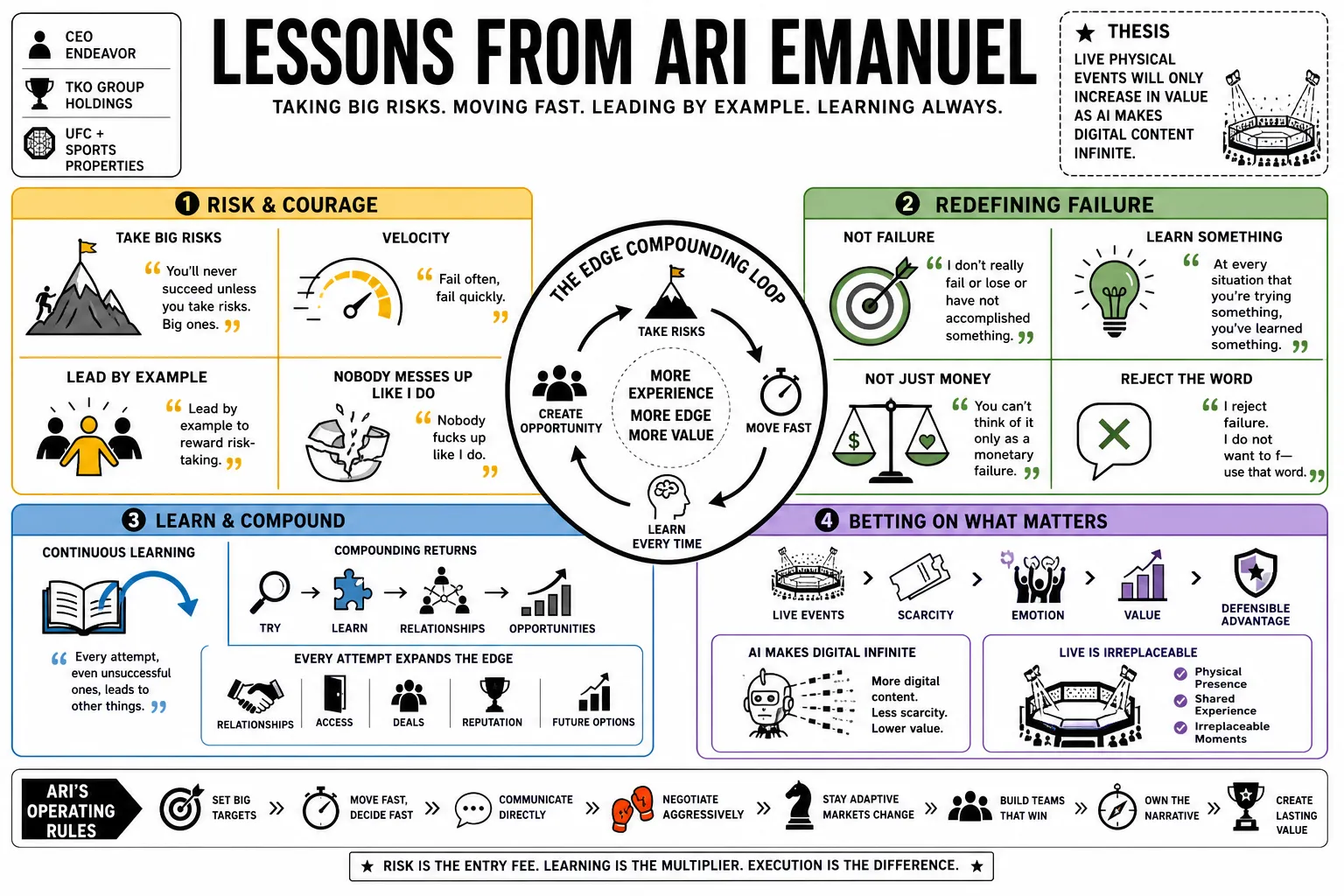
Lessons from Ari Emanuel
Ari Emanuel is CEO and executive chair of TKO Group Holdings and executive chairman of WME Group. His career spans talent representation and ownership of sports properties such as UFC. He argues that live, physical events could become more valuable as AI expands digital content. This profile examines his approach to deals, setbacks and changing markets. — TKO — Ariel Emanuel Biography. — Invest Like the Best — The Anti-AI Bet.
Part 1: Risk and Failure
- On Taking Risks: Buying UFC meant taking responsibility for a major business before all its future broadcast deals were secured. Emanuel describes the strain of having few bidders as a contract approached renewal, and the work needed to get a deal done. — Invest Like the Best — The Anti-AI Bet.
- On Velocity: Emanuel does not judge an experiment only by how quickly it succeeds. Recalling years of trial and learning in marketing, he says what mattered was eventually understanding the business and reaching the position he wanted. — MIPCOM 2018 — Ari Emanuel Keynote.
- On Setting Culture: Emanuel tries to model how he handles pressure, repeat that example, and help colleagues when they ask. He also tells them that missing an objective can be part of learning. — A Bit of Optimism — Family.
- On Making Mistakes: Emanuel acknowledges his own mistakes, including losing his temper in an early William Morris negotiation and delaying the deal. Recognizing the error matters more than pretending the process was flawless. — Invest Like the Best — The Anti-AI Bet.
- On Redefining Failure: Emanuel treats a decision that did not produce the intended outcome as a learning process rather than a verdict of failure. What he learns can improve his next decision. — A Bit of Optimism — Family.
- On Continuous Learning: An attempt that misses its objective can still create relationships and new ways of thinking. Emanuel values those gains because they can make the next attempt better. — A Bit of Optimism — Family.
- On Non-Monetary Losses: Emanuel says he does not evaluate a business mistake only through profit and loss, while acknowledging the freedom his financial success gave him. Some ventures that were not large successes still taught him about the market and led to useful relationships. — MIPCOM 2018 — Ari Emanuel Keynote.
- On Falling Vs. Failing: Agreeing with Simon Sinek's distinction between falling and failing, Emanuel says a missed outcome can still leave him better prepared for the next attempt. — A Bit of Optimism — Family.
Part 2: Negotiation and Dealmaking
- On Fairness: Emanuel recalls a senior Warner Brothers lawyer telling him that fairness is where a negotiation ends. He uses that lesson to accept a workable result even when neither side gets everything it wants. — In Good Company — Ari Emanuel.
- On Adapting Tactics: Match the tactic to the actual market. Emanuel says that when there is only one buyer and a deal needs to happen, the priority may be to close rather than wait for competition that does not exist. — In Good Company — Ari Emanuel.
- On Leverage: When several buyers are competing, Emanuel may extend the negotiation to seek a higher price. That tactic depends on having alternatives, not simply on being patient. — In Good Company — Ari Emanuel.
- On Honor: Emanuel says negotiators must keep their word. A difficult negotiation does not excuse abandoning the commitments they make. — In Good Company — Ari Emanuel.
- On Reputation: Treat each negotiation as part of a longer relationship. Emanuel says a reputation for keeping one's word precedes a negotiator and follows them into later deals. — In Good Company — Ari Emanuel.
- On Conflict: Asked about conflicts between representing clients and owning production businesses, Emanuel argues that the purpose is to offer clients more options. He says they should be free to decline and that failing to act in their interests could cost the agency their business. — MIPCOM 2018 — Ari Emanuel Keynote.
- On Closing Deals: Closing a deal requires persistent follow-up and clear communication. Emanuel says to keep calling when a response has not arrived and to over-communicate rather than assume the other side understands. — Invest Like the Best — The Anti-AI Bet.
- On Difficult Partners: Emanuel recognizes that an important business relationship may include things he dislikes. Emotional endurance helps him stay engaged with that relationship rather than demand that every aspect be comfortable. — Invest Like the Best — The Anti-AI Bet.
Part 3: Embracing Change
- On The Nature Of Business: Emanuel observes that change in entertainment is accelerating. His response is to become more comfortable adapting, rather than assume the business will stay as it was. — On Purpose — Ari Emanuel.
- On The End Of Tradition: Emanuel describes a modern agency as a full-service business that can combine marketing, books, licensing and merchandising. Its capabilities have to evolve with what clients need. — In Good Company — Ari Emanuel.
- On Finding New Avenues: Emanuel expanded beyond negotiating talent fees into owning businesses and developing additional commercial opportunities. He describes ownership as a way to apply the agency's capabilities beyond representation alone. — In Good Company — Ari Emanuel.
- On Market Trends: Emanuel's strategy combines representing creators with owning sports and event properties. That gives him different ways to participate in changes in how entertainment is produced, distributed and consumed. — In Good Company — Ari Emanuel.
- On Diversification: Emanuel has built a business spanning representation, sports ownership and services such as production, licensing and distribution. Its operations cannot be understood as a talent agency alone. — In Good Company — Ari Emanuel.
- On Shifting Work Habits: In his 2025 interview, Emanuel speculates that shorter working weeks could expand time available for entertainment and live events. His suggestion that weekends could start on Wednesday by 2027 is a forecast, not an established work pattern. — Invest Like the Best — The Anti-AI Bet.
- On Avoiding Outdated Models: As new platforms and formats emerge, Emanuel says agencies must adapt their skills and services to remain useful to clients. He points to work with podcasts and Instagram alongside older film and television businesses. — In Good Company — Ari Emanuel.
- On Looking Ahead: In his 2021 IPO letter, Emanuel said public ownership could accelerate Endeavor's mission, including expanding into emerging formats and encouraging prudent risk-taking. He framed the listing as a tool for pursuing that long-term vision. — Endeavor — 2021 IPO Prospectus.
Part 4: Talent and Leadership
- On Delegation: Delegation includes letting successors make mistakes. Emanuel says leaders who take over a business need room both to do good work and to learn when something goes wrong. — Invest Like the Best — The Anti-AI Bet.
- On Humility: Emanuel is comfortable admitting that he does not know everything. He treats recognizing that limit as a reason to draw on the strengths of people around him. — Yale — Ari Emanuel Interview.
- On Partnerships: Emanuel builds teams by finding people whose strengths complement his own. Asking for help and trusting others lets him do work he could not do alone. — A Bit of Optimism — Family.
- On Being A Partner: Act as a client's business partner, not only a representative. Emanuel describes combining services inside the agency to help clients develop their businesses. — In Good Company — Ari Emanuel.
- On Ecosystems: Emanuel describes helping talent build businesses and equity beyond their immediate performing work. The agency's wider services can support those opportunities. — On Purpose — Ari Emanuel.
- On Broad Definitions: The businesses Emanuel helped build serve talent across film, television, music, food, fashion, sports and digital media. Their scope extends beyond a narrow definition of screen entertainment. — Endeavor — Silver Lake Acquisition Announcement.
- On Ideas: Emanuel says that, after achieving financial security, he became more interested in whether his ideas were right and could be realized. The work is not simply about accumulating more money. — Invest Like the Best — The Anti-AI Bet.
- On Seeking Counsel: Emanuel surrounds himself with different voices to get feedback and refine his thinking. He tries to test his point of view rather than assume his own opinion is sufficient. — A Bit of Optimism — Family.
- On Making The Final Call: Listen to trusted advisers, then take responsibility for the decision. Emanuel says there comes a point when he has to decide that it is time to make the bet. — On Purpose — Ari Emanuel.
- On Staying Close: Maintaining a partnership requires staying close enough to know what is happening in the other person's life and business. Emanuel describes ongoing attention, not only contact when a transaction is due. — In Good Company — Ari Emanuel.
Part 5: Strategy and The Future of Entertainment
- On The Anti-AI Bet: Emanuel's live-events thesis is that cheaper and more abundant digital content could make scarce, in-person experiences more attractive. It is an investment view, not a guarantee that every event will rise in value. — Invest Like the Best — The Anti-AI Bet.
- On Human Nature: Emanuel expects people to keep seeking shared experiences at concerts, comedy shows and sporting events. His live-events strategy rests partly on that belief about social demand. — Invest Like the Best — The Anti-AI Bet.
- On Scarcity: The capacity of a particular live event is limited. Emanuel sees that scarcity as a different proposition from digital content that can be reproduced at much lower cost. — Invest Like the Best — The Anti-AI Bet.
- On Media Consolidation: At the September 2024 IMG x RedBird Summit, Emanuel predicted that consolidation could leave roughly five or six major streamers or content providers. This was his dated forecast, not a settled count of today's market. — TheWrap — IMG x RedBird Summit.
- On The Creator Economy: Emanuel sees talent looking beyond performance fees toward ownership and equity in other businesses. He describes digital creators as another part of that shift in how talent can build commercial value. — On Purpose — Ari Emanuel.
- On The Flywheel Effect: Emanuel describes combining owned sports properties with production, distribution, licensing and other capabilities. The aim is to create more commercial opportunities for those properties than ownership alone would provide. — In Good Company — Ari Emanuel.
- On The UFC Acquisition: The 2023 agreement to combine UFC and WWE valued UFC at $12.1 billion in enterprise value. That figure belongs to a specific transaction; it is not an estimate of what UFC is worth today. — WWE — 2023 UFC Transaction Filing.
- On Strategic Alignment: Endeavor's 2021 IPO prospectus linked owning sports properties with control over decisions affecting their long-term value. Ownership was part of its operating strategy, not simply another way to earn an advisory fee. — Endeavor — 2021 IPO Prospectus.
- On Public Vs. Private Markets: In October 2023, Emanuel said Endeavor should evaluate strategic alternatives because he believed its public-market valuation did not reflect the value of its assets. That was a company-specific judgment, not a rule that going private is always the right response. — Endeavor — Review of Strategic Alternatives.
Part 6: Dyslexia and Overcoming Challenges
- On Cognitive Advantage: Emanuel says dyslexia helped him develop other strengths, including relying on people whose abilities complement his own. He describes that as part of his personal experience, not as a universal cognitive advantage. — Yale — Ari Emanuel Interview.
- On Early Struggles: Emanuel recalls being diagnosed with dyslexia and ADHD in third grade, struggling with reading, and facing mockery and low expectations at school. His mother's sustained support helped him persist. — Yale — Ari Emanuel Interview.
- On Finding Solutions: Emanuel believes that struggling with dyslexia helped him find inventive solutions and develop other skills. He presents that as his own interpretation of his experience. — Yale — Ari Emanuel Interview.
- On Impostor Syndrome: Emanuel describes carrying a fear that others would discover he was not smart, even after becoming successful. He connects that insecurity to his childhood difficulties with dyslexia. — A Bit of Optimism — Family.
- On Self-Belief: Emanuel has become more comfortable valuing his own ideas and ability to organize people. He does not need to be the expert at every task to contribute as a leader. — A Bit of Optimism — Family.
- On Losing Embarrassment: Emanuel says the embarrassment he experienced in special education made later professional embarrassment less intimidating. That is how he explains his own willingness to keep going under scrutiny. — Invest Like the Best — The Anti-AI Bet.
- On Parenting: Emanuel stresses love, education and early help for children who struggle with dyslexia. He credits his own mother's involvement with helping him continue when teachers doubted him. — Yale — Ari Emanuel Interview.
- On Independence: Discussing how his parents encouraged independence, Emanuel agrees with Sinek that learning to ask for help can build the ability to work with a team. The conversation offers a personal reflection, not proof that one parenting style inevitably causes a particular outcome. — A Bit of Optimism — Family.
- On The Internal Engine: Emanuel describes a persistent internal drive to pursue his work. Even as he has become more comfortable with himself, he says that drive continues. — A Bit of Optimism — Family.
Part 7: Resilience and Pressure
- On Endurance: Emanuel emphasizes enduring setbacks, not merely winning confrontations. In his view, staying in business requires being able to absorb difficulties and continue. — In Good Company — Ari Emanuel.
- On Getting Back Up: After a setback, Emanuel's priority is to get back up and return to the work. He describes recovery as a continuing part of running a business. — In Good Company — Ari Emanuel.
- On Framing Stress: Emanuel credits Billie Jean King for the idea that pressure can be a privilege. He uses it to remind himself and colleagues to appreciate having consequential work to do. — A Bit of Optimism — Family.
- On Accepting Aggravation: Emanuel says business involves aggravating moments and that accepting them helped him enjoy the process more. He separates that acceptance from whether a particular outcome works out. — In Good Company — Ari Emanuel.
- On Emotional Pain: Emanuel sees emotional endurance as an important part of leadership. Difficult negotiations and imperfect relationships can require staying engaged while the situation remains uncomfortable. — Invest Like the Best — The Anti-AI Bet.
- On The Path To The Top: Emanuel describes success as a winding path rather than a straight line. He expects setbacks along the way and does not treat an uncomfortable stretch as proof that the whole direction is wrong. — A Bit of Optimism — Family.
- On Leaning Into The Fire: Emanuel prefers being involved where consequential decisions are happening rather than standing aside. He says that participation gives him a different sense of the world. — In Good Company — Ari Emanuel.
- On Courage In Crises: Emanuel credits Dana White's determination to resume UFC events during COVID with helping the business through the crisis. He describes also arranging the travel, testing and isolation needed for Fight Island. — Invest Like the Best — The Anti-AI Bet.
- On Being Comfortable With Discomfort: Emanuel says he has become comfortable operating in uncomfortable situations. Rapid change makes that ability particularly important to how he approaches his work. — On Purpose — Ari Emanuel.
Part 8: Philosophy on Life and Work
- On The Inner Voice: Emanuel notices the inner voice that tells him not to make an inconvenient trip or do difficult work. He describes recognizing that resistance and choosing to show up anyway. — On Purpose — Ari Emanuel.
- On Fighting Laziness: Emanuel says resisting the urge to avoid difficult tasks takes continuing effort, especially as he gets older. He tries not to let familiarity with that resistance become an excuse to stop doing the work. — On Purpose — Ari Emanuel.
- On Urgency: Emanuel recalls that a serious accident forced him to reconsider what he wanted to do. He uses the reminder that life is not a rehearsal to explain why he pursued the agency he wanted to build. — On Purpose — Ari Emanuel.
- On Time Management: Emanuel describes reading widely and talking to many people about where the world is heading. Seeking those perspectives helps him refine his thinking beyond his own day-to-day view of the business. — A Bit of Optimism — Family.
- On Competitive Environments: Emanuel credits Jeff Bezos with advice to distinguish active competition from the rest of life. He uses the on-field metaphor to recognize when forceful competition is appropriate, not as a literal call for violence. — Invest Like the Best — The Anti-AI Bet.
- On Off-Field Behavior: The other half of the advice Emanuel attributes to Bezos is knowing when competition has ended. He tries to avoid carrying the same combative stance into situations where it is no longer needed. — Invest Like the Best — The Anti-AI Bet.
- On Early Motivations: Emanuel says that, for much of his early career, he was trying to prove to others—and to himself—that he was not stupid. He connects that drive to the insecurity of his school years. — On Purpose — Ari Emanuel.
- On Finding Contentment: Emanuel says his motivation has shifted toward accomplishing work he finds worthwhile rather than simply making his financial stack larger. That change is part of how he describes finding more contentment. — On Purpose — Ari Emanuel.
- On Work-Life Balance: Emanuel says he does not frame his own life in terms of work-life balance. Staying closely involved in his partners' businesses is central to how he chooses to work. — In Good Company — Ari Emanuel.