Art Levy is Vice President of Global Partnerships at Cognition. He previously spent seven years at Brex, where he became Chief Business Officer and built its partnerships engine. The lessons below draw on his earlier interviews about careers, business strategy, partnerships, and acquisitions. — Cognition’s Hiring Announcement.
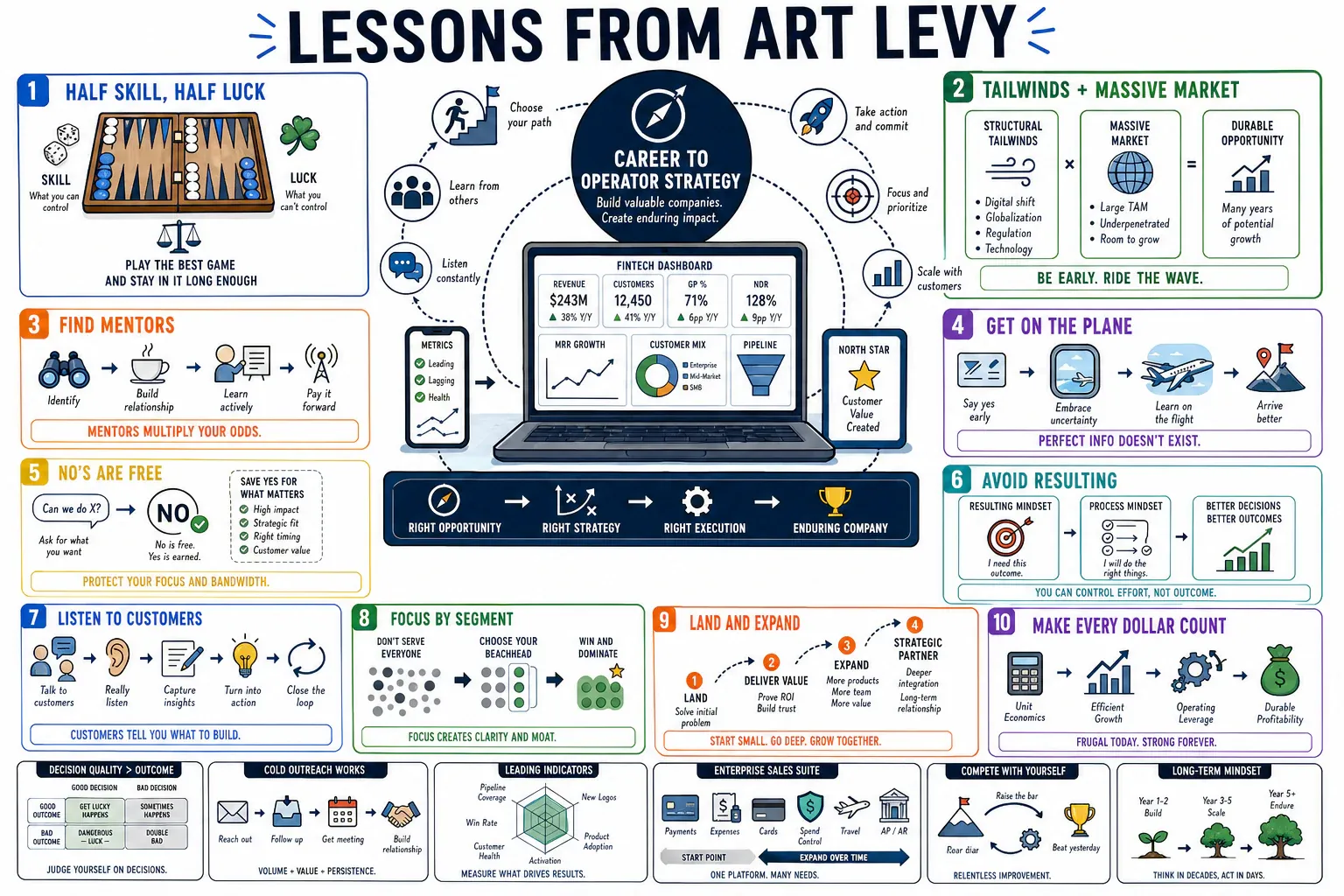
Career and Personal Growth
- On choosing which company to join: When choosing an operating role, Levy looks for company momentum, a large market, and a mentor inside the business. He used the same framework when considering Teespring and Brex. — Building Brex Interview.
- The necessity of mentorship: A mentor inside the company can help a new operator find their footing and have their voice heard. Levy sees that support as especially important when joining as an employee rather than a founder. — Building Brex Interview.
- On the transition from investor to operator: Levy prefers operating because he likes making decisions, iterating, and seeing tangible progress. He recognizes that the same impatience can work against the patience required in investing. — Building Brex Interview.
- On networking to find opportunities: While considering a move out of investing, Levy built relationships with New York venture investors who could introduce him to promising companies. He was open about wanting an operating role. — Building Brex Interview.
- On being proactive to seize opportunities: Levy moved quickly when Brex offered a meeting: a Friday invitation led to a Monday visit in San Francisco. His advice is to show up promptly when an important opportunity opens. — Building Brex Interview.
- On making yourself available: To move a deal forward, Levy tries to accommodate the other person's available times, even when he is more senior or represents the larger company. He prioritizes getting the meeting over asserting status. — Building Brex Interview.
- On networking with authenticity: Purposeful networking need not be disingenuous. Levy favors being clear about why he wants to meet someone while still taking a genuine interest in them. — Building Brex Interview.
- On being open to unsolicited messages: Levy makes time for thoughtful cold outreach and offers short calls when the sender has done the work. When he is reaching out himself, he carefully crafts the first message around the recipient and the proposed partnership. — Building Brex Interview.
- On the influence of family: Having an entrepreneurial father made building a company feel like a natural ambition for Levy. That influence stayed with him as he moved from finance into startups. — This Week in Fintech Interview.
- Advice for young VCs: If venture investing is not the career you want, Levy advises meeting founders and looking for a company to join. Staying solely to reach the next title can postpone the work you actually want to do. — Building Brex Interview.
- On evaluating decisions: Drawing on Annie Duke's Thinking in Bets, Levy separates the quality of a decision from the outcome it happens to produce. His Teespring experience illustrates why an unsuccessful outcome alone does not settle whether the original choice was sensible. — Building Brex Interview.
- On learning from failure: Reflecting on his move back into investing after Teespring, Levy says a setback can teach you something without making the setback desirable. In hindsight, he wishes he had stayed closer to the operating work he enjoyed. — Change Order — Fintech Startups.
Strategy and Business Growth
- On Brex's core vision: In his Brex interview, Levy described the company's vision as helping customers make every dollar count. The product mix could differ with a customer's size and needs. — This Week in Fintech Interview.
- The secret to effective positioning: Levy connects positioning to listening to customers and building for the needs that emerge as they grow. Brex's early customers helped reveal demand for bill pay, spend controls, and global capabilities. — This Week in Fintech Interview.
- On the importance of focus: Levy says Brex stretched itself too thin by trying to build for too many needs at once. Its response was to focus on fewer core products and be more deliberate about how it served different customer segments. — Fintech Leaders Interview.
- On scaling with customers: Moving upmarket can be more natural when it follows customers who are already growing. Levy recommends learning from their changing needs and adding the capabilities that keep the product relevant to them. — Mostly Metrics Interview.
- The challenge of moving downmarket: A downmarket move can require a new sales motion, pricing approach, and acquisition strategy. Levy notes that enterprise field sales may not make economic sense for much smaller contracts. — Mostly Metrics Interview.
- On when to introduce a second product: Levy argues against launching a second product before establishing the first, using $10 million in revenue as his own rough warning threshold. Reaching that number is not, in his view, an automatic reason to expand. — Mostly Metrics Interview.
- The importance of strategic timing: Customer requests and churn warnings can signal the need for a new product before headline growth slows. Levy says Brex began building its spend product ahead of the tech-market downturn rather than waiting for growth to weaken. — Mostly Metrics Interview.
- On enterprise sales strategy: An all-in-one enterprise pitch can slow a sale when different people own decisions about travel, cards, and spend management. Levy favors fitting the buying process rather than insisting on one bundled purchase. — Sacra — Brex Embedded.
- On the "land and expand" model: Levy describes landing through a specific workflow: a purchasing card in Coupa or a travel card in Navan. A good initial experience can then give the client team an opening to offer other relevant Brex products. — Sacra — Brex Embedded.
- On the importance of positioning by segment: As the product and customer base change, revisit positioning by segment and the niche you want to serve. Levy recommends Jack Trout's Positioning as a useful starting point for that work. — Building Brex Interview.
- The power of a clear initial message: Levy recalls Brex's early card-for-startups billboards as a simple way to make the intended audience recognize itself. The message became less sufficient as Brex added products and served larger companies. — Building Brex Interview.
- On what defines the best founders: Levy emphasizes getting close to the work rather than staying an armchair adviser. His examples include visiting businesses, learning the tools they use, and understanding whether the product solves their needs. — Building Brex Interview.
- The value of an audacious vision: The founders' ambitious vision and the strength of the early team helped convince Levy to join Brex. He saw those qualities alongside the market opportunity and momentum, not as substitutes for them. — This Week in Fintech Interview.
- On the path to IPO: Discussing IPO readiness, Levy stressed helping investors understand the business model as well as developing more predictable operations. Public recognition alone was not enough in his view. — Sourcery — Brex and M&A.
- On competition: Learn what competitors are doing without letting every launch overturn your roadmap. Levy argues that a clear customer-informed vision helps a company avoid repeatedly changing direction. — This Week in Fintech Interview.
- On setting audacious goals: Levy sees ambitious targets as a way to stretch a team beyond its immediate expectations. Missing the literal target can still leave meaningful progress, though the goal itself is not a promise of success. — Fintech Leaders Interview.
Mergers & Acquisitions (M&A)
- On the key to successful M&A: Successful deals in Levy's experience start with both sides being candid about what matters and what would make the combination work. Price is part of the discussion, but so are expectations after closing. — OnlyCFO M&A Interview.
- The goal of M&A is synergy: For Levy, the case for an acquisition should explain how the buyer's platform helps the acquired founder take the product further. The combination needs a credible operating benefit, not just attractive arithmetic. — OnlyCFO M&A Interview.
- Founder retention is a sign of success: Levy reports that founders in Brex's more successful acquisitions stayed for more than three years. He sees their continued involvement as important, without treating tenure alone as proof a deal worked. — OnlyCFO M&A Interview.
- For acquired founders, the role matters: Levy says negotiations with entrepreneurial founders can spend more time on their future role than on price. Clarify what they will build, who they will work with, and how the larger company will support them. — OnlyCFO M&A Interview.
- On attracting entrepreneurial talent post-acquisition: An acquirer needs to offer founders a place where they can keep building, not simply a payout. Levy points to entrepreneurial cultures such as Databricks when discussing how a larger company can attract that talent. — OnlyCFO M&A Interview.
- On the M&A landscape: In his 2025 M&A discussion, Levy expected large technology companies to keep consolidating smaller businesses. He saw established distribution as one reason buyers might acquire promising new products. — Sourcery — Brex and M&A.
- Why a tuck-in may not solve the problem: Levy argues that buying a smaller competitor does not automatically solve a competitive problem. If weak adoption reflects more than missing features, acquiring the product may leave the underlying problem intact. — Sourcery — Brex and M&A.
- How to attract an acquirer: A useful partnership can help a potential acquirer learn the product and the team before a sale is on the table. Levy recommends building those relationships rather than first appearing only when you are ready to sell. — Brex M&A Panel.
- When selling your startup, you're selling the vision: For a product acquisition, Levy advises explaining what the early product could become with the buyer's support. Make the future opportunity credible while being clear about what exists today. — Brex M&A Panel.
- For founders, the decision to sell is personal: A founder's decision to sell includes personal circumstances, burnout, and the desire for liquidity. Levy cautions that advisers with many investments do not have the same exposure as someone building one company full-time. — Brex M&A Panel.
- A deal isn’t done until it closes: Keep alternatives and contingency plans alive while an acquisition is being negotiated. Levy warns that even a written indication of intent is not the same as a closed deal, and the business must keep operating until closing. — Brex M&A Panel.
Partnerships
- The purpose of the Chief Business Officer role: At Brex, Levy described the CBO remit as revenue-generating partnerships, corporate development, acquisitions, and fundraising. It was an externally focused role with goals that could take many months to mature. — This Week in Fintech Interview.
- Persistence in partnerships pays off: Navan initially declined Levy's partnership proposal while pursuing its own card strategy. Years later, the companies reconnected when their needs aligned; a previous rejection did not make the opportunity permanently closed. — This Week in Fintech Interview.
- Partnerships should enhance the partner's product: A partnership should improve the other company's product as well as your own distribution. Levy describes Brex's Navan integration in terms of better travel payments and reconciliation for shared customers. — Sacra — Brex Embedded.
- Building internal buy-in for partnerships is crucial: Do not ask engineering to prioritize an integration without explaining why it matters. Levy brings internal teams into the partnership's purpose, trade-offs, and customer value so they can make informed decisions. — Building Brex Interview.
- Brex's first channel sales motion: Levy's first Brex channel role involved getting venture firms and accelerators to recommend Brex to portfolio companies. He studied Bill.com's channel approach and used service, incentives, and ecosystem relationships to make the referrals worthwhile. — Sourcery — Brex and M&A.
- Embedded finance as a customer acquisition tool: Embedded payments can make Brex a customer's first point of contact inside a platform they already use. Levy notes that some customers remain embedded-only, so the entry point can be valuable even without selling them the whole suite. — Sacra — Brex Embedded.
- On negotiation and emotional intelligence: Levy treats negotiation as an exercise in understanding the other side, not simply demanding your terms. He recommends Chris Voss's Never Split the Difference for practical techniques such as mirroring that help the conversation move forward. — Change Order — Fintech Startups.
Company Culture and Leadership
- On the culture of communication at Brex: Levy describes Brex's communication culture as direct and focused on moving work forward. That preference works alongside judgment about the relationship and the person receiving the feedback. — Building Brex Interview.
- How to be direct and effective: Levy builds close relationships with cross-functional peers before being blunt with them. He is more careful with people he does not know or who are less senior, because directness should not feel like a reprimand. — Building Brex Interview.
- The importance of in-person connection: Levy favors meeting in person when a partnership is stuck or time matters. He says a face-to-face conversation can reveal information that months of remote meetings have not surfaced. — This Week in Fintech Interview.
- In large companies, don't assume departments communicate well: Different departments in a large company may have different information or priorities. Levy checks whether he has reached the right person rather than assuming one department's answer speaks for the whole company. He also cautions that approaching another department can backfire. — Building Brex Interview.
- On building founder instincts: Levy connects Brex's founder-like culture to lean teams, hands-on leaders, and having to win support for resources. Employees are expected to keep solving problems and move work forward rather than wait for a ready-made path. — Fintech Leaders Interview.
Learn more:
- Building Brex: Arthur Levy on Networking, Grit, and the Power of Showing Up — Primary Venture Partners
- Why Most Fintech Startups Fail (& How To Survive) | Michael Tannenbaum & Art Levy — Change Order Podcast
- Brex CBO Art Levy: The Partnerships Playbook, How Brex Went Founder Mode, and Why You Always ‘Get on the Plane’ — This Week in Fintech
- The Brex Growth Strategy: From Startup to Multibillion Fintech — Fintech Leaders with Miguel Armaza
- What Got You Here Isn’t Getting You There: An Interview with Brex’s Chief Strategy Officer, Art Levy — Mostly Metrics
- Art Levy, Chief Business Officer at Brex, on the Strategy of Brex Embedded — Sacra
- Brex’s Road to IPO and the Golden Age of M&A — Sourcery with Molly O’Shea
- M&A in 2025 w/ Art Levy — OnlyCFO’s Newsletter
- Expert Panel: Start-up M&A in a Down Market — Brex