Lessons from Arthur C. Brooks
Arthur C. Brooks is a Vanderbilt University professor, a senior fellow at Harvard Business School, a bestselling author, and a columnist at The Free Press. He studies the art and science of happiness, translating behavioral research into practical guidance on joy, purpose, relationships, and meaningful work. — Arthur Brooks — Official Biography.
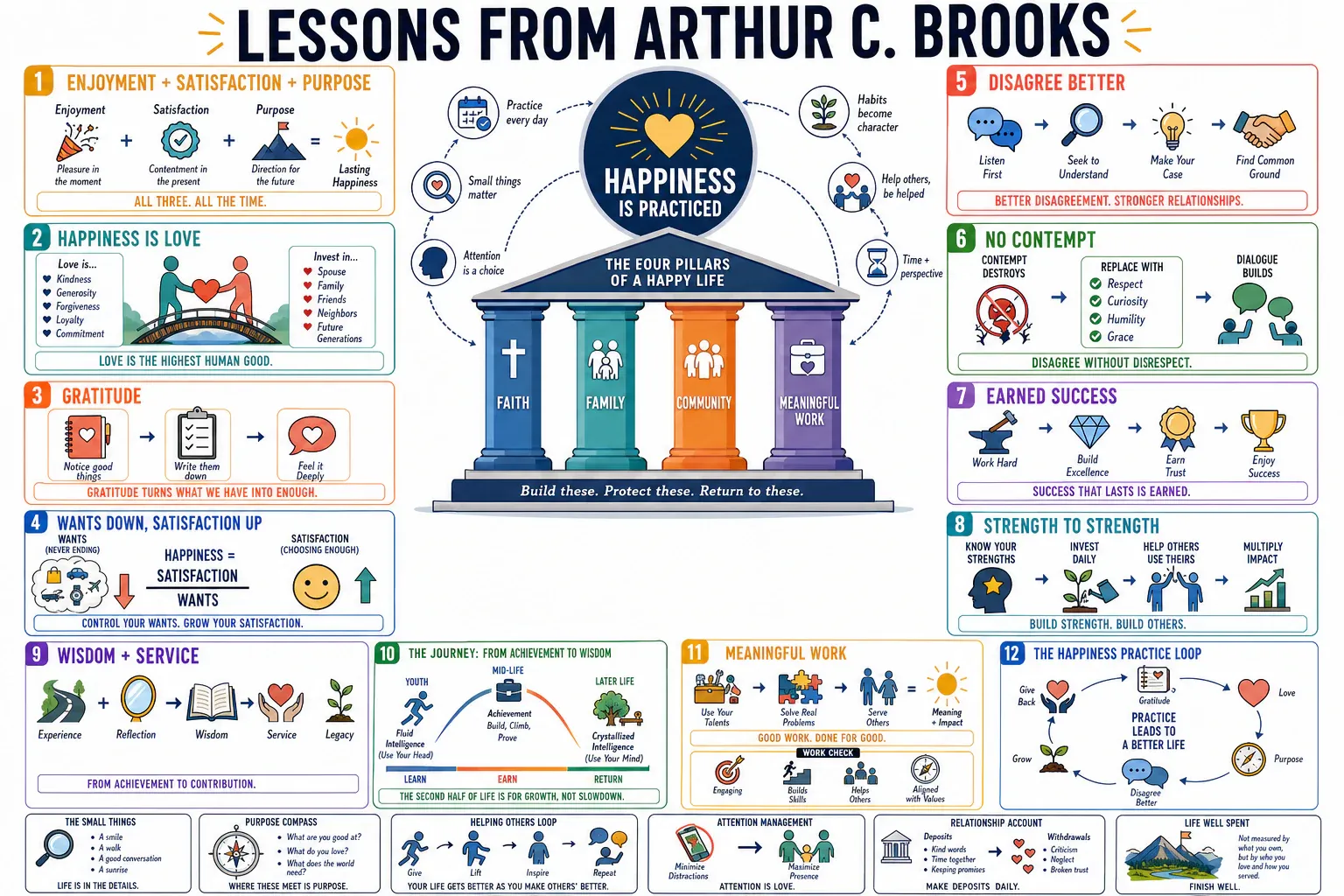
On the Nature of Happiness
- Brooks defines happiness as a balance of enjoyment, satisfaction, and meaning—not simply a pleasant feeling. — Conversations with Tyler — Arthur Brooks.
- Brooks compares satisfaction to what you have divided by what you want. His advice is to manage unnecessary wants, not only accumulate more. — Sunday Paper — The Secret to More Joy.
- Brooks says awareness of limited time helps him savor his work and choose questions he considers important. — Conversations with Tyler — Arthur Brooks.
- Brooks warns that the satisfaction of an achievement fades, making the pursuit of ever more rewards a treadmill. He recommends managing desires instead. — Sunday Paper — The Secret to More Joy.
- Brooks argues that living fully includes unhappiness: the search for meaning can involve pain, rather than continuous enjoyment. — Conversations with Tyler — Arthur Brooks.
On Love and Relationships
- Brooks distinguishes disagreement from contempt: treating someone as worthless damages the respect that relationships and public debate need. — BYU — More Love, Less Contempt.
- Brooks argues for better disagreement, not less disagreement. Competing ideas can strengthen society without demeaning the people who hold them. — BYU — More Love, Less Contempt.
- For Brooks, civility is only a starting point. Countering contempt requires actively willing another person's good, not merely tolerating them. — BYU — More Love, Less Contempt.
- Brooks emphasizes lasting affection, understanding, and commitment over the emotional highs of falling in love. — The Atlantic — Companionate Love.
- Describing his own marriage, Brooks says his wife is both his romantic partner and his closest friend. — The Atlantic — Companionate Love.
- Brooks highlights the Harvard adult-development study's association between satisfying relationships and later-life well-being, rather than promising health through marriage. — The Atlantic — Companionate Love.
- Brooks advises persuading through respect and care rather than insults. Winning an exchange is not the same as changing someone's mind. — Winsome Conviction — On Contempt.
On Work and Success
- Brooks identifies two priorities for fulfilling work: earning success through effort and using that work to serve other people. — Conversations with Tyler — Arthur Brooks.
- Brooks asks students to treat their lives as enterprises they are building, with love and happiness—not just money—as the returns they seek. — Syracuse — Happiness Recipe.
- Brooks recommends loosening attachment to status and directing work toward teaching and helping others. — The Atlantic — Your Professional Decline.
- Brooks warns that career strengths can change earlier than expected; timing differs by occupation and person. — The Atlantic — Your Professional Decline.
- Brooks advises adapting work to changing strengths instead of trying to sustain every earlier ability. — The Atlantic — Your Professional Decline.
- Brooks distinguishes solving unfamiliar problems from applying accumulated knowledge; the latter can remain useful as people age. — The Atlantic — Your Professional Decline.
- His practical response is to shift more work toward teaching and mentorship as strengths change. — The Atlantic — Your Professional Decline.
- Brooks conjectures that attaching self-worth to prestige can make a later career slowdown especially painful. — The Atlantic — Your Professional Decline.
- Drawing on Tibetan Buddhist teaching, Brooks distinguishes pain from resistance to pain. He presents acceptance as a way of approaching suffering, not a clinical treatment. — Conversations with Tyler — Arthur Brooks.
On Faith and a Transcendent Perspective
- Brooks uses faith broadly to include experiences beyond oneself. He gives appreciating nature as an example that need not depend on formal religion. — Syracuse — Happiness Recipe.
- Brooks worries that a screen-centered, constantly optimized life crowds out questions of meaning and mystery. His advice is to make room for those questions. — Conversations with Tyler — Arthur Brooks.
- In his religious advice, Brooks treats possessions as tools, people as worthy of love, and God rather than oneself as the focus of worship. — Providence College — Commencement Address.
- Brooks recalls a chapel's exit sign about entering mission territory. He interprets it as an invitation to share what one finds good and true with joy. — BYU — More Love, Less Contempt.
On Personal Growth and a Better Life
- Brooks describes emotions as signals, not permanent rewards. His practical warning is not to expect the excitement of an achievement to last indefinitely. — Sunday Paper — The Secret to More Joy.
- Brooks distinguishes modest self-protection from believing something fundamentally untrue. He recommends honesty about basic realities and more attention to the world beyond oneself. — Conversations with Tyler — Arthur Brooks.
- Brooks recommends sustained investment in four areas: faith or transcendence, family, friendship, and work. — Syracuse — Happiness Recipe.
- In his 2009 talk, Brooks argues that giving can contribute to happiness and productive work. This is not a guarantee that donations cause financial success. — BYU — Why Giving Matters.
- Brooks reported in 2009 that charitable givers were 43 percent more likely to describe themselves as very happy. The comparison is an association, not proof of causation. — BYU — Why Giving Matters.
- Brooks recommends service as a leadership practice: generosity and cooperation can help others recognize someone as a leader. — BYU — Why Giving Matters.
- Brooks treats curiosity and the desire to learn as valuable parts of a meaningful life, not merely idle distractions. — Conversations with Tyler — Arthur Brooks.
Learn more
- Conversations with Tyler — Arthur Brooks on Reinvention, Religion, and the Science of Happiness (Episode 274)
- Maria Shriver’s Sunday Paper — Arthur C. Brooks Has the Secret to More Joy
- Syracuse University — Arthur C. Brooks Shares Happiness Recipe: Enjoyment, Satisfaction and Meaning
- BYU Speeches — More Love, Less Contempt (2019 Commencement Address)
- BYU Speeches — Why Giving Matters (2009 Forum Address)
- The Atlantic — The Type of Love That Makes People Happiest
- The Atlantic — Your Professional Decline Is Coming (Much) Sooner Than You Think
- Providence College — Commencement Address: Arthur C. Brooks, Ph.D. (2024)
- Winsome Conviction — Episode 52: On Contempt with Arthur Brooks