Arthur Hayes is a co-founder of BitMEX and CIO and co-founder of Maelstrom. He previously worked as an equity-derivatives trader at Deutsche Bank and Citigroup. — Maelstrom — Team.
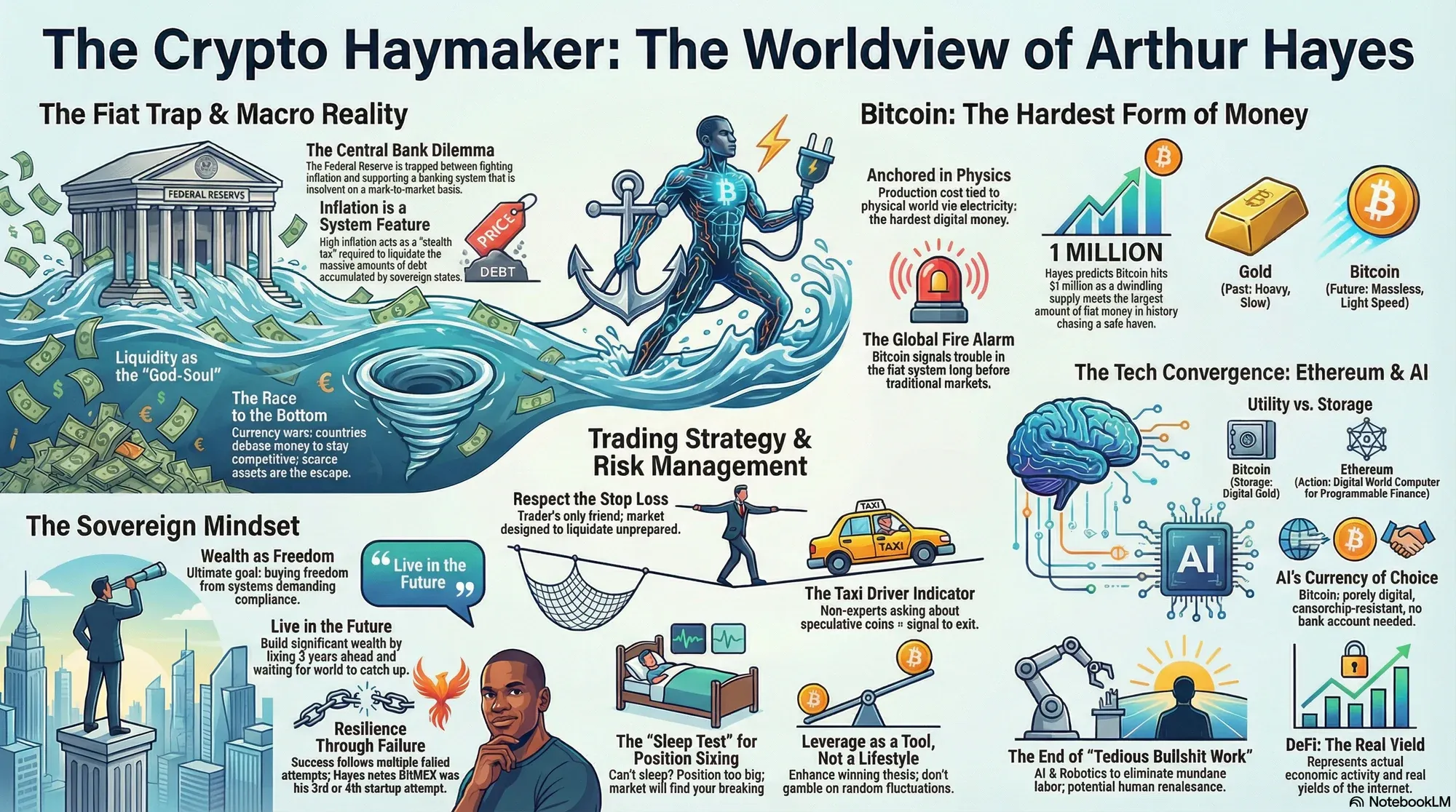
Part 1: Macroeconomics & The Fiat Trap
- On the Fed's Dilemma: Hayes argued in March 2023 that tightening to fight inflation also exposed bank balance-sheet losses, creating pressure for intervention. — Kaiseki.
- On Fiat Debasement: Hayes argues that governments facing higher costs and financing pressures may turn to monetary financing, with consequences for the purchasing power of fiat savings. — Energy Cancelled.
- On Real Interest Rates: Hayes emphasizes evaluating savings after inflation: a low nominal yield can still leave a saver with less purchasing power. — Pumping Iron.
- On Central Bank Intervention: In January 2026, Hayes said he would wait for balance-sheet evidence of Federal Reserve intervention in yen and Japanese bond markets before increasing risk. — Woomph.
- On Global Liquidity: Hayes tracks Treasury cash balances, reverse-repo balances and quantitative tightening when assessing how dollar liquidity may affect crypto markets. — Heatwave.
- On Currency Wars: Hayes analyzes currency policy through competing incentives: export competitiveness, domestic inflation and intervention can pull governments in different directions. — Woomph.
- On the Banking Crisis: Hayes links bank vulnerability to deposit withdrawals and losses on long-duration assets. His March 2023 analysis emphasizes how quickly those pressures can compound. — Kaiseki.
- On Inflationary Cycles: Hayes argues that governments can favor repaying debt with debased money because higher rates threaten heavily indebted balance sheets. — Pumping Iron.
- On Election Promises: Hayes argues that electoral incentives favor spending and easier financial conditions; in December 2023, he expected those pressures to persist through the 2024 election year. — Expression.
- On the End of Fiat: Hayes describes a recurring cycle in which tightening exposes financial stress and authorities respond with easier money, leaving vulnerabilities for the next crisis. — Pumping Iron.
Part 2: Bitcoin: The Hardest Form of Money
- On Bitcoin’s Fundamental Value: Hayes’s valuation thesis connects Bitcoin to the electricity required for proof-of-work; production costs do not guarantee its market price. — Massa.
- On the $1 Million Prediction: In November 2024, Hayes linked a $1 million Bitcoin forecast to a hypothetical expansion of bank credit and shrinking freely traded supply. It was a scenario, not a guaranteed outcome. — Black or White?.
- On Gold vs. Bitcoin: Hayes contrasts gold’s physical transport and storage requirements with Bitcoin’s digital transfers when considering money for autonomous software. — Massa.
- On Censorship Resistance: Hayes favors publicly verifiable blockchain rules over discretionary intermediaries when considering payment systems for autonomous agents. — Massa.
- On Bitcoin as a Fire Alarm: Hayes treats divergences between Bitcoin and other markets as possible warnings about credit conditions—not as an infallible prediction of what comes next. — This Is Fine.
- On Volatility: Hayes argues that conviction through volatility requires understanding a project’s purpose and how its token captures value—not merely buying because prices rise. — Yes ... I Read the Whitepaper.
- On The Halving: Before the April 2024 halving, Hayes distinguished medium-term optimism from near-term risks: a popular bullish narrative and tightening liquidity could still precede a sell-off. — Heatwave.
- On Institutional Adoption: Hayes distinguishes asset managers’ fee-generating Bitcoin products from using the network itself; institutional accumulation does not automatically advance every goal of decentralization. — Expression.
- On Sovereign HODLing: Hayes warns that a government Bitcoin stockpile can become a political instrument: a later administration could sell what an earlier one bought. — The Genie.
Part 3: Trading Strategy & Risk Management
- On Leverage: Hayes describes leverage as a trade-off: posting less exchange collateral can reduce custody exposure, but insufficient margin increases liquidation risk. — ALL ABOARD!.
- On Position Sizing: Hayes limits speculative deployment to liquid funds he is comfortable risking, rather than treating a market forecast as permission to commit everything. — Be Present.
- On Market Irrationality: Hayes revises a bearish view when liquidity conditions change rather than insisting prices must immediately conform to his longer-term macro outlook. — Be Present.
- On Tactical Shorts: In June 2026, Hayes described retaining core Bitcoin and Ether holdings while taking tactical derivative shorts—a distinction between long-term holdings and short-term positioning. — Reality Test.
- On Stop Losses: Hayes describes being stopped out of leveraged Bitcoin-proxy positions before a yen-market move. Risk controls can override a broader market thesis. — Woomph.
- On Cycle Peaks: Hayes examines credit conditions around past Bitcoin peaks rather than assuming a fixed four-year schedule reliably predicts the next top. — Long Live the King!.
- On Bottom Fishing: Hayes describes keeping liquidity available for a rebound while waiting for clearer monetary support, rather than assuming a falling price alone makes a purchase timely. — This Is Fine.
- On Emotional Detachment: Hayes accepts that taking profits can prove premature; he treats missed upside as an opportunity cost rather than a reason to abandon his risk assessment. — Heatwave.
- On The 'Dead Cat Bounce': Hayes distinguishes participating in a potentially temporary liquidity-driven rally from assuming the market’s underlying risks have disappeared. — Be Present.
- On Information Asymmetry: Hayes warns that attractive yields can conceal subsidies, leverage and weak underwriting; investors should understand the cash flows and counterparty risks behind them. — Number Three.
Part 4: Crypto Infrastructure & The Exchange Business
- On the Perpetual Swap: Hayes says perpetual swaps addressed two problems: fragmented liquidity across expiry dates and customers’ difficulty understanding futures. — Adapt or Die.
- On Liquidation Engines: Hayes explains that crypto margin systems must accommodate losses exceeding posted collateral; insurance funds and deleveraging help manage that risk. — Adapt or Die.
- On Regulation: Hayes warns that compliance costs can make customers uneconomic to serve and give incumbent banks grounds to challenge startups that bypass regulations. — TechNode — BitMEX Founders Interview.
- On Security: Hayes warns that assets held on exchanges carry custody risk, including hacking losses, even when a trading strategy appears market-neutral. — ALL ABOARD!.
- On Customer Experience: Hayes describes simplifying derivatives as a practical goal: fewer confusing expiries meant fewer support questions. New funding mechanics still required customer education. — Adapt or Die.
- On Market Making: Hayes explains how funding payments encouraged arbitrageurs to align perpetual-swap prices with spot prices; liquidity depended on economic incentives. — Adapt or Die.
- On Infrastructure Resilience: In a 2017 interview, Hayes credited industry-standard trading technology with helping BitMEX scale as customer interest grew. — Wharton FinTech — Arthur Hayes Interview.
- On Founding BitMEX: Hayes credits higher available leverage with improving early BitMEX adoption, while explaining that it required changes to the exchange’s margin system. — Adapt or Die.
Part 5: Geopolitics & The Global Liquidity Game
- On the U.S. Dollar Hegemony: Hayes links dollar dominance to trade invoicing, open capital markets and the Treasury market’s capacity to absorb large foreign savings. — Energy Cancelled.
- On the USD-Yen Connection: Hayes uses yen-dollar exchange rates and interest-rate differences to analyze carry-trade and currency-hedging pressures, rather than treating either market in isolation. — Shikata Ga Nai.
- On China’s Role: Hayes argues that China’s trade surpluses create a reserve-allocation dilemma, and proposes gold as one alternative to accumulating foreign-currency claims. — Energy Cancelled.
- On War and Debt: Hayes argues that expanded war spending can add to government borrowing and pressure financing conditions. His October 2023 essay frames this as a macroeconomic risk. — The Periphery.
- On Deglobalization: Hayes argues that geopolitical fragmentation can increase interest in reserve assets outside another government’s financial claims, including gold and Bitcoin. — Energy Cancelled.
- On Petrodollars: Hayes links dollar-priced trade surpluses to Treasury purchases, and argues that changes in where exporters save could alter demand for U.S. debt. — Energy Cancelled.
- On Sanctions as a Double-Edged Sword: Hayes argues that reserve freezes expose the risks of holding claims on foreign-controlled payment networks and can motivate a search for alternatives. — Energy Cancelled.
- On Emerging Markets: Hayes points to mobile payments in Kenya as an example of financial leapfrogging, while noting that trust in banks and everyday habits can slow adoption. — TechNode — BitMEX Founders Interview.
- On Capital Controls: Hayes describes Bitcoin-only transfers as less dependent on local banking access, while acknowledging that regulation still shapes where exchange customers can trade. — TechNode — BitMEX Founders Interview.
Part 6: Ethereum & The Programmable Financial Future
- On Ethereum as a Utility: Hayes presents Ethereum as a programmable platform for financial services, distinct from treating Bitcoin principally as monetary collateral. — Yes ... I Read the Whitepaper.
- On 'The Merge': Before the Merge, Hayes argued that validator rewards would make Ether resemble a yield-bearing instrument and broaden investors’ valuation frameworks. — Five Ducking Digits.
- On Smart Contracts: Hayes sees potential for public blockchains to automate financial intermediation, while acknowledging that DeFi had not yet served ordinary consumer lending at scale. — Yes ... I Read the Whitepaper.
- On Staking vs. Mining: Hayes modeled staking rewards as cash flows but also flagged smart-contract, liquidity and collateral risks. Yield alone did not eliminate those risks. — Five Ducking Digits.
- On Layer 2 Solutions: Hayes argues that customizable Ethereum layer-twos could support corporate tokenization projects while Ethereum supplies settlement security. He presents this as an investment narrative. — Situationship.
- On Tokenization: Hayes cautions that tokenizing property does not remove its liquidity or legal constraints; he questions what a token adds over existing fractional-ownership products. — Expression.
- On the 'Internet of Value': Hayes explores permissionless financial services on public blockchains as alternatives to traditional intermediaries; he does not establish that transfers are free. — Yes ... I Read the Whitepaper.
Part 7: The Symbiosis of AI & Decentralized Finance
- On AI’s Currency of Choice: Hayes proposes Bitcoin as money for AI because it is digital, uses public rules and connects proof-of-work to energy. — Massa.
- On AI as a Sovereign Agent: Hayes imagines autonomous agents needing a payment system without human identity checks, and argues that blockchain payments could meet that requirement. — Massa.
- On Decentralized Computing: Hayes imagines AI replicated across computers and jurisdictions, and argues that such agents would need organizational rules independent of a single state. — Moai.
- On AI-Driven Deflation: Hayes models a scenario in which AI-related job losses impair household debts and bank balance sheets, eventually prompting monetary intervention. This is his forecast, not an established outcome. — This Is Fine.
- On Automation and Labor: Hayes hopes AI and automation will free people from tedious work and leave more room for creative pursuits; he presents this as a possibility. — Massa.
- On Smart Agents: Hayes proposes smart contracts for autonomous organizations so that investment terms and payments are enforced through code rather than ordinary court proceedings. — Moai.
- On the Convergence: Hayes’s AI-crypto thesis depends on autonomous organizations using blockchains and decentralized exchanges; the proposed benefits depend on that adoption actually occurring. — Moai.
Part 8: Wealth, Sovereignty & The Philosophy of a Crypto Native
- On Hard Work: Hayes rejects shortcuts to success, emphasizing the work and effort behind worthwhile results. — The Genie.
- On Global Citizenship: Hayes evaluates location through practical advantages: Hong Kong offers proximity to China and English common law, but startups must understand each market’s local regulations. — TechNode — BitMEX Founders Interview.
- On the Sovereign Individual: Hayes distinguishes trading Bitcoin-linked products for fiat returns from holding Bitcoin in self-custody to participate in a financial system outside state-controlled intermediaries. — Expression.
- On Learning from Failure: Hayes describes changing BitMEX’s leverage and contract design after weak early adoption, illustrating product iteration rather than persistence with the original offering unchanged. — Adapt or Die.
- On Resilience: Hayes emphasizes how people respond to events rather than treating circumstances alone as destiny. — The Periphery.
- On Living in the Future: Hayes looks for shifts from an idea being dismissed to becoming plausible, rather than requiring precise long-range forecasts before considering an investment thesis. — Moai.
- On Health and Wealth: Hayes says healthy living and quality of life matter to him, and describes exercise and outdoor activities as part of his routine. — Odaily — Arthur Hayes Interview.
- On Taking Risks: Hayes encourages learning through small experiments with money one can afford to lose before becoming more deeply involved in crypto. — Wharton FinTech — Arthur Hayes Interview.