Arthur Patterson co-founded Accel with Jim Swartz in 1983. As a lead investor, he has worked with management teams including those at Portal Software and Veritas. Before Accel, he was a general partner at Adler & Company and began his venture-capital career at Citicorp Venture Capital. — Accel — Arthur Patterson.
Part 1: The Prepared Mind & Investment Philosophy
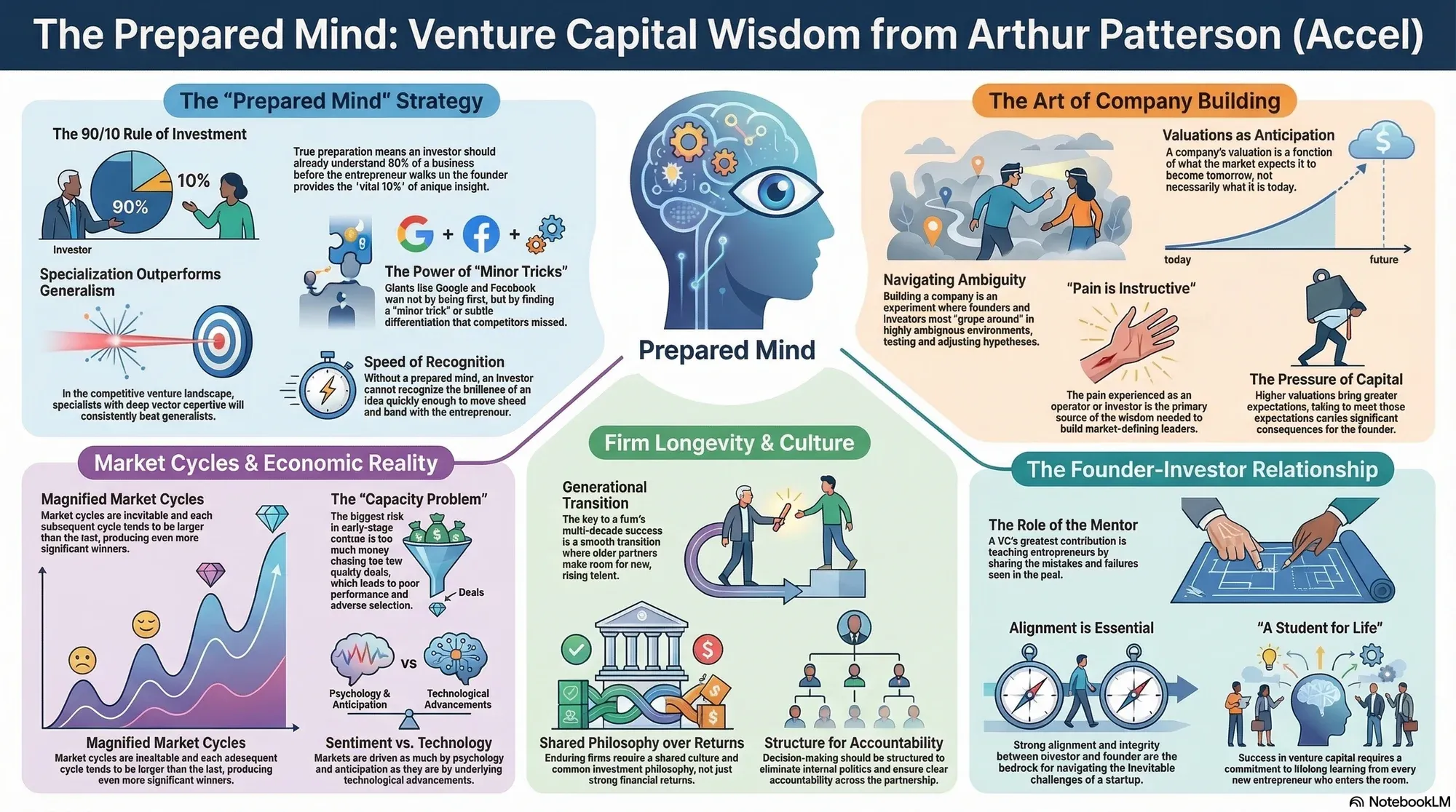
- On the Prepared Mind: Patterson’s prepared-mind approach begins with studying a sector and its participants before a founder arrives, rather than starting the research only after hearing a pitch. — super{set} — Starting Accel.
- On Sector Expertise: Patterson uses a 90/10 analogy: an investor should already understand most of the business context before meeting the entrepreneur. — super{set} — Starting Accel.
- On the Founder’s Contribution: In Patterson’s 90/10 analogy, preparation does not replace the founder: the entrepreneur contributes the critical insight the investor has not found. — super{set} — Starting Accel.
- On Recognition: Prior knowledge helps an investor recognize an opportunity and connect with its founder quickly. Patterson describes seeing the billing opportunity at Portal when others focused on replacing the CEO. — super{set} — Starting Accel.
- On Specialization: Specialization gave Accel a more systematic way to assess software and communications opportunities than spreading each partner across unrelated industries. — super{set} — Starting Accel.
- On Early Strategy: Starting Accel without an inherited portfolio gave Patterson and Jim Swartz room to choose focused sectors and build an investment approach around them. — super{set} — Starting Accel.
- On High-Quality Ideas: Patterson observes that strong ideas can attract stronger people as a company develops; the initial team need not already contain every person it will need. — super{set} — Hits and Misses.
- On Minor Differentiation: Patterson uses Google and Facebook to argue that entering an existing market with a useful difference can matter more than being first. — super{set} — Hits and Misses.
- On Luck: In his lifetime-achievement remarks, Patterson credits repeated opportunities and, especially, the relationships with family, partners and entrepreneurs that shaped his good fortune. — NVCA Lifetime Achievement Remarks.
- On Focused Portfolios: Patterson favors a coherent portfolio in selected areas where the partnership has developed an advantage, rather than chasing every appealing new opportunity. — Stanford — Investing in the Dot-Com Bubble.
Part 2: The Art of Company Building & Scale
- On Ambiguity: For Patterson, company-building is an uncertain experiment, not a process with a reliable recipe that identifies all the eventual winners in advance. — super{set} — Hits and Misses.
- On instructive Pain: Startup mistakes can be expensive. Patterson describes helping entrepreneurs avoid avoidable errors, rather than assuming that suffering itself always produces wisdom. — Stanford — Investing in the Dot-Com Bubble.
- On Helping Founders: Patterson sees teaching entrepreneurs what earlier mistakes have taught him as a useful part of venture investing, so new teams need not repeat the same errors. — super{set} — What Makes VC Satisfying.
- On Category Leadership: Patterson’s work with management teams has centered on developing market-defining companies, including Portal Software and Veritas. — Accel — Arthur Patterson.
- On the Experiment of Startups: Early-stage experiments should be focused enough to reveal what works. Patterson contrasts testing with one sales team against expanding so widely that the results become hard to interpret. — super{set} — Company-Building as an Experiment.
- On Global Ambition: Accel’s global approach relies on teams immersed in their local markets, not merely opening offices abroad, according to its 2019 account of the firm’s strategy. — Accel — What Comes Next.
- On Early Stage Discipline: Accel’s 2019 strategy statement describes focus on seed and Series A venture, alongside bootstrapped growth equity, as a way to limit distractions and spend more time helping founders. — Accel — What Comes Next.
- On Enduring Value: Patterson describes staying with promising projects for years while judging whether they are making progress, even when the market or product develops differently from the original plan. — super{set} — Time Horizons.
Part 3: Market Cycles & Economic Reality
- On Economic Cycles: Patterson looks for the technological drivers beneath venture-market cycles, while stressing how hard it is to know when the next major opportunity will arrive. — super{set} — The Patterson Cycle.
- On Cycle Magnification: Patterson attributes the extended cycle he discusses to several simultaneous technology shifts—cloud, mobile, big data and machine learning—rather than a single driver. — super{set} — The Patterson Cycle.
- On the Capacity Problem: Patterson argues that very large funds can be disadvantaged in early-stage investing, even when a strong franchise still attracts founders and deals. — super{set} — Large VC Funds.
- On Market Hype: In a hyped market, Patterson notes that several teams may pursue the same opportunity at once; enthusiasm alone does not establish which team will succeed. — super{set} — Hits and Misses.
- On Dot-Com Comparisons: Patterson recalls dot-com-era companies whose ideas arrived before the necessary conditions existed. An appealing idea can still be too early for its market. — super{set} — The Patterson Cycle.
- On Free Markets: Patterson sees entrepreneurs and the market system as important contributors to rising living standards. This is his view of venture investing’s wider role, not proof that every venture-backed business creates a public benefit. — super{set} — What Makes VC Satisfying.
- On Timing: A promising company still needs its market to develop. Patterson emphasizes that the timing of that tailwind is difficult to predict, even when an investor can see the opportunity. — super{set} — Time Horizons.
- On Resilience: Patterson recalls adapting during the 1974 downturn by investing in public companies when private opportunities were scarce, rather than assuming the previous pace of deals would continue. — super{set} — Starting Accel.
- On Market Sentiment: Patterson warns that rising prices can make people eager to believe a compelling story and less skeptical of it—including venture capitalists. — super{set} — Speculation and Belief.
Part 4: Venture Capital Excellence & Firm Culture
- On Generational Transition: Patterson describes giving younger investors meaningful equity early, with senior partners participating through co-investment, to enlarge the firm’s opportunity rather than preserve their own share. — Stanford — Investing in the Dot-Com Bubble.
- On Firm Longevity: Accel’s founders deliberately kept their names off the door. The firm’s 2019 account links that choice to collaboration, putting the group first and developing investors from within. — Accel — What Comes Next.
- On Internal Politics: Patterson describes clear responsibility for a deal: its lead partner keeps returning to the partnership with progress updates and the case for continued support, even when the original plan changes. — super{set} — Time Horizons.
- On the Profession's Satisfaction: Patterson finds satisfaction in working with entrepreneurs, helping them avoid mistakes and seeing their companies develop, alongside the financial side of venture investing. — super{set} — What Makes VC Satisfying.
- On Global Expansion: Patterson says Accel’s international funds need local independence to understand their own markets, while sharing standards and processes with the wider firm. — Stanford — Investing in the Dot-Com Bubble.
- On Firm Evolution: Patterson explains that Accel moved away from hardware projects partly because software offered more room to adapt when the initial product or market assumptions proved wrong. — super{set} — Time Horizons.
- On Partner Selection: Patterson favors venture partners who are curious, persistent and willing to find people smarter than themselves. Successful operating experience alone does not make someone a suitable investor. — super{set} — Hiring Executives.
- On Lifetime Achievement: Accepting his lifetime-achievement award, Patterson credits the entrepreneurs, managers and fellow partners who enabled his career, rather than presenting the achievement as his work alone. — NVCA Lifetime Achievement Remarks.
- On Ethics: Patterson treats integrity as essential because investors depend on layers of information. If those inputs cannot be trusted, promotion and apparent momentum can mislead them. — super{set} — Signal and Noise.
Part 5: Leadership & The Founder Journey
- On Operational Guidance: Patterson describes an investor’s practical work as helping a founder find a strategy, raise money and recruit people, without taking over the founder’s job. — super{set} — Time Horizons.
- On Choosing Founders: Patterson values founders who can bring in strong people without needing to control everything themselves. His Portal example emphasizes openness to complementary talent. — super{set} — Early-Stage Hiring.
- On Shared Vision: Investor advice has to become the entrepreneur’s own conviction to be acted on. Patterson argues that being right in a board meeting is not enough if the founder has not adopted the idea. — Stanford — Investing in the Dot-Com Bubble.
- On Scaling Networks: An investor’s experience in one company can create useful connections for another. Patterson recalls drawing on his internet-services relationships when helping Portal recruit leadership. — super{set} — Early-Stage Hiring.
- On Founder Persistence: Patterson kept supporting Rapt while Tom Chavez continued making progress and repositioning the software. Persistence meant taking responsibility and improving the business, not merely enduring pain. — super{set} — Why Tom Wasn’t Fired.
- On Impact: Patterson describes the growth of entrepreneurial companies—and their contribution to jobs and economic dynamism—as a rewarding part of his career. — NVCA Lifetime Achievement Remarks.
- On Lifelong Learning: Patterson describes venture investing as an apprenticeship: repeated company cases, experience and exchanges within the partnership help investors develop judgment. — Stanford — Investing in the Dot-Com Bubble.