Assaf Rappaport is the co-founder and CEO of Wiz. He previously co-founded Adallom, which Microsoft acquired in 2015, and led Microsoft’s Cloud Security group and Israel R&D Center. These lessons examine his approach to customers, teams, growth, and cloud security. — Wiz — Assaf Rappaport.
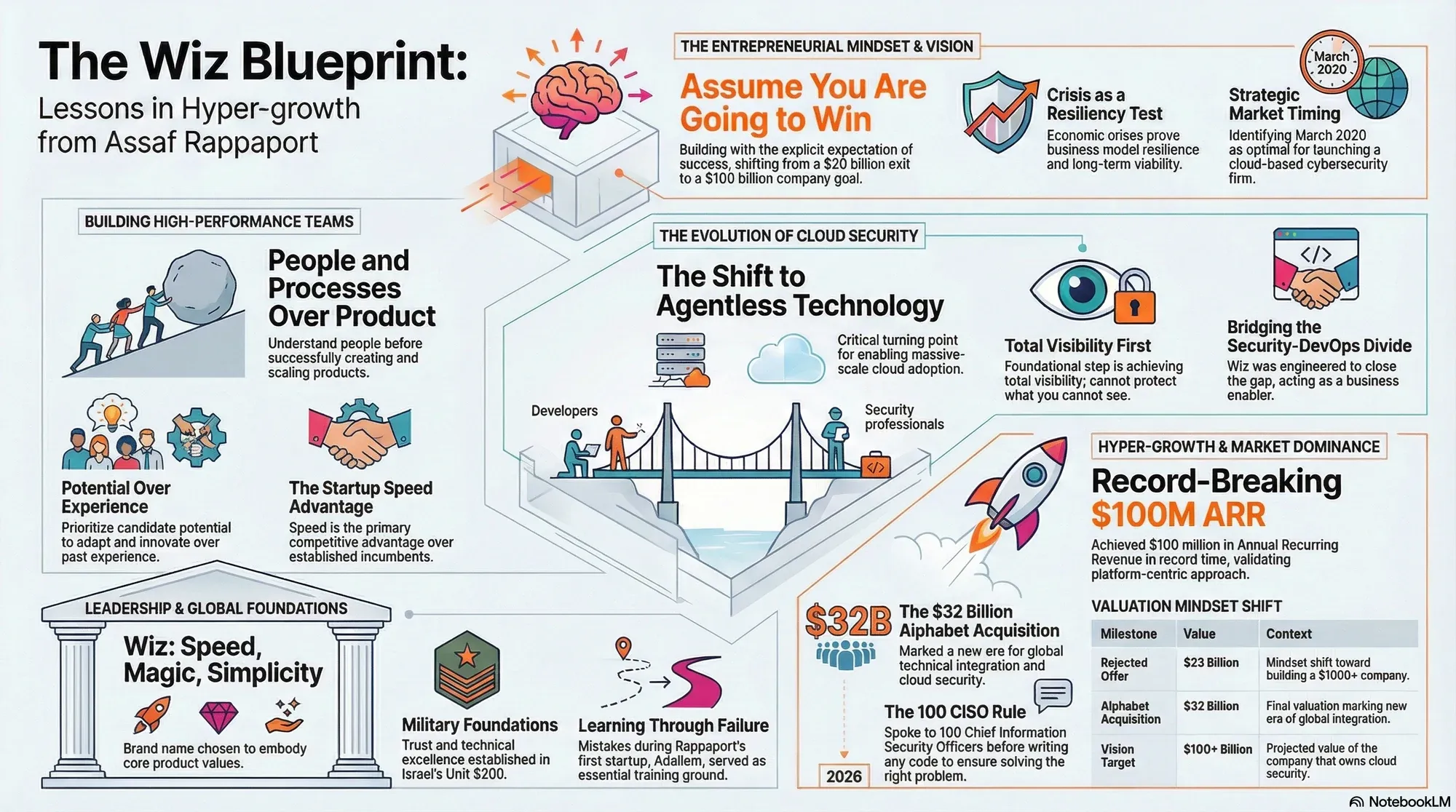
Part 1: The Entrepreneurial Mindset & Vision
- On Market Timing: The pandemic initially made starting Wiz seem risky. In hindsight, Rappaport saw March 2020 as favorable timing because customers accelerated their move to the cloud. — Index Ventures — Cloud Captains.
- On Strategic Pivoting: Keep the team focused while remaining willing to change strategy, explore alternatives, and revise expectations as the market changes. — AWS — Seven Tips for Founders.
- On Long-term Value: Solve an important problem from the outset while ensuring that the company is also building for the future. Rappaport treats these as competing demands to balance. — Candid with Index — Assaf Rappaport.
- On Company Scale: In 2024, Rappaport argued that a cloud-security leader could become a company worth more than $100 billion. He explicitly acknowledged that it might not be Wiz: execution would decide. — Disrupt 2024 Interview (YouTube).
- On Decision-Making Scale: Rejecting a major acquisition offer changes the scale of the independent company you must build. Rappaport described the 2024 decision as requiring a much larger ambition, not merely a higher sale price. — Disrupt 2024 Interview (YouTube).
- On Economic Crises: Build for a crisis that may last years, rather than a company intended to survive only two or three. Rappaport advocated greater efficiency without a panicked wholesale change of direction. — CTech — Rappaport on the 2022 Downturn.
- On Opportunity Identification: Use long-term goals to identify opportunities and guide investment, rather than allowing a downturn to erase the company’s direction. — AWS — Seven Tips for Founders.
- On Embracing Uncertainty: Uncertainty can energize a startup when the team can work within changing circumstances and stay focused on its goals. — AWS — Seven Tips for Founders.
Part 2: Building High-Performance Teams & Culture
- On Co-founder Synergy: The co-founders’ different personalities help them bring out the best in one another. Complementary strengths matter more than making every founder alike. — Index Ventures — Cloud Captains.
- On Priorities: Understand security leaders’ problems, processes, and priorities before designing the technology. People and their work determine what the product needs to solve. — Index Ventures — Cloud Captains.
- On Hiring Potential: Experience matters, but recruitment should also consider potential and genuine passion. Build a culture in which unfamiliar talent can succeed through a startup’s changing demands. — LinkedIn Learning — Recruiting for a Startup.
- On Growth Through Failure: Teams need room to try unfamiliar ideas and learn from failure. That permission supports experimentation rather than treating every unsuccessful attempt as disqualifying. — AWS — Seven Tips for Founders.
- On Employee Well-being: A downturn affects employee morale as well as the balance sheet. Do not take employees’ well-being for granted while navigating financial pressure. — AWS — Seven Tips for Founders.
- On Local Talent Hubs: In the 2022 downturn, Rappaport distinguished falling market valuations from the underlying skills of Israeli engineers. He argued that those skills and demand for cloud security had not disappeared. — CTech — Rappaport on the 2022 Downturn.
- On Compensation Philosophy: In May 2022, Rappaport expected strong demand for Israeli technical talent to sustain pay despite falling technology valuations. This was his forecast at the time, not a guarantee about salaries. — CTech — Rappaport on the 2022 Downturn.
- On Leadership Betting: Rappaport framed the 2024 choice to remain independent as a bet on his team’s ability to execute. Confidence in people, not market size alone, underpinned that decision. — Disrupt 2024 Interview (YouTube).
- On Collaborative Speed: Keep building through organizational uncertainty. Rappaport emphasized that the team continued delivering during the acquisition process and treated its pace of innovation as a competitive priority. — Wiz — It’s Official: Wiz Joins Google.
- On Iterative Cycles: Use short iterative cycles to build the team’s confidence in bold ideas and execution. Fast learning and willingness to experiment belong together. — AWS — Seven Tips for Founders.
Part 3: The Evolution of Cloud Security
- On Product Scalability: Working at Microsoft exposed the founders to technology built for global scale. Rappaport said they brought that experience into Wiz from the beginning instead of relying only on startup shortcuts. — Disrupt 2024 Interview (YouTube).
- On Market Consolidation: Rappaport identified two pressures toward consolidation: customers wanted more coherent security platforms, while startups and investors increasingly needed viable exits. These were market observations, not a certainty about every vendor. — Disrupt 2024 Interview (YouTube).
- On Platform Necessity: A security platform should connect related risks in one technology stack. Buying products and bundling them together is not the same as giving customers an integrated platform. — Disrupt 2024 Interview (YouTube).
- On Security Scanning: Rappaport described Wiz’s agentless, API-centered approach as scanning cloud workloads without deploying an agent to each one. The mechanism reduces deployment work; it does not imply instant detection of every vulnerability. — Wiz — $100M ARR in 18 Months.
- On Bridging Gaps: Give developers and security teams a shared view of cloud risk. Rappaport described Wiz as helping bridge their differing perspectives rather than leaving security isolated in one team. — Wiz — $100M ARR in 18 Months.
- On Agentless Technology: Agent deployment and maintenance can create friction and coverage gaps. Rappaport presented Wiz’s agentless connection model as a way to reduce those obstacles, not as the sole cause of cloud adoption. — Wiz — $100M ARR in 18 Months.
- On Contextual Security: Prioritize risks using their relationships across network, identity, secrets, and workloads. Rappaport contrasted that context with an unconnected list of alerts. — Wiz — $100M ARR in 18 Months.
- On Security as an Enabler: Security should support the pace of development rather than become a barrier to it. Rappaport’s stated aim is to let customers build quickly while maintaining security. — Wiz — It’s Official: Wiz Joins Google.
- On Cloud Visibility: Make complex cloud environments visible before deciding which risks need attention. Rappaport described Wiz as combining multicloud coverage with risk correlation, rather than merely producing more alerts. — Wiz — Celebrating Our Series C.
Part 4: Hyper-growth, Sales, and Market Dominance
- On Customer Discovery: Talk to prospective customers before committing to a solution. Rappaport said those conversations challenged his belief that cloud security was already solved and clarified the problem Wiz should address. — Disrupt 2024 Interview (YouTube).
- On Quality Control: Growth creates pressure to hire and deliver quickly. Rappaport’s question was how to expand without lowering the standard for people, customer commitment, and the product. — Index Ventures — Cloud Captains.
- On Financial Discipline: In the 2022 downturn, Rappaport put cash burn ahead of growth at any cost. The aim was to grow with more balance and avoid depending on repeated fundraising. — CTech — Rappaport on the 2022 Downturn.
- On Inorganic Growth (M&A): Evaluate acquisitions for the people’s market knowledge, customer experience, and lessons from mistakes—not just a product to resell. Integration and culture fit matter even when cash is available. — Disrupt 2024 Interview (YouTube).
- On Constant Feedback: Keep talking with customers to identify gaps as their needs for innovation and scale evolve. Initial discovery is not a substitute for continuing feedback. — AWS — Seven Tips for Founders.
- On Customer Priority: Let customer input guide product development and decisions. Involve users early so the product addresses a real pain rather than an internally assumed need. — AWS — Seven Tips for Founders.
- On Global Ambition: Design for leading enterprises from the outset, including the complexity and operational constraints of their environments. Rappaport described that as Wiz’s original product brief. — Wiz — $100M ARR in 18 Months.
- On Sales Momentum: Early commercial wins helped demonstrate that customers valued the solution. Rappaport reported Wiz’s first multimillion-dollar deal six months after the first code, after identifying unmet multicloud security needs. — Wiz — Celebrating Our Series C.
- On Revenue Milestones: In August 2022, Rappaport reported that Wiz had grown from $1 million to $100 million in annual recurring revenue in 18 months. He treated revenue as a measure of value delivered to customers. — Wiz — $100M ARR in 18 Months.
Part 5: Leadership Lessons & Global Impact
- On Military Foundations: Rappaport credited Unit 8200 with introducing the future co-founders and showing him the impact of combining strong talent with technology. That shared experience preceded their business partnership. — Index Ventures — Cloud Captains.
- On Learning from Mistakes: Startup shortcuts can leave substantial technical debt. Rappaport used Adallom’s experience to explain why learning to build more deliberately at Microsoft shaped Wiz’s early engineering choices. — Disrupt 2024 Interview (YouTube).
- On the Alphabet Acquisition (2026): Google announced a $32 billion agreement to acquire Wiz in March 2025, subject to closing adjustments. The acquisition completed on March 11, 2026, with a commitment to keep Wiz available across major clouds. — Google — Acquisition Agreement — Google — Acquisition Completion.
- On Earning Dedication: Attracting talented employees is not enough. Rappaport argues that leaders must continue earning their dedication and confidence instead of assuming it will persist. — AWS — Seven Tips for Founders.