Avital Balwit writes about AI, employment, human identity, and compute governance. In her 2024 Palladium essay, she was identified as chief of staff to Anthropic’s CEO and wrote in her personal capacity, not on behalf of the company. — My Last Five Years of Work.
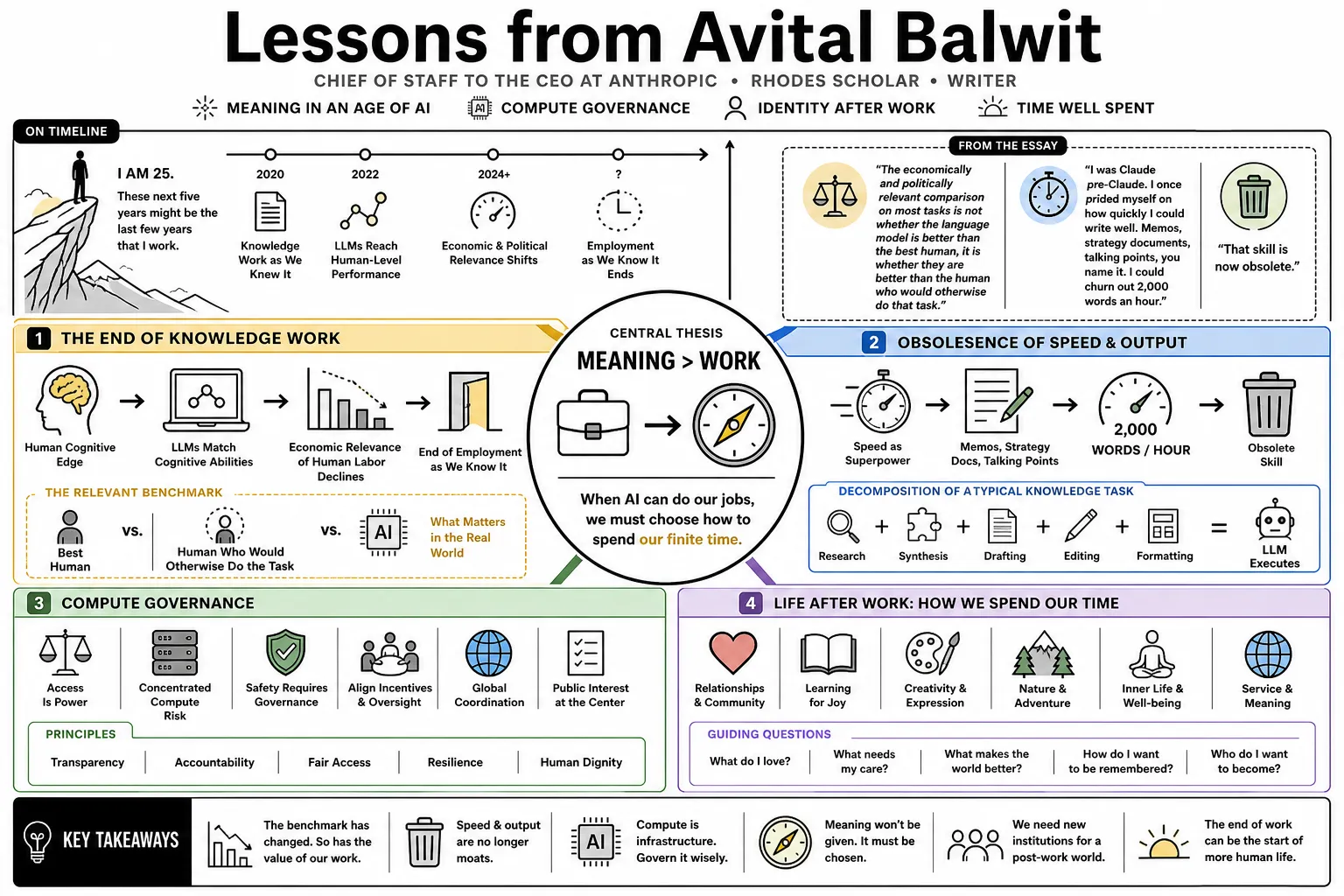
Part 1: The End of Knowledge Work
- On timeline: In her 2024 essay, Balwit raised the possibility that the next five years might be her last years of work. This was her forecast about a possible technological transition, not a settled employment deadline. — My Last Five Years of Work.
- On the relevant benchmark: Assess AI against the person who would otherwise perform the task, not only the world’s best expert. Balwit argues that this comparison is more relevant to possible job displacement. — My Last Five Years of Work.
- On the obsolescence of speed: Balwit describes losing a writing-speed advantage to Claude while still believing she could write better at the time. Her expectation that model quality would surpass hers was a forecast, not an established result. — How Will AI Change What It Means to Be Human?.
- On remote work vulnerability: Balwit expects online tasks involving reading, analysis, synthesis, and content generation to be vulnerable to automation. She distinguishes this forecast from slower robotics deployment and occupations where human participation is valued. — My Last Five Years of Work.
- On the feeling of replacement: Balwit describes feeling impressed by Claude and humbled when it performs tasks that once made her feel uniquely valuable. Her account illustrates a personal identity challenge, not a measured effect on every worker. — How Will AI Change What It Means to Be Human?.
- On the twilight of intellectual supremacy: Balwit argues that young workers should prepare for systems that may surpass their cognitive abilities. She acknowledges disagreement about timelines and distinguishes a capable model’s arrival from its diffusion through the economy. — Career Advice from the AI Frontier.
- On the commodification of cognition: Shift some attention from producing content to specifying goals, evaluating outputs, and synthesizing results. Balwit describes becoming more of an editor-in-chief for many emails and memos rather than writing every draft herself. — Career Advice from the AI Frontier.
- On the irrelevance of exceptionalism: The absence of extraordinary achievements does not settle whether AI can displace ordinary work. Balwit notes that most workers do not write award-winning books or patent inventions either. — My Last Five Years of Work.
Part 2: Navigating Obsolescence and Denial
- On knowledge worker denial: Balwit criticizes judging AI only by the tasks it still struggles with. Her argument is to consider its expanding capabilities as well, not to disregard real limitations or assume every worker is in denial. — My Last Five Years of Work.
- On the risk of demoralization: Balwit warns against making intelligence and cognitive performance the whole basis of self-worth. Her educational advice calls for developing values, initiative, and collaboration alongside knowledge. — Career Advice from the AI Frontier.
- On confronting obsolescence: Do not assume today’s harder cognitive tasks offer permanent protection. Balwit advises comparing model capabilities over time while planning under uncertainty about future progress and adoption. — Career Advice from the AI Frontier.
- On the delusion of permanent supervision: Treat human oversight requirements as something to reconsider as capabilities change. Balwit proposes evolving standards for when oversight is required or desired; she does not establish that supervision will disappear everywhere. — Career Advice from the AI Frontier.
- On the limits of upskilling: A single round of retraining may be insufficient for a changing career. Balwit emphasizes learning quickly, letting go of outdated expertise, and considering shorter, recurring education cycles. — Career Advice from the AI Frontier.
Part 3: Redefining Human Value and Meaning
- On decoupling worth from intelligence: Develop sources of self-worth beyond intelligence. Balwit points to kindness, courage, persistence, and humor as qualities people can cultivate rather than grounding identity only in cognitive output. — Career Advice from the AI Frontier.
- On doing things for joy: Choose activities for their enjoyment or meaning even when someone else could do them better. Balwit presents this as preparation for a possible future with less need for paid work. — My Last Five Years of Work.
- On writing without utility: Writing can remain worthwhile without being the best writer. Balwit says she writes partly for enjoyment and because the activity can improve her, not solely for comparative performance. — My Last Five Years of Work.
- On the AI search for meaning: Balwit speculates that sufficiently capable, relatively aligned AI might help people find purpose as well as perform work. She acknowledges that this expectation may sound wishful; it is not a guarantee of wellbeing. — My Last Five Years of Work.
- On physical presence: Embodied activities can be rewarding without excellence. Balwit describes enjoying ballet and recounts an unnamed AI researcher practicing jiu-jitsu and surfing for the experience rather than superior performance. — My Last Five Years of Work.
- On productive leisure: How people use free time matters, not just how much they have. Balwit discusses social and purposeful leisure as a possible route to wellbeing, while acknowledging uncertainty about unemployment research. — My Last Five Years of Work.
- On the burden of free time: A post-work scenario raises questions about how to use unstructured time. Balwit examines those questions while assuming material needs are met; she does not prove that economic scarcity will disappear. — My Last Five Years of Work.
- On the dignity of effort: Preserve some effort when the process itself matters. Balwit describes writing some pieces without AI because struggling with ideas develops her thinking, even when it does not produce a better output. — Career Advice from the AI Frontier.
Part 4: The Religious Dimensions of AI
- On the god-shaped hole: Balwit rejects the simple explanation that AI researchers are building an idol to replace lost faith. She argues that intense work on AI brings them close to longstanding questions about human existence and what comes next. — Searching for God in Silicon Valley.
- On jokes about building God: Balwit interprets jokes about building God as shorthand for researchers’ expectations of future technological power. She explicitly says the people she has met do not mean creating a supernatural or divine being. — Searching for God in Silicon Valley.
- On the expected transformation: Balwit describes an eschatological element in AI culture: many builders expect a sweeping transformation soon. She notes that how cataclysmic the change will be remains an open question. — Searching for God in Silicon Valley.
- On moral guidance at the frontier: Balwit says decisions about the values of powerful AI systems carry high moral stakes. She wishes for clearer guidance and observes that technical reasoning alone does not settle questions about how to live well. — Searching for God in Silicon Valley.
- On the quest for immortality: Balwit reports that some in Silicon Valley expect future AI to cure disease and address aging. She treats these as expectations of varying certainty, and says questions of omniscience and immortality draw a largely materialist community toward religious territory. — Searching for God in Silicon Valley.
- On the burden of creation: Balwit describes frontier-AI work as fascinating and consuming, with some workers fearing loss of control, misuse, and economic disruption. This is her observation, not evidence that every developer carries a religious burden. — Searching for God in Silicon Valley.
- On transcendent depth: Balwit asks why a material account of brains, hearts, and physical laws can still leave people feeling awe and a sense of something more. She presents this as a question about human experience, not a demonstrated property of AI models. — Searching for God in Silicon Valley.
- On secular faith: Balwit observes that a largely materialist AI community has acquired some features of faith without intending to. The comparison is interpretive; it does not mean researchers literally believe they are creating a god. — Searching for God in Silicon Valley.
- On awe beyond technology: Balwit notes that nature, scientific discovery, art, and religious practice can evoke awe. In her account, religion has been a durable way to join wonder with belonging and moral orientation; the essay does not attribute that feeling to compute scale alone. — Searching for God in Silicon Valley.
Part 5: Policy, Compute Governance, and Alignment
- On the target of regulation: Balwit proposes physical AI hardware as a promising governance lever because chips are countable and trackable. Her 2023 essay presents this as a policy direction, not proof that it is the most effective approach in every setting. — How We Can Regulate AI.
- On compute governance: A chip registry and preregistration of large training runs could support oversight focused on major frontier projects. Balwit’s proposal aims to avoid broad burdens on smaller projects, while requiring coordination and workable verification. — How We Can Regulate AI.
- On the scarcity of chips: The concentrated supply chain for advanced chips could make ownership tracking practical. Balwit proposes using that leverage to enforce safety standards, rather than assuming chip scarcity alone ensures safe development. — How We Can Regulate AI.
- On direct vs. social alignment: In their joint paper, Anton Korinek and Balwit distinguish pursuing an operator’s goals from addressing effects on society, including externalities. They argue that social alignment also requires governance of conflicts between individual and group goals. — Aligned with Whom?.
- On trackability: Hardware offers a tangible object for oversight that software alone does not. Balwit also examines how decentralized training could complicate governance; visibility is not a guarantee that every training run can be detected. — How We Can Regulate AI.
- On the limits of self-regulation: Balwit argues for enforceable standards alongside technical safety work. Her proposal includes penalties or stopping noncompliant training, but she stresses that evaluations and implementation still require substantial development. — How We Can Regulate AI.
- On mitigating risk: Balwit proposes evaluating dangerous capabilities and controlling increases in model scale to improve the chance of detecting risks. She treats this as a developing governance approach, not a guaranteed way to stop every harmful capability. — How We Can Regulate AI.
- On democratic input: Governance needs decisions about values and acceptable risks, not just chip tracking. Balwit argues that the public and government should determine the standards AI models are expected to meet. — How We Can Regulate AI.
- On the geopolitics of hardware: Compute governance depends on where chips are used and which jurisdictions enforce standards. Balwit discusses export controls and international coordination as possible tools, not a complete solution to international security. — How We Can Regulate AI.
Part 6: Intimacy, Relationships, and Human Connection
- On AI in the home: Balwit describes sometimes choosing whether to ask her partner or Claude a difficult question. She finds the model’s entry into a domain once occupied by someone she loves unsettling. — How Will AI Change What It Means to Be Human?.
- On the durability of human connection: Human relationships can matter even when AI offers useful advice. Balwit recounts her mother finding Claude’s retirement advice moving but still wanting to discuss it with her daughter. — Career Advice from the AI Frontier.
- On hyper-mediation: Balwit expects growing AI-generated information to require more AI tools for interpreting other systems’ activity. She warns that this additional mediation requires trust and can risk deskilling, while arguing that delegation can also enrich people. — The Coming Age of Hyper-Mediation.
- On counseling and care: Balwit expects a preference for human workers to persist in some relationship-based roles, such as counseling and care. This is a forecast about customer preference, not proof of permanent job protection or clinical superiority. — My Last Five Years of Work.
Part 7: Everyday Workflows with Frontier Models
- On speed advantages: For longer emails where she has few content preferences, Balwit says Claude can produce an adequate draft faster than she can. She distinguishes this from short messages where writing the prompt may take as much effort as writing the message. — How I Use Claude.
- On daily reliance: Balwit describes moving from occasional experimentation to using Claude multiple times a day after finding newer versions useful. This is her 2024 experience, not a rule that every workflow must become AI-dependent. — How I Use Claude.
- On thought partnership: Balwit describes using Claude to discuss everyday personal questions and weigh options, including choices about framing art. This is her account of useful advice, not a guarantee that the model is objective, unbiased, or always correct. — How I Use Claude.
- On task delegation: Choose concrete tasks for delegation and review the results. Balwit describes supplying relevant documents for drafts, asking for editing or summaries, and adjusting the degree of review to the task. — How I Use Claude.
- On reducing friction: A model draft can make an aversive writing task easier to start. Balwit describes assembling relevant inputs, iterating on draft letters, and finishing them with human editing; the barrier is reduced, not eliminated. — How I Use Claude.
- On maintaining voice: Use AI to amplify a distinct viewpoint rather than relying on interchangeable competent content. Balwit argues that trust, perspective, and relationships still affect why an audience chooses to read someone’s work. — Career Advice from the AI Frontier.
- On cognitive offloading: Delegate some restructuring and wording work without abandoning judgment. Balwit describes asking Claude for headers, shorter drafts, and tone changes, then tracking and reviewing the changes. — How I Use Claude.
- On continuous learning: Balwit uses Claude for German conversation, corrections, and exercises alongside a human tutor. She reports pronunciation limitations, making this an example of useful assistance rather than an unparalleled teacher of every subject. — How I Use Claude.
- On the baseline of quality: A model draft can provide a starting point to improve—or clarify what you do not want. Balwit argues that inputs, prompts, and review affect quality; AI assistance does not remove the responsibility to evaluate the result. — How I Use Claude.
Part 8: Preparing for the Post-AGI Era
- On the necessity of UBI: If AI eliminates large numbers of jobs, Balwit argues for transfers that preserve dignity and economic security. She does not present universal basic income as the only possible arrangement or claim redistribution will happen automatically. — Career Advice from the AI Frontier.
- On the definition of AGI: Balwit discusses AGI as a possible system capable of tasks humans perform. Her essay distinguishes cognitive progress from slower physical automation; technical capability alone does not establish universal deployment or sever employment immediately. — My Last Five Years of Work.
- On managing the transition: Prepare for both possible job losses and shifts in underlying tasks. Balwit argues that support must address economic security as well as the purpose, relationships, and community roles work can provide. — Career Advice from the AI Frontier.
- On shifting ambition: Balwit advises directing ambition toward goals worth pursuing and developing a vision for what to build with stronger tools. She also identifies relationships and values as sources of human meaning beyond cognitive performance. — Career Advice from the AI Frontier.
- On techno-optimism: Balwit sees a possible path to longer, healthier, wealthier, and more meaningful lives. She explicitly says that this outcome is not guaranteed; optimism does not settle the risks or distribution of gains. — Career Advice from the AI Frontier.
- On the urgency of adaptation: Take near-term transformative AI seriously without treating one timeline as certain. In her 2025 essay, Balwit distinguishes an expected arrival in the next few years from greater uncertainty about diffusion across the economy. — Career Advice from the AI Frontier.
- On the ultimate human task: Deciding what to build and what values to pursue remains important alongside technical capability. Balwit emphasizes taste, vision, and thoughtful direction, not a proof that choosing goals will be humanity’s only remaining task. — Career Advice from the AI Frontier.